
Why pH matters in environmental monitoring?
pH matters in environmental monitoring because it directly affects aquatic ecosystem health, metal solubility and toxicity, nutrient availability, pollutant mobility, biological activity, corrosion potential, treatment efficiency, and regulatory discharge compliance, with many environmental standards requiring waters to remain within approximately pH 6.0–9.0 to protect ecosystems and infrastructure.
- Aquatic ecosystem health: Most freshwater organisms survive within a limited pH range (typically 6.5–8.5), and deviations can cause stress or mortality.
- Metal solubility and toxicity: Lower pH increases solubility of metals such as aluminum, lead, and copper, raising ecological and human health risks.
- Nutrient availability: pH influences the chemical form of nitrogen and phosphorus, affecting eutrophication potential.
- Pollutant mobility: Many contaminants change speciation with pH, altering transport behavior in soil and groundwater.
- Biological activity: Microbial degradation rates in wastewater and natural systems are pH-dependent.
- Corrosion potential: Acidic or alkaline water accelerates corrosion in pipes and monitoring infrastructure.
- Treatment efficiency: Water and wastewater treatment processes rely on controlled pH for coagulation, disinfection, and precipitation.
- Regulatory compliance: Environmental agencies typically define discharge or ambient limits (often pH 6.0–9.0), requiring documented monitoring and reporting.
How does pH influence environmental monitoring quality and safety?
In environmental monitoring, pH directly influences ecosystem stability, contaminant behavior, treatment performance, corrosion control, public health protection, and regulatory compliance, because many chemical reactions, metal solubility equilibria, and biological processes are highly pH-dependent. Accurate and stable pH measurement ensures that discharge permits (commonly pH 6.0–9.0), drinking water standards, and ecological protection thresholds are met, preventing environmental damage and legal non-compliance.
| Influence Factor | How pH Influences It | Related Terms | Typical Range / Value |
| Aquatic life protection | Determines organism survival | Ecotoxicity, biodiversity | 6.5–8.5 (freshwater typical) |
| Metal solubility | Controls dissolution of heavy metals | Al³⁺, Pb²⁺, Cu²⁺ mobility | Increased <6.0 |
| Ammonia toxicity | Affects NH₃/NH₄⁺ equilibrium | Unionized ammonia | More toxic >8.5 |
| Nutrient behavior | Alters phosphorus precipitation | PO₄³⁻ availability | Optimal near neutral |
| Pollutant mobility | Changes contaminant speciation | Redox, solubility equilibrium | pH-dependent |
| Treatment efficiency | Impacts coagulation & precipitation | Alum dosing, lime treatment | 6.0–8.5 typical |
| Corrosion control | Influences pipe degradation | Langelier Index | <6.5 acidic risk |
| Disinfection performance | Affects chlorine efficacy | HOCl/OCl⁻ ratio | Best <7.5 |
| Regulatory compliance | Defines discharge limits | Environmental permits | 6.0–9.0 common |
| Public health safety | Protects drinking water quality | Potability standards | 6.5–8.5 typical |

Why are environmental monitoring systems sensitive to pH deviations?
Environmental monitoring systems are highly sensitive to pH deviations because pH directly controls chemical speciation, metal solubility, nutrient equilibrium, microbial activity, corrosion behavior, and regulatory compliance thresholds, with many environmental standards requiring waters to remain within pH 6.0–9.0 (and drinking water often 6.5–8.5). Even small excursions (≈±0.5–1.0 pH unit) can significantly alter contaminant mobility, toxicity, and treatment effectiveness, leading to ecological harm, infrastructure damage, and legal non-compliance.
- Metal mobilization risk: At lower pH (<6.0), metals such as aluminum, lead, and copper become more soluble, increasing ecological and human toxicity.
- Ammonia toxicity increase: At higher pH (>8.5), the equilibrium shifts toward unionized ammonia (NH₃), which is more toxic to aquatic organisms.
- Nutrient imbalance: pH shifts alter phosphorus precipitation and nitrogen transformation rates, contributing to eutrophication.
- Biological stress: Aquatic organisms typically tolerate only narrow ranges (≈6.5–8.5); deviations cause physiological stress or mortality.
- Treatment inefficiency: Coagulation, precipitation, and disinfection processes have optimal pH windows (often 6.0–8.5); outside these, removal efficiency declines.
- Corrosion or scaling: Acidic conditions increase corrosion risk, while high pH promotes scaling in pipes and monitoring systems.
- Regulatory non-compliance: Exceeding permitted discharge limits (commonly 6.0–9.0) may trigger violations, fines, or mandatory corrective actions.
Typical pH ranges and control targets in environmental monitoring
Typical pH ranges and control targets in environmental monitoring are defined by ecosystem protection criteria, drinking water standards, wastewater discharge permits, and industrial effluent regulations, with many applications operating within guideline ranges such as pH 6.0–9.0 for surface discharge and 6.5–8.5 for potable water systems. These targets are established to balance chemical stability, biological tolerance, contaminant mobility, corrosion control, and treatment performance, ensuring both environmental protection and regulatory compliance.
Common pH ranges in environmental monitoring
Common pH ranges in environmental monitoring typically fall between pH 4.0–9.5, depending on water type, regulatory framework, ecosystem sensitivity, and treatment objectives, because pH directly affects aquatic life tolerance, contaminant solubility, corrosion control, and discharge compliance. Each environmental subcategory defines its own acceptable range to balance ecological protection, infrastructure safety, and regulatory standards.
| Environmental Application / Category | Typical pH Range | Why This Range Is Used | Related Terms / Considerations |
| Surface water (rivers, lakes) | 6.0–9.0 | Protects aquatic ecosystems | Biodiversity, ecotoxicity |
| Freshwater aquatic life protection | 6.5–8.5 | Optimal biological tolerance | Fish survival range |
| Drinking water (potable systems) | 6.5–8.5 | Ensures palatability and corrosion control | Potability standards |
| Wastewater discharge (municipal) | 6.0–9.0 | Meets environmental permit limits | Effluent compliance |
| Industrial effluent | 5.5–9.5 (permit-specific) | Prevents environmental harm | Regulatory discharge limits |
| Groundwater monitoring | 5.5–8.5 | Indicates contamination or geochemical shifts | Acidification risk |
| Acid mine drainage areas | 2.0–6.0 | Monitoring contamination impact | Metal solubility |
| Seawater / marine systems | 7.5–8.5 | Natural ocean buffering | Carbonate equilibrium |
| Cooling tower water | 6.5–9.0 | Balances scaling and corrosion | Langelier Index |
| Stormwater runoff | 6.0–8.5 | Detects pollution impact | Urban runoff control |

Factors that define pH control targets
pH control targets in environmental monitoring are defined by regulatory discharge limits, ecosystem protection criteria, contaminant chemistry, metal solubility behavior, nutrient dynamics, treatment process requirements, corrosion control needs, geochemical background conditions, and public health standards, because pH directly governs chemical speciation, biological tolerance, infrastructure stability, and legal compliance.
- Regulatory discharge limits: Environmental permits commonly define allowable ranges (often pH 6.0–9.0) to prevent ecological damage.
- Ecosystem protection criteria: Aquatic organisms typically tolerate narrower ranges (≈6.5–8.5), requiring stricter monitoring in sensitive habitats.
- Contaminant chemistry: The solubility and toxicity of metals and pollutants change significantly with pH shifts.
- Metal solubility behavior: Lower pH increases dissolution of metals such as aluminum and lead, influencing risk assessments.
- Nutrient dynamics: Nitrogen and phosphorus availability and transformation depend on pH-dependent equilibria.
- Treatment process requirements: Coagulation, precipitation, and disinfection processes operate efficiently within defined pH windows (often 6.0–8.5).
- Corrosion control needs: Maintaining pH near neutral reduces pipe corrosion and infrastructure degradation.
- Geochemical background conditions: Natural soil and rock composition influence baseline pH in groundwater and surface water.
- Public health standards: Drinking water guidelines (commonly 6.5–8.5) ensure palatability and safety.
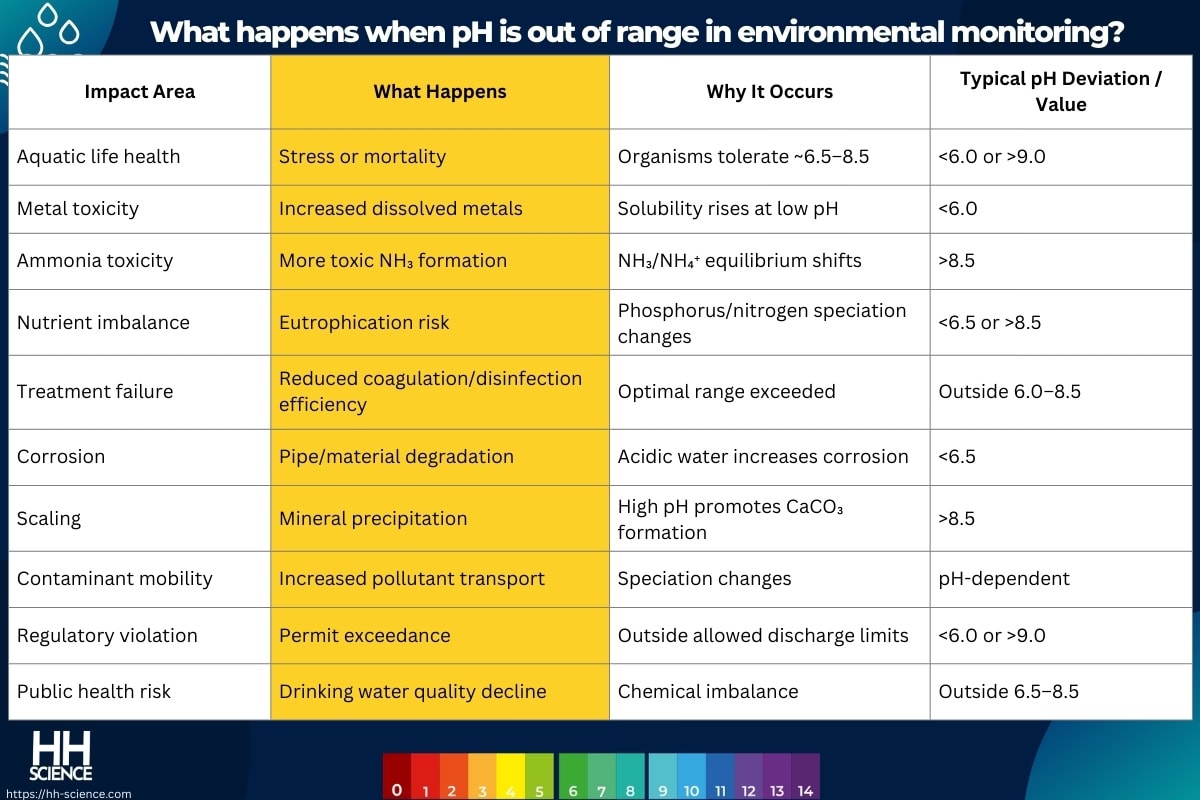
What happens when pH is out of range in environmental monitoring?
When pH moves outside acceptable environmental ranges (commonly 6.0–9.0 for discharge and 6.5–8.5 for drinking water), it can cause aquatic ecosystem stress or mortality, increased metal solubility and toxicity, altered ammonia toxicity, nutrient imbalance and eutrophication, treatment inefficiency, infrastructure corrosion or scaling, contamination mobility shifts, and regulatory non-compliance, because chemical speciation, biological tolerance, and reaction equilibria are strongly pH-dependent.
| Impact Area | What Happens | Why It Occurs | Typical pH Deviation / Value |
| Aquatic life health | Stress or mortality | Organisms tolerate ~6.5–8.5 | <6.0 or >9.0 |
| Metal toxicity | Increased dissolved metals | Solubility rises at low pH | <6.0 |
| Ammonia toxicity | More toxic NH₃ formation | NH₃/NH₄⁺ equilibrium shifts | >8.5 |
| Nutrient imbalance | Eutrophication risk | Phosphorus/nitrogen speciation changes | <6.5 or >8.5 |
| Treatment failure | Reduced coagulation/disinfection efficiency | Optimal range exceeded | Outside 6.0–8.5 |
| Corrosion | Pipe/material degradation | Acidic water increases corrosion | <6.5 |
| Scaling | Mineral precipitation | High pH promotes CaCO₃ formation | >8.5 |
| Contaminant mobility | Increased pollutant transport | Speciation changes | pH-dependent |
| Regulatory violation | Permit exceedance | Outside allowed discharge limits | <6.0 or >9.0 |
| Public health risk | Drinking water quality decline | Chemical imbalance | Outside 6.5–8.5 |
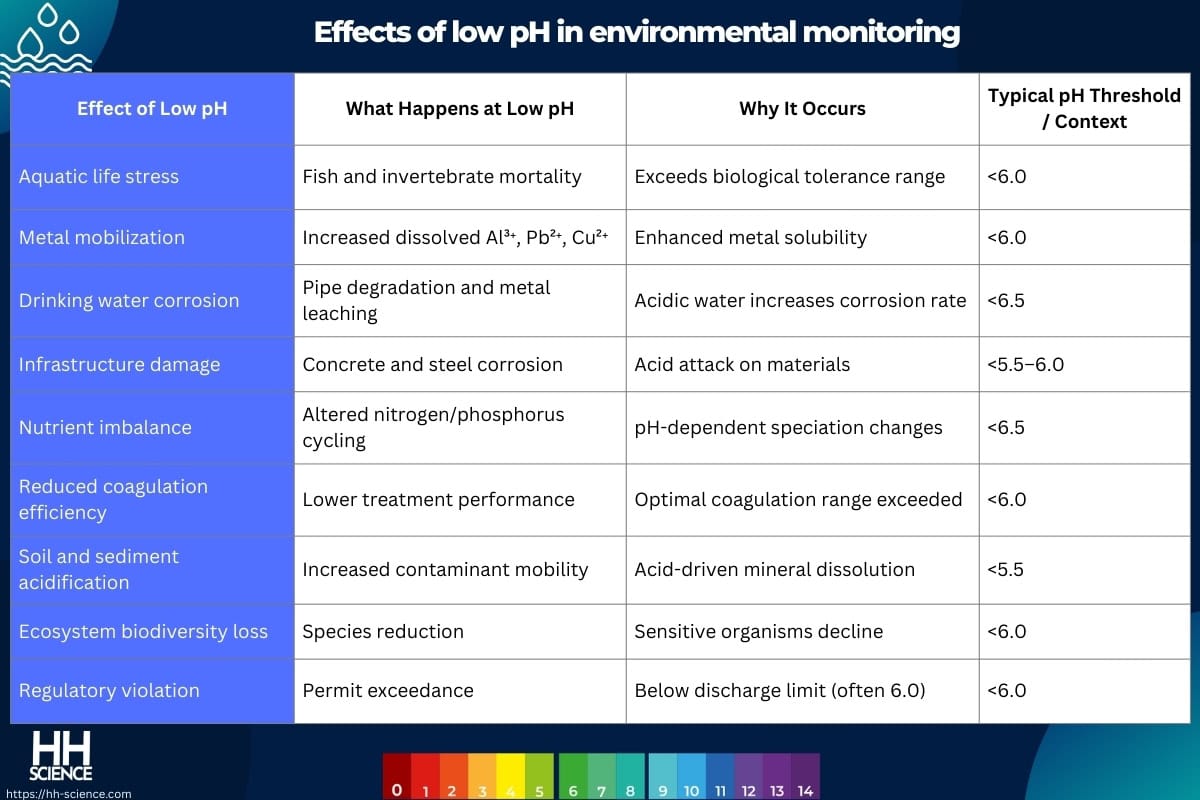
Effects of low pH in environmental monitoring
Low pH in environmental systems can cause aquatic organism stress or mortality, increased heavy metal solubility and toxicity, infrastructure corrosion, altered nutrient cycling, reduced treatment efficiency, and regulatory non-compliance, because higher hydrogen ion concentration shifts chemical equilibria, increases dissolution reactions, and disrupts biological tolerance ranges (commonly below pH 6.0–6.5 in freshwater systems).
| Effect of Low pH | What Happens at Low pH | Why It Occurs | Typical pH Threshold / Context |
| Aquatic life stress | Fish and invertebrate mortality | Exceeds biological tolerance range | <6.0 |
| Metal mobilization | Increased dissolved Al³⁺, Pb²⁺, Cu²⁺ | Enhanced metal solubility | <6.0 |
| Drinking water corrosion | Pipe degradation and metal leaching | Acidic water increases corrosion rate | <6.5 |
| Infrastructure damage | Concrete and steel corrosion | Acid attack on materials | <5.5–6.0 |
| Nutrient imbalance | Altered nitrogen/phosphorus cycling | pH-dependent speciation changes | <6.5 |
| Reduced coagulation efficiency | Lower treatment performance | Optimal coagulation range exceeded | <6.0 |
| Soil and sediment acidification | Increased contaminant mobility | Acid-driven mineral dissolution | <5.5 |
| Ecosystem biodiversity loss | Species reduction | Sensitive organisms decline | <6.0 |
| Regulatory violation | Permit exceedance | Below discharge limit (often 6.0) | <6.0 |
Effects of high pH in environmental monitoring
High pH in environmental systems can cause aquatic organism stress, increased ammonia toxicity, scaling and mineral precipitation, reduced disinfection efficiency, altered nutrient equilibrium, membrane fouling in treatment systems, infrastructure scaling, and regulatory non-compliance, because alkaline conditions shift chemical equilibria, increase hydroxide ion concentration, and change contaminant speciation (commonly above pH 8.5–9.0 in surface waters).
| Effect of High pH | What Happens at High pH | Why It Occurs | Typical pH Threshold / Context |
| Aquatic life stress | Physiological disruption | Exceeds optimal 6.5–8.5 range | >9.0 |
| Ammonia toxicity increase | More NH₃ (unionized) form | NH₄⁺ ⇌ NH₃ equilibrium shift | >8.5 |
| Scaling formation | CaCO₃ precipitation | Carbonate equilibrium shift | >8.5 |
| Reduced chlorine efficiency | Lower HOCl fraction | HOCl/OCl⁻ ratio decreases | >7.5–8.0 |
| Nutrient imbalance | Altered phosphorus availability | Precipitation at high pH | >8.5 |
| Membrane fouling | Mineral scaling on filters | High carbonate hardness | >8.5 |
| Infrastructure scaling | Deposits in pipes/towers | Supersaturation conditions | >8.5 |
| Industrial discharge violation | Permit exceedance | Outside common 6.0–9.0 limit | >9.0 |
| Taste and aesthetic issues | Bitter or slippery water | High alkalinity | >8.5 |

Operational, quality, and compliance risks
When pH deviates from acceptable environmental limits (commonly 6.0–9.0 for discharge and 6.5–8.5 for drinking water), it creates significant operational instability, environmental quality degradation, and regulatory exposure because pH governs chemical speciation, toxicity thresholds, corrosion indices, and treatment performance efficiency.
Operational risk: Treatment inefficiency – Coagulation, precipitation, and disinfection processes operate optimally within ~6.0–8.5; outside this range, chemical dosing increases and removal efficiency declines.
- Operational risk: Infrastructure damage – Low pH (<6.5) increases corrosion rates, while high pH (>8.5) promotes scaling (CaCO₃ deposition), raising maintenance costs.
- Quality risk: Ecological impact – Aquatic organisms typically tolerate 6.5–8.5; excursions (<6.0 or >9.0) can cause stress, biodiversity loss, or fish mortality.
- Quality risk: Increased contaminant mobility – Low pH enhances heavy metal solubility (Al³⁺, Pb²⁺), while high pH (>8.5) increases toxic NH₃ formation.
- Compliance risk: Permit violations – Exceeding regulated discharge limits (often 6.0–9.0) can trigger fines, mandatory reporting, or operational shutdown.
- Compliance risk: Drinking water non-conformance – Operating outside potable guidelines (6.5–8.5) may require corrective action and public notification.
- Compliance risk: Long-term monitoring failure – Inaccurate or unstable pH measurement can invalidate environmental impact reports and regulatory submissions.
pH measurement challenges in environmental monitoring
pH measurement in environmental monitoring presents unique challenges because sensors must operate reliably in variable temperature conditions, fluctuating conductivity, high suspended solids, biofouling environments, remote field locations, and long-term unattended deployments, while still meeting regulatory accuracy requirements (often ±0.1 pH or better). Factors such as electrode drift, junction clogging, calibration stability, low ionic strength waters, flow variability, and data logging integrity directly influence measurement reliability and compliance reporting in environmental programs.
Temperature effects
Temperature is a major challenge in environmental monitoring because natural waters experience daily and seasonal fluctuations (often 0–35 °C or wider), which affect both the electrode response (Nernst slope), chemical equilibria (pKa shifts), gas solubility (CO₂), and biological activity. Without proper automatic temperature compensation (ATC) and stable sensor design, temperature variation can introduce systematic pH error (≥±0.05–0.1 pH), apparent drift, and misinterpretation of regulatory compliance data, especially in long-term field deployments.
| Temperature Factor | How It Affects pH Measurement | Related Terms | Typical Conditions / Values |
| Nernst slope variation | Electrode sensitivity changes with temperature | Nernst equation | ~59.16 mV/pH at 25 °C |
| Chemical equilibrium shift | True pH changes with temperature | pKa shift | ≈±0.01–0.03 pH per 10 °C |
| CO₂ solubility change | Alters carbonic acid balance | Carbonate system | Warmer water → higher pH |
| Biological activity | Changes respiration/photosynthesis rate | Diurnal cycle | Daily pH swings 0.2–1.0 |
| Seasonal variation | Long-term baseline shifts | Thermal stratification | Surface vs depth differences |
| Low-temperature response lag | Slower sensor stabilization | t90 response time | <5–10 °C |
| Thermal gradients | Localized measurement variability | Mixing inefficiency | Rivers, reservoirs |
| ATC limitation | Compensation assumes uniform temperature | Automatic Temp Compensation | Sensor vs water mismatch |
| Ice formation risk | Physical sensor damage | Freeze-thaw cycle | <0 °C |

Fouling and contamination
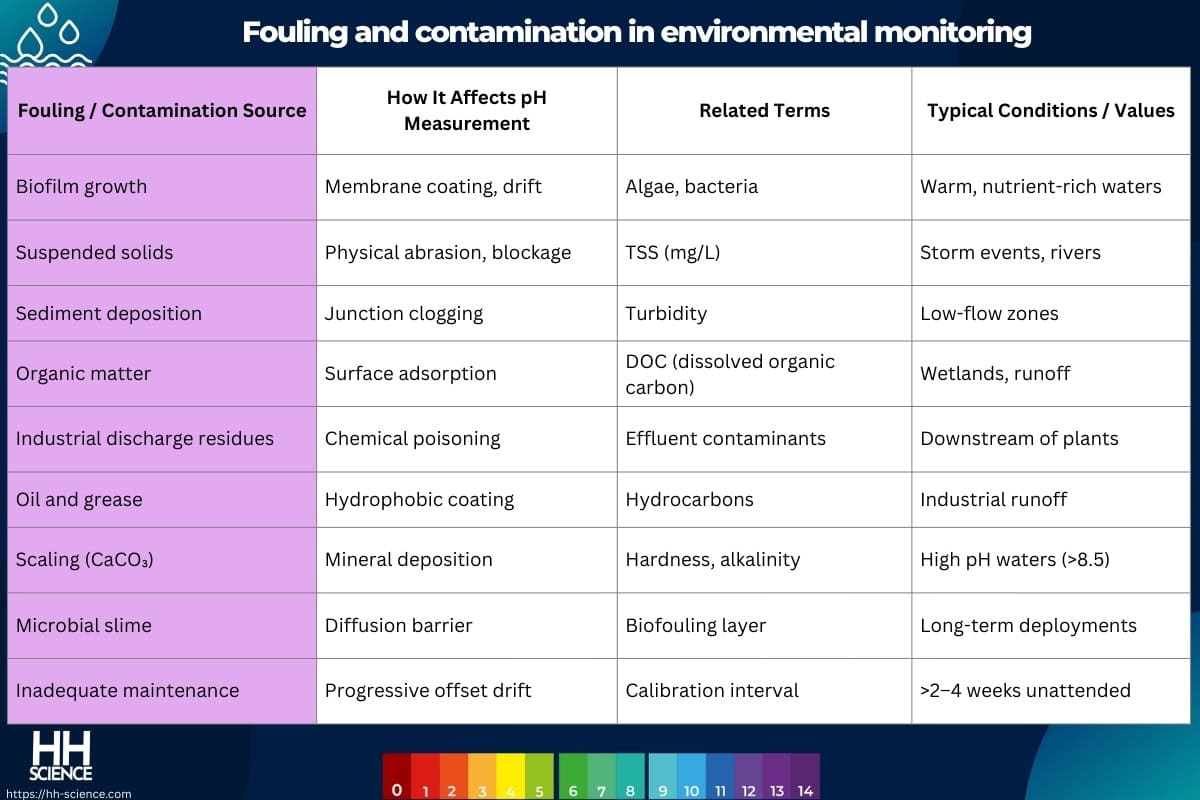
Fouling and contamination are major challenges in environmental monitoring because pH sensors are exposed to suspended solids, algae, biofilms, sediment, organic matter, oils, and industrial residues, often in remote, long-term deployments. These materials can coat the glass membrane or block the reference junction, causing signal drift (≥±0.1 pH), slow response, unstable readings, and calibration loss, which directly affects compliance reporting and long-term trend accuracy.
| Fouling / Contamination Source | How It Affects pH Measurement | Related Terms | Typical Conditions / Values |
| Biofilm growth | Membrane coating, drift | Algae, bacteria | Warm, nutrient-rich waters |
| Suspended solids | Physical abrasion, blockage | TSS (mg/L) | Storm events, rivers |
| Sediment deposition | Junction clogging | Turbidity | Low-flow zones |
| Organic matter | Surface adsorption | DOC (dissolved organic carbon) | Wetlands, runoff |
| Industrial discharge residues | Chemical poisoning | Effluent contaminants | Downstream of plants |
| Oil and grease | Hydrophobic coating | Hydrocarbons | Industrial runoff |
| Scaling (CaCO₃) | Mineral deposition | Hardness, alkalinity | High pH waters (>8.5) |
| Microbial slime | Diffusion barrier | Biofouling layer | Long-term deployments |
| Inadequate maintenance | Progressive offset drift | Calibration interval | >2–4 weeks unattended |
Pressure and flow conditions
Pressure and flow conditions create challenges in environmental monitoring because pH sensors are deployed in rivers, streams, wastewater channels, pipelines, groundwater wells, and depth-profile stations, where variable velocity, turbulence, hydrostatic pressure, and stagnant zones can affect measurement stability and representativeness. Changes in flow and pressure influence the boundary layer at the glass membrane, reference junction equilibrium, gas exchange (CO₂), and signal noise, potentially leading to unstable readings, response lag, or apparent drift (≥±0.05–0.1 pH) during dynamic environmental events such as storms or discharge surges.
| Pressure / Flow Factor | How It Affects pH Measurement | Related Terms | Typical Conditions / Values |
| High flow velocity | Signal fluctuation, reduced stabilization time | Turbulence, shear stress | >1 m/s (rivers) |
| Turbulent flow | Increased measurement noise | Reynolds number (Re >4000) | Storm runoff events |
| Low-flow / stagnant zones | Slow response, drift | Boundary layer thickening | Wetlands, reservoirs |
| Hydrostatic pressure (depth) | Reference equilibrium shift | Pressure head | 1 bar per 10 m depth |
| Pulsating flow (pumps) | Oscillating readings | Pump cycles | Wastewater stations |
| Rapid flow changes | Temporary measurement spikes | Flow surge | Rain events |
| Groundwater wells | Limited mixing, slow stabilization | Static water column | Monitoring boreholes |
| Pipeline pressure | Seal stress, electrolyte imbalance | 1–5 bar typical | Industrial discharge lines |
| Air–water interface turbulence | CO₂ exchange variability | Gas transfer | Surface monitoring |

Chemical exposure
Chemical exposure is a significant challenge in environmental monitoring because pH sensors may be deployed in treated wastewater, industrial effluent, cooling tower systems, and drinking water distribution networks, where chlorine, chloramines, ozone, peracetic acid, corrosion inhibitors, coagulants, and pH adjustment chemicals are present. These chemicals can etch the glass membrane, poison or dehydrate the reference junction, alter junction potential, degrade seals, and accelerate sensor aging, leading to measurement drift (≥±0.05–0.1 pH), reduced slope (<85–90%), slower response time, and premature failure, especially in long-term unattended monitoring.
| Chemical Type / Source | How It Affects pH Measurement | Related Terms | Typical Conditions / Values |
| Free chlorine | Oxidizes membrane surface | Cl₂, HOCl | 0.2–5 mg/L (drinking water) |
| Chloramines | Gradual reference poisoning | Combined chlorine | Distribution systems |
| Ozone | Strong oxidative stress | O₃ disinfection | Advanced treatment plants |
| Peracetic acid | Membrane degradation | PAA | Wastewater disinfection |
| Caustic dosing | Glass etching, slope reduction | NaOH | pH adjustment (>10) |
| Acid dosing | Electrolyte depletion | H₂SO₄, HCl | pH control (<4) |
| Corrosion inhibitors | Junction film formation | Phosphates, silicates | Cooling towers |
| Coagulants | Surface deposits | Alum, ferric salts | 6.0–8.0 treatment range |
| Long-term exposure | Accelerated aging | Chemical fatigue | Continuous monitoring sites |

Bio-load or process residues
Bio-load and process residues are significant challenges in environmental monitoring because pH sensors are often deployed in natural waters, wastewater streams, wetlands, industrial discharge points, and long-term monitoring stations, where microorganisms, algae, suspended solids, organic matter, and treatment by-products accumulate on sensor surfaces. These materials can create biofilm formation, membrane coating, junction clogging, diffusion barriers, and signal drift (≥±0.05–0.1 pH), reducing measurement accuracy and compromising compliance reporting and long-term trend reliability.
| Bio-load / Residue Source | How It Affects pH Measurement | Related Terms | Typical Conditions / Values |
| Algae growth | Surface coating, slow response | Biofilm, photosynthesis | Nutrient-rich lakes |
| Bacterial biofilm | Diffusion barrier, drift | Microbial slime | Wastewater effluent |
| Suspended solids | Abrasion, junction clogging | TSS (mg/L) | Storm runoff events |
| Organic matter | Membrane adsorption | DOC, humic acids | Wetlands, rivers |
| Sediment deposition | Blocked reference junction | Turbidity | Low-flow zones |
| Treatment residues | Chemical film buildup | Alum, ferric salts | Post-coagulation discharge |
| Industrial residues | Chemical poisoning | Process by-products | Downstream monitoring |
| Long-term deployment | Progressive offset drift | Extended calibration interval | >2–4 weeks unattended |
| Seasonal biological blooms | Rapid fouling increase | Eutrophication | Warm weather cycles |

Common pH sensor types used in environmental monitoring
Common pH sensor types used in environmental monitoring include standard glass electrode sensors, combination pH sensors (single or double junction), ruggedized field probes, differential (junction-free) sensors, low-conductivity pH sensors (for ultrapure or rainwater), ISFET sensors, and digital or smart pH sensors, each selected based on water chemistry variability, fouling risk, conductivity level, deployment duration, and regulatory accuracy needs (typically ±0.05–0.1 pH). Glass and combination sensors remain widely used for routine surface and wastewater monitoring, double-junction and differential designs improve reliability in high-biofouling or industrial effluent conditions, low-conductivity sensors stabilize readings in rainwater or high-purity systems, and digital sensors enhance remote data logging, diagnostics, and long-term unattended compliance monitoring.
Combination pH sensors
Combination pH sensors are widely used in environmental monitoring because they integrate the measuring electrode and reference electrode into a single probe, offering a practical balance of accuracy (typically ±0.05–0.1 pH), durability, ease of field deployment, and cost-effectiveness for surface water, wastewater, groundwater, and discharge monitoring. Their design supports portable field use, inline installations, and long-term monitoring stations, while double-junction variants improve resistance to biofouling, suspended solids, and industrial contaminants.
| Combination pH sensors Feature | Description | Why It Matters in Environmental Monitoring |
| Integrated measuring + reference electrode | Single compact probe | Simplifies field deployment and maintenance |
| Accuracy range | ±0.05–0.1 pH typical | Meets most environmental regulatory requirements |
| Single or double junction | Ceramic or double reference barrier | Improves resistance to contamination and clogging |
| Rugged housing | Epoxy or reinforced body | Withstands outdoor and wastewater conditions |
| Portable compatibility | Works with handheld meters | Supports spot checks and field sampling |
| Inline adaptability | Fits flow cells and pipes | Enables continuous discharge monitoring |
| Broad pH range | 0–14 operational capability | Suitable for diverse water chemistries |
| Temperature sensor integration | Built-in ATC | Compensates for seasonal and daily fluctuations |
| Moderate maintenance needs | Periodic cleaning/calibration | Suitable for 2–4 week field intervals |

Differential pH sensors
Differential pH sensors are well suited for environmental monitoring because they eliminate the traditional liquid reference junction—often the weakest point in high-biofouling, high-suspended-solids, low-conductivity, or industrial effluent environments—thereby improving long-term stability and reducing maintenance. By using two measuring electrodes instead of a standard reference system, they provide more stable readings (typically ±0.05–0.1 pH) in remote or unattended deployments where junction clogging, contamination, and drift are common challenges.
| Differential pH sensor Feature | Description | Why It Matters in Environmental Monitoring |
| Dual measuring electrodes | Differential potential measurement | Eliminates unstable liquid reference junction |
| Junction-free design | No salt bridge or flowing electrolyte | Reduces clogging in turbid or biofouled waters |
| Improved stability in low conductivity | Performs better in rainwater or groundwater | Suitable for <50 µS/cm conditions |
| Reduced drift | Less offset change over time | Supports long-term compliance reporting |
| Rugged field construction | Reinforced housing | Withstands outdoor and wastewater sites |
| CIP/chemical resistance | Tolerates industrial discharge chemicals | Suitable for harsh effluent environments |
| Lower maintenance frequency | Fewer junction cleaning issues | Ideal for remote monitoring stations |
| Compatible with digital systems | Often integrated with smart transmitters | Enables remote diagnostics and logging |
| Typical accuracy | ±0.05–0.1 pH | Meets regulatory discharge monitoring needs |

Digital or smart pH sensors
Digital (smart) pH sensors are increasingly used in environmental monitoring because they convert the high-impedance electrode signal into a stable digital output at the sensor head, reducing signal noise over long cable runs and improving reliability in remote, field-based, and unattended monitoring stations. They are particularly valuable where continuous logging, telemetry transmission, regulatory reporting, and low maintenance intervals (2–8 weeks or longer) are required to meet environmental compliance and long-term trend analysis needs.
| Digital (smart) pH sensor Feature | Description | Why It Matters in Environmental Monitoring |
| On-sensor signal conversion | Analog-to-digital at probe | Minimizes electrical noise in remote installations |
| Digital communication protocols | Modbus, RS485, SDI-12 | Integrates with dataloggers and telemetry systems |
| Built-in temperature sensor | Automatic Temperature Compensation (ATC) | Maintains accuracy during seasonal variation |
| Stored calibration data | Calibration saved in probe memory | Enables quick field replacement without recalibration |
| Sensor diagnostics | Slope %, offset, impedance monitoring | Predictive maintenance and drift detection |
| Remote data logging | Time-stamped data storage | Supports regulatory reporting and audits |
| Telemetry compatibility | GSM, satellite, IoT systems | Enables real-time remote monitoring |
| Rugged environmental design | Weatherproof, IP-rated housing | Suitable for outdoor deployment |
| Typical accuracy | ±0.05–0.1 pH | Meets most discharge and environmental standards |

Inline, immersion, or portable configurations
Different pH sensor configurations are used in environmental monitoring because measurement objectives vary between continuous discharge compliance, in-situ ecosystem assessment, groundwater sampling, and field verification, each requiring different levels of stability, accessibility, and deployment duration. Selecting the correct configuration ensures representative sampling, regulatory compliance (commonly ±0.05–0.1 pH accuracy), minimal fouling risk, and efficient maintenance planning.
| Configuration | Typical Use in Environmental Monitoring | Key Features | Why It Is Used |
| Inline | Industrial effluent discharge lines | Continuous monitoring, flow cell design | Ensures real-time regulatory compliance |
| Inline (bypass loop) | Controlled sampling from pipelines | Stable flow, easier servicing | Improves measurement stability and maintenance |
| Immersion (submersible) | Rivers, lakes, reservoirs | Waterproof housing, long cable | In-situ ecosystem monitoring |
| Immersion (fixed station) | Long-term monitoring buoys | Rugged, telemetry-compatible | Continuous environmental trend tracking |
| Immersion (groundwater well) | Monitoring boreholes | Slim profile, low-flow compatibility | Accurate groundwater assessment |
| Portable (handheld) | Field spot checks | Lightweight, battery-powered | On-site verification and rapid sampling |
| Portable (lab-grade) | Sample validation | High precision measurement | Confirms compliance or calibration |
| Multi-parameter sonde integration | Combined water quality probes | pH + DO + conductivity | Comprehensive environmental assessment |

Installation and maintenance considerations in environmental monitoring
In environmental monitoring, proper installation and maintenance of pH sensors are critical because measurements are often conducted under variable temperature (0–35 °C+), fluctuating conductivity (<10 to >10,000 µS/cm), high biofouling conditions, suspended solids, and remote unattended deployments, while still needing to meet regulatory accuracy requirements (typically ±0.05–0.1 pH). Correct practices—such as placement in well-mixed representative zones, protection from sediment burial, regular cleaning (often every 2–4 weeks depending on fouling), calibration with certified buffers, temperature compensation verification, and proactive replacement when slope falls below ~85–90%—ensure reliable compliance reporting, long-term data integrity, and defensible environmental assessments.
Typical installation locations
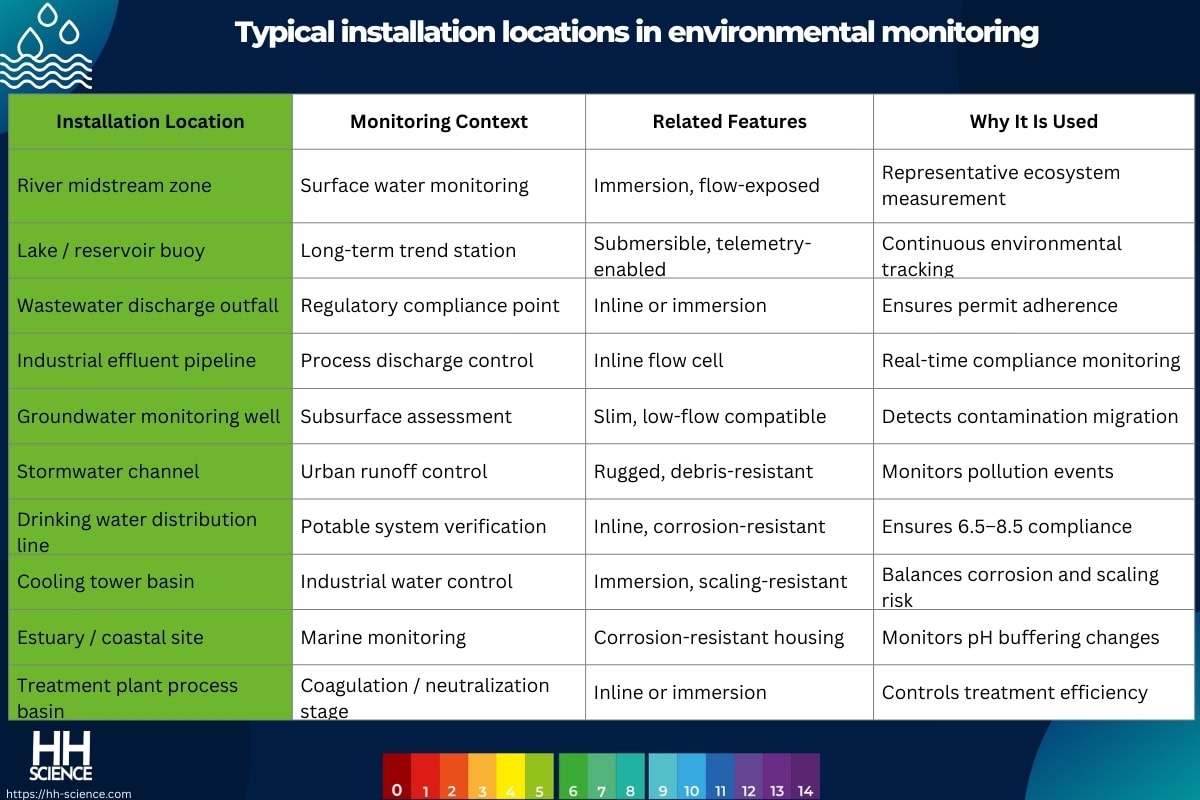
In environmental monitoring, pH sensors are installed at locations where they can provide representative, regulatory-relevant, and trend-consistent measurements across surface water, groundwater, wastewater discharge, and industrial effluent systems. Placement is influenced by flow dynamics, accessibility, fouling risk, conductivity level, depth, and compliance requirements (commonly pH 6.0–9.0 discharge limits) to ensure defensible and stable long-term data.
| Installation Location | Monitoring Context | Related Features | Why It Is Used |
| River midstream zone | Surface water monitoring | Immersion, flow-exposed | Representative ecosystem measurement |
| Lake / reservoir buoy | Long-term trend station | Submersible, telemetry-enabled | Continuous environmental tracking |
| Wastewater discharge outfall | Regulatory compliance point | Inline or immersion | Ensures permit adherence |
| Industrial effluent pipeline | Process discharge control | Inline flow cell | Real-time compliance monitoring |
| Groundwater monitoring well | Subsurface assessment | Slim, low-flow compatible | Detects contamination migration |
| Stormwater channel | Urban runoff control | Rugged, debris-resistant | Monitors pollution events |
| Drinking water distribution line | Potable system verification | Inline, corrosion-resistant | Ensures 6.5–8.5 compliance |
| Cooling tower basin | Industrial water control | Immersion, scaling-resistant | Balances corrosion and scaling risk |
| Estuary / coastal site | Marine monitoring | Corrosion-resistant housing | Monitors pH buffering changes |
| Treatment plant process basin | Coagulation / neutralization stage | Inline or immersion | Controls treatment efficiency |
Calibration and cleaning frequency
In environmental monitoring, calibration and cleaning frequency are critical because pH sensors operate in variable temperature, fluctuating conductivity, high biofouling, suspended solids, and remote deployments, where drift and contamination can quickly exceed typical regulatory accuracy needs (±0.05–0.1 pH). Maintenance intervals depend on site conditions (freshwater vs wastewater), fouling intensity, deployment duration, regulatory reporting requirements, and sensor type, ensuring reliable long-term environmental data.
| Maintenance Aspect | Typical Frequency | Related Features / Terms | Why It Is Required |
| Routine calibration (field stations) | Every 2–4 weeks | Certified buffers (pH 4.01 / 7.00 / 10.01) | Maintains regulatory accuracy |
| High-fouling sites (wastewater) | Weekly or biweekly | Biofilm, TSS | Prevents drift ≥±0.1 pH |
| Low-conductivity waters | Monthly | Rainwater, groundwater | Ensures stable reference response |
| Storm event monitoring | Before & after event | Runoff impact | Confirms measurement validity |
| Long-term unattended deployment | 2–8 weeks depending on site | Remote telemetry | Balances maintenance vs cost |
| Cleaning (light fouling) | Every 2–4 weeks | Surface wipe, mild rinse | Removes algae or sediment |
| Cleaning (heavy biofouling) | Weekly | Biofilm removal | Maintains response time |
| Post-chemical exposure check | After disinfectant contact | Chlorine, oxidants | Confirms sensor integrity |
| Visual inspection | Each site visit | Membrane, junction | Early fouling detection |
| Replacement threshold check | Ongoing | Slope <85–90% | Ensures long-term reliability |

Expected sensor lifespan
In environmental monitoring, pH sensor lifespan depends on water chemistry variability, biofouling intensity, suspended solids, chemical exposure, temperature fluctuations (0–35 °C+), and maintenance frequency, with regulatory accuracy requirements typically around ±0.05–0.1 pH. Because sensors are often deployed in remote or unattended locations, lifecycle planning must balance durability, drift rate, fouling resistance, and calibration stability, rather than waiting for total failure.
| Sensor Type / Operating Condition | Typical Lifespan | Related Features | Why Lifespan Is Affected |
| Standard glass combination sensor | 6–12 months | Single junction | Sensitive to fouling and contamination |
| Double-junction combination sensor | 9–18 months | Improved reference protection | Better resistance to clogging |
| Differential (junction-free) sensor | 18–24 months | No liquid reference | Reduced drift in harsh waters |
| Digital / smart sensor | 12–24 months | Diagnostics, slope monitoring | Enables predictive replacement |
| High-biofouling site (wastewater) | 6–9 months | Heavy biofilm growth | Accelerated membrane coating |
| Low-conductivity freshwater | 12–24 months | Stable chemical exposure | Lower fouling but reference-sensitive |
| Industrial effluent exposure | 6–12 months | Chemical-resistant housing | Oxidants and scaling reduce life |
| Remote long-term deployment | 12–18 months | Rugged, telemetry-compatible | Reduced handling but gradual drift |
| Cold climate exposure | 9–18 months | Freeze–thaw resistance | Thermal cycling stress |
| End-of-life indicator | — | Slope <85–90%, unstable offset | Triggers replacement to maintain ±0.1 pH accuracy |

Trade-offs between accuracy, maintenance, and durability
In industrial water applications, the trade-off between accuracy, maintenance, and durability arises because high-accuracy pH sensors (typically ±0.01–0.05 pH) use thin glass membranes and sensitive reference junctions that deliver precise control but are more vulnerable to abrasion, scaling, high TDS, oxidants, temperature swings (0–80 °C), and pressure variation (1–10 bar). More durable designs—featuring thicker or ruggedized glass, double or junction-free reference systems, pressurized electrolytes, and chemically resistant housings—reduce maintenance frequency and extend service life in harsh cooling tower, boiler, and wastewater environments, but generally provide practical control accuracy of ±0.05–0.1 pH, which is sufficient for most regulatory discharge and process control requirements but not laboratory-grade precision.
Regulatory or quality considerations in environmental monitoring
In environmental monitoring, regulatory and quality considerations are critical because pH is often a legally controlled parameter in surface water standards, wastewater discharge permits, groundwater protection programs, and drinking water regulations, with common allowable ranges such as pH 6.0–9.0 for discharge and 6.5–8.5 for potable systems. Compliance requires traceable calibration, documented monitoring frequency, validated field procedures, data logging integrity, deviation reporting, and defensible measurement accuracy (typically ±0.05–0.1 pH) to ensure environmental protection, public health safety, and audit-ready regulatory reporting.
Industry standards in environmental monitoring
Industry standards in environmental monitoring define how pH must be measured, calibrated, validated, reported, and audited to ensure ecological protection, public health safety, and regulatory compliance, since many jurisdictions enforce discharge limits such as pH 6.0–9.0 and drinking water targets of 6.5–8.5. These standards establish requirements for method accuracy (often ±0.1 pH or better), traceable calibration, field quality control (QC), sampling integrity, data logging, and long-term monitoring reliability, making standardized procedures essential for defensible environmental reporting.
| Standard / Organization | Scope | Related Terms / Values | Why It Matters for pH | Key Measurement / System Features |
| EPA (e.g., Method 150.1) | U.S. water & wastewater | pH 6.0–9.0 discharge limits | Defines official pH measurement methods | Calibrated field/lab meters |
| ISO 10523 | International water quality | Electrometric pH method | Standardizes pH measurement procedure | Defined accuracy & calibration |
| ISO 5667 | Water sampling | Sampling protocol | Ensures representative field samples | Proper handling & preservation |
| WHO Guidelines | Drinking water quality | 6.5–8.5 potable range | Protects public health | Routine monitoring |
| EU Water Framework Directive | EU environmental policy | Surface water quality targets | Harmonized environmental standards | Long-term monitoring |
| APHA Standard Methods | Laboratory analysis | QC, method validation | Ensures analytical consistency | Documented calibration |
| ASTM D1293 | Water pH test method | Electrode testing | Provides procedural guidance | Defined electrode handling |
| NPDES | U.S. wastewater permits | Permit-specific pH limits | Legal discharge compliance | Continuous or grab sampling |
| ISO 17025 | Laboratory competence | Traceability, uncertainty | Validates pH lab data | Certified buffers & documentation |
| National environmental agencies | Country-specific enforcement | Site-specific pH limits | Enforces compliance reporting | Approved monitoring protocols |

Internal process and quality requirements in environmental monitoring
In environmental monitoring, internal process and quality requirements ensure that pH data are accurate, reproducible, defensible, and trend-consistent, especially in long-term programs where regulatory accuracy is typically ±0.05–0.1 pH. These requirements define how organizations manage calibration intervals, field verification, fouling control, documentation, data integrity, and lifecycle planning, reducing the risk of reporting errors or non-compliance.
| Internal Requirement | Related Terms / Typical Values | Why It Is Required | Key Measurement / System Features |
| Defined monitoring range | Commonly 6.0–9.0 (discharge) | Aligns with permit thresholds | Stable field measurement |
| Accuracy target | ±0.05–0.1 pH | Ensures regulatory defensibility | Calibrated sensors |
| Calibration schedule | Every 2–4 weeks typical | Controls drift | Certified buffer solutions |
| Field verification checks | Before/after sampling | QA/QC validation | Portable reference meter |
| Fouling management plan | Site-dependent (weekly–monthly cleaning) | Maintains response stability | Anti-fouling design |
| Temperature compensation | ATC verification | Reduces thermal error | Integrated temperature probe |
| Data logging integrity | Time-stamped records | Supports audits & reporting | Secure data storage |
| Alarm thresholds | High/low pH alerts | Enables rapid corrective action | Remote telemetry integration |
| Drift monitoring | Slope ≥85–90% | Predictive maintenance | Sensor diagnostics |
| Replacement planning | 6–24 month lifecycle | Avoids data gaps | Lifecycle tracking system |

Compliance-driven monitoring needs in environmental monitoring
In environmental monitoring, compliance-driven monitoring needs are defined to ensure that pH measurements meet legal discharge permits, ecosystem protection criteria, drinking water standards, and long-term environmental impact reporting, since pH limits are often legally enforceable (commonly 6.0–9.0 for discharge and 6.5–8.5 for potable systems). These requirements ensure traceable calibration, documented sampling protocols, defensible accuracy (typically ±0.05–0.1 pH), continuous or periodic monitoring, alarm thresholds, and auditable data retention, enabling regulatory inspections and environmental enforcement actions to rely on validated measurement records.
| Compliance Monitoring Need | Related Terms / Typical Values | Why It Is Required | Key Measurement / System Features |
| Defined discharge limits | pH 6.0–9.0 typical | Legal permit compliance | Continuous or grab monitoring |
| Drinking water target range | 6.5–8.5 | Public health protection | Stable, low-drift sensors |
| Method standard adherence | EPA / ISO 10523 | Ensures measurement consistency | Calibrated electrometric method |
| Calibration traceability | Certified buffers (4.01/7.00/10.01) | Audit defensibility | Documented calibration logs |
| Monitoring frequency control | Daily–monthly (site-specific) | Prevents unnoticed excursions | Scheduled sampling plan |
| Alarm & action limits | High/low pH thresholds | Rapid response to violations | Remote telemetry alerts |
| Data integrity management | Time-stamped records | Inspection readiness | Secure digital logging |
| Field QA/QC verification | Pre/post sampling check | Ensures data validity | Portable reference meter |
| Long-term trend validation | Multi-year data stability | Environmental impact studies | Drift monitoring & diagnostics |
| Incident reporting protocol | Deviation documentation | Regulatory enforcement compliance | Integrated reporting system |

Selecting the right pH measurement approach in environmental monitoring
Selecting the right pH measurement approach in environmental monitoring is critical because pH is often a legally controlled parameter with defined limits (commonly 6.0–9.0 for discharge and 6.5–8.5 for potable water) that require defensible accuracy (typically ±0.05–0.1 pH) under variable field conditions such as temperature fluctuations, low or high conductivity, biofouling, suspended solids, and remote deployment. The chosen approach must align with monitoring objective (compliance vs trend analysis), site conditions (surface water, groundwater, wastewater, marine), installation type (inline, immersion, portable), calibration protocol, telemetry integration, and maintenance interval, ensuring reliable, representative, and audit-ready environmental data.
Decision support for environmental monitoring
Decision support defines how critical pH control is for a specific environmental program by translating regulatory discharge limits (commonly pH 6.0–9.0), drinking water targets (6.5–8.5), required accuracy (±0.05–0.1 pH), monitoring frequency, and risk level of ecological impact into measurable system requirements. Its role is to determine whether the application requires continuous online monitoring, periodic grab sampling, remote telemetry, or laboratory confirmation, ensuring that measurement performance aligns with compliance obligations and environmental protection goals.
Application-driven measurement strategies
Application-driven measurement strategies define how pH should be measured based on site conditions (freshwater, marine, groundwater, wastewater), conductivity variability (<10 to >10,000 µS/cm), fouling intensity, flow dynamics, and temperature fluctuations (0–35 °C+). This step ensures the selection of the appropriate configuration—inline, immersion, submersible, or portable—along with double-junction or differential designs, matching real environmental stresses to stable and representative field performance.
Linking environmental monitoring to sensor selection and OEM solutions
Linking environmental monitoring needs to sensor selection converts compliance, operational, and environmental factors into specific sensor technologies and OEM capabilities, such as ruggedized housings, anti-fouling designs, low-conductivity compatibility, digital communication (Modbus/SDI-12), remote diagnostics, and telemetry integration. This step ensures the chosen OEM solution delivers the required accuracy, durability, maintenance interval, lifecycle cost efficiency, and defensible data integrity necessary for long-term environmental monitoring and regulatory reporting.


