
Why pH matters in metallurgical mining?
pH matters in metallurgical mining because it directly controls metal recovery efficiency, reagent effectiveness, mineral selectivity, leaching kinetics, precipitation behavior, corrosion rates, scaling formation, tailings stability, cyanide detoxification, and environmental discharge compliance, making it a central chemical control parameter across flotation, hydrometallurgy, solvent extraction, electrowinning, and wastewater treatment systems.
- Metal recovery efficiency: pH determines metal ion solubility and surface chemistry, directly influencing recovery rates in flotation and leaching circuits.
- Reagent effectiveness: Collectors, depressants, frothers, lime, and acids perform optimally only within specific pH ranges, affecting cost efficiency and process stability.
- Mineral selectivity: Controlled pH modifies mineral surface charge and adsorption behavior, enabling selective separation of valuable ore from gangue.
- Leaching kinetics: Acidic or alkaline pH conditions regulate reaction speed and metal dissolution efficiency in heap leaching and tank leaching.
- Precipitation behavior: Heavy metal removal and impurity control depend on precise pH adjustment (often pH 8.5–10.5 for hydroxide precipitation).
- Corrosion rates: Extreme pH conditions accelerate equipment degradation in pipelines, reactors, and electrowinning cells.
- Scaling formation: Incorrect pH promotes scaling and fouling, reducing heat transfer efficiency and increasing maintenance frequency.
- Tailings stability: pH affects geochemical stability and acid mine drainage (AMD) risk in tailings storage facilities.
- Cyanide detoxification: In gold processing, maintaining alkaline pH (>10.5) prevents hydrogen cyanide gas formation and ensures safe operation.
- Environmental discharge compliance: Regulatory frameworks typically require effluent pH within 6.0–9.0 to protect ecosystems and groundwater quality.
How does pH influence metallurgical mining quality and safety?
pH influences metallurgical mining quality and safety by controlling chemical reaction pathways, metal solubility, flotation selectivity, leaching efficiency, cyanide stability, corrosion behavior, heavy metal precipitation, tailings chemistry, and regulatory discharge conformity, directly affecting metal recovery rate, product purity, process stability, worker exposure risk, and environmental liability. In flotation, hydrometallurgy, cyanidation, solvent extraction, electrowinning, and wastewater treatment systems, even small deviations (±0.05–0.10 pH in critical circuits) can reduce recovery yield, increase reagent consumption, accelerate equipment degradation, trigger toxic gas formation, or cause non-compliant effluent release.
| Influence Area | Process Factor | Related Terms | Typical pH Value / Range | Impact on Quality | Impact on Safety |
| Flotation Selectivity | Surface chemistry control | Collectors, depressants, zeta potential | pH 8–11 typical | Improves mineral separation & concentrate grade | Reduces chemical overuse and instability |
| Leaching Efficiency | Metal dissolution kinetics | Acid leaching, heap leach, tank leach | Acidic pH <2 (Cu); Alkaline >10 (Au) | Maximizes metal recovery rate | Controls acid handling risk |
| Cyanide Stability | HCN gas prevention | Cyanidation, detoxification | >10.5 for gold processing | Maintains gold dissolution efficiency | Prevents toxic hydrogen cyanide release |
| Heavy Metal Precipitation | Hydroxide formation | Zn, Cu, Ni, Cr removal | pH 8.5–10.5 | Ensures impurity removal & water clarity | Prevents environmental contamination |
| Corrosion Control | Equipment durability | Pipelines, reactors, EW cells | Extreme pH accelerates corrosion | Maintains equipment integrity | Reduces leak and failure risk |
| Scaling & Fouling | Salt precipitation | Calcium scaling, sludge formation | Varies by chemistry | Prevents efficiency loss | Reduces maintenance hazards |
| Tailings Stability | Acid Mine Drainage (AMD) | Sulfide oxidation, geochemical balance | Low pH <4 risk zone | Maintains long-term site stability | Prevents environmental liability |
| Wastewater Compliance | Regulatory discharge | Environmental permits | pH 6.0–9.0 typical | Ensures compliant effluent release | Avoids fines and shutdown risk |

Why are metallurgical mining systems sensitive to pH deviations?
Metallurgical mining systems are highly sensitive to pH deviations because pH directly governs metal ion solubility (speciation), mineral surface charge (zeta potential), reagent adsorption behavior, oxidation–reduction balance, hydroxide precipitation thresholds, and gas stability equilibria, all of which operate within relatively narrow chemical windows in flotation circuits, leaching tanks, cyanidation systems, solvent extraction (SX), electrowinning (EW), and tailings treatment. In many operations, optimal performance depends on controlled ranges such as pH 8–11 for flotation selectivity, <2 for acid copper leaching, >10.5 for cyanide stability, and 8.5–10.5 for heavy metal precipitation, meaning even small deviations (±0.05–0.10 in controlled circuits or ±0.5 in bulk systems) can shift reaction kinetics, alter equilibrium constants, and destabilize process chemistry.
If pH is not correctly controlled, flotation recovery can decrease due to poor collector adsorption and reduced mineral selectivity, leading to lower concentrate grade and increased reagent consumption. In leaching operations, incorrect pH can slow metal dissolution rates or cause premature precipitation, reducing extraction efficiency and increasing operational cost per ton. In gold cyanidation, dropping below pH 10.5 increases the risk of hydrogen cyanide (HCN) gas formation, creating severe worker safety hazards and regulatory violations. In wastewater and tailings systems, improper pH can prevent effective heavy metal precipitation, resulting in elevated dissolved metals (Zn²⁺, Cu²⁺, Ni²⁺, Cr³⁺/Cr⁶⁺) and non-compliant discharge outside the typical 6.0–9.0 regulatory range. Additionally, extreme acidic or alkaline conditions accelerate corrosion of pipelines, reactors, and electrowinning cells, increasing maintenance frequency, downtime risk, and long-term capital expenditure.
Typical pH ranges and control targets in metallurgical mining
Typical pH ranges and control targets in metallurgical mining vary by process stage—including flotation circuits, acid and alkaline leaching, cyanidation, solvent extraction (SX), electrowinning (EW), neutralization, and tailings management—where each operation operates within defined chemical windows to optimize metal recovery, reagent efficiency, precipitation thresholds, corrosion control, and regulatory discharge compliance (commonly pH 6.0–9.0 for effluent). Understanding these target ranges, tolerance bands (often ±0.05–0.10 in critical circuits), and their relationship to reaction kinetics, metal speciation, hydroxide formation, and gas stability provides the foundation for detailed process-specific analysis in the following sections.
Common pH ranges in metallurgical mining
Common pH ranges in metallurgical mining typically span from strongly acidic conditions (<2.0) in acid leaching systems to strongly alkaline conditions (>11.0) in flotation and cyanidation circuits, with intermediate control zones (pH 4–9) used in solvent extraction, neutralization, tailings stabilization, and wastewater discharge compliance (commonly 6.0–9.0). These ranges are defined by metal solubility behavior, mineral surface chemistry, hydroxide precipitation thresholds, cyanide stability requirements (>10.5), acid mine drainage risk (<4.0), and environmental regulations, making process-specific pH control essential for recovery efficiency, operational stability, equipment protection, and safety management.
| Application / Subcategory | Typical pH Range | Process Type | Related Terms | Purpose of Control | Risk if Out of Range |
| Acid Copper Leaching | pH < 2.0 | Heap leaching / Tank leaching | Sulfuric acid (H2SO4), Cu2+ solubility | Maximizes copper dissolution | Reduced extraction efficiency or premature precipitation |
| Gold Cyanidation | pH 10.5–11.5 | Alkaline leaching | Cyanide stability, HCN equilibrium | Prevents toxic HCN gas formation | Severe safety hazard & gold loss |
| Base Metal Flotation | pH 8.0–11.0 | Selective flotation | Zeta potential, collectors, depressants | Improves mineral selectivity | Lower concentrate grade & higher reagent cost |
| Alkaline Cleaning / Pretreatment | pH 9.0–13.0 | Ore surface conditioning | NaOH dosing, surface activation | Removes impurities before processing | Surface contamination & reduced recovery |
| Solvent Extraction (SX) | pH 1.5–2.5 (aqueous phase) | Hydrometallurgy | Phase separation, metal transfer | Optimizes extraction efficiency | Poor phase separation & metal loss |
| Electrowinning (EW) | pH 1.5–3.0 | Electrochemical recovery | Electrolyte stability, conductivity | Ensures stable metal deposition | Low plating efficiency & corrosion |
| Heavy Metal Precipitation | pH 8.5–10.5 | Wastewater treatment | Hydroxide formation (Zn, Ni, Cu) | Maximizes metal removal | Non-compliant discharge levels |
| Tailings Management | pH 6.5–8.5 (controlled) | Storage & stabilization | Acid mine drainage (AMD) | Maintains geochemical stability | Environmental contamination risk |
| Final Effluent Discharge | pH 6.0–9.0 | Regulated wastewater release | Environmental permits | Ensures regulatory compliance | Fines, shutdown, legal liability |

Factors that define pH control targets
pH control targets in metallurgical mining are defined by ore mineralogy, metal solubility and speciation, reagent chemistry, reaction kinetics, precipitation equilibria, redox conditions (Eh), temperature, slurry density (solids percentage), ionic strength, process stage (flotation, leaching, SX/EW, neutralization), equipment material compatibility, environmental discharge regulations (commonly pH 6.0–9.0), worker safety thresholds (e.g., cyanide stability >10.5), and economic optimization of recovery versus reagent consumption, because each of these factors directly influences chemical equilibrium, process efficiency, safety risk, and compliance exposure.
- Ore mineralogy: Different sulfide, oxide, or carbonate ores respond to pH differently due to variations in surface chemistry and dissolution behavior.
- Metal solubility and speciation: The solubility of Cu²⁺, Zn²⁺, Ni²⁺, Fe³⁺ and other ions changes sharply at defined pH thresholds, determining recovery or precipitation efficiency.
- Reagent chemistry: Collectors, depressants, frothers, lime, sulfuric acid, and cyanide have optimal activity windows that define practical control ranges.
- Reaction kinetics: Acidic or alkaline environments accelerate or slow leaching reactions, directly affecting throughput and recovery rate.
- Precipitation equilibria: Hydroxide formation typically occurs in defined bands (often pH 8.5–10.5), setting targets for metal removal systems.
- Redox conditions (Eh): pH interacts with oxidation–reduction potential, influencing metal oxidation states and process stability.
- Temperature: Elevated temperatures shift equilibrium constants and electrode response, requiring adjusted pH setpoints.
- Slurry density (solids percentage): High solids content affects buffering capacity and measurement stability, influencing control tolerance.
- Ionic strength: High dissolved salt concentration alters activity coefficients and electrode performance, impacting accurate setpoint definition.
- Process stage: Different stages such as flotation (pH 8–11) or acid leaching (<2) demand distinct control windows.
- Equipment material compatibility: Extreme pH accelerates corrosion or scaling, requiring setpoints that protect infrastructure.
- Environmental discharge regulations: Final effluent must meet regulatory limits (typically 6.0–9.0), defining downstream neutralization targets.
- Worker safety thresholds: Maintaining alkaline conditions (>10.5 in cyanidation) prevents toxic hydrogen cyanide gas formation.
- Economic optimization: pH targets are balanced to maximize metal recovery while minimizing reagent consumption and operational cost per ton.
What happens when pH is out of range in metallurgical mining?
When pH is out of range in metallurgical mining, it can cause reduced metal recovery, poor flotation selectivity, excessive reagent consumption, slowed leaching kinetics, premature metal precipitation, unstable cyanide chemistry, toxic gas formation (HCN), corrosion acceleration, scaling and fouling, electrowinning inefficiency, heavy metal discharge exceedance, tailings acidification (acid mine drainage), environmental non-compliance, and increased operational cost, because pH directly governs metal speciation, surface charge behavior, chemical equilibrium constants, hydroxide solubility thresholds, and gas stability reactions across flotation, hydrometallurgy, SX/EW, and wastewater systems.
| Impact Area | Out-of-Range Condition | Typical pH Value | What Happens | Why It Happens (Chemical Basis) |
| Flotation Recovery Loss | Too low or too high | < 8 or > 11 | Reduced mineral selectivity & lower concentrate grade | Collector adsorption and zeta potential shift |
| Excess Reagent Consumption | Unstable control | ±0.5 deviation typical | Increased lime, acid, or collector usage | Compensatory chemical dosing |
| Leaching Inefficiency | pH too high in acid leach | > 2 | Reduced copper dissolution rate | Lower proton availability for reaction |
| Premature Metal Precipitation | pH too high | > 3–4 (acid systems) | Metal hydroxide formation before recovery | Solubility product threshold exceeded |
| Cyanide Gas Formation | pH too low | < 10.5 | Hydrogen cyanide (HCN) release | Equilibrium shift toward volatile HCN |
| Corrosion Acceleration | Extreme acidic or alkaline | < 2 or > 12 | Pipeline & reactor degradation | Increased electrochemical corrosion rate |
| Scaling & Fouling | High alkaline condition | > 9–10 | Calcium or metal salt deposits | Reduced salt solubility |
| Electrowinning Instability | Outside electrolyte spec | < 1.5 or > 3 | Irregular metal deposition | Electrolyte conductivity imbalance |
| Heavy Metal Discharge Failure | Improper neutralization | < 8.5 or > 10.5 | Incomplete precipitation | Hydroxide formation not optimized |
| Acid Mine Drainage (AMD) | Uncontrolled acid generation | < 4 | Long-term tailings acidification | Sulfide oxidation producing sulfuric acid |
| Regulatory Non-Compliance | Effluent outside limits | < 6 or > 9 | Fines or shutdown risk | Violation of discharge permits |

Effects of low pH in metallurgical mining
Low pH in metallurgical mining can cause excessive metal solubility, uncontrolled acid leaching, poor flotation selectivity, hydrogen cyanide (HCN) gas formation, accelerated corrosion, increased reagent consumption, destabilized solvent extraction performance, reduced electrowinning efficiency, heavy metal mobility in tailings, acid mine drainage (AMD), and environmental discharge violations, because acidic conditions increase proton concentration (H⁺ activity), shift metal speciation toward dissolved ionic forms, alter mineral surface charge, and accelerate electrochemical and oxidation reactions.
| Effect Area | Typical Low pH Range | What Happens | Chemical / Process Reason | Operational or Safety Impact |
| Excess Metal Dissolution | < 3 | Uncontrolled solubility of Cu²⁺, Zn²⁺, Ni²⁺ | High proton concentration increases metal ion formation | Loss of selectivity & downstream instability |
| Flotation Selectivity Loss | < 8 (flotation circuits) | Poor mineral separation | Surface charge (zeta potential) shifts | Lower concentrate grade |
| HCN Gas Formation | < 10.5 (cyanidation) | Hydrogen cyanide volatilization | Equilibrium shifts toward molecular HCN | Severe worker safety hazard |
| Accelerated Corrosion | < 2 | Pipeline & tank degradation | Increased electrochemical reaction rate | Leakage & maintenance cost increase |
| Reagent Overconsumption | Below control setpoint | Higher lime or neutralizer demand | Continuous acid neutralization required | Increased operational cost |
| SX Phase Instability | < 1.5–2 (aqueous phase) | Poor phase separation | Disrupted extraction equilibrium | Metal recovery loss |
| Electrowinning Inefficiency | < 1.5 | Unstable electrodeposition | Electrolyte imbalance | Lower current efficiency |
| Heavy Metal Mobility | < 6 (tailings) | Dissolved metals in drainage | Hydroxides re-dissolve in acidic conditions | Environmental contamination |
| Acid Mine Drainage (AMD) | < 4 | Self-propagating acid generation | Sulfide oxidation produces sulfuric acid | Long-term site liability |
| Regulatory Non-Compliance | < 6 (effluent) | Discharge limit violation | Environmental permit breach | Fines & operational shutdown risk |

Effects of high pH in metallurgical mining
High pH in metallurgical mining can cause premature metal hydroxide precipitation, scaling and fouling, reduced leaching efficiency, poor flotation selectivity, excessive lime consumption, solvent extraction instability, electrowinning imbalance, reduced metal solubility, sludge overproduction, and discharge non-compliance, because elevated hydroxide ion concentration (OH⁻ activity) shifts metal speciation toward insoluble hydroxides, alters mineral surface charge, changes equilibrium constants, and reduces the solubility of calcium, magnesium, and transition metal ions.
| Effect Area | Typical High pH Range | What Happens | Chemical / Process Reason | Operational or Safety Impact |
| Premature Metal Precipitation | > 3–4 (acid systems) / > 8.5 (neutralization) | Metal hydroxides form before controlled recovery | Solubility product (Ksp) exceeded | Metal loss & recovery inefficiency |
| Scaling & Fouling | > 9–10 | Calcium, magnesium, and metal salt deposits | Reduced salt solubility at alkaline conditions | Clogged pipes & increased maintenance |
| Reduced Leaching Efficiency | > 2 (acid leaching) | Slower metal dissolution | Lower proton availability (H⁺) | Reduced extraction rate |
| Poor Flotation Selectivity | > 11–12 | Unintended gangue activation or depression | Excess surface charge modification | Lower concentrate grade |
| Excess Lime Consumption | Above optimal control band | Overdosing of alkaline reagents | Continuous correction attempts | Higher operating cost |
| Solvent Extraction Instability | > 2.5 (aqueous phase) | Poor phase separation & extraction loss | Disrupted equilibrium distribution ratio | Lower metal transfer efficiency |
| Electrowinning Imbalance | > 3 | Irregular electrodeposition | Electrolyte conductivity & chemistry shift | Reduced current efficiency |
| Reduced Metal Solubility | > 8–10 | Dissolved metals precipitate as hydroxides | Increased OH⁻ concentration | Process instability |
| Sludge Overproduction | > 10–11 | Excess hydroxide sludge formation | Over-precipitation of dissolved metals | Higher disposal cost |
| Regulatory Non-Compliance | > 9 (effluent discharge) | Discharge permit violation | Environmental pH limit exceeded | Fines & operational risk |

Operational, quality, and compliance risks
When pH is out of range in metallurgical mining systems, operational instability, product quality degradation, and regulatory non-compliance risks increase simultaneously because metal speciation, reagent performance, hydroxide solubility, redox balance (Eh), and discharge thresholds are all pH-dependent and often operate within narrow tolerance bands (±0.05–0.10 in controlled circuits; regulatory discharge typically 6.0–9.0).
- Operational risks: Process instability occurs when pH deviates from flotation (typically 8–11), acid leaching (<2), or cyanidation (>10.5) targets, leading to fluctuating recovery rates, excessive lime or acid consumption, scaling (>9–10), corrosion (<2 or >12), unplanned downtime, and increased maintenance frequency due to accelerated electrochemical reactions and precipitation imbalances.
- Quality risks: Concentrate grade and metal purity decline when incorrect pH shifts mineral surface charge (zeta potential), disrupts collector adsorption, alters solvent extraction distribution ratios (optimal aqueous phase often 1.5–2.5), or destabilizes electrowinning electrolytes (typically 1.5–3.0), resulting in reduced recovery efficiency, higher impurity carryover, sludge overproduction (>10–11), and inconsistent final product specifications.
- Compliance risks: Environmental and safety exposure increases when effluent falls outside regulated discharge limits (commonly pH 6.0–9.0), heavy metal precipitation fails outside optimal 8.5–10.5 ranges, tailings acidify below pH 4 (acid mine drainage risk), or cyanide systems drop below pH 10.5 causing potential HCN gas formation, leading to permit violations, fines, shutdown risk, and long-term environmental liability.
pH measurement challenges in metallurgical mining applications
pH measurement in metallurgical mining applications presents unique technical challenges due to high solids slurry content (often 20–60% solids), abrasive particles, extreme chemical conditions (pH <2 to >12), high ionic strength, heavy metal contamination, temperature variation (20–80°C), coating and scaling potential, and strong redox environments (Eh interaction), all of which affect electrode stability, reference junction performance, response time, and calibration accuracy (typically ±0.05–0.10 pH required in critical circuits). Understanding these measurement constraints—including fouling risk, junction poisoning, glass membrane degradation, signal drift, and integration with automated dosing or PLC systems—is essential before defining application-specific sensor selection, maintenance strategies, and control architecture in the following sections.
Temperature effects
Temperature effects present a critical pH measurement challenge in metallurgical mining because most flotation cells, leach tanks, solvent extraction circuits, and electrowinning electrolytes operate between 20–80°C (and sometimes higher in pressure leaching), where temperature directly influences chemical equilibrium constants (Ka, Ksp), metal solubility, reaction kinetics, electrode slope (Nernst response ~59.16 mV/pH at 25°C), reference stability, and glass membrane resistance. If temperature compensation (ATC) is not properly applied, measured pH can deviate by >0.1–0.3 pH units, leading to incorrect lime or acid dosing, altered precipitation thresholds (e.g., hydroxide formation at pH 8.5–10.5), unstable cyanide control (>10.5), and reduced recovery efficiency or safety margin.
| Temperature Factor | Typical Condition | Related Terms | Impact on pH Measurement | Operational Consequence |
| Nernst Slope Variation | 20–80°C process range | mV/pH response, electrode slope | Signal sensitivity changes with temperature | Measurement drift without ATC |
| Chemical Equilibrium Shift | Elevated leach temperatures | Ka, Ksp, metal speciation | Actual solution pH changes with temperature | Altered precipitation & dissolution thresholds |
| Metal Solubility Change | Heated acidic systems | Cu²⁺, Zn²⁺, Fe³⁺ solubility | Higher temperature modifies solubility | Unexpected recovery fluctuations |
| Reference Junction Stability | >60°C continuous exposure | Electrolyte leakage, junction clogging | Accelerated degradation of reference system | Shortened sensor lifespan |
| Glass Membrane Resistance | Low temperature <15°C | Impedance increase | Slower response time | Delayed process control reaction |
| Cyanide Stability Shift | Gold leaching >30°C | HCN equilibrium | Temperature affects dissociation balance | Reduced safety margin if pH near 10.5 |
| Scaling Acceleration | High temperature alkaline systems | Calcium precipitation | Faster salt crystallization | Probe coating & measurement error |

Fouling and contamination
Fouling and contamination are major pH measurement challenges in metallurgical mining because flotation slurries (20–60% solids), fine ore particles, silica, calcium scaling, metal hydroxide precipitates (often forming at pH 8.5–10.5), organic collectors, oils, and high dissolved metal concentrations (Cu²⁺, Zn²⁺, Fe³⁺) can coat the glass membrane or block the reference junction, altering ion exchange, increasing impedance, and causing signal drift (>±0.1–0.3 pH). In leaching, SX/EW, neutralization, and tailings systems, fouling reduces response time, shifts calibration slope, increases maintenance frequency, and can trigger incorrect chemical dosing, leading to unstable recovery rates, excess reagent consumption, scaling acceleration, and regulatory compliance risk if effluent control (6.0–9.0) is compromised.
| Fouling / Contamination Type | Typical Condition | Related Terms | Impact on pH Measurement | Operational Consequence |
| Solid Particle Coating | 20–60% slurry solids | Ore fines, silica, tailings | Slower response & unstable readings | Delayed dosing correction |
| Metal Hydroxide Deposits | pH 8.5–10.5 | Zn(OH)2, Fe(OH)3, Cu(OH)2 | Glass surface blockage | Measurement drift & false high pH |
| Scaling Formation | >9–10 alkaline systems | CaCO3, Mg(OH)2 precipitation | Membrane insulation | Reduced sensitivity & frequent cleaning |
| Organic Reagent Coating | Flotation circuits | Collectors, frothers, oils | Surface contamination of glass bulb | Inconsistent pH control |
| Reference Junction Clogging | High ionic strength & solids | Salt crystals, sludge | Electrical potential instability | Erratic signal & calibration failure |
| Heavy Metal Poisoning | High Cu²⁺, Fe³⁺ concentration | Reference electrolyte contamination | Altered reference potential | Systematic measurement error |
| Sludge Accumulation | Neutralization tanks | Hydroxide sludge | Sensor burial or coating | Signal loss & maintenance downtime |

Pressure and flow conditions
Pressure and flow conditions create significant pH measurement challenges in metallurgical mining because leach reactors, autoclaves, slurry pipelines, flotation circuits, and neutralization systems operate under variable hydraulic loads, turbulent flow, elevated pressure (including pressure oxidation systems >10–40 bar), and high-velocity abrasive slurries, all of which influence reference junction stability, membrane integrity, response time, and measurement repeatability. High flow velocity can cause mechanical erosion of the glass bulb, fluctuating pressure can disturb the reference electrolyte interface, insufficient flow can create stagnant boundary layers that delay response, and pressure differentials can drive process fluid into the reference junction, leading to drift (>±0.1–0.3 pH), shortened sensor lifespan, incorrect dosing control, and unstable recovery performance.
| Pressure / Flow Factor | Typical Condition | Related Terms | Impact on pH Measurement | Operational Consequence |
| High Slurry Velocity | Pipeline transport, flotation recirculation | Abrasion, erosion | Glass bulb wear & signal instability | Frequent probe replacement |
| Turbulent Flow | Agitated tanks | Mixing intensity, vortex formation | Signal fluctuation | Control loop oscillation |
| Low Flow / Stagnation | Dead zones in tanks | Boundary layer buildup | Slow response time | Delayed chemical dosing |
| Elevated Pressure | Autoclaves 10–40 bar+ | Pressure oxidation (POX) | Reference electrolyte compression | Measurement drift |
| Pressure Differential | Improper installation | Process ingress | Reference contamination | Systematic pH error |
| Cavitation / Gas Entrapment | High-speed pumps | Air bubbles, CO2 release | Unstable electrode potential | Erratic readings |
| Variable Flow Rate | Batch or intermittent dosing | Hydraulic fluctuation | Inconsistent measurement repeatability | Over- or under-dosing risk |

Chemical exposure
Chemical exposure presents a critical pH measurement challenge in metallurgical mining because oxidizing agents (e.g., sodium hypochlorite, chlorine), biocides, corrosion inhibitors (e.g., amines, phosphates), antiscalants, flocculants, and process additives used in water circuits, cooling systems, heap leach irrigation, and wastewater treatment can chemically attack the glass membrane, poison the reference junction, alter redox balance (Eh), or create coating films on the sensing surface. These chemicals can cause slope degradation (departure from theoretical ~59.16 mV/pH at 25°C), reference potential instability, increased response time, calibration drift (>±0.1–0.3 pH), shortened sensor lifespan, and inaccurate dosing control, ultimately affecting recovery efficiency, corrosion protection performance, and regulatory discharge compliance (commonly pH 6.0–9.0).
| Chemical Exposure Type | Typical Condition | Related Terms | Impact on pH Measurement | Operational Consequence |
| Oxidizing Agents | Cooling water, disinfection | NaOCl, Cl2, ORP interaction | Glass membrane oxidation & slope loss | Calibration drift & shortened probe life |
| Biocides | Water recirculation systems | Microbial control chemicals | Reference junction degradation | Unstable readings |
| Corrosion Inhibitors | Closed-loop piping systems | Amines, phosphates | Surface film formation on glass | Slow response time |
| Antiscalants | Alkaline water circuits | Polyphosphates | Membrane coating | Reduced sensitivity |
| Flocculants / Polymers | Tailings & wastewater treatment | Coagulation agents | Sensor surface fouling | Frequent cleaning requirement |
| High Oxidation Potential | Oxidative leaching systems | Eh interaction | Reference poisoning & signal drift | Measurement instability |
| Strong Alkaline Exposure | > pH 12 systems | NaOH, caustic dosing | Alkaline attack on glass membrane | Reduced electrode lifespan |

Bio-load or process residues
Bio-load and process residues present pH measurement challenges in metallurgical mining because biological growth (in cooling water, tailings ponds, recycle water circuits) and accumulated process residues (fine ore particles, flotation reagents, organic collectors, oils, sludge, iron hydroxide deposits) can form insulating films or biofilms on the glass membrane and block the reference junction, altering ion exchange dynamics, increasing membrane impedance, and destabilizing the reference potential. These conditions lead to slower response time, slope degradation (departure from ~59.16 mV/pH at 25°C), calibration drift (>±0.1–0.3 pH), increased maintenance frequency, and incorrect chemical dosing, which can ultimately affect flotation efficiency, neutralization control (pH 8.5–10.5 for precipitation), effluent compliance (6.0–9.0), and long-term operational reliability.
| Bio-load / Residue Type | Typical Condition | Related Terms | Impact on pH Measurement | Operational Consequence |
| Biofilm Formation | Cooling water & tailings ponds | Microbial growth, algae | Membrane coating & signal dampening | Delayed control response |
| Iron Hydroxide Deposits | Oxidative environments | Fe(OH)3 precipitation (pH > 3–4) | Glass bulb blockage | Measurement drift |
| Flotation Reagent Residue | pH 8–11 flotation circuits | Collectors, frothers, oils | Hydrophobic surface contamination | Unstable pH readings |
| Fine Slurry Sedimentation | 20–60% solids systems | Ore fines, tailings sludge | Sensor burial or partial insulation | Signal loss & maintenance downtime |
| Organic Polymer Accumulation | Wastewater treatment | Flocculants, coagulants | Reference junction clogging | Erratic or drifting measurement |
| Oil & Grease Contamination | Process water recirculation | Hydrocarbon films | Reduced glass ion exchange efficiency | Calibration instability |
| Sulfide Oxidation Residues | Acid mine drainage zones | Sulfur compounds | Reference poisoning | Systematic measurement error |

Common pH sensor types used in metallurgical mining
Common pH sensor types used in metallurgical mining include combination glass electrodes (standard industrial probes), high-temperature and high-pressure resistant electrodes, flat-surface or anti-fouling electrodes, double- or triple-junction reference electrodes, differential pH sensors, solid-state (ISFET) sensors, slurry-insertion and retractable immersion assemblies, high-alkali-resistant glass formulations, and heavy-duty inline process transmitters with automatic temperature compensation (ATC), because mining applications span extreme pH ranges (<2 to >12), high solids slurries (20–60%), elevated temperatures (20–80°C+), high ionic strength, abrasive flow, and aggressive chemical exposure. Each sensor type is selected based on chemical compatibility (H₂SO₄, NaOH, cyanide), pressure rating (including autoclaves >10–40 bar), fouling resistance, reference junction protection, response stability (±0.05–0.10 pH in critical circuits), maintenance interval, and integration with PLC/SCADA dosing systems to ensure recovery efficiency, equipment protection, and regulatory compliance (6.0–9.0 discharge control).
Combination pH sensors
Combination pH sensors are widely used in metallurgical mining because they integrate the measuring glass electrode and reference electrode into a single rugged body, simplifying installation in flotation cells, leach tanks, neutralization basins, and effluent discharge points where space, vibration, slurry density (20–60% solids), and maintenance accessibility are practical constraints. Their suitability for applications spanning pH <2 (acid leaching) to >12 (alkaline circuits), temperatures 20–80°C, and high ionic strength environments makes them a cost-effective and scalable solution when equipped with chemical-resistant glass, double-junction reference systems, automatic temperature compensation (ATC), and industrial 4–20 mA or digital transmitter integration to maintain ±0.05–0.10 pH control accuracy in critical circuits.
| Combination pH sensor Feature | Related Terms | Typical Value / Condition | Why It Matters in Metallurgical Mining |
| Integrated Measuring & Reference Electrode | Combination design | Single probe body | Simplifies installation in tanks & pipelines |
| Wide pH Operating Range | Acid & alkaline resistance | pH 0–14 (process <2 to >12) | Supports leaching, flotation & neutralization |
| Temperature Compatibility | ATC (Pt100 / Pt1000) | 20–80°C typical process | Maintains measurement accuracy |
| Double / Triple Junction | Reference protection | High ionic strength systems | Prevents junction poisoning & clogging |
| Chemical-Resistant Glass | High-alkali or HF-resistant glass | Strong acids (H2SO4), NaOH exposure | Extends sensor lifespan |
| Industrial Output Compatibility | 4–20 mA, Modbus, digital | PLC / SCADA integration | Enables automated dosing control |
| Rugged Housing | PVDF, PPS, glass-reinforced materials | Slurry & abrasive conditions | Improves durability in harsh environments |
| Accuracy Performance | Calibration stability | ±0.05–0.10 pH in controlled circuits | Supports recovery efficiency & compliance |

Differential pH sensors
Differential pH sensors are particularly suitable for metallurgical mining applications because they use two measuring electrodes (process and reference field) instead of a traditional liquid reference junction, making them highly resistant to fouling, reference poisoning, high solids slurries (20–60%), coating, heavy metal contamination (Cu²⁺, Fe³⁺, Zn²⁺), and sulfide-rich environments commonly found in flotation, leaching, tailings, and wastewater neutralization systems. Their sealed reference design, stable millivolt differential measurement, tolerance to high ionic strength, and reduced junction clogging risk make them advantageous in harsh conditions where conventional combination electrodes experience drift (>±0.1–0.3 pH), short lifespan, and frequent maintenance, especially in processes spanning pH <2 to >12 and temperatures 20–80°C.
| Differential pH sensor Feature | Related Terms | Typical Value / Condition | Why It Matters in Metallurgical Mining |
| Differential Measurement Design | Two glass electrodes | No liquid junction | Reduces reference contamination risk |
| Sealed Reference System | Polymer-filled or gel system | High solids & slurry exposure | Prevents junction clogging |
| High Fouling Resistance | Coating tolerance | Flotation reagents, sludge | Maintains stable readings in dirty environments |
| Tolerance to High Ionic Strength | Saline & metal-rich solutions | Leach & SX systems | Improves long-term stability |
| Wide Operating pH Range | Acid & alkaline exposure | pH 0–14 | Supports full mining process spectrum |
| Temperature Compatibility | Integrated ATC | 20–80°C typical | Maintains compensation accuracy |
| Reduced Maintenance Frequency | Extended service interval | Harsh chemical systems | Lowers downtime & replacement cost |
| Industrial Integration | 4–20 mA / Digital output | PLC / SCADA systems | Enables stable closed-loop dosing control |

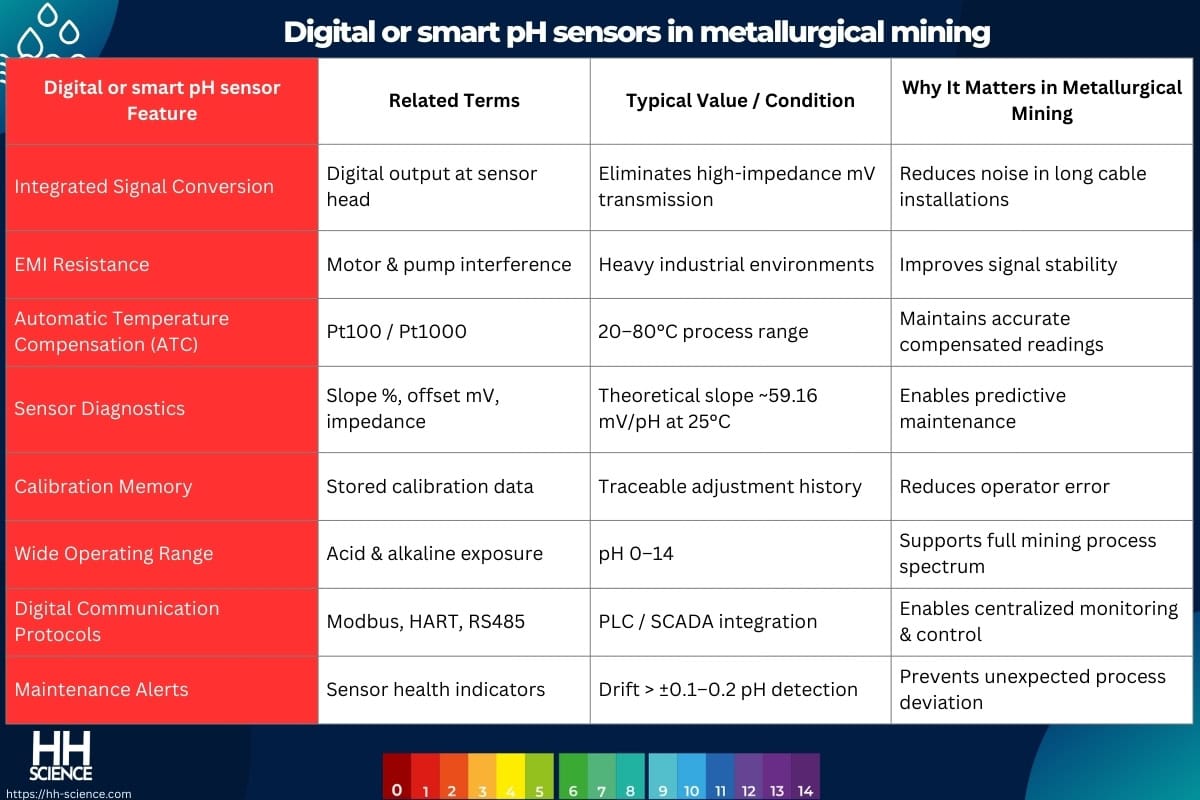
Digital or smart pH sensors
Digital or smart pH sensors are increasingly used in metallurgical mining because they convert the high-impedance millivolt signal directly at the sensor head into a stable digital output, minimizing signal noise over long cable runs, improving resistance to electromagnetic interference (EMI) from large motors and pumps, and enabling predictive diagnostics in harsh environments spanning pH <2 to >12, high ionic strength, 20–80°C temperatures, and abrasive slurry systems. Their integrated microprocessor, automatic temperature compensation (ATC), sensor health monitoring (slope %, offset mV, impedance), calibration memory, and direct PLC/SCADA communication (Modbus, HART, digital protocols) improve measurement stability (±0.05–0.10 pH in controlled circuits), reduce maintenance errors, and support compliance documentation for discharge control (6.0–9.0) and critical recovery processes.
| Digital or smart pH sensor Feature | Related Terms | Typical Value / Condition | Why It Matters in Metallurgical Mining |
| Integrated Signal Conversion | Digital output at sensor head | Eliminates high-impedance mV transmission | Reduces noise in long cable installations |
| EMI Resistance | Motor & pump interference | Heavy industrial environments | Improves signal stability |
| Automatic Temperature Compensation (ATC) | Pt100 / Pt1000 | 20–80°C process range | Maintains accurate compensated readings |
| Sensor Diagnostics | Slope %, offset mV, impedance | Theoretical slope ~59.16 mV/pH at 25°C | Enables predictive maintenance |
| Calibration Memory | Stored calibration data | Traceable adjustment history | Reduces operator error |
| Wide Operating Range | Acid & alkaline exposure | pH 0–14 | Supports full mining process spectrum |
| Digital Communication Protocols | Modbus, HART, RS485 | PLC / SCADA integration | Enables centralized monitoring & control |
| Maintenance Alerts | Sensor health indicators | Drift > ±0.1–0.2 pH detection | Prevents unexpected process deviation |
Inline, immersion, or portable configurations
Inline, immersion, and portable pH configurations are selected in metallurgical mining based on process criticality, installation environment, slurry density (20–60% solids), pressure conditions (including pipelines and autoclaves), maintenance accessibility, and control strategy requirements, because different stages such as flotation cells, heap leach irrigation lines, solvent extraction circuits, electrowinning electrolytes, neutralization tanks, and final effluent discharge demand distinct mounting methods and response characteristics. Inline systems support continuous closed-loop dosing and real-time PLC/SCADA integration (±0.05–0.10 pH in critical circuits), immersion assemblies provide flexible installation in open tanks and high-solids basins, and portable meters enable spot verification, calibration checks, and troubleshooting to maintain compliance (typically 6.0–9.0 discharge) and recovery efficiency.
| Configuration Type | Typical Installation | Related Terms | Typical Condition / Value | Why It Matters in Metallurgical Mining |
| Inline (In-Pipe) | Pipelines, recirculation loops | Continuous monitoring, closed-loop dosing | Pressurized flow systems | Real-time automated pH control |
| Retractable Inline Assembly | High-pressure or abrasive lines | Hot-tap service, maintenance without shutdown | 10–40 bar possible | Reduces downtime in critical circuits |
| Immersion (Submersible) | Open tanks, flotation cells | Slurry exposure, 20–60% solids | Non-pressurized basins | Flexible installation in large reactors |
| Immersion with Protective Cage | Abrasive slurry systems | Mechanical protection | High solids & turbulence | Prevents sensor damage |
| Portable Handheld Meter | Field verification & sampling | Grab sample testing | Calibration ±0.1 pH typical | Cross-checks inline accuracy |
| Portable for Compliance Sampling | Effluent discharge points | Regulatory spot measurement | pH 6.0–9.0 discharge control | Supports audit & reporting verification |

Installation and maintenance considerations in metallurgical mining
Installation and maintenance considerations in metallurgical mining are critical because pH sensors operate in abrasive slurries (20–60% solids), extreme chemical conditions (pH <2 to >12), elevated temperatures (20–80°C+), high ionic strength, turbulent flow, and pressure systems (including pipelines and autoclaves), where improper mounting depth, poor flow positioning, inadequate sealing, or lack of temperature compensation (ATC) can cause drift (>±0.1–0.3 pH), junction clogging, membrane damage, and shortened sensor lifespan. Proper installation design—such as retractable assemblies, protective cages, chemical-resistant materials (PVDF, PPS), correct grounding to avoid electrical noise, scheduled calibration (often weekly or biweekly in harsh circuits), and routine cleaning to remove scaling or hydroxide deposits (pH 8.5–10.5 precipitation zones)—ensures measurement stability (±0.05–0.10 pH in critical circuits), optimized reagent dosing, regulatory compliance (6.0–9.0 discharge), and reduced operational downtime.
Typical installation locations
Typical pH sensor installation locations in metallurgical mining include flotation cells, conditioning tanks, acid and alkaline leach reactors, heap leach irrigation lines, solvent extraction (SX) mixers and settlers, electrowinning (EW) electrolyte loops, neutralization tanks, thickener underflow lines, tailings discharge pipelines, recycle water circuits, cooling water systems, and final effluent discharge points, because each process stage requires real-time or verification-level monitoring to control metal solubility, reagent dosing (lime, H₂SO₄, NaOH), cyanide stability (>10.5), hydroxide precipitation (8.5–10.5), corrosion risk (<2 or >12), and regulatory discharge compliance (6.0–9.0). Installation features vary by location and may include abrasion-resistant immersion assemblies (20–60% solids), retractable inline housings for pressurized lines (10–40 bar), chemical-resistant materials (PVDF, PPS), protective cages, automatic temperature compensation (20–80°C), grounding for EMI protection, and PLC/SCADA integration for closed-loop dosing control (±0.05–0.10 pH in critical circuits).
| Installation Location | Process Stage | Related Terms | Typical Condition / Value | Key Installation Features |
| Flotation Cell | Mineral separation | Collectors, frothers, zeta potential | pH 8–11, 20–40% solids | Immersion probe with abrasion protection |
| Conditioning Tank | Reagent mixing | Lime dosing, surface activation | Turbulent mixing | Robust mounting & ATC |
| Acid Leach Reactor | Hydrometallurgy | H2SO4, Cu2+ solubility | pH < 2, 40–80°C | Chemical-resistant glass & housing |
| Heap Leach Irrigation Line | Ore percolation | Acid distribution | Low pH, variable flow | Inline installation |
| Solvent Extraction (SX) | Phase transfer | Aqueous phase control | pH 1.5–2.5 | Stable low-pH compatible sensor |
| Electrowinning (EW) Loop | Electrolyte control | Conductivity, deposition stability | pH 1.5–3 | Inline pressurized assembly |
| Neutralization Tank | Metal precipitation | Hydroxide formation | pH 8.5–10.5 | Immersion with cleaning access |
| Thickener Underflow | Slurry handling | High solids content | 30–60% solids | Heavy-duty protective cage |
| Tailings Discharge Line | Waste management | AMD control | Target 6.5–8.5 | Continuous monitoring probe |
| Final Effluent Outlet | Regulatory compliance | Environmental permit | pH 6.0–9.0 | Inline sensor with data logging |

Calibration and cleaning frequency
Calibration and cleaning frequency in metallurgical mining depends on slurry density (20–60% solids), fouling rate, chemical aggressiveness (pH <2 acid leach or >12 alkaline circuits), temperature exposure (20–80°C+), heavy metal concentration (Cu²⁺, Fe³⁺, Zn²⁺), scaling tendency (pH 8.5–10.5 precipitation zones), and process criticality (±0.05–0.10 pH tolerance in flotation or cyanidation), because harsh operating conditions accelerate slope degradation (departure from ~59.16 mV/pH at 25°C), reference junction clogging, and signal drift (>±0.1–0.3 pH). High-risk circuits such as flotation, neutralization, and cyanidation typically require weekly or biweekly calibration with certified buffers (pH 4.01, 7.00, 10.01) and routine chemical or mechanical cleaning, while lower-risk recycle water or effluent monitoring systems may allow monthly intervals depending on fouling load and compliance sensitivity (6.0–9.0 discharge).
| Application Area | Typical Condition | Related Terms | Recommended Calibration Frequency | Recommended Cleaning Frequency | Reason for Frequency |
| Flotation Circuits | pH 8–11, 20–40% solids | Collectors, zeta potential | Weekly | Weekly or biweekly | High fouling & tight control tolerance (±0.05–0.10) |
| Acid Leaching | pH < 2, 40–80°C | H2SO4 exposure | Biweekly | Biweekly | Chemical attack on glass membrane |
| Gold Cyanidation | pH > 10.5 | HCN stability | Weekly | Weekly | Safety-critical control requirement |
| Neutralization Tanks | pH 8.5–10.5 | Hydroxide precipitation | Weekly | Weekly | Scaling & sludge formation |
| Solvent Extraction (SX) | pH 1.5–2.5 | Phase equilibrium | Biweekly | Biweekly | Low pH stress & organic contamination risk |
| Electrowinning (EW) | pH 1.5–3 | Electrolyte stability | Monthly | Monthly | Relatively cleaner electrolyte |
| Tailings Monitoring | Variable pH, high solids | AMD risk | Monthly | Monthly | Environmental monitoring focus |
| Final Effluent Discharge | pH 6.0–9.0 | Regulatory compliance | Monthly (or per permit) | Monthly | Compliance documentation requirement |

Expected sensor lifespan
Expected sensor lifespan in metallurgical mining depends on chemical exposure (pH <2 acid leach or >12 alkaline systems), slurry abrasiveness (20–60% solids), temperature load (20–80°C+), pressure conditions (including 10–40 bar autoclaves), fouling rate (hydroxide precipitation at pH 8.5–10.5), heavy metal contamination (Cu²⁺, Fe³⁺), and maintenance quality, because these factors influence glass membrane degradation, reference junction stability, slope retention (ideal ~95–105% of theoretical 59.16 mV/pH at 25°C), and long-term signal drift (>±0.1–0.3 pH). In harsh flotation, leaching, and neutralization circuits, industrial pH sensors typically last 3–9 months, while moderate electrolyte or effluent monitoring environments may allow 9–18 months, provided regular calibration, cleaning, and proper installation are maintained to protect recovery efficiency and compliance control (6.0–9.0 discharge).
| Application Area | Typical Condition | Related Stress Factors | Expected Lifespan | Primary Limiting Factor |
| Flotation Circuits | pH 8–11, 20–40% solids | Abrasion, reagent coating | 4–9 months | Slurry abrasion & fouling |
| Acid Leaching | pH < 2, 40–80°C | Strong acid attack | 3–6 months | Glass membrane degradation |
| Gold Cyanidation | pH > 10.5 | High alkalinity | 6–9 months | Alkaline glass erosion |
| Neutralization Tanks | pH 8.5–10.5, sludge | Hydroxide scaling | 4–8 months | Reference junction clogging |
| Solvent Extraction (SX) | pH 1.5–2.5 | Organic contamination | 6–12 months | Membrane coating & chemical stress |
| Electrowinning (EW) | pH 1.5–3 | Stable electrolyte | 9–18 months | General aging & slope decline |
| Tailings Monitoring | Variable pH, solids | Environmental exposure | 6–12 months | Biofouling & scaling |
| Final Effluent Discharge | pH 6.0–9.0 | Lower chemical stress | 12–18 months | Normal electrode aging |

Trade-offs between accuracy, maintenance, and durability
In metallurgical mining applications, trade-offs between accuracy (±0.05–0.10 pH in critical flotation or cyanidation circuits), maintenance frequency (weekly or biweekly calibration in high-solids 20–60% slurry systems), and durability (3–18 month lifespan depending on chemical aggressiveness pH <2 to >12, 20–80°C temperature, abrasion, and fouling load) must be carefully balanced because improving one parameter often increases stress on the others. High-accuracy glass electrodes with fast response and tight slope tolerance (~95–105% of 59.16 mV/pH at 25°C) typically require more frequent cleaning and recalibration in hydroxide precipitation zones (pH 8.5–10.5), while heavy-duty, chemically resistant or differential sensors designed for durability and fouling resistance may sacrifice response speed or fine-resolution stability, and low-maintenance configurations optimized for long service intervals may operate with wider control tolerances (±0.1–0.3 pH), which can impact reagent consumption, recovery efficiency, and discharge compliance (6.0–9.0).
Regulatory or quality considerations in metallurgical mining
Regulatory and quality considerations in metallurgical mining are critical because pH directly affects environmental discharge compliance (commonly pH 6.0–9.0 for effluent permits), heavy metal precipitation efficiency (typically optimized at pH 8.5–10.5), cyanide stability control (>10.5 to prevent HCN gas formation), acid mine drainage (AMD) risk (<4.0), and product purity specifications in flotation, leaching, solvent extraction (SX), and electrowinning (EW) processes. Maintaining calibrated, traceable measurement accuracy (often ±0.05–0.10 pH in controlled circuits), documented quality management procedures, and reliable inline monitoring systems ensures regulatory conformity, worker safety, consistent metal recovery rates, and defensible audit records aligned with environmental permits, internal QA/QC standards, and international operational best practices.
Industry standards in metallurgical mining
Industry standards in metallurgical mining define how pH must be measured, controlled, documented, and audited across flotation, leaching, solvent extraction (SX), electrowinning (EW), tailings management, and wastewater discharge systems, because pH directly impacts metal recovery efficiency, heavy metal precipitation (often optimized at pH 8.5–10.5), cyanide safety control (>10.5), acid mine drainage risk (<4.0), and environmental compliance (commonly 6.0–9.0 discharge limits). These standards establish requirements for laboratory traceability (±0.1 pH typical lab accuracy), field calibration procedures, environmental monitoring protocols, occupational safety thresholds, chemical management practices, and quality management systems to ensure operational reliability, regulatory conformity, and international trade acceptance.
| Standard / Organization | Scope | Related Terms / Values | Why It Matters for pH | Key Measurement / System Features |
| ISO 9001 | Quality management systems | Process control, documentation | Ensures consistent pH control in recovery circuits | Documented calibration & SOPs |
| ISO 14001 | Environmental management | Effluent pH 6.0–9.0 (typical) | Supports environmental compliance | Continuous monitoring & recordkeeping |
| ISO 17025 | Laboratory competence | Traceability, uncertainty ±0.1 pH | Validates analytical pH testing | Certified buffers & audit trails |
| ASTM (e.g., D1293) | Water pH test methods | Electrometric measurement | Standardizes pH testing procedures | Defined electrode handling |
| EPA (e.g., NPDES) | Industrial discharge permits | pH 6.0–9.0 limits | Legal effluent compliance | Inline monitoring & reporting |
| WHO Guidelines | Water quality protection | 6.5–8.5 potable range | Protects downstream water resources | Routine monitoring |
| ICMM (International Council on Mining & Metals) | Mining sustainability principles | Environmental risk management | Guides responsible tailings & AMD control | Documented environmental monitoring |
| Global Industry Standard on Tailings Management (GISTM) | Tailings governance | Geochemical stability (pH control) | Prevents acid mine drainage | Long-term monitoring systems |
| OSHA / Occupational Safety Standards | Worker safety | Cyanide safety >10.5 pH | Prevents toxic HCN exposure | Continuous monitoring in critical areas |
| EU Industrial Emissions Directive (IED) | Industrial environmental control | BAT emission limits | Ensures compliant mining operations | Automated data logging |
| National Environmental Agencies | Country-specific mining regulation | Site-specific pH limits | Mandates legal operation | Approved monitoring protocols |

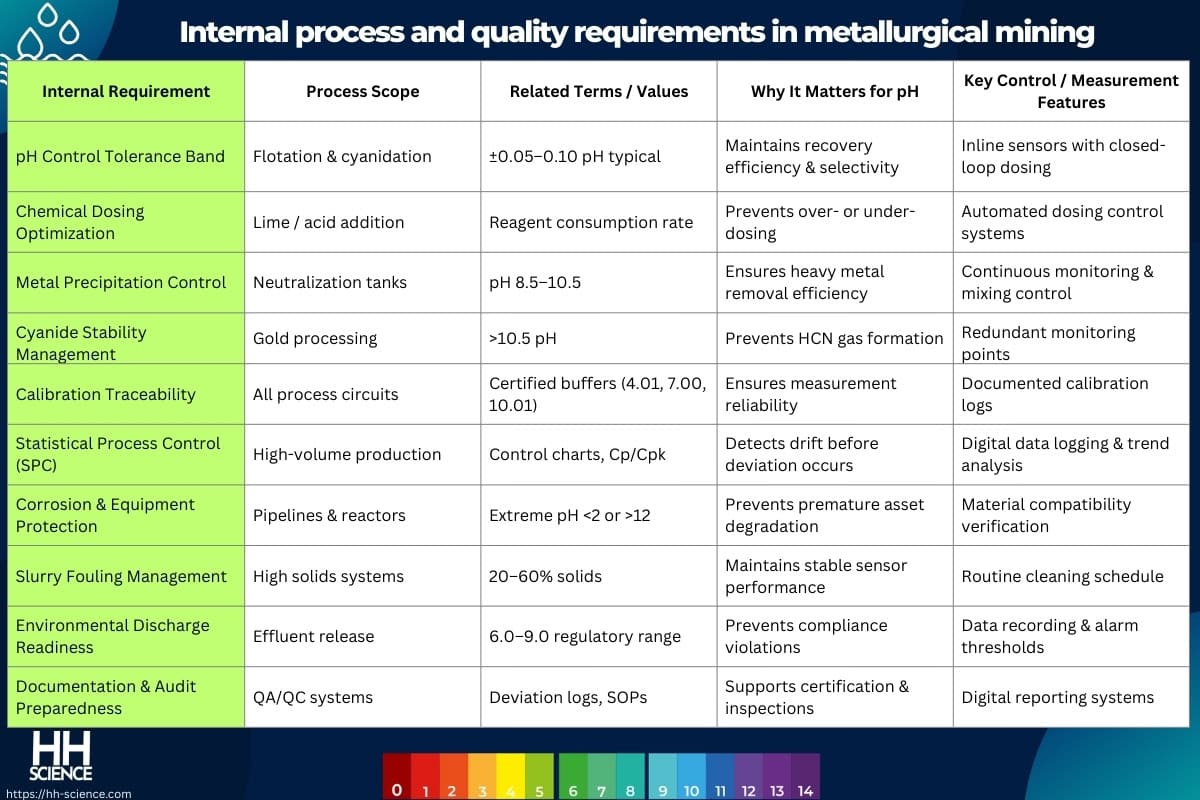
Internal process and quality requirements in metallurgical mining
Internal process and quality requirements in metallurgical mining define how pH must be controlled, verified, documented, and optimized across flotation circuits (typically pH 8–11), acid leaching (<2), cyanidation (>10.5), solvent extraction (1.5–2.5), electrowinning (1.5–3.0), neutralization (8.5–10.5), and final discharge (6.0–9.0), because pH directly influences metal recovery rate, reagent efficiency, hydroxide precipitation thresholds, cyanide stability, corrosion behavior, and product purity specifications. These internal requirements establish tolerance bands (often ±0.05–0.10 pH in critical recovery circuits), calibration traceability, statistical process control (SPC), automated dosing logic, contamination control, and maintenance intervals to ensure consistent concentrate grade, minimized reagent consumption, regulatory readiness, and long-term operational reliability.
| Internal Requirement | Process Scope | Related Terms / Values | Why It Matters for pH | Key Control / Measurement Features |
| pH Control Tolerance Band | Flotation & cyanidation | ±0.05–0.10 pH typical | Maintains recovery efficiency & selectivity | Inline sensors with closed-loop dosing |
| Chemical Dosing Optimization | Lime / acid addition | Reagent consumption rate | Prevents over- or under-dosing | Automated dosing control systems |
| Metal Precipitation Control | Neutralization tanks | pH 8.5–10.5 | Ensures heavy metal removal efficiency | Continuous monitoring & mixing control |
| Cyanide Stability Management | Gold processing | >10.5 pH | Prevents HCN gas formation | Redundant monitoring points |
| Calibration Traceability | All process circuits | Certified buffers (4.01, 7.00, 10.01) | Ensures measurement reliability | Documented calibration logs |
| Statistical Process Control (SPC) | High-volume production | Control charts, Cp/Cpk | Detects drift before deviation occurs | Digital data logging & trend analysis |
| Corrosion & Equipment Protection | Pipelines & reactors | Extreme pH <2 or >12 | Prevents premature asset degradation | Material compatibility verification |
| Slurry Fouling Management | High solids systems | 20–60% solids | Maintains stable sensor performance | Routine cleaning schedule |
| Environmental Discharge Readiness | Effluent release | 6.0–9.0 regulatory range | Prevents compliance violations | Data recording & alarm thresholds |
| Documentation & Audit Preparedness | QA/QC systems | Deviation logs, SOPs | Supports certification & inspections | Digital reporting systems |
Compliance-driven monitoring needs in metallurgical mining
Compliance-driven monitoring needs in metallurgical mining require continuous, traceable, and defensible pH control across flotation tailings, acid leach circuits, cyanidation systems (>10.5 safety threshold), solvent extraction (1.5–2.5), electrowinning (1.5–3.0), neutralization (8.5–10.5), tailings storage facilities, and final effluent discharge points (commonly 6.0–9.0 regulatory limits), because pH directly governs heavy metal mobility (Cu²⁺, Zn²⁺, Ni²⁺), hydroxide precipitation efficiency, acid mine drainage (AMD) risk (<4.0), toxic gas prevention (HCN), and environmental permit conformity. These compliance frameworks demand calibrated measurement accuracy (often ±0.1 pH for reporting), automated data logging, alarm thresholds, redundancy in critical circuits, documented calibration procedures (buffers 4.01 / 7.00 / 10.01), and integration with SCADA systems to ensure legal operation, audit readiness, worker safety, and long-term environmental liability mitigation.
| Compliance Requirement | Monitoring Scope | Related Terms / Values | Why It Matters for pH | Key Measurement / System Features |
| Effluent Discharge Compliance | Final wastewater outlet | pH 6.0–9.0 typical limit | Prevents regulatory violations & fines | Continuous inline monitoring with alarms |
| Heavy Metal Removal Verification | Neutralization tanks | Optimal pH 8.5–10.5 | Ensures Zn, Cu, Ni precipitation efficiency | Closed-loop dosing & logging |
| Cyanide Safety Control | Gold leaching circuits | >10.5 pH threshold | Prevents HCN gas formation | Redundant sensors & alarm systems |
| Acid Mine Drainage (AMD) Monitoring | Tailings & waste rock | Risk below pH 4.0 | Prevents long-term environmental damage | Long-term field monitoring systems |
| Laboratory Reporting Accuracy | QA/QC sampling | ±0.1 pH uncertainty typical | Ensures defensible audit documentation | ISO 17025-aligned calibration |
| Permit-Based Monitoring (NPDES / National) | Regulated mining sites | Site-specific pH thresholds | Maintains legal operating status | Automated data recording & reporting |
| Worker Exposure Protection | Acid & alkaline handling areas | Extreme pH <2 or >12 | Reduces corrosive injury risk | Local monitoring with safety alarms |
| International Sustainability Standards | ICMM / Tailings governance | Environmental risk management | Supports responsible mining certification | Traceable monitoring & reporting systems |
| Data Traceability & Audit Trail | All regulated processes | Time-stamped logs | Provides defensible compliance records | SCADA integration & digital storage |

Selecting the right pH measurement approach in metallurgical mining
Selecting the right pH measurement approach in metallurgical mining is critical because processes such as flotation (pH 8–11), acid leaching (<2), cyanidation (>10.5), solvent extraction (1.5–2.5), electrowinning (1.5–3.0), neutralization (8.5–10.5), and effluent discharge (6.0–9.0) operate under high solids slurry conditions (20–60%), elevated temperatures (20–80°C+), high ionic strength, abrasive flow, chemical aggressiveness (H₂SO₄, NaOH, cyanide), and strict compliance thresholds, where even ±0.05–0.10 pH deviation can affect recovery efficiency, precipitation kinetics, corrosion rate, and safety margins. The appropriate solution—whether combination, differential, or digital smart sensors; inline, retractable, or immersion assemblies; high-alkali-resistant glass; double-junction references; ATC integration; and SCADA-linked closed-loop dosing—must align with process criticality, fouling risk, pressure conditions (including 10–40 bar systems), maintenance strategy, and regulatory reporting requirements to ensure stable operation, optimized reagent usage, asset protection, and defensible environmental compliance.
Decision support for metallurgical mining
Decision support in metallurgical mining evaluates ore mineralogy, metal speciation (Cu²⁺, Zn²⁺, Fe³⁺), process stage (flotation pH 8–11, acid leach <2, cyanidation >10.5, neutralization 8.5–10.5, discharge 6.0–9.0), slurry density (20–60% solids), temperature load (20–80°C+), pressure conditions (up to 10–40 bar), and compliance exposure to determine required accuracy (±0.05–0.10 pH in critical circuits) and acceptable maintenance intervals. This framework supports risk-based selection of sensor type, installation configuration, calibration frequency, and redundancy level, ensuring optimized metal recovery, controlled reagent consumption, minimized corrosion, and defensible environmental reporting.
Application-driven measurement strategies
Application-driven measurement strategies align pH monitoring architecture with specific mining processes such as flotation selectivity control (zeta potential management), acid leaching kinetics (H₂SO₄ dosing), cyanide stability (>10.5 to prevent HCN), solvent extraction equilibrium (1.5–2.5 aqueous phase), and heavy metal precipitation (8.5–10.5), taking into account fouling risk, ionic strength, temperature variation, and process dynamics. By defining measurement tolerance bands, response time requirements, ATC integration, and closed-loop dosing logic per application, this strategy ensures stable chemical equilibrium, improved concentrate quality, and controlled environmental discharge.
Linking metallurgy mining to sensor selection and oem solutions
Linking metallurgical mining requirements to sensor selection and OEM integration ensures that probe materials (high-alkali-resistant glass, PVDF/PPS housings), reference designs (double junction or differential), pressure ratings, digital diagnostics (slope %, impedance), and communication outputs (4–20 mA, Modbus, SCADA) are matched to aggressive chemical exposure, abrasive slurry flow, and regulatory monitoring needs. This alignment enables OEM system designers and plant engineers to implement durable, low-maintenance, and compliance-ready pH measurement systems that support long-term operational reliability, process efficiency, and environmental sustainability.


