
How does a pH sensor work?
A pH sensor works by converting the chemical activity of hydrogen ions (H⁺) in a solution into an electrical signal that can be measured and displayed as a pH value. Inside the sensor, two main components—the measuring (glass) electrode and the reference electrode—form an electrochemical cell. The measuring electrode is made of a special pH-sensitive glass membrane that allows H⁺ ions from the sample to interact with the hydrated gel layer on its surface. This interaction creates a potential (voltage) difference between the inside of the glass (filled with a known buffer) and the external sample solution, which is directly related to the hydrogen ion concentration.
The reference electrode, typically a silver/silver chloride (Ag/AgCl) element immersed in a stable electrolyte such as KCl, maintains a constant potential independent of the sample. When both electrodes are connected, the sensor measures the electromotive force (EMF) generated between them—this potential difference changes according to the activity of hydrogen ions in the sample.
The relationship between this potential and the pH value is described by the Nernst equation:

where:
- E = measured potential (mV)
- E⁰ = standard electrode potential
- R = universal gas constant (8.314 J/mol·K)
- T = temperature in Kelvin
- n = charge number (1 for H⁺)
- F = Faraday constant (96,485 C/mol)
- a₍H⁺₎ = hydrogen ion activity
At 25°C, this yields approximately 59.16 mV per pH unit, meaning every one-unit change in pH corresponds to a 59.16 mV change in voltage. The sensor’s electronics or pH meter interprets this voltage and displays it as a numeric pH value.
Once the meter knows the slope (S, mV/pH) and offset (E₀, mV at a known pH) from calibration, it converts voltage to pH by a simple linear transform:
- Two-point calibration (e.g., pH 7 and pH 4/10) fits S and E₀, then
pH = pH_ref + (E_meas − E_ref) / S (with S ≈ −59.16 mV/pH at 25 °C; the meter applies temperature compensation so S follows Nernst).
- Single-point updates offset only (less accurate). In practice, the meter measures E_meas in mV, applies the calibrated S and E₀ (and temperature), and displays the computed pH.
Here are three quick, concrete examples (assume 25 °C, two-point calibration done, slope S = −59.16 mV/pH, and the meter’s offset is set so E = 0 mV at pH 7):
Around pH 4
If the meter reads +177.48 mV: pH=7+(177.48−0)/−59.16=7−3.0=4.00
Around pH 7
If the meter reads +3.0 mV (a tiny positive drift): pH=7+(3.0−0)/−59.16=7−0.0507≈6.95
Around pH 10
If the meter reads −177.48 mV: pH=7+(-177.48−0)/−59.16=7+3.0=10.00
Accuracy vs resolution: Many meters display to 0.01 pH (some to 0.001 pH), but realistic accuracy depends on electrode quality, calibration, temperature control, sample type, and junction condition:
- Good benchtop systems: ±0.01 pH typical (best-case ±0.005–0.01).
- High-end research setups (careful technique, fresh buffers, stable temps): ±0.002–0.005 pH possible.
- Portable/field and many online industrial sensors: ±0.02–0.05 pH (harsh processes up to ±0.1 pH).
The bottom line: You’ll often see 0.01 or 0.001 on screen, but trust about ±0.01 pH in good lab practice and ±0.02–0.05 pH in typical process conditions.
In practical applications—whether in water treatment, food processing, or hydroponics—the pH sensor continuously measures this voltage and converts it into real-time pH readings to monitor and control chemical or biological processes.
To ensure accuracy, pH sensors require regular calibration with standard buffer solutions (typically pH 4.00, 7.00, and 10.00). Calibration aligns the sensor’s voltage response with known reference points, compensating for aging or slight drifts in electrode performance. Additionally, cleaning the glass membrane and properly storing it in the electrode solution prevents junction clogging, maintains stable ion exchange, and prolongs sensor life.
In short, a pH sensor transforms invisible chemical ion activity into a precise, measurable electrical signal—allowing industries and laboratories to control processes where pH defines safety, efficiency, and quality.
What does a pH sensor measure?
A pH sensor measures the hydrogen ion activity (a₍H⁺₎) in a solution and converts it into an electrical potential difference (voltage) according to the Nernst equation. This voltage, expressed in millivolts (mV), reflects the logarithmic concentration of hydrogen ions and is then translated into a pH value, which represents the negative base-10 logarithm of hydrogen ion activity:
At 25 °C, the sensor’s potential changes by about 59.16 mV per pH unit, meaning more positive voltages indicate more acidic solutions (low pH) and more negative voltages indicate more alkaline solutions (high pH).
What are the pH sensor measurement specifications?
A pH sensor is typically defined by its measurement range, accuracy, response time, calibration method, slope, and offset, which together determine how precisely and reliably it can convert hydrogen ion activity into a pH value. These specifications are critical because they describe the sensor’s operating capability, performance stability, and data quality under real-world conditions.
- pH Measurement Range: Usually 0–14 pH, representing the full scale from highly acidic to highly alkaline solutions; some specialized electrodes extend from −1 to 15 pH for extreme chemical processes.
- Accuracy: Indicates how close the reading is to the true pH, typically ±0.01 pH for laboratory sensors and ±0.02–0.05 pH for industrial probes.
- Response Time: The time to reach 95% of the final reading, generally <30 seconds in fresh buffer solutions, is affected by membrane condition and sample temperature.
- Two-Point Calibration: Standard procedure using two buffer solutions (commonly pH 7 and 4 or 10) to establish the sensor’s slope (mV/pH) and offset (zero potential) for accurate conversion of voltage to pH.
- Slope: The voltage change per pH unit, theoretically −59.16 mV/pH at 25 °C; real electrodes are acceptable between −54 and −60 mV/pH depending on condition and temperature.
- Offset: The potential at pH 7, ideally 0 mV, but acceptable within ±30 mV, compensating for manufacturing and aging differences between electrodes.

How accurate is a pH sensor?
A pH sensor typically achieves an accuracy of ±0.01 pH under laboratory conditions and ±0.02–0.05 pH in industrial or field environments, but its precision is affected by calibration quality, temperature stability, electrode condition, sample type, measurement system, and maintenance practices. Each of these factors influences how faithfully the sensor converts voltage into a true pH value.
- Calibration Quality: The closer and more stable the calibration buffers (e.g., pH 4, 7, 10) and the more precise the meter’s slope and offset adjustments, the smaller the measurement error.
- Temperature Stability: pH electrodes follow the Nernst equation, and the slope changes with temperature (~0.198 mV/pH/°C), so poor temperature compensation can cause ±0.01–0.03 pH deviation per 10 °C.
- Electrode Condition: Aging, glass membrane fatigue, or junction clogging reduces ion exchange efficiency, often drifting readings by ±0.02–0.05 pH or more.
- Sample Type: High ionic strength, viscosity, or contamination (e.g., protein or oil samples) can alter junction potential and slow response, lowering accuracy.
- Measurement System: Low-quality meters, electrical noise, or unstable reference circuits introduce additional millivolt variation, directly translating into pH error.
- Maintenance and Cleaning: Regular cleaning, rehydration, and storage in proper electrolytes minimize drift; neglect can double or triple measurement error over time.
What is a pH sensor made of?
A pH sensor is constructed from different materials for each functional part, carefully selected to balance chemical durability, electrical stability, and measurement precision. The electrode body must resist corrosion and pressure; the glass membrane needs ion selectivity and chemical sensitivity; the reference electrode and electrolyte ensure stable voltage; the junction controls ion exchange with the sample; and the connector guarantees signal integrity.
| pH Sensor Part | Common Materials | Purpose / Reason for Use |
| Electrode Body | Glass, Epoxy, Polycarbonate (PC), Polyether Ether Ketone (PEEK), PVC | Provides structural strength and chemical resistance; material chosen based on temperature, pressure, and sample type (e.g., industrial vs lab). |
| Glass Membrane | pH-sensitive sodium–silicate glass | Reacts selectively with hydrogen ions, producing a potential difference proportional to pH; designed for fast response and minimal drift. |
| Reference Electrode | Silver wire coated with Silver Chloride (Ag/AgCl) | Creates a stable and reproducible reference potential independent of the sample’s composition. |
| Reference Electrolyte | Potassium Chloride (KCl) liquid, gel, or polymer | Provides a conductive medium between the reference electrode and sample; maintains constant ionic strength. |
| Reference Junction | Porous Ceramic, Teflon (PTFE), Fiber Wick, or Ground Glass | Allows ionic flow between the electrolyte and sample while minimizing contamination and clogging. |
| Connector / Cable | Coaxial cable, BNC, DIN, or S8 connectors with gold-plated or stainless contacts | Transfers the mV signal to the meter with minimal electrical noise and corrosion. |

What are the components of a pH sensor?
A pH sensor is composed of several key parts — pH probe, pH electrodes (measuring and reference), electrode body, glass membrane, reference junction, temperature sensor, housing and connector, and signal conditioning electronics — each designed to ensure the sensor accurately converts hydrogen ion activity into a stable electrical signal. These components work together to provide precise, fast, and reliable pH readings under various laboratory and industrial conditions.
- pH Probe: The overall assembly that contains the electrodes, junction, and electrolyte, functioning as the main sensing element inserted into the sample.
- pH Electrodes (Measuring + Reference): The measuring electrode detects hydrogen ion activity, while the reference electrode provides a constant potential for comparison, forming an electrochemical cell.
- Electrode Body: The structural shell that protects internal components and ensures chemical resistance to different sample environments.
- Glass Membrane: A thin pH-sensitive glass bulb at the tip of the measuring electrode that interacts with hydrogen ions and generates a potential difference proportional to pH.
- Reference Junction: A porous interface that connects the internal reference electrolyte to the sample solution, allowing controlled ion exchange while preventing contamination.
- Temperature Sensor: Measures sample temperature so the system can apply temperature compensation, maintaining accuracy according to the Nernst equation.
- Housing and Connector: Encloses the probe and provides a secure electrical connection to the meter or transmitter, shielding the mV signal from noise and moisture.
- Signal Conditioning Electronics: Converts the raw millivolt signal into a digital or analog output (e.g., 4–20 mA or Modbus) for display, control, or data logging in analytical instruments.
What is the difference between a pH probe, a pH sensor and a pH electrode?
The electrode senses, the probe holds and protects and the sensor interprets and communicates. The terms pH probe, pH sensor, and pH electrode are often used interchangeably, but they actually describe different levels of the same measurement system. The confusion arises because modern pH measuring devices frequently combine all three functions into a single assembly — what most people call a “pH probe” — even though each term refers to a specific part or role in the measurement process.
- A pH electrode is the core electrochemical element that directly senses hydrogen ion activity.
- A pH probe is the physical assembly that houses one or more electrodes (usually a combination electrode) and other parts like the junction, electrolyte, and temperature sensor.
- A pH sensor is the complete device, often including the probe plus built-in electronics for signal amplification, digital conversion, or process control output.
| Term | Definition | Main Components | Function / Role | Typical Use Context |
| pH Electrode | The electrochemical element that measures hydrogen ion activity through voltage potential. | Measuring electrode (glass bulb), reference electrode (Ag/AgCl), electrolyte, junction. | Generates a millivolt signal proportional to the pH of the solution. | Scientific theory, electrode replacement, calibration discussions. |
| pH Probe | The mechanical assembly containing one or more electrodes, junction, and body. | Combination electrode, body material, junction, temperature sensor, connector. | Acts as the sensing unit inserted into the sample; provides the mV output to a meter or transmitter. | Laboratory and process instruments, product specifications. |
| pH Sensor | The complete device that may include the probe, cable, and signal conditioning electronics. | Probe, housing, preamplifier or transmitter, cable/connector, digital interface. | Converts electrochemical signals into usable outputs (analog or digital) for control or monitoring systems. | Industrial automation, process control, and smart digital measurement systems. |

What is a pH probe?
A pH probe is the physical sensing assembly—usually a combination electrode that integrates a measuring (glass) electrode and a reference (Ag/AgCl) electrode with electrolyte and a reference junction—that converts hydrogen-ion activity into a millivolt signal for a meter or transmitter. It typically includes a temperature sensor for ATC, a chemically resistant body with connector/cable, presents very high input impedance (≈10⁷–10⁹ Ω), and produces about ±414 mV across pH 0–14 at 25 °C (≈59.16 mV/pH), enabling ±0.01 pH accuracy in good lab conditions after two-point calibration (slope & offset).
How does a pH probe work?
A pH probe works by turning the chemical activity of hydrogen ions (H⁺) in a sample into a millivolt (mV) signal that a pH meter/transmitter can read and convert to pH. In a typical combination probe, a measuring (glass) electrode with a hydrated gel layer at its glass membrane develops a potential that depends on H⁺ activity, while an internal reference (Ag/AgCl) electrode in KCl electrolyte provides a stable comparison through a reference junction. The probe’s two electrodes therefore form an electrochemical cell whose EMF follows the Nernst equation, giving ≈ 59.16 mV per pH unit at 25 °C (about ±414 mV across pH 0–14). A high-impedance meter/transmitter/PLC reads this EMF, applies temperature compensation (ATC) and the probe’s calibrated slope and offset, and outputs the pH value.
The pH probe is the front-end sensing interface inserted into the process or sample; it partners with a pH meter, analyzer, or controller (sometimes with onboard preamp/signal conditioning) to deliver a clean, stable signal for display, logging, or closed-loop dosing.
The purpose of a pH probe is to provide accurate, repeatable pH measurement for control and compliance—e.g., dosing acid/alkali in wastewater, mash control in brewing, nutrient balance in hydroponics, or QC in labs—by reliably converting H⁺ activity into a calibrated electrical signal that the instrument can interpret as pH.
What are the types of pH probes?
A pH probe comes in many types, including combination vs. separate half-cells, ISFET (solid-state), refillable vs. gel-filled, single- vs. double-junction, laboratory vs. industrial process formats (immersion, insertion, flow-through, retractable, sanitary), body materials (glass, epoxy, PEEK/PVC), tip geometries (bulb, flat, spear, micro), integrated-temperature (ATC), differential pH designs, pressurized-reference/low-maintenance, high-temperature/CIP/SIP-sterilizable, low-ionic-strength/Tris-compatible clog-resistant, and solvent/low-sodium-error specialty probes.
- Combination vs. separate half-cells: Combination probes house measuring and reference electrodes together for convenience; separate half-cells split them for specialized setups or harsh media.
- ISFET (solid-state) probes: Use an ion-sensitive field-effect transistor (no fragile glass), ideal for food, biotech, and field work with fast warm-up and robust handling.
- Refillable vs. gel-filled: Refillable references allow electrolyte replacement for long life and stable junction potential; gel-filled are maintenance-light and leak-resistant.
- Single- vs. double-junction: Double-junction designs add a barrier to protect the reference from sample poisoning (e.g., sulfides, proteins), improving longevity.
- Laboratory vs. industrial (immersion/insertion/flow-through/retractable/sanitary): Process formats fit pipes, tanks, or hygienic lines and allow service without shutdown; lab probes suit benchtop and portable meters.
- Body materials (glass, epoxy, PEEK/PVC): Glass offers chemical resistance and thermal stability; epoxy/PEEK/PVC provide impact resistance and ruggedness for field or process use.
- Tip geometries (bulb, flat, spear, micro): Bulb tips give general-purpose sensitivity; flat tips clean easily on surfaces; spear tips pierce semi-solids; micro tips fit small volumes.
- Integrated-temperature (ATC) probes: Include Pt100/Pt1000 or thermistors to auto-compensate the Nernst slope for accurate readings across temperatures.
- Differential pH probes: Use a third electrode to reference an internal stable solution, greatly reducing ground-loop and junction errors in noisy industrial sites.
- Pressurized-reference / low-maintenance: Keep electrolyte under slight pressure to prevent sample ingress and minimize clogging for long service intervals.
- High-temperature / CIP/SIP-sterilizable: Built with high-temp glass and rugged seals to withstand autoclave, steam-in-place, and hot caustic/acid cleaning cycles.
- Low-ionic-strength / Tris-compatible, clog-resistant: Open or PTFE junctions and suitable electrolytes maintain stability in protein buffers, low-salt waters, and viscous samples.
- Solvent-resistant / low-sodium-error specialty: Optimized glasses and seals resist organics and reduce alkaline (sodium) error at high pH or high Na⁺ concentrations.

What are the components of a pH probe?
A pH probe consists of an electrode body, glass membrane, reference electrode, reference electrolyte, and reference junction, engineered to convert hydrogen-ion activity into a stable millivolt signal that a meter can transform into an accurate pH value. Each part ensures chemical selectivity, electrical stability, and controlled ionic contact with the sample.
- Electrode Body: The protective housing (glass/epoxy/PEEK/PVC) that holds all internal parts, chosen for chemical resistance and mechanical strength.
- Glass Membrane: The H⁺-sensitive thin glass bulb that develops a potential proportional to hydrogen-ion activity at the sample interface.
- Reference Electrode: A stable Ag/AgCl element that provides a constant reference potential independent of the sample composition.
- Reference Electrolyte: Typically KCl (liquid/gel/polymer) that conducts ions from the reference electrode to the junction, maintaining stable potential.
- Reference Junction: A porous interface (ceramic/PTFE/open) that permits controlled ion flow between electrolyte and sample while minimizing contamination and drift.
Why is a reference electrode needed while measuring pH with a pH probe?
A reference electrode is needed because the glass (measuring) electrode’s absolute potential is undefined; pH is obtained from the electromotive force (EMF) between a stable reference potential and the measuring electrode so the meter can map voltage to pH via the Nernst equation (≈ 59.16 mV per pH unit at 25 °C). The reference (usually Ag/AgCl immersed in KCl electrolyte) supplies a near-constant potential and an ionic path through the reference junction, keeping junction potentials to only a few mV and allowing the instrument (high input impedance, typically ≥10⁹–10¹² Ω) to solve accurately for pH. In practice, calibration fits the probe’s slope (often −54 to −60 mV/pH) and offset (ideally 0 mV at pH 7, acceptable within ±30 mV), while a good reference shows very low drift (≈ <1–2 mV/day); without this stable reference, the EMF would wander and pH error would be uncontrolled.
Are pH probes and pH meters the same?
No, pH probes and pH meters are not the same, because the pH probe is the electrochemical sensing component that generates a millivolt (mV) signal based on hydrogen-ion activity, while the pH meter is the electronic measuring instrument that reads this signal, applies calibration (slope and offset) and temperature compensation, and converts it into a displayed pH value.
The probe produces about ±414 mV over the pH 0–14 range (≈ 59.16 mV per pH unit at 25 °C), requiring the meter’s high input impedance (≥ 10⁹–10¹² Ω) to avoid loading errors. The meter also performs two- or three-point calibration to correct for electrode aging and offset drift, ensuring overall measurement accuracy of ±0.01 pH in lab systems or ±0.02–0.05 pH in industrial sensors.
How often should you clean your pH probe?
You should clean your pH probe after each use in laboratory applications and at least once per week or every 8–24 hours of continuous industrial operation, because residue buildup, protein films, oils, or mineral deposits can alter the junction potential and change the probe’s slope and offset, reducing accuracy by ±0.02–0.1 pH or more.
What are the types of pH probe bodies?
A pH probe body is typically made from glass, epoxy, or polymer materials such as PEEK, PVC, or polycarbonate, each selected for its chemical resistance, mechanical strength, and suitability for specific temperature and process conditions. The body material determines how well the probe performs in laboratory, industrial, or harsh chemical environments.
- Glass Body: Offers excellent chemical resistance and thermal stability (up to 130 °C), ideal for laboratory and high-precision applications, but fragile and not suited for heavy-duty use.
- Epoxy Body: Durable and impact-resistant, making it suitable for fieldwork and portable meters; limited to moderate temperatures (≤80 °C) and non-aggressive chemicals.
- Polymer Body (PEEK, PVC, Polycarbonate): Combines mechanical toughness and chemical resistance for industrial and process probes; PEEK withstands high pressure and aggressive chemicals, PVC suits wastewater, and polycarbonate is lightweight and economical.
What are the types of pH probe junctions?
A pH probe junction can be either single-junction or double-junction, each designed to control ionic flow between the reference electrolyte and the sample while preventing contamination and potential drift. The choice affects the probe’s stability, lifetime, and resistance to poisoning from complex or dirty samples.
- Single-Junction: Contains one liquid junction where the reference electrolyte (typically KCl) contacts the sample; suitable for clean, aqueous, and low-contamination samples such as laboratory buffers or drinking water.
- Double-Junction: Adds a second barrier and an intermediate electrolyte chamber to isolate the internal Ag/AgCl reference from the sample, preventing contamination from sulfides, proteins, or heavy metals—ideal for wastewater, biological, or chemical process samples where electrode poisoning is common.
What are the mounting options of pH probes?
A pH probe can be mounted in several ways — handheld or portable, insertion-style, or flow-through — depending on whether the measurement is taken manually, directly in a process line, or continuously in a closed system. Each mounting option is chosen to match the measurement environment, accessibility, and maintenance requirements.
- Handheld or Portable: Used with benchtop or portable pH meters for spot measurements in laboratories, field sampling, or water testing; easy to clean and calibrate but not suited for continuous monitoring.
- Insertion-Style: Installed directly into tanks, pipes, or reactors through threaded fittings or retractable assemblies for in-line measurement in process industries such as wastewater or chemical production.
- Flow-Through: Mounted in a flow cell or bypass loop that allows continuous sampling and easy sensor replacement or calibration without interrupting the main process flow, ideal for industrial automation and water treatment systems.
What is a pH electrode?
A pH electrode is the electrochemical sensing element within a pH probe that generates a millivolt (mV) potential proportional to the hydrogen ion activity (a₍H⁺₎) of a solution, according to the Nernst equation. It consists of a measuring (glass) electrode with a pH-sensitive glass membrane and a reference electrode with a stable Ag/AgCl potential, forming a complete electrochemical cell. The potential difference between them changes by approximately 59.16 mV per pH unit at 25 °C, producing a total voltage range of about ±414 mV across pH 0–14. This signal is read by a high-impedance pH meter or transmitter, which applies temperature compensation, calibration (slope and offset), and converts the voltage into an accurate pH value for monitoring or control applications.
How does a pH electrode work?
A pH electrode works by measuring the electrical potential created by the difference in hydrogen ion activity (a₍H⁺₎) between the sample solution and a known internal reference, producing a millivolt signal that follows the Nernst equation (≈ 59.16 mV per pH unit at 25 °C). The electrode’s pH-sensitive glass membrane selectively interacts with hydrogen ions, forming a thin hydrated gel layer where ion exchange occurs; this creates a potential relative to the inner reference solution of fixed pH. The electrode is paired with a reference electrode—typically Ag/AgCl in KCl electrolyte—that provides a stable, constant potential through a reference junction, completing the electrochemical cell.
In practice, the measuring electrode detects changes in hydrogen ion concentration, while the reference electrode serves as the comparison baseline; together they produce an EMF that the pH meter or transmitter (high input impedance ≥ 10⁹ Ω) reads and converts into a numeric pH value after applying slope and offset calibration.
Different types of electrodes serve distinct purposes are listed below.
- Glass electrodes are the standard for aqueous solutions, offering high accuracy (± 0.01 pH).
- ISFET electrodes use a solid-state ion-sensitive field-effect transistor, providing fast response and durability without fragile glass.
- Antimony or metal oxide electrodes are used in extreme or high-temperature environments where glass cannot withstand the conditions.
The pH electrode, integrated into a pH probe or sensor assembly, thus plays the critical role of detecting and translating chemical ion activity into a precise electrical signal, enabling reliable pH monitoring and control in laboratories, water treatment, food processing, and industrial systems.
How do pH combination electrodes work?
pH combination electrodes work by integrating both the measuring (glass) electrode and the reference (Ag/AgCl) electrode into a single compact body, allowing the sensor to generate a complete electromotive force (EMF) that corresponds directly to the hydrogen ion activity (a₍H⁺₎) in a solution. The glass electrode contains an internal buffer solution of known pH (usually pH 7) and a silver/silver chloride internal reference wire, while the reference half contains a KCl electrolyte and a reference junction that maintains ionic contact with the sample.
When the electrode is immersed in a solution, hydrogen ions at the outer surface of the pH-sensitive glass membrane exchange with sodium ions in the glass matrix, forming a membrane potential proportional to the hydrogen ion concentration difference between the inner buffer and the sample. The reference electrode provides a stable potential that does not change with the sample composition. The resulting total voltage between the two electrodes follows the Nernst equation:
At 25 °C, the slope equals 59.16 mV per pH unit, so the overall potential difference ranges from +414 mV at pH 0 to −414 mV at pH 14.
The pH meter (with input impedance ≥ 10⁹ Ω) measures this voltage, applies temperature compensation and the probe’s calibration values (slope and offset), and converts it into the displayed pH. Because both electrodes are built into one body with a shared electrolyte and junction, combination electrodes simplify setup, minimize junction errors, and provide ±0.01 pH accuracy in laboratory and industrial measurements.
What are the types of pH electrodes?
A pH electrode is generally classified into two main types — measuring electrodes and reference electrodes — because accurate pH measurement requires one electrode to respond to hydrogen ion activity and another to provide a stable reference potential for comparison. Together, they form the electrochemical cell that produces the voltage the pH meter interprets as a pH value.
- Measuring Electrode: Also called the glass electrode, it features a pH-sensitive glass membrane that develops a potential proportional to the hydrogen ion activity (a₍H⁺₎) of the sample; it typically provides about 59.16 mV per pH unit at 25 °C and defines the sensor’s sensitivity.
- Reference Electrode: A non-reactive Ag/AgCl element immersed in a stable KCl electrolyte, it maintains a constant potential through a reference junction, ensuring the measuring electrode’s potential can be accurately compared and converted into the final pH reading.
What are the types of pH electrode filling solutions?
A pH electrode can use either a refillable or a sealed (gel-filled) filling solution system, chosen based on maintenance preference, measurement stability, and application environment. The filling solution—typically potassium chloride (KCl)—provides ionic contact between the reference electrode and the sample through the junction, affecting accuracy, response time, and lifespan.
- Refillable Electrodes: Contain a liquid KCl electrolyte that can be replenished as it depletes or leaks through the junction, maintaining stable ionic conductivity and low drift; ideal for laboratory and high-precision applications where regular maintenance is acceptable.
- Sealed (Gel-Filled) Electrodes: Contain a non-refillable KCl gel or polymer that prevents leakage and contamination, offering a maintenance-free design suited for fieldwork and industrial environments, though with a shorter service life and slightly slower response compared to refillable types.
How does pH sensor maintenance work?
pH sensor maintenance involves four key practices — cleaning, calibration, proper storage, and careful handling — because each directly affects the sensor’s accuracy, response time, and lifespan by preserving the glass membrane’s sensitivity and the reference junction’s stability. Consistent maintenance prevents measurement drift, contamination, and premature electrode failure.
- Cleaning: Removes residues, proteins, oils, or mineral buildup that can block the reference junction or coat the glass membrane; use appropriate cleaning solutions (acidic, enzymatic, or detergent) based on the sample type.
- Calibration: Adjusts the sensor’s slope and offset using at least two standard buffer solutions (commonly pH 4.00, 7.00, and 10.00) to correct for electrode aging and temperature variation, ensuring ±0.01 pH accuracy.
- Proper Storage: Keeps the glass membrane hydrated in 3 M KCl or electrode storage solution when not in use, preventing dehydration and junction potential instability that cause slow response or drift.
- Handling: Avoids mechanical shock, extreme temperature changes, and drying of the bulb; always rinse with deionized water between samples and never wipe the glass membrane, as friction can create static charge and temporary measurement error.
How to clean a pH sensor?
To clean a pH sensor, you should follow these steps: rinse, soak, clean, rinse again, and recondition — because residues, films, or deposits on the glass membrane or reference junction can block ion exchange, causing slow response, unstable readings, or accuracy loss of ±0.05–0.1 pH. Proper cleaning restores the sensor’s full sensitivity and extends its lifespan.
- Rinse: Begin by rinsing the probe gently with deionized water to remove loose particles or sample residues and prevent contamination between cleaning solutions.
- Soak: Immerse the sensor in an appropriate cleaning solution for 15–30 minutes depending on the contamination type (e.g., acid cleaner for scale, enzyme cleaner for proteins, detergent for oils).
- Clean: Gently stir or move the probe during soaking to help the solution reach the glass membrane and junction; never use brushes or abrasive materials that can scratch the surface.
- Rinse Again: Thoroughly rinse with deionized water to remove any cleaning residues that could affect calibration or measurement.
- Recondition: Soak the sensor for 1 hour in 3 M KCl or electrode storage solution to rehydrate the glass membrane and stabilize the reference potential before calibration or reuse.
How to calibrate a pH sensor?
To calibrate a pH sensor, you should follow these steps: rinse, prepare buffers, immerse, adjust slope and offset, and verify — because calibration aligns the sensor’s millivolt output with known pH standards, correcting for aging, temperature variation, and electrode drift to ensure ±0.01 pH accuracy.
- Rinse: Start by rinsing the pH probe with deionized water to remove any residue or contamination that could alter the calibration results.
- Prepare Buffers: Use fresh, certified buffer solutions (commonly pH 7.00 and 4.00 or 10.00) at the same temperature as the measurement environment to ensure consistent Nernst slope behavior.
- Immerse: Place the probe in the first buffer (pH 7.00) and wait until the reading stabilizes; this sets the offset (E₀), ideally 0 mV at pH 7.
- Adjust Slope and Offset: Rinse, then place the probe in the second buffer (pH 4.00 or 10.00); the meter calculates the slope (mV/pH) — ideally −59.16 mV/pH at 25 °C — and corrects for deviations.
- Verify: Rinse again and test with a third buffer (optional) to confirm that readings fall within ±0.02 pH of the expected value, ensuring reliable calibration before returning to measurement.
How to store a pH sensor?
To store a pH sensor, you should follow these steps: rinse, inspect, fill or refresh electrolyte, immerse in storage solution, and seal properly — because proper storage keeps the glass membrane hydrated, maintains reference junction conductivity, and prevents measurement drift or permanent damage from dehydration.
- Rinse: Clean the sensor with deionized water to remove any remaining sample or buffer residues that could crystallize or contaminate the storage solution.
- Inspect: Check the glass bulb and junction for cracks, discoloration, or buildup; damaged or clogged probes should be cleaned or replaced before storage.
- Fill or Refresh Electrolyte (for refillable types): Top up the KCl electrolyte to the recommended level to prevent air bubbles and maintain stable internal pressure during storage.
- Immerse in Storage Solution: Place the sensing tip in 3 M KCl or a dedicated electrode storage solution to keep the glass membrane hydrated and the reference junction active; never store in pure water, as it leaches ions and destabilizes the reference potential.
- Seal Properly: Cover the probe with its protective cap or soaking bottle to minimize evaporation and contamination, and store upright at room temperature (15–30 °C) away from direct sunlight or heat sources.
How to handle a pH sensor?
To handle a pH sensor, you should follow these steps: inspect before use, avoid impact, keep the membrane hydrated, rinse between samples, and calibrate regularly — because the glass membrane and reference junction are sensitive components that require careful handling to maintain accuracy (±0.01 pH) and extend the sensor’s lifespan.
- Inspect Before Use: Check the sensor for cracks, air bubbles in the internal solution, or salt deposits; physical or electrolyte defects can cause unstable readings or drift.
- Avoid Impact: Handle the probe gently by its body, not the cable or tip; the glass bulb is fragile and even small shocks can cause microfractures or response degradation.
- Keep the Membrane Hydrated: Always store and operate the probe with a moist glass membrane by soaking it in 3 M KCl or storage solution, as dehydration causes slow response and permanent sensitivity loss.
- Rinse Between Samples: Rinse with deionized water before and after each measurement to avoid cross-contamination and maintain junction stability.
- Calibrate Regularly: Perform two-point calibration daily or before critical measurements to adjust for electrode aging, ensuring the slope (≈ 59.16 mV/pH) and offset (≈ 0 mV at pH 7) remain within specification.
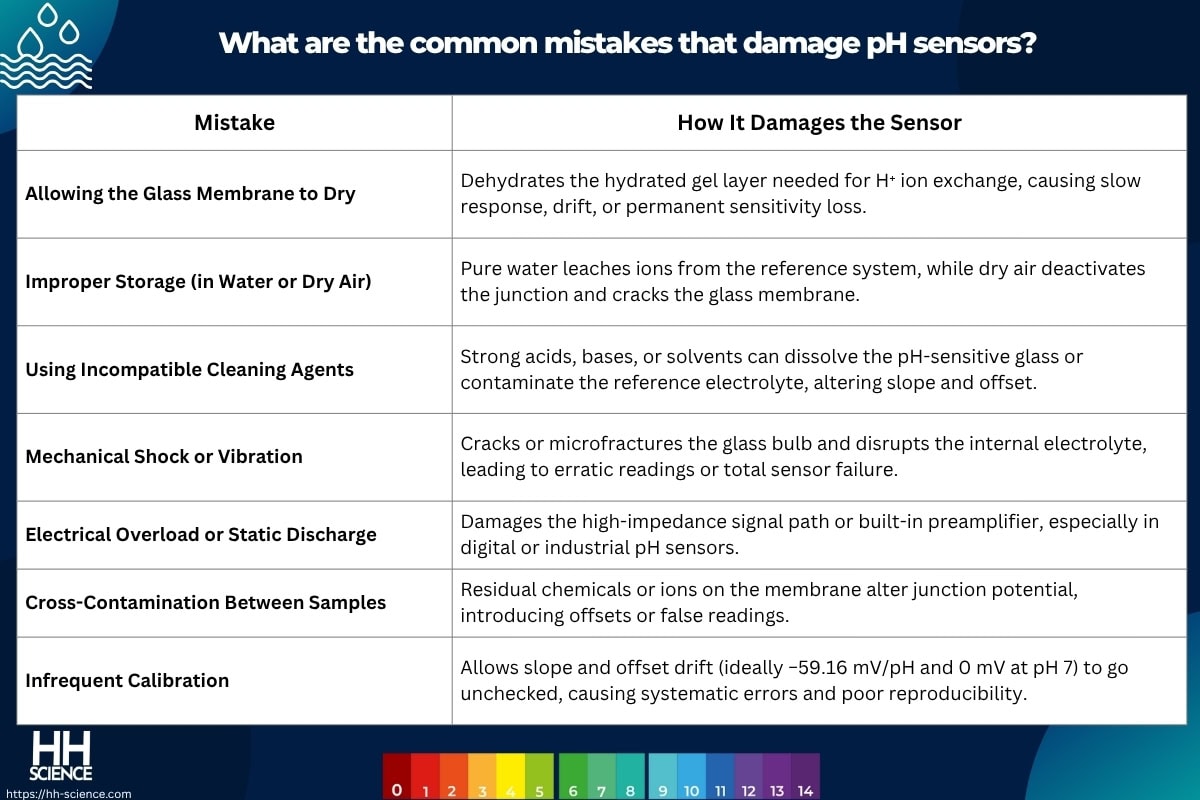
What are the common mistakes that damage pH sensors?
Common mistakes that damage pH sensors include drying of the glass membrane, improper storage, using incompatible cleaning agents, mechanical shock, electrical overloading, cross-contamination, and infrequent calibration, because each disrupts the hydration layer, reference junction stability, or electrical response, leading to inaccurate readings, slow response, or permanent electrode failure.
| Mistake | How It Damages the Sensor |
| Allowing the Glass Membrane to Dry | Dehydrates the hydrated gel layer needed for H⁺ ion exchange, causing slow response, drift, or permanent sensitivity loss. |
| Improper Storage (in Water or Dry Air) | Pure water leaches ions from the reference system, while dry air deactivates the junction and cracks the glass membrane. |
| Using Incompatible Cleaning Agents | Strong acids, bases, or solvents can dissolve the pH-sensitive glass or contaminate the reference electrolyte, altering slope and offset. |
| Mechanical Shock or Vibration | Cracks or microfractures the glass bulb and disrupts the internal electrolyte, leading to erratic readings or total sensor failure. |
| Electrical Overload or Static Discharge | Damages the high-impedance signal path or built-in preamplifier, especially in digital or industrial pH sensors. |
| Cross-Contamination Between Samples | Residual chemicals or ions on the membrane alter junction potential, introducing offsets or false readings. |
| Infrequent Calibration | Allows slope and offset drift (ideally −59.16 mV/pH and 0 mV at pH 7) to go unchecked, causing systematic errors and poor reproducibility. |
What are the additional features for the pH sensor?
A pH sensor can include several additional features such as temperature compensation, built-in temperature sensing, submersible and water-resistant designs, suitability for food or sanitary applications, resistance to desulfurization and denitrification processes, hydrofluoric acid compatibility, high-temperature-resistant membranes (HT), and low-temperature capability, all designed to ensure accurate, stable, and long-lasting performance under specific environmental or industrial conditions.
- Temperature Compensation: Automatically corrects the pH measurement according to the Nernst slope variation with temperature (≈ 0.198 mV/pH per °C), ensuring consistent accuracy in fluctuating thermal environments.
- Built-in Temperature Sensing: Integrates a Pt100/Pt1000 or NTC thermistor directly into the probe to provide real-time temperature data for automatic temperature compensation (ATC).
- Submersible and Water-Resistant Designs: Feature sealed bodies and reinforced cables for continuous immersion in tanks, open channels, or outdoor installations, protecting internal components from moisture and corrosion.
- Suitability for Food or Sanitary Applications: Made with FDA- and 3A-compliant materials, smooth surfaces, and CIP/SIP-compatible seals to ensure hygienic measurement in food, beverage, and pharmaceutical processes.
- Desulfurization & Denitrification Processes: Use anti-sulfide junctions and chemically resistant materials to prevent poisoning of the Ag/AgCl reference system in flue-gas treatment or wastewater plants.
- Hydrofluoric Acid Compatibility: Equipped with HF-resistant glass membranes that withstand etching or degradation from fluoride ions, suitable for semiconductor and chemical production.
- High-Temperature-Resistant Membrane (HT): Uses special glass formulations that tolerate continuous operation up to 130–150 °C, ideal for sterilization, autoclaving, or steam-in-place systems.
- Low-Temperature Capability: Maintains fast response and stable potential in cold or refrigerated processes (0–5 °C) by using low-resistance glass membranes optimized for low-ion mobility.

Applications and industries using pH sensors
pH sensors are widely used across many industries, including water and wastewater treatment, food and beverage production, chemical and pharmaceutical manufacturing, hydroponics and agriculture, environmental monitoring, pool and spa management, and metallurgy and mining, because controlling acidity or alkalinity is essential for process efficiency, product quality, and regulatory compliance.
- Water and Wastewater Treatment: Monitor and control neutralization, chlorination, and biological treatment processes to ensure effluent meets environmental discharge standards.
- Food and Beverage Production: Maintain optimal pH for fermentation, flavor consistency, and microbial safety in products such as beer, dairy, wine, and soft drinks.
- Chemical and Pharmaceutical Manufacturing: Ensure correct reaction conditions, buffer stability, and product purity in synthesis, formulation, and quality control.
- Hydroponics and Agriculture: Regulate nutrient availability and root-zone balance in soil-free systems or irrigation water to optimize plant growth and yield.
- Environmental Monitoring: Track pH levels in rivers, lakes, and groundwater to detect pollution, acid rain, or ecological imbalance.
- Pool and Spa Management: Automatically control disinfection and chemical dosing to maintain safe, comfortable, and corrosion-free water conditions.
- Metallurgy and Mining: Control leaching, electroplating, and wastewater neutralization processes where precise pH regulation affects metal recovery and environmental safety.


