
Why pH matters in wastewater applications?
pH matters in wastewater applications because it directly influences biological treatment performance, chemical reaction efficiency, pollutant removal, infrastructure integrity, safety, and regulatory compliance across municipal and industrial treatment processes.
- Biological treatment performance: pH controls the activity and survival of microorganisms responsible for BOD, COD, and nutrient removal.
- Chemical treatment efficiency: Coagulation, precipitation, and neutralization reactions depend on pH to achieve effective contaminant removal.
- Pollutant removal effectiveness: Key processes such as ammonia stripping, phosphorus removal, and metal precipitation are highly pH-dependent.
- Infrastructure protection: Extreme pH accelerates corrosion or scaling in tanks, pipes, and equipment, increasing maintenance and capital costs.
- Operational safety: Highly acidic or alkaline wastewater poses risks to personnel and downstream processes.
- Regulatory compliance: Discharge permits and environmental regulations specify allowable pH ranges, making accurate monitoring essential to avoid violations and penalties.
How does pH influence wastewater quality and safety?
pH influences wastewater quality and safety by controlling chemical speciation, biological activity, reaction efficiency, toxicity, and material stability throughout treatment and discharge processes. Deviations in pH can quickly shift wastewater from treatable to hazardous, affecting treatment performance, worker safety, and environmental compliance.
| Influence Area | How pH Affects Wastewater | Related Terms | Operational / Compliance Value |
| Biological treatment activity | pH determines microbial metabolism and survival | Activated sludge, nitrification, denitrification | Stable BOD/COD and nutrient removal |
| Toxicity of contaminants | pH changes chemical form and toxicity of pollutants | Ammonia toxicity, metal solubility | Protection of biomass and aquatic life |
| Chemical reaction efficiency | pH controls reaction rates and completeness | Coagulation, precipitation, neutralization | Effective pollutant removal |
| Nutrient removal performance | Optimal pH required for nitrogen and phosphorus processes | Ammonia stripping, phosphate precipitation | Improved effluent quality |
| Sludge characteristics | pH affects floc formation and settling | Sludge dewatering, flocculation | Better solids separation |
| Infrastructure integrity | Extreme pH accelerates corrosion or scaling | Concrete corrosion, scaling | Reduced maintenance and downtime |
| Worker and process safety | Very low or high pH creates hazardous conditions | Acidic/alkaline exposure | Safer plant operation |
| Discharge compliance | pH limits are enforced by permits | Effluent standards, discharge limits | Avoidance of fines and violations |
| Environmental impact | pH affects receiving water ecosystems | Aquatic toxicity, buffering capacity | Environmental protection |
| Process stability | Stable pH supports predictable treatment performance | Process control | Reliable plant operation |

Why are wastewater systems sensitive to pH deviations?
Wastewater systems are highly sensitive to pH deviations because biological processes, chemical reactions, and material stability all operate within limited pH windows, and wastewater streams often have low buffering capacity and rapidly changing composition. When pH is not properly controlled, it can inhibit or kill treatment microorganisms, increase toxicity of ammonia and metals, reduce chemical treatment efficiency, accelerate corrosion or scaling, disrupt sludge settling, cause permit violations, and ultimately increase operating costs, environmental risk, and regulatory exposure.
Typical pH ranges and control targets in wastewater applications
Typical pH ranges and control targets in wastewater applications define the operating windows required to maintain biological activity, optimize chemical treatment reactions, and meet discharge permit requirements. Establishing clear control targets provides a reference for process stability, early detection of upset conditions, and consistent regulatory compliance across variable influent and treatment stages.
Common pH ranges in wastewater
Common pH ranges in wastewater applications typically span pH 6.0–9.0, with tighter control windows applied at specific treatment stages because biological activity, chemical reactions, and discharge compliance are all pH-dependent. Different wastewater subcategories require different target ranges to protect microorganisms, maximize treatment efficiency, and meet regulatory limits.
| Wastewater Application / Process Stage | Typical pH Range | Why This Range Is Used | Operational / Compliance Value |
| Raw influent (municipal) | 6.0 – 8.5 | Reflects domestic wastewater variability without treatment | Baseline monitoring, upset detection |
| Biological treatment (activated sludge) | 6.5 – 8.0 | Optimal range for microbial metabolism | Stable BOD/COD removal |
| Nitrification processes | 7.0 – 8.0 | Nitrifying bacteria are highly pH-sensitive | Effective ammonia removal |
| Denitrification processes | 6.5 – 8.5 | Supports heterotrophic bacterial activity | Nitrogen reduction efficiency |
| Chemical phosphorus removal | 5.5 – 7.5 | Required for effective metal–phosphate precipitation | Improved phosphorus removal |
| Industrial wastewater (general) | 6.0 – 9.0 | Common permit and treatment acceptance range | Pretreatment compliance |
| Metal-containing industrial effluent | 8.0 – 10.0 (during treatment) | Promotes metal precipitation | Reduced dissolved metals |
| Neutralization systems | 6.5 – 8.5 | Brings acidic or alkaline streams to safe range | Process safety, downstream protection |
| Sludge treatment and conditioning | 6.0 – 8.0 | Affects floc structure and dewatering | Better solids handling |
| Final effluent discharge | 6.0 – 9.0 (permit-dependent) | Required by environmental regulations | Legal discharge compliance |
| Receiving water protection zones | Permit-specific (often 6.5 – 8.5) | Protects aquatic ecosystems | Environmental safeguarding |

Factors that define pH control targets
pH control targets in wastewater applications are defined by treatment process requirements, influent variability, biological tolerance, chemical reaction conditions, infrastructure materials, discharge regulations, and environmental protection goals, because wastewater systems must balance process efficiency with safety and compliance.
- Treatment process requirements: Each treatment stage (biological, chemical, physical) has an optimal pH range for effective performance.
- Influent variability: Fluctuations in industrial and domestic inputs require pH targets that can absorb shocks without process failure.
- Biological tolerance: Microorganisms used in treatment operate within narrow pH windows.
- Chemical reaction conditions: Coagulation, precipitation, and neutralization depend on pH-dependent chemistry.
- Infrastructure materials: Pipes, tanks, and equipment have pH limits to avoid corrosion or scaling.
- Discharge regulations: Permits define allowable pH ranges for treated effluent.
- Environmental protection goals: pH limits protect receiving waters and aquatic ecosystems.
What happens when pH is out of range in wastewater applications?
When pH is out of range in wastewater applications, it can cause biological process inhibition, increased toxicity, chemical treatment failure, sludge settling problems, infrastructure damage, safety hazards, and regulatory non-compliance, because wastewater treatment relies on tightly pH-dependent biological and chemical mechanisms.
| Impact Area | Typical pH Condition | Why It Happens | Operational / Compliance Risk |
| Biological treatment failure | Low pH < 6.0 or High pH > 9.0 | Microorganisms are inhibited or killed outside tolerance range. | Loss of BOD/COD and nutrient removal |
| Nitrification inhibition | pH < 6.5 | Nitrifying bacteria are highly pH-sensitive. | Elevated ammonia in effluent |
| Increased ammonia toxicity | High pH > 8.5 | Higher fraction of toxic free ammonia (NH3). | Biomass damage, aquatic toxicity |
| Metal solubility increase | Low pH < 6.0 | Metals remain dissolved instead of precipitating. | Toxic effluent, permit violations |
| Poor chemical precipitation | Outside target pH window | Reactions become incomplete or inefficient. | High phosphorus or metal residuals |
| Sludge settling problems | Low or high pH | Floc structure and charge balance are disrupted. | Poor clarification, solids carryover |
| Corrosion of infrastructure | Low pH < 6.0 | Acidic conditions attack concrete and metals. | Asset damage, higher maintenance cost |
| Scaling and deposition | High pH > 9.0 | Carbonates and hydroxides precipitate. | Blockages, reduced hydraulic capacity |
| Worker safety hazards | Extreme pH (< 5 or > 10) | Increased chemical exposure risk. | Health and safety incidents |
| Discharge permit violations | Outside permit range (often 6.0–9.0) | Regulatory limits are exceeded. | Fines, enforcement actions |

Effects of low pH in wastewater applications
Low pH in wastewater applications causes biological inhibition, increased metal solubility, infrastructure corrosion, poor sludge settling, chemical treatment inefficiency, safety risks, and regulatory non-compliance, because acidic conditions disrupt both biological and chemical equilibria essential to wastewater treatment.
| Effect | Why It Occurs at Low pH | Operational / Compliance Impact |
| Inhibition of biological treatment | Acidic conditions suppress microbial metabolism | Reduced BOD/COD and nutrient removal |
| Nitrification failure | Nitrifying bacteria are highly sensitive to acidic pH | Elevated ammonia in effluent |
| Increased metal solubility | Metals remain dissolved rather than precipitating | Toxic effluent, permit violations |
| Corrosion of pipes and tanks | Acids accelerate corrosion of concrete and metals | Asset damage, higher maintenance cost |
| Poor sludge flocculation | Charge balance of flocs is disrupted | Poor settling, solids carryover |
| Inefficient chemical treatment | Coagulation and precipitation reactions fail | Higher chemical consumption, poor removal |
| Increased H₂S release | Acidic conditions favor hydrogen sulfide formation | Odor issues, safety hazards |
| Worker safety risks | Acidic wastewater increases exposure hazards | Health and safety incidents |
| Discharge non-compliance | Effluent falls below permitted pH limits | Fines, enforcement actions |

Effects of high pH in wastewater applications
High pH in wastewater applications leads to biological inhibition, increased ammonia toxicity, scaling and precipitation, reduced chemical treatment efficiency, sludge handling problems, safety hazards, and regulatory non-compliance, because alkaline conditions alter chemical speciation, disrupt biological activity, and promote unwanted mineral formation.
| Effect | Why It Occurs at High pH | Operational / Compliance Impact |
| Inhibition of biological treatment | Elevated pH stresses or inactivates microorganisms | Reduced BOD/COD removal efficiency |
| Increased ammonia toxicity | Higher pH shifts ammonium (NH₄⁺) to toxic free ammonia (NH₃) | Biomass damage, aquatic toxicity |
| Scaling and precipitation | Carbonates and hydroxides precipitate at high pH | Pipe blockages, reduced hydraulic capacity |
| Reduced chemical treatment efficiency | Coagulation and precipitation chemistry becomes less effective | Poor phosphorus and metal removal |
| Sludge settling and dewatering issues | Floc structure and particle interactions are disrupted | Poor clarification, higher solids carryover |
| Damage to membranes and equipment | Alkalinity accelerates material degradation | Shortened equipment lifespan |
| Increased odor and gas release | High pH affects gas–liquid equilibrium | Odor complaints, safety concerns |
| Worker safety risks | Alkaline wastewater increases chemical burn risk | Health and safety incidents |
| Discharge non-compliance | Effluent exceeds permitted pH limits | Fines, enforcement actions |

Operational, quality, and compliance risks
When pH is out of range in wastewater applications, operational, quality, and compliance risks escalate simultaneously because pH sits at the intersection of biological performance, chemical treatment efficiency, and regulatory control.
- Operational risks: pH excursions disrupt biological reactors, reduce chemical reaction efficiency, increase chemical consumption, accelerate corrosion or scaling, and drive unplanned interventions, raising OPEX and downtime.
- Quality risks: Incorrect pH degrades effluent quality by impairing BOD/COD removal, nutrient reduction, metal precipitation, and sludge settling, leading to unstable process performance and variable discharge quality.
- Compliance risks: Wastewater permits strictly define allowable pH ranges, so sustained deviations trigger violations, fines, reporting obligations, or forced discharge shutdowns, directly impacting plant reliability and regulatory standing.
pH measurement challenges in wastewater application
pH measurement challenges in wastewater applications arise from harsh, variable process conditions including high solids, biological activity, chemical dosing, and fluctuating temperature and flow. Understanding these challenges is essential for selecting robust sensor technologies, appropriate installation methods, and maintenance strategies that ensure reliable pH control, process stability, and regulatory compliance in real-world wastewater environments.
Temperature effects
Temperature effects are a significant pH measurement challenge in wastewater applications because temperature directly influences electrode response, chemical equilibria, and biological reaction rates in systems with highly variable thermal conditions. Fluctuating or extreme temperatures can cause apparent pH drift, slow sensor response, and misinterpretation of process conditions if temperature compensation, sensor design, and installation are not properly matched to the application.
| Temperature Condition | How It Affects pH Measurement | Related Terms | Operational / Process Value |
| Influent temperature variation | Changes electrode slope and signal stability. | Nernst equation, temperature coefficient | Measurement consistency during load changes |
| Poor temperature compensation | Causes mismatch between true and measured pH. | ATC, compensation error | False alarms or missed excursions |
| Cold wastewater (< 10 °C) | Increases electrode impedance and response time. | High-impedance glass | Slow stabilization, delayed control actions |
| Warm or hot wastewater (> 35 °C) | Accelerates sensor aging and reference drift. | Glass hydration, reference depletion | Shortened sensor lifespan |
| Seasonal temperature shifts | Gradual baseline drift in pH trends. | Seasonal variation, trend analysis | Misinterpretation of process performance |
| Temperature gradients in tanks | Sensor reads local rather than bulk conditions. | Thermal stratification | Non-representative measurements |
| Exothermic chemical dosing | Localized temperature spikes near injection points. | Neutralization heat | Temporary signal distortion |
| Biological process heat | Microbial activity alters local temperature. | Bioreactor kinetics | Coupled pH–process instability |

Fouling and contamination
Fouling and contamination are major pH measurement challenges in wastewater applications because sensors are continuously exposed to solids, biological growth, oils, grease, and chemical residues that can interfere with electrode surfaces and reference junctions. These conditions distort ion exchange, slow response time, increase drift, and reduce measurement reliability, making pH control more difficult in processes where accuracy directly affects treatment efficiency and compliance.
| Fouling / Contamination Source | How It Affects pH Measurement | Related Terms | Operational / Process Value |
| Suspended solids | Coat glass membrane and block ion exchange. | TSS, boundary layer effects | Slower response, reduced accuracy |
| Biofilm growth | Creates diffusion barriers and reference blockage. | Biological fouling, biofouling | Increased drift, frequent cleaning |
| Grease and oils | Hydrophobic films isolate electrode surface. | FOG (fats, oils, grease) | Erratic readings, signal loss |
| Chemical precipitates | Deposit on glass or junction surfaces. | Scaling, precipitation | Measurement bias, clogging |
| Sludge carryover | Abrasive contact damages sensitive surfaces. | Sludge abrasion | Shortened sensor lifespan |
| Industrial contaminants | Introduce aggressive or reactive species. | Solvents, heavy metals | Rapid sensor degradation |
| Inadequate cleaning | Residues remain after maintenance. | Maintenance residue | Persistent measurement error |
| Reference junction clogging | Limits electrolyte flow. | Junction poisoning | Loss of reference stability |

Pressure and flow conditions
Pressure and flow conditions are a major pH measurement challenge in wastewater applications because variable hydraulics, turbulence, and solids loading directly affect sensor exposure, signal stability, and mechanical integrity. Fluctuating flow rates and pressure changes can create non-representative readings, accelerate sensor wear, and introduce noise or air interference that undermines reliable pH control in treatment and compliance-critical processes.
| Pressure / Flow Condition | How It Affects pH Measurement | Related Terms | Operational / Process Value |
| High flow velocity | Increases shear forces on the electrode surface | Turbulence, shear stress | Signal noise, reduced accuracy |
| Low or stagnant flow | Limits ion exchange at the glass membrane | Boundary layer thickening | Slow response, apparent drift |
| Rapid flow fluctuations | Cause unstable sensor wetting and exposure | Hydraulic shock | Erratic readings |
| Pressure surges | Stress sensor seals and reference systems | Pressure shock, mechanical stress | Increased failure risk |
| Air entrainment / bubbles | Interrupt electrode–water contact | Cavitation, gas interference | Spikes and false alarms |
| Solids-laden high flow | Abrasive wear on glass and junction | TSS abrasion | Shortened sensor lifespan |
| Improper mounting angle | Traps air or solids around sensor tip | Installation geometry | Non-representative measurements |
| Chemical dosing near sensor | Creates localized flow and pressure changes | Injection turbulence | Distorted local pH values |

Chemical exposure
Chemical exposure is a significant pH measurement challenge in wastewater applications because sensors are routinely exposed to aggressive disinfectants, corrosion inhibitors, acids, alkalis, and treatment chemicals used for neutralization, odor control, and process optimization. These chemicals can alter electrode surfaces, poison reference junctions, accelerate sensor aging, and create localized pH gradients, leading to drift, slow response, or misleading readings if sensor design and placement are not properly matched to the application.
| Chemical Exposure Source | How It Affects pH Measurement | Related Terms | Operational / Process Value |
| Strong acids and bases | Cause rapid chemical attack on glass and seals | Neutralization chemicals, pH shock | Accelerated sensor wear, drift |
| Disinfectants (chlorine, hypochlorite) | Oxidize reference junctions and internal components | Oxidative stress, chlorine attack | Reduced sensor lifespan |
| Corrosion inhibitors | Form films on glass and junction surfaces | Passivation layers | Slower response, bias |
| Lime and caustic dosing | Create localized high-pH zones near injection points | Caustic carryover | Non-representative measurements |
| Ferric or aluminum salts | Promote precipitation and fouling on sensors | Coagulants, scaling | Increased maintenance frequency |
| Industrial wastewater chemicals | Introduce solvents or reactive species | Solvent exposure, toxicity | Rapid sensor degradation |
| Cleaning-in-place (CIP) chemicals | Stress materials during maintenance cycles | CIP exposure | Shortened service life |
| Chemical overdosing events | Create extreme pH excursions | Process upset | Measurement instability, alarms |

Bio-load or process residues
Bio-load and process residues are persistent pH measurement challenges in wastewater applications because high biological activity and residual organics continuously interact with sensor surfaces and reference systems. Biomass, extracellular polymers, and process by-products can coat electrodes, block junctions, and alter local chemistry, causing drift, slow response, and loss of representativeness—especially in aeration basins, sludge handling, and side-stream processes.
| Bio-load / Residue Source | How It Affects pH Measurement | Related Terms | Operational / Process Value |
| Activated sludge biomass | Coats glass membrane and junction | MLSS, EPS | Slower response, reduced accuracy |
| Biofilm formation | Creates diffusion barriers and junction clogging | Biofouling, boundary layer | Increased drift, frequent cleaning |
| Extracellular polymers (EPS) | Sticky films trap solids and chemicals | EPS, fouling matrix | Persistent bias, maintenance burden |
| Organic load fluctuations | Rapid changes in local chemistry near sensor | BOD/COD variability | Noisy signals, misinterpretation |
| Sludge carryover | Abrasive contact damages glass and seals | Sludge abrasion | Shortened sensor lifespan |
| Grease and scum | Hydrophobic layers isolate electrode | FOG | Erratic readings, signal loss |
| Side-stream residues (digesters) | High ammonia/alkalinity alters local pH | Sidestream treatment | Non-representative measurements |
| Post-maintenance residues | Incomplete rinsing leaves films | Maintenance residue | Temporary instability after service |

Common pH sensor types used in wastewater applications
Common pH sensor types used in wastewater applications include robust combination pH sensors, differential pH sensors, and digital or smart pH sensors, selected to withstand harsh process conditions while maintaining reliable measurement. These sensors are deployed in inline, immersion, or portable configurations to balance durability, fouling resistance, maintenance effort, and data quality, ensuring stable process control and regulatory compliance across variable wastewater environments.
Combination pH sensors
Combination pH sensors are widely used in wastewater applications because they integrate the measuring electrode and reference electrode into a single, robust body that can tolerate variable pH, high solids, biological activity, and frequent chemical exposure. Their relatively simple construction, wide availability, and compatibility with aggressive environments make them a practical choice for continuous monitoring, control loops, and compliance points in municipal and industrial wastewater treatment.
| Feature | Description | Value in Wastewater Applications |
| Integrated measuring and reference electrode | Single-body design combining pH and reference | Simplified installation and replacement |
| Wide pH operating range | Designed to handle acidic and alkaline wastewater | Suitable for influent, neutralization, and effluent |
| Rugged glass membrane | Thicker, impact-resistant glass | Improved durability in solids-rich streams |
| Double or open reference junction | Reduces clogging from sludge and biofilm | More stable readings, longer service intervals |
| Chemical-resistant materials | Housing and seals resist acids, bases, and disinfectants | Extended lifespan in harsh environments |
| Fast response time | Responds quickly to pH changes | Effective process control and alarms |
| Cost-effective design | Lower initial cost compared to advanced sensors | Economical for multiple monitoring points |
| Broad transmitter compatibility | Works with most analog pH transmitters | Easy integration into existing systems |

Differential pH sensors
Differential pH sensors are used in wastewater applications where conventional reference electrodes struggle with fouling, clogging, or chemical poisoning. By eliminating the liquid junction and measuring pH using two matched electrodes, differential sensors provide improved stability and reduced maintenance in high-solids, biologically active, and chemically aggressive wastewater environments.
| Feature | Description | Value in Wastewater Applications |
| Differential measurement principle | Uses two matched electrodes instead of a liquid reference | Stable readings in fouling-prone conditions |
| No liquid junction | Eliminates junction clogging by sludge or biofilm | Reduced maintenance and downtime |
| High resistance to fouling | Less affected by solids, grease, and biofilms | Reliable long-term monitoring |
| Reduced reference drift | Reference stability independent of electrolyte | Improved trend reliability |
| Suitable for harsh chemistry | Performs well in wastewater with disinfectants and coagulants | Extended sensor life |
| Consistent response in variable flow | Less sensitive to hydraulic changes | More representative measurements |
| Higher initial cost | More complex construction | Lower total cost of ownership in difficult applications |
| Ideal for critical points | Used where sensor access is limited or maintenance is costly | Increased operational confidence |

Digital or smart pH sensors
Digital or smart pH sensors are increasingly used in wastewater applications because they improve measurement reliability, diagnostics, and maintenance efficiency in harsh, variable process conditions. By digitizing the signal at the sensor and embedding diagnostics and calibration data, they reduce noise, simplify asset management, and support compliance documentation in plants with limited maintenance windows.
| Feature | Description | Value in Wastewater Applications |
| Digital signal processing at sensor | Converts high-impedance analog signal to digital locally | Reduced electrical noise and signal distortion |
| Built-in sensor diagnostics | Monitors impedance, response time, and reference condition | Early detection of fouling or sensor failure |
| Stored calibration data | Calibration history stored in sensor memory | Faster replacement, improved traceability |
| Predictive maintenance indicators | Estimates remaining sensor life | Reduced unplanned downtime |
| Plug-and-play replacement | Automatic recognition by compatible transmitters | Faster commissioning and lower labor cost |
| Long cable immunity | Digital signals unaffected by cable length or EMI | Flexible installation across large plants |
| Data integrity support | Secure data transmission and logging | Compliance and audit confidence |
| Integration with control systems | Seamless connection to PLCs and SCADA | Improved process control visibility |

Inline, immersion, or portable configurations
Inline, immersion, or portable pH sensor configurations are used in wastewater applications to match highly variable process conditions, accessibility constraints, and monitoring objectives across treatment stages. Selecting the right configuration ensures representative measurement, minimizes fouling and damage risk, and balances continuous control needs with operational flexibility and maintenance practicality.
| Configuration | Description | Typical Use Cases | Value in Wastewater Applications |
| Inline configuration | Sensor installed directly in a pipe or flow-through housing | Effluent discharge lines, neutralization systems | Continuous compliance monitoring and process control |
| Immersion configuration | Sensor submerged in open tanks or basins | Aeration tanks, equalization basins, clarifiers | Direct measurement in high-volume, variable processes |
| Portable configuration | Handheld meter with removable pH probe | Spot checks, troubleshooting, compliance verification | Independent validation and rapid diagnostics |
| Flow-through (bypass) cells | Sidestream sampling with controlled flow | High-solids or chemically aggressive streams | Improved stability and easier maintenance |
| Retractable assemblies | Sensor can be withdrawn under pressure | Pressurized lines or difficult-access locations | Safe servicing without process shutdown |
| Temporary installations | Short-term deployment during investigations | Process optimization or upset analysis | Flexibility without permanent modification |
| Redundant configurations | Multiple sensors at critical points | Compliance-critical discharge locations | Risk reduction and data confidence |

Installation and maintenance considerations in wastewater applications
Installation and maintenance considerations are critical in wastewater applications because pH sensors operate in harsh environments characterized by high solids, biological fouling, chemical dosing, and hydraulic variability. Proper installation location, protective mounting, accessible cleaning design, and realistic maintenance intervals ensure reliable pH measurement, protect sensor lifespan, and support stable process control and regulatory compliance.
Typical installation locations
Typical installation locations for pH sensors in wastewater applications are selected to support process control, protect downstream equipment, and ensure regulatory compliance across highly variable treatment stages. Placement balances representativeness, fouling risk, accessibility, and measurement purpose (control vs. monitoring vs. compliance).
| Installation Location | Description | Key Features | Value in Wastewater Applications |
| Influent channels | Upstream of treatment processes | High variability, early warning | Detects acidic/alkaline shocks and industrial discharges |
| Equalization basins | Mixed influent prior to treatment | Dampened fluctuations | Stable control reference for downstream processes |
| Neutralization tanks | Acid/alkali dosing points | Strong pH gradients | Direct control of pH adjustment |
| Aeration basins | Biological treatment zones | High bio-load, mixing | Protects microbial activity and nitrification |
| Chemical treatment stages | Coagulation or precipitation zones | Chemical exposure | Optimizes chemical dosing efficiency |
| Sludge handling processes | Thickening and dewatering units | High solids content | Improves sludge conditioning and settling |
| Sidestream treatment lines | Return flows (e.g., digester supernatant) | High ammonia and alkalinity | Prevents process upset in main line |
| Final effluent discharge | Outlet before release to environment | Compliance-critical | Ensures permit pH limits are met |
| Industrial pretreatment outlets | Before discharge to municipal system | Variable industrial chemistry | Protects downstream infrastructure |
| Bypass or sample lines | Controlled sidestream measurement | Easier access and cleaning | Improved reliability and maintenance safety |

Calibration and cleaning frequency
Calibration and cleaning frequency in wastewater applications are driven by process criticality, fouling intensity, chemical exposure, biological load, and regulatory requirements, because harsh and variable conditions accelerate sensor drift and contamination. Properly defined intervals maintain measurement accuracy, protect process control loops, and ensure defensible compliance data.
| Wastewater Application / Condition | Typical Calibration Frequency | Typical Cleaning Frequency | Key Influencing Features | Operational / Compliance Value |
| Influent monitoring | Weekly to monthly | Weekly or as needed | High variability, solids, shock loads | Early detection of abnormal discharges |
| Equalization basins | Monthly | Weekly to biweekly | Mixed influent, moderate fouling | Stable reference for downstream control |
| Neutralization tanks | Weekly | Weekly or more frequent | Strong pH swings, chemical dosing | Accurate pH control, chemical optimization |
| Aeration basins | Monthly | Weekly to biweekly | High bio-load, biofouling | Protects biological treatment performance |
| Chemical treatment stages | Weekly to monthly | Weekly | Coagulants, precipitates | Efficient chemical dosing |
| Sludge handling processes | Monthly | Weekly or frequent | High solids, abrasion | Reliable sludge conditioning |
| Sidestream treatment lines | Weekly to monthly | Weekly | High ammonia, alkalinity | Prevents main-process upset |
| Final effluent discharge | Monthly (permit-driven) | Biweekly to monthly | Compliance-critical, lower fouling | Regulatory confidence |
| Industrial pretreatment outlets | Weekly to monthly | Weekly | Aggressive chemistry, variability | Downstream protection |
| Portable pH measurements | Before each use | After each use | Handling and exposure | Trustworthy spot checks |

Expected sensor lifespan
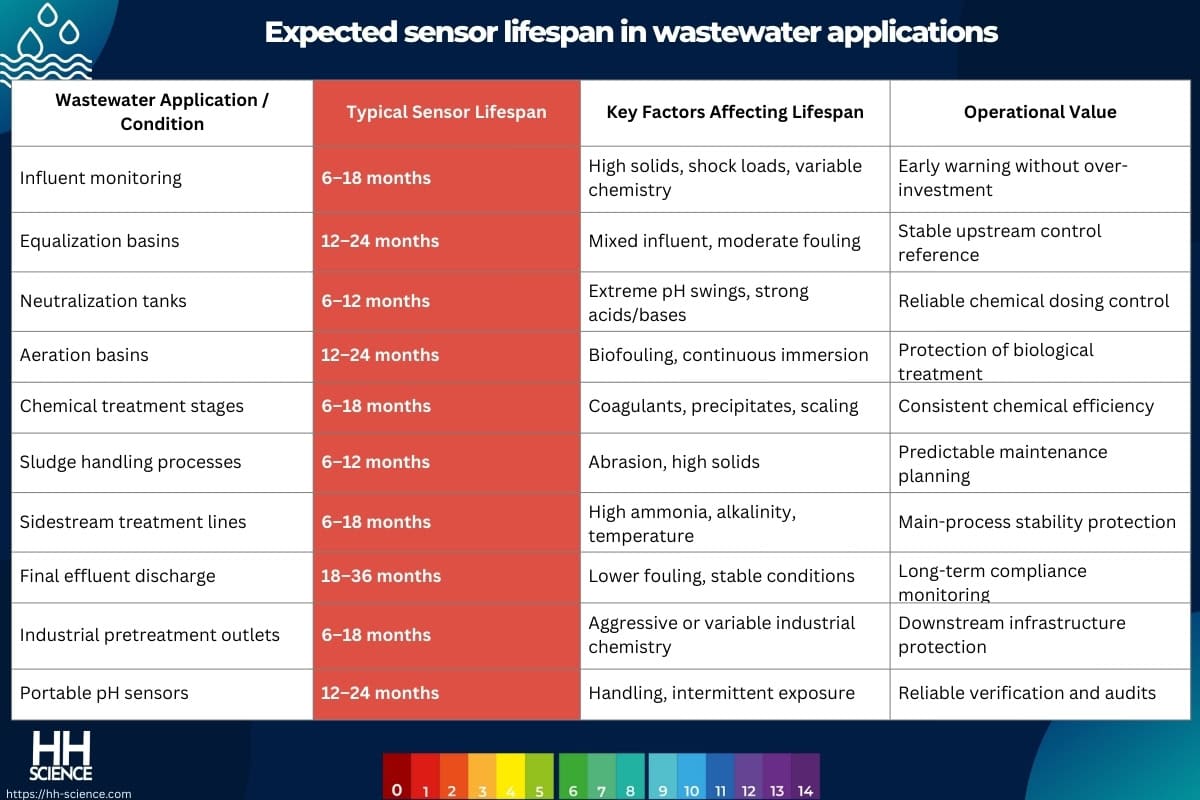
Expected pH sensor lifespan in wastewater applications depends on process severity, fouling load, chemical exposure, installation configuration, and maintenance discipline, because wastewater environments place continuous mechanical, chemical, and biological stress on sensors. Understanding realistic lifespan expectations helps operators plan replacements, control maintenance cost, and avoid unexpected measurement failure at compliance-critical points.
| Wastewater Application / Condition | Typical Sensor Lifespan | Key Factors Affecting Lifespan | Operational Value |
| Influent monitoring | 6–18 months | High solids, shock loads, variable chemistry | Early warning without over-investment |
| Equalization basins | 12–24 months | Mixed influent, moderate fouling | Stable upstream control reference |
| Neutralization tanks | 6–12 months | Extreme pH swings, strong acids/bases | Reliable chemical dosing control |
| Aeration basins | 12–24 months | Biofouling, continuous immersion | Protection of biological treatment |
| Chemical treatment stages | 6–18 months | Coagulants, precipitates, scaling | Consistent chemical efficiency |
| Sludge handling processes | 6–12 months | Abrasion, high solids | Predictable maintenance planning |
| Sidestream treatment lines | 6–18 months | High ammonia, alkalinity, temperature | Main-process stability protection |
| Final effluent discharge | 18–36 months | Lower fouling, stable conditions | Long-term compliance monitoring |
| Industrial pretreatment outlets | 6–18 months | Aggressive or variable industrial chemistry | Downstream infrastructure protection |
| Portable pH sensors | 12–24 months | Handling, intermittent exposure | Reliable verification and audits |
Trade-offs between accuracy, maintenance, and durability
In wastewater applications, trade-offs between accuracy, maintenance, and durability arise because high-accuracy pH sensors with sensitive glass and tight tolerances provide better process control but are more vulnerable to fouling, abrasion, and chemical attack. More rugged sensor designs reduce maintenance frequency and downtime in harsh environments but may sacrifice response speed or resolution, making application-specific balancing essential to achieve reliable control, regulatory compliance, and optimized total cost of ownership.
Regulatory or quality considerations in wastewater applications
Regulatory and quality considerations in wastewater applications are critical because pH is a permit-regulated discharge parameter directly tied to environmental protection, public safety, and treatment plant authorization. Accurate, continuous, and well-documented pH monitoring supports compliance with discharge permits, pretreatment requirements, and environmental regulations while reducing the risk of violations, enforcement actions, and unplanned operational shutdowns.
Industry and wastewater quality standards in wastewater applications
Industry and wastewater quality standards define allowable pH ranges, monitoring practices, documentation requirements, and enforcement mechanisms to protect receiving waters, infrastructure, and public health. These standards exist because pH directly affects pollutant toxicity, biological treatment performance, and environmental impact, making it a core compliance parameter in municipal and industrial wastewater management.
| Standard / Regulation | Scope / Region | Why It Matters for Wastewater pH | Related Terms | Compliance / Operational Value | Key Features |
| NPDES (Clean Water Act) | United States | Sets enforceable effluent pH limits for discharges | Discharge permits, effluent limits | Legal authorization to discharge | Permit-specific pH range (often 6.0–9.0) |
| EPA Pretreatment Standards | United States | Protects municipal systems from harmful industrial discharges | Industrial pretreatment | Infrastructure and process protection | pH limits for indirect dischargers |
| EU Urban Waste Water Treatment Directive (UWWTD) | European Union | Regulates wastewater treatment and discharge quality | Environmental protection | Harmonized compliance across EU | Member-state enforced pH limits |
| EU Industrial Emissions Directive (IED) | European Union | Controls industrial wastewater impacts | BAT, BREF | Reduced environmental risk | Industry-specific pH controls |
| ISO 5667 (Water Quality – Sampling) | International | Defines representative sampling and handling | Sampling integrity | Reliable compliance data | Standardized monitoring practices |
| ISO 9001 / ISO 14001 | International | Requires controlled monitoring and documentation | Quality management, EMS | Audit readiness | Process and record control |
| Local discharge permits | Global / Local | Translate regulations into site-specific pH limits | Permit conditions | Day-to-day compliance | Enforceable numeric ranges |
| Receiving water standards | Regional authorities | Protect aquatic ecosystems | Water quality criteria | Environmental safeguarding | Ecosystem-based pH targets |
| Industrial sector guidelines | Industry-specific | Address unique wastewater chemistry | Sector BAT | Optimized treatment | Tailored pH limits |
| Customer and municipal agreements | Contractual | Define acceptance criteria for wastewater | Trade effluent agreements | Business continuity | Contractually binding pH limits |

Internal process and quality requirements in wastewater applications
Internal process and quality requirements in wastewater applications define how pH is measured, controlled, documented, and acted upon to ensure stable treatment performance and continuous regulatory compliance, because influent variability and harsh conditions can quickly destabilize processes. These requirements translate external permits and environmental obligations into daily operating discipline that reduces risk, controls cost, and protects downstream systems.
| Internal Requirement | Why It Is Required | Related Terms | Operational / Compliance Value | Key Features |
| Defined internal pH control limits | Tighter internal limits prevent permit exceedance | Control bands, setpoints | Early upset prevention | Warning and action thresholds |
| Standard operating procedures (SOPs) | Ensure consistent response to pH deviations | SOPs, work instructions | Repeatable operations | Documented actions and responsibilities |
| Calibration and maintenance schedules | Maintain measurement accuracy in harsh conditions | Calibration intervals, PM | Reliable data for control and compliance | Planned service routines |
| Alarm management and escalation | Enable rapid corrective action | Alarm limits, escalation | Reduced downtime and violations | Defined response hierarchy |
| Chemical dosing control logic | Stabilize pH during neutralization | PID control, feed-forward | Optimized chemical use | Automated adjustment |
| Data logging and retention | Support audits and investigations | Data integrity, records | Audit defensibility | Secure long-term storage |
| Trend analysis and performance review | Detect gradual drift or process degradation | Trend monitoring, KPIs | Predictive maintenance | Historical analysis |
| Change management procedures | Control impacts of process changes | MOC, validation | Reduced unintended upsets | Documented approvals |
| Operator training and competency | Ensure correct interpretation and action | Training records | Reduced human error | Regular training updates |
| Internal audits and reviews | Verify adherence to requirements | QA/QC review | Continuous improvement | Periodic assessments |
| Emergency response protocols | Manage extreme pH events safely | Spill response, HAZMAT | Safety and compliance protection | Predefined emergency steps |

Compliance-driven monitoring needs in wastewater applications
Compliance-driven monitoring needs in wastewater applications include continuous pH monitoring, defined alarm limits, traceable calibration, data integrity, reporting capability, verification measurements, redundancy at critical points, and documented response procedures, because pH is a permit-regulated parameter with direct environmental and legal consequences. These needs exist to ensure timely detection of excursions, defensible compliance evidence, and consistent corrective action across variable influent and process conditions.
| Monitoring Need | Why It Is Required | Related Terms | Compliance / Operational Value | Key Features |
| Continuous pH monitoring | Detects real-time excursions before permit exceedance | Online monitoring, real-time control | Immediate compliance assurance | Inline/immersion sensors, live data |
| Defined alarm limits | Triggers action before violations occur | Alarm thresholds, setpoints | Rapid corrective response | Configurable alarms, escalation |
| Traceable calibration records | Proves measurement accuracy during audits | Calibration traceability | Audit defensibility | Time-stamped logs, certificates |
| Data integrity and security | Prevents loss or manipulation of records | Data integrity, access control | Regulatory trust | Secure storage, user permissions |
| Historical data retention | Supports inspections and investigations | Recordkeeping, archiving | Proof of ongoing compliance | Long-term data archives |
| Standardized reporting | Meets regulatory reporting obligations | Effluent reports, permits | Legal conformity | Automated report generation |
| Verification and cross-checks | Confirms online sensor reliability | Grab samples, validation | Reduced compliance risk | Portable meters, lab comparison |
| Redundancy at critical points | Maintains monitoring during sensor failure | Backup sensors | Risk mitigation | Parallel measurement points |
| Change tracking and documentation | Links pH shifts to process changes | Change management | Transparency and root cause | Logged changes, approvals |
| Documented response procedures | Ensures consistent corrective actions | SOPs, CAPA | Controlled recovery | Predefined response plans |

Selecting the right pH measurement approach in wastewater applications
Selecting the right pH measurement approach in wastewater applications is critical because sensors must deliver reliable data under highly variable conditions involving solids, biological activity, chemical dosing, and hydraulic fluctuations. Aligning sensor technology, installation configuration, maintenance strategy, and data management with process severity and compliance risk ensures stable treatment performance, optimized chemical usage, and defensible regulatory compliance.
Decision support for wastewater applications
Decision support translates wastewater-specific requirements—such as influent variability, solids loading, chemical dosing intensity, biological sensitivity, and permit limits—into clear pH measurement criteria. By evaluating factors like sensor robustness, fouling resistance, maintenance capacity, data traceability, and total cost of ownership, decision support reduces selection risk and ensures pH monitoring supports both process stability and regulatory compliance.
Application-driven measurement strategies
Application-driven measurement strategies align pH monitoring methods with specific wastewater treatment stages, such as influent screening, neutralization, biological treatment, or final discharge. This approach ensures that sensor type, configuration, placement, and maintenance frequency reflect real operating conditions, delivering representative data that supports effective control actions rather than unreliable or misleading measurements.
Linking wastewater applications to sensor selection and oem solutions
Linking wastewater applications to sensor selection and OEM solutions connects process challenges directly to optimized sensor designs, materials, and integration options. This enables tailored solutions—such as abrasion-resistant housings, open junction references, differential measurement, digital diagnostics, or custom mounting assemblies—that improve durability, reduce maintenance burden, and maximize long-term performance and compliance value across diverse wastewater environments.


