
Why pH matters in swimming pools and spas?
In swimming pools and spas, pH directly affects disinfection efficiency, bather safety and comfort, corrosion control, scaling prevention, chemical consumption, regulatory compliance, and overall system performance, making it one of the most critical control parameters in recreational water treatment.
- Disinfection efficiency: pH determines the balance between hypochlorous acid (HOCl) and hypochlorite ion (OCl⁻), where lower pH within the recommended range (7.2–7.6) increases HOCl availability and maximizes microbial inactivation value.
- Bather safety and comfort: Improper pH can cause eye irritation, skin dryness, mucous membrane discomfort, and reduced bathing experience, directly impacting user satisfaction and facility reputation.
- Corrosion control: Low pH increases water aggressiveness, accelerating corrosion of metal components such as heat exchangers, ladders, pumps, and stainless-steel fittings, thereby raising maintenance and replacement costs.
- Scaling prevention: High pH promotes calcium carbonate precipitation, increasing scaling risk on tiles, filters, heaters, and sensors, which reduces heat transfer efficiency and flow performance.
- Chemical consumption: Off-range pH leads to inefficient sanitizer performance, requiring higher chlorine dosing to achieve the same oxidation-reduction potential (ORP) target, increasing operational expenditure.
- Regulatory compliance: Health authorities and pool standards typically mandate strict pH control ranges to ensure safe public operation and documented water quality performance.
- Overall system performance: Stable pH supports optimized alkalinity balance, consistent ORP control, extended sensor lifespan, and predictable automated dosing system behavior, improving long-term operational reliability and total cost of ownership.
How does pH influence swimming pools and spas quality and safety?
In swimming pools and spas, pH directly governs microbial control efficiency, chemical stability, material durability, user safety, and regulatory conformity by influencing the balance of disinfectant species, carbonate chemistry equilibrium, saturation index, oxidation-reduction potential (ORP), and overall water aggressiveness; deviations from the recommended range (typically 7.2–7.6) can reduce pathogen inactivation rates, accelerate corrosion, promote scale formation, increase chemical demand, and compromise both operational safety and cost efficiency.
| Influence Factor | How pH Affects It | Related Terms | Operational / Safety Value |
| Disinfection Efficiency | Lower pH increases hypochlorous acid (HOCl) proportion, improving microbial kill rate; higher pH shifts equilibrium to hypochlorite ion (OCl⁻), reducing effectiveness | HOCl/OCl⁻ equilibrium, free chlorine, CT value, pathogen inactivation | Faster disinfection, reduced chlorine consumption, improved health protection |
| Oxidation-Reduction Potential (ORP) | pH changes directly alter ORP readings even at constant chlorine levels | ORP control, sanitizer efficiency, redox balance | Stable automated dosing, reliable microbial control |
| Bather Health & Comfort | Low pH increases acidity and irritation; high pH reduces disinfectant efficiency and may cause cloudy water | Eye irritation, skin irritation, mucous membrane sensitivity | Improved user comfort, reduced complaints, enhanced facility reputation |
| Corrosion Risk | Low pH increases water aggressiveness toward metals and concrete | Corrosion rate, metal ion release, galvanic corrosion | Extended equipment lifespan, reduced maintenance costs |
| Scaling Potential | High pH promotes calcium carbonate precipitation and scaling | Langelier Saturation Index (LSI), total alkalinity, calcium hardness | Prevented heater blockage, maintained heat transfer efficiency |
| Chemical Consumption | Off-range pH requires additional acid/base and chlorine dosing to maintain targets | Acid dosing, sodium hypochlorite, alkalinity adjustment | Lower operating costs, optimized chemical usage |
| Water Clarity | Improper pH can destabilize dissolved solids and reduce filtration performance | Turbidity, suspended solids, filter efficiency | Clear water appearance, better filtration performance |
| Regulatory Compliance | Public health standards mandate strict pH control ranges | Local health codes, pool standards, compliance monitoring | Avoided penalties, ensured safe public operation |
| Sensor Performance | Extreme pH and scaling affect probe accuracy and lifespan | pH electrode fouling, reference junction clogging, calibration drift | Accurate measurement, reduced downtime, longer sensor life |

Why are swimming pools and spas systems sensitive to pH deviations?
Swimming pools and spas are highly sensitive to pH deviations because their water chemistry operates within a tightly balanced equilibrium between disinfectant speciation (HOCl/OCl⁻), carbonate buffering (CO₂–HCO₃⁻–CO₃²⁻ system), alkalinity stability, calcium hardness saturation, and oxidation-reduction potential (ORP), meaning even small pH shifts can rapidly alter microbial inactivation efficiency, scaling tendency (Langelier Saturation Index), corrosion rate, and chemical dosing demand; unlike many industrial systems, pools and spas experience continuous disturbance from bather load, aeration, temperature fluctuations, sanitizer addition, and make-up water, which accelerates pH drift and amplifies its operational impact. When pH is not maintained within the recommended range (typically 7.2–7.6), potential effects include reduced pathogen kill rate and increased infection risk, eye and skin irritation, metal corrosion and concrete degradation, calcium carbonate scaling on heaters and filters, sensor fouling and calibration drift, excessive chemical consumption, cloudy water formation, regulatory non-compliance, shortened equipment lifespan, and ultimately increased total cost of ownership and reputational risk for facility operators.
Typical pH ranges and control targets in swimming pools and spas
Maintaining defined pH ranges in swimming pools and spas is essential for stabilizing disinfectant speciation (HOCl/OCl⁻ equilibrium), supporting carbonate buffering capacity (total alkalinity), controlling saturation balance (LSI), and ensuring consistent ORP performance within automated dosing systems. Understanding the typical control targets and acceptable operating limits provides the technical foundation for optimizing water quality stability, minimizing corrosion and scaling risk, meeting regulatory standards, and improving long-term operational efficiency.
Common pH ranges in swimming pools and spas
In swimming pools and spas, the most widely accepted operational pH range is 7.2–7.6, with broader allowable limits typically between 7.0–7.8 depending on facility type, sanitizer system, and regulatory framework; these ranges are defined to optimize hypochlorous acid (HOCl) availability, stabilize total alkalinity buffering, control calcium carbonate saturation (LSI), maintain effective ORP levels, and protect both bathers and infrastructure. Slight variations exist across subcategories such as residential pools, commercial/public facilities, therapy pools, and high-temperature spas because factors like bather load, aeration rate, sanitizer type (chlorine, bromine, salt chlorination), and temperature influence pH drift dynamics and control precision requirements.
| Application Subcategory | Typical Operating pH Range | Broader Allowable Range | Related Terms | Control Value / Purpose |
| Residential Swimming Pools | 7.2–7.6 | 7.0–7.8 | Free chlorine, HOCl/OCl⁻ balance, total alkalinity | Optimized disinfection efficiency with manageable chemical demand |
| Commercial / Public Pools | 7.2–7.6 | 7.2–7.8 (often stricter enforcement) | ORP control, regulatory compliance, CT value | Stable microbial control and compliance with public health standards |
| Spas / Hot Tubs (High Temperature) | 7.2–7.6 | 7.2–7.8 | Temperature effect on ORP, CO₂ outgassing, aeration | Compensates for accelerated pH drift and higher sanitizer demand |
| Therapy / Hydrotherapy Pools | 7.2–7.6 | 7.2–7.6 (tightly controlled) | Patient safety, corrosion control, buffering capacity | Enhanced comfort, equipment protection, and medical safety |
| Saltwater Chlorinated Pools | 7.2–7.5 | 7.0–7.8 | Electrolysis, sodium hypochlorite generation, scaling tendency | Minimizes scaling at cell plates and stabilizes chlorine generation efficiency |
| Bromine-based Spa Systems | 7.2–7.8 | 7.2–8.0 (slightly wider tolerance) | Bromine efficacy, sanitizer stability | Maintains effective oxidation while reducing irritation risk |

Factors that define pH control targets
In swimming pools and spas, pH control targets are defined by sanitizer chemistry, temperature, total alkalinity, calcium hardness, bather load, aeration and hydraulic design, source water quality, regulatory standards, material compatibility, and automation/control strategy, because each of these factors directly influences disinfectant speciation (HOCl/OCl⁻ balance), carbonate equilibrium stability (CO₂–HCO₃⁻–CO₃²⁻ system), saturation index (LSI), corrosion potential, scaling tendency, and overall operational safety.
- Sanitizer chemistry: The type of disinfectant (chlorine, bromine, salt chlorination) determines how strongly pH affects microbial inactivation efficiency, ORP stability, and chemical demand.
- Temperature: Higher water temperatures accelerate chemical reaction rates, CO₂ outgassing, and pH drift, requiring tighter control in spas and hot tubs.
- Total alkalinity: Alkalinity acts as a buffering system that resists rapid pH fluctuations, directly influencing dosing frequency and stability.
- Calcium hardness: Calcium levels interact with pH to determine scaling or corrosive conditions through the Langelier Saturation Index (LSI).
- Bather load: Organic contaminants, sweat, and body oils increase sanitizer consumption and shift chemical balance, indirectly driving pH changes.
- Aeration and hydraulic design: Water features, jets, and turbulence enhance CO₂ stripping, which raises pH and increases control demand.
- Source water quality: Fill water composition, including dissolved solids and alkalinity, establishes the baseline buffering and scaling risk profile.
- Regulatory standards: Public health codes define allowable pH ranges to ensure safe operation and documented compliance.
- Material compatibility: Equipment materials such as stainless steel, heat exchangers, liners, and seals require pH limits to prevent corrosion or degradation.
- Automation and control strategy: The type of dosing system, sensor accuracy, calibration practices, and ORP integration determine how precisely pH can be maintained within target limits.
What happens when pH is out of range in swimming pools and spas?
When pH in swimming pools and spas moves outside the recommended range (typically 7.2–7.6), it can cause reduced disinfection efficiency, increased infection risk, eye and skin irritation, corrosion of metal and concrete surfaces, calcium carbonate scaling, cloudy water formation, excessive chemical consumption, unstable ORP readings, sensor fouling, equipment damage, regulatory non-compliance, and shortened asset lifespan, because pH directly shifts disinfectant speciation (HOCl/OCl⁻ balance), alters carbonate equilibrium (CO₂–HCO₃⁻–CO₃²⁻ system), changes saturation index (LSI), and affects overall water aggressiveness and buffering stability.
| Condition | pH Range | What Happens | Related Terms | Operational / Safety Impact |
| Too Low (Acidic Water) | < 7.0 | Water becomes aggressive and corrosive | Corrosion rate, metal ion release, LSI negative | Damage to heat exchangers, ladders, pumps, higher maintenance cost |
| Too Low (Acidic Water) | < 7.0 | Increased irritation to eyes and skin | Mucous membrane sensitivity, acidity | Reduced bather comfort, complaints |
| Too Low (Acidic Water) | < 7.0 | Accelerated concrete and grout degradation | Surface etching, material compatibility | Structural wear, shortened facility lifespan |
| Slightly Low | 7.0–7.2 | Overactive chlorine, faster consumption | HOCl dominance, higher reaction rate | Increased chemical demand, unstable control |
| Optimal Range | 7.2–7.6 | Balanced disinfectant efficiency and stability | HOCl/OCl⁻ equilibrium, buffering capacity | Maximum microbial control and cost efficiency |
| Slightly High | 7.6–7.8 | Reduced chlorine effectiveness | OCl⁻ dominance, lower CT value | Slower pathogen inactivation |
| Too High (Alkaline Water) | > 7.8 | Calcium carbonate scaling | Positive LSI, precipitation, hardness | Heater blockage, filter fouling, energy inefficiency |
| Too High (Alkaline Water) | > 7.8 | Cloudy water formation | Turbidity, suspended solids | Poor visual water quality |
| Too High (Alkaline Water) | > 7.8 | Increased chlorine dosing required | ORP suppression, sanitizer inefficiency | Higher operational cost |
| Extreme High | > 8.2 | Significant drop in disinfection power | Low HOCl fraction, reduced ORP | Elevated microbial safety risk |
| Any Unstable Range | Rapid fluctuations | Sensor drift and control instability | Electrode fouling, calibration shift | Inaccurate dosing, automation failure |

Effects of low pH in swimming pools and spas
Low pH in swimming pools and spas can cause metal corrosion, concrete and grout degradation, equipment damage, eye and skin irritation, excessive chlorine consumption, unstable ORP readings, metallic staining, and increased maintenance costs, because acidic water increases hydrogen ion activity, shifts the saturation index (LSI) toward aggressive conditions, accelerates electrochemical corrosion reactions, destabilizes material surfaces, and enhances oxidant reactivity within the disinfectant system.
| Effect of Low pH | Typical Low pH Range | Why It Happens (Technical Cause) | Related Terms | Operational / Safety Impact |
| Metal Corrosion | < 7.0 | Acidic water increases electrochemical oxidation of metals | Corrosion rate, galvanic corrosion, metal ion release | Damage to ladders, pumps, heat exchangers, higher replacement cost |
| Concrete / Grout Etching | < 7.0 | Low pH dissolves calcium compounds from cementitious materials | Surface degradation, material solubility, LSI negative | Structural wear, surface roughness, shortened lifespan |
| Equipment Damage | < 7.0 | Aggressive water attacks seals, gaskets, and metallic components | Material compatibility, chemical attack | Increased downtime and maintenance frequency |
| Eye & Skin Irritation | < 7.2 | Elevated acidity irritates mucous membranes | Acidity, irritation index | Reduced bather comfort, complaints |
| Excessive Chlorine Consumption | 7.0–7.2 | Higher HOCl reactivity increases oxidation rate | HOCl dominance, reaction kinetics | Increased chemical dosing cost |
| ORP Instability | < 7.2 | Rapid oxidant activity causes fluctuating redox readings | ORP fluctuation, redox imbalance | Automated control instability |
| Metallic Staining | < 7.0 | Dissolved metal ions precipitate later as stains | Iron/copper solubility, oxidation | Aesthetic damage, additional cleaning cost |
| Increased Maintenance Cost | < 7.2 | Combined corrosion and chemical imbalance | Asset degradation, lifecycle cost | Higher total cost of ownership |

Effects of high pH in swimming pools and spas
High pH in swimming pools and spas can cause reduced disinfection efficiency, increased microbial survival risk, calcium carbonate scaling, cloudy water formation, filter and heater blockage, suppressed ORP levels, excessive chlorine dosing, sensor fouling, rough surface deposits, and increased operational costs, because alkaline conditions shift disinfectant speciation from hypochlorous acid (HOCl) to the less effective hypochlorite ion (OCl⁻), increase carbonate ion concentration in the CO₂–HCO₃⁻–CO₃²⁻ equilibrium, drive positive Langelier Saturation Index (LSI) conditions that promote precipitation, and reduce overall chemical control stability.
| Effect of High pH | Typical High pH Range | Why It Happens (Technical Cause) | Related Terms | Operational / Safety Impact |
| Reduced Disinfection Efficiency | > 7.6 | HOCl fraction decreases, OCl⁻ dominates | HOCl/OCl⁻ equilibrium, CT value | Slower pathogen inactivation, increased health risk |
| Increased Microbial Survival Risk | > 7.8 | Lower oxidizing strength at higher pH | ORP reduction, sanitizer inefficiency | Compromised public health protection |
| Calcium Carbonate Scaling | > 7.8 | Higher carbonate ion concentration promotes precipitation | LSI positive, calcium hardness, scaling tendency | Heater inefficiency, pipe blockage |
| Cloudy Water | > 7.8 | Precipitated calcium and suspended solids increase turbidity | Turbidity, particulate formation | Poor water clarity, aesthetic complaints |
| Filter & Heater Blockage | > 7.8 | Mineral deposits accumulate on surfaces | Scale deposition, heat transfer loss | Increased energy consumption, equipment damage |
| Suppressed ORP Levels | > 7.6 | Alkaline conditions reduce redox potential | ORP control, oxidation efficiency | Automated dosing instability |
| Excessive Chlorine Demand | > 7.8 | Operators increase chlorine to compensate for low efficiency | Chemical overfeeding, dosing correction | Higher chemical cost |
| Sensor Fouling | > 7.8 | Scale deposits form on pH and ORP electrodes | Electrode coating, calibration drift | Measurement inaccuracy, frequent maintenance |
| Rough Surface Deposits | > 7.8 | Mineral scaling adheres to pool walls and tiles | Calcium precipitation, hardness imbalance | Cleaning burden, surface degradation |
| Increased Operational Cost | > 7.6 | Combined inefficiency and maintenance impact | Chemical consumption, asset wear | Higher total cost of ownership |

Operational, quality, and compliance risks
When pH is out of range in swimming pools and spas, the resulting consequences extend beyond chemical imbalance and translate into operational instability, water quality degradation, and regulatory compliance exposure, because pH directly governs disinfectant speciation (HOCl/OCl⁻ equilibrium), carbonate buffering stability (total alkalinity), oxidation-reduction potential (ORP), saturation index (LSI), and material compatibility across the entire hydraulic system.
- Operational Risks: Off-range pH increases chemical dosing demand (acid/base correction, chlorine compensation), destabilizes automated control loops (pH–ORP interaction), accelerates corrosion or scaling on pumps, heaters, filters, and sensors, promotes electrode fouling and calibration drift, and ultimately raises maintenance frequency, downtime probability, energy consumption, and total cost of ownership.
- Water Quality Risks: Improper pH reduces microbial inactivation efficiency (lower HOCl fraction at high pH), increases pathogen survival probability, promotes turbidity through mineral precipitation, contributes to staining or surface degradation, and creates bather discomfort (eye and skin irritation), directly impacting safety perception and facility reputation.
- Compliance Risks: Public health regulations typically mandate strict pH ranges (commonly 7.2–7.6 or 7.2–7.8) and documented monitoring records; sustained deviation may lead to failed inspections, liability exposure, fines, temporary shutdown orders, insurance complications, and reputational damage for commercial operators.
pH measurement challenges in swimming pools and spas application
Accurate pH measurement in swimming pools and spas presents specific technical challenges due to temperature fluctuations, continuous aeration and CO₂ off-gassing, variable bather load, chemical dosing cycles, scaling tendency, biofilm formation, and sensor exposure to oxidizing disinfectants, all of which can affect electrode stability, reference junction integrity, response time, and long-term calibration accuracy. Understanding these application-specific stress factors is essential for selecting appropriate sensor technology, installation configuration, maintenance strategy, and control integration to ensure reliable data quality, optimized chemical dosing, and sustained regulatory compliance.
Temperature effects
Temperature variation is a critical challenge for pH measurement and control in swimming pools and spas because it directly influences electrode response behavior, Nernst slope sensitivity, chemical reaction kinetics, disinfectant speciation (HOCl/OCl⁻ equilibrium), ORP values, and CO₂ equilibrium dynamics, meaning even if the measured pH value appears stable, the underlying chemical activity and sensor accuracy can shift significantly with temperature changes. In high-temperature environments such as spas and hot tubs, elevated thermal conditions accelerate CO₂ outgassing (which raises pH), increase sanitizer reaction rates, amplify scaling tendency (positive LSI), stress glass membrane stability, shorten sensor lifespan, and require temperature compensation mechanisms within the measurement system to maintain reliable control and dosing precision.
| Temperature Condition | Technical Effect | Related Terms | Measurement Impact | Operational Value / Risk |
| Low Temperature (< 20°C) | Slower electrochemical response | Nernst equation, slope reduction | Slower stabilization time, delayed readings | Reduced dosing responsiveness |
| Moderate Temperature (20–30°C) | Stable sensor performance | Automatic Temperature Compensation (ATC), calibration slope | Accurate measurement when properly compensated | Optimal control conditions |
| High Temperature (30–40°C, typical spa) | Increased electrode slope and drift potential | Nernst slope (~59 mV/pH at 25°C), temperature coefficient | Requires precise ATC to avoid measurement error | Higher control sensitivity required |
| Elevated Temperature (> 35°C) | Accelerated CO₂ outgassing | Carbonate equilibrium, aeration effect | Upward pH drift independent of dosing | Increased acid demand |
| High Temperature + High Hardness | Increased scaling tendency | LSI positive, calcium carbonate precipitation | Scale formation on electrode surface | Sensor fouling, calibration drift |
| Temperature Fluctuation Cycles | Thermal stress on glass membrane | Glass hydration layer, reference junction stress | Reduced electrode lifespan | Higher maintenance frequency |
| High Temperature + Chlorine | Increased oxidation stress | Oxidative degradation, membrane aging | Faster sensor aging | Shortened probe service life |

Fouling and contamination
Fouling and contamination are major challenges in pH measurement for swimming pools and spas because the sensor surface and reference junction are continuously exposed to biofilm formation, body oils, sunscreen residues, calcium carbonate scaling, metal hydroxide deposits, and oxidizing disinfectants, all of which can block ion exchange at the glass membrane, clog the porous junction, alter diffusion potentials, and introduce measurement drift or slow response. In high-bather-load and aerated environments, these deposits accumulate more rapidly, leading to unstable readings, frequent recalibration, increased chemical overdosing or underdosing, reduced control accuracy, and shortened sensor service life, directly impacting water quality stability and operational cost efficiency.
| Fouling / Contamination Type | Typical Condition | Technical Mechanism | Related Terms | Measurement Impact | Operational Risk / Value |
| Biofilm Formation | High bather load, warm water | Microbial layer forms on glass membrane | Biofouling, organic load, EPS layer | Sluggish response, drift | Inaccurate dosing, compliance risk |
| Body Oils & Sunscreen Residues | Outdoor pools, heavy usage | Hydrophobic film coats electrode surface | Organic fouling, surface contamination | Reduced sensitivity, delayed stabilization | Overdosing of acid/base |
| Calcium Carbonate Scaling | High pH, high hardness | Mineral precipitation on sensor surface | LSI positive, scaling tendency | Signal suppression, calibration shift | Frequent cleaning, shorter lifespan |
| Metal Hydroxide Deposits | Iron/copper in source water | Oxidized metals deposit on junction | Metal staining, precipitation | Reference blockage, unstable readings | Maintenance burden |
| Oxidative Degradation | High chlorine concentration | Chemical attack on membrane/junction | Oxidation stress, material compatibility | Membrane aging, slope loss | Increased replacement frequency |
| Suspended Solids | Poor filtration | Particle adhesion to electrode | Turbidity, particulate fouling | Noise in signal, unstable output | Control loop instability |
| Reference Junction Clogging | Combined scaling + organics | Blocked electrolyte diffusion | Junction poisoning, diffusion potential | Erratic or drifting pH values | Automation failure risk |

Pressure and flow conditions
Pressure and flow conditions significantly affect pH measurement reliability in swimming pools and spas because sensor performance depends on stable sample contact, controlled hydraulic residence time, consistent diffusion across the glass membrane and reference junction, and absence of excessive mechanical stress; fluctuations in flow velocity, turbulence, backpressure, cavitation, or stagnant zones can introduce signal noise, unstable readings, junction contamination, and accelerated electrode wear. Improper hydraulic design—such as direct installation in high-velocity return lines or low-flow dead zones—can lead to delayed response, air bubble interference, pressure-induced electrolyte leakage, and measurement drift, ultimately impacting dosing accuracy, ORP coordination, and overall chemical control stability.
| Condition | Typical Scenario | Technical Mechanism | Related Terms | Measurement Impact | Operational Risk / Value |
| High Flow Velocity | Installation in main return line | Excess shear stress and turbulence | Hydraulic velocity, turbulence, Reynolds number | Signal instability, mechanical stress | Reduced sensor lifespan |
| Low Flow / Stagnant Water | Dead legs, poor bypass design | Slow sample refresh and ion exchange | Residence time, diffusion limitation | Delayed response, inaccurate control | Overdosing due to lag |
| Fluctuating Pressure | Pump cycling, filter backwash | Electrolyte imbalance across junction | Backpressure, junction potential shift | Drift or unstable readings | Control loop instability |
| Excessive Backpressure | Direct inline mounting | Compression of reference junction | Pressure rating, electrolyte leakage | Shortened probe life | Increased maintenance cost |
| Air Bubble Entrapment | Aerated water features, jets | Gas pockets block membrane contact | CO₂ stripping, cavitation | Erratic or spiking readings | Dosing errors |
| Turbulent Sampling Point | Near bends or pumps | Non-uniform flow distribution | Laminar vs turbulent flow | Noise in measurement signal | Reduced control precision |
| Proper Bypass Flow (Controlled 0.3–1.0 m/s typical) | Dedicated sampling cell | Stable hydraulic conditions | Flow cell design, constant pressure | Accurate and repeatable readings | Optimized chemical control |

Chemical exposure
Chemical exposure is a critical challenge for pH measurement in swimming pools and spas because sensors are continuously subjected to oxidizing disinfectants (free chlorine, hypochlorous acid, bromine), pH adjustment chemicals (hydrochloric acid, sodium carbonate), corrosion inhibitors, and supplemental treatments, all of which can chemically attack the glass membrane, degrade reference junction materials, alter electrolyte composition, and accelerate slope loss or response drift. Over time, repeated exposure to high oxidant concentration, chemical shock dosing, or incompatible treatment additives can cause membrane dehydration, junction poisoning, oxidative aging, and material incompatibility, leading to inaccurate readings, unstable control loops, increased recalibration frequency, shortened sensor lifespan, and higher total operating cost.
| Chemical Condition | Typical Scenario | Technical Mechanism | Related Terms | Measurement Impact | Operational Risk / Value |
| High Free Chlorine (Shock Dosing) | Periodic superchlorination | Oxidative attack on membrane and junction | HOCl concentration, oxidation stress | Accelerated slope degradation | Shortened probe lifespan |
| Continuous Chlorine Exposure | Normal disinfection cycle | Long-term material oxidation | Redox environment, material compatibility | Gradual drift, calibration shift | Increased maintenance frequency |
| Bromine Systems | Spa applications | Oxidative and halogen interaction with materials | Bromine residual, halogen chemistry | Membrane aging | Reduced long-term stability |
| Acid Dosing (HCl) | pH correction | Localized low-pH exposure damages membrane | Chemical dosing point proximity | Temporary instability, drift | Incorrect dosing feedback |
| Alkaline Adjustment (Soda Ash) | pH increase | High localized pH affects glass hydration layer | Glass membrane equilibrium | Slower response time | Control delay |
| Corrosion Inhibitors / Additives | Specialty treatments | Interaction with reference junction electrolyte | Junction poisoning, diffusion potential | Erratic readings | Automation instability |
| Metal Sequestrants | Iron/copper control | Chemical film formation on electrode | Complexation, surface contamination | Signal suppression | Reduced accuracy |
| Ozone / UV + Chlorine Systems | Advanced treatment | Strong oxidizing environment | Oxidative degradation | Faster membrane wear | Increased replacement cost |

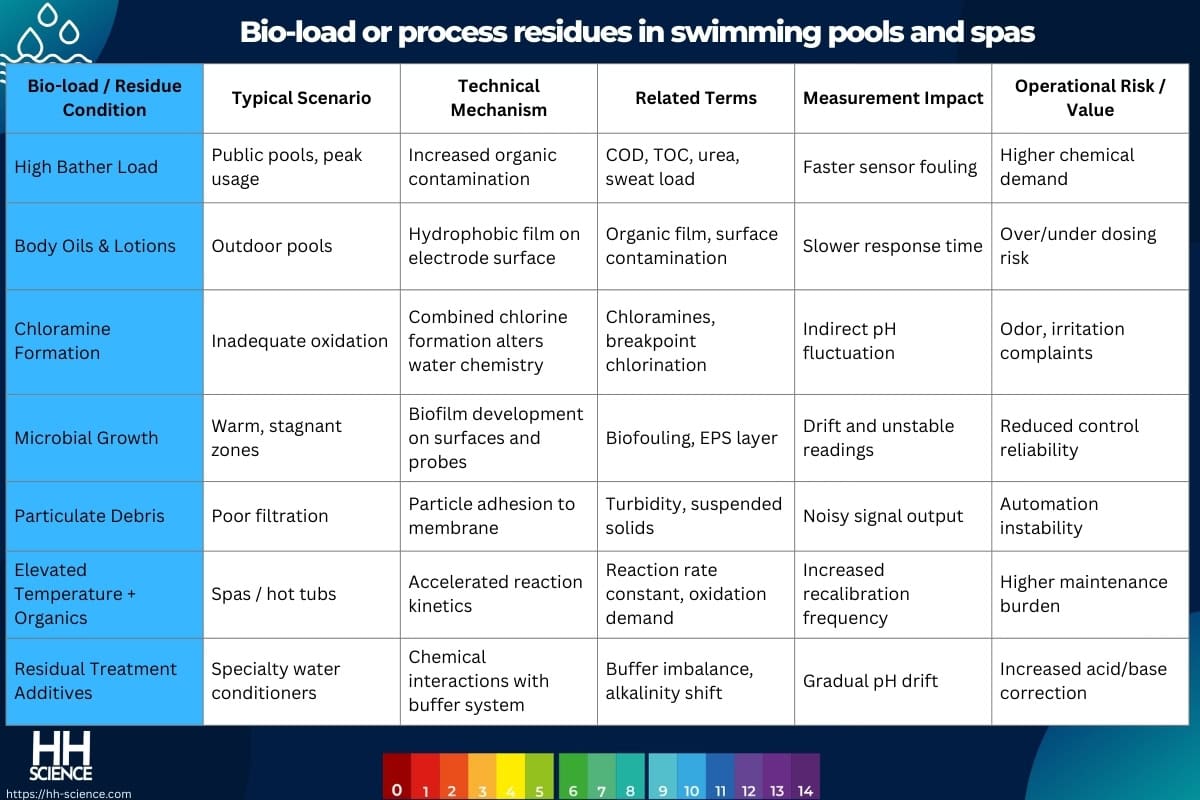
Bio-load or process residues
Bio-load and process residues present a persistent challenge in swimming pools and spas because continuous bather input introduces organic matter (sweat, urea, amino acids, body oils), personal care products (lotions, sunscreen), microorganisms, and particulate debris, which increase chemical oxygen demand (COD), react with disinfectants to form chloramines, promote biofilm development, and alter carbonate buffering stability; these contaminants not only drive higher sanitizer consumption and pH fluctuation but also accumulate on sensor surfaces and reference junctions, impairing ion exchange, slowing electrode response, and causing measurement drift. In high-temperature and high-aeration spa environments, these effects are amplified due to accelerated reaction kinetics and CO₂ stripping, resulting in more frequent calibration requirements, unstable dosing control, increased turbidity risk, and reduced overall water quality consistency.
| Bio-load / Residue Condition | Typical Scenario | Technical Mechanism | Related Terms | Measurement Impact | Operational Risk / Value |
| High Bather Load | Public pools, peak usage | Increased organic contamination | COD, TOC, urea, sweat load | Faster sensor fouling | Higher chemical demand |
| Body Oils & Lotions | Outdoor pools | Hydrophobic film on electrode surface | Organic film, surface contamination | Slower response time | Over/under dosing risk |
| Chloramine Formation | Inadequate oxidation | Combined chlorine formation alters water chemistry | Chloramines, breakpoint chlorination | Indirect pH fluctuation | Odor, irritation complaints |
| Microbial Growth | Warm, stagnant zones | Biofilm development on surfaces and probes | Biofouling, EPS layer | Drift and unstable readings | Reduced control reliability |
| Particulate Debris | Poor filtration | Particle adhesion to membrane | Turbidity, suspended solids | Noisy signal output | Automation instability |
| Elevated Temperature + Organics | Spas / hot tubs | Accelerated reaction kinetics | Reaction rate constant, oxidation demand | Increased recalibration frequency | Higher maintenance burden |
| Residual Treatment Additives | Specialty water conditioners | Chemical interactions with buffer system | Buffer imbalance, alkalinity shift | Gradual pH drift | Increased acid/base correction |
Common pH sensor types used in swimming pools and spas
Common pH sensor types used in swimming pools and spas include combination glass pH electrodes, double-junction electrodes, gel-filled reference sensors, refillable reference sensors, differential pH sensors, solid-state (ISFET) pH sensors, and digital smart pH sensors, each selected based on oxidant resistance, junction stability, maintenance requirements, hydraulic compatibility, and integration with automated dosing or ORP control systems. These sensor types are chosen to address application-specific challenges such as chlorine exposure, scaling tendency (LSI control), biofouling risk, pressure and flow variability, temperature compensation needs (ATC), and long-term calibration stability, ensuring reliable measurement accuracy, reduced maintenance frequency, optimized chemical dosing efficiency, and improved total cost of ownership for both residential and commercial pool environments.
Combination pH sensors
Combination pH sensors are widely used in swimming pools and spas because they integrate the glass measuring electrode and reference electrode into a single body, providing compact installation, simplified wiring, and stable performance in continuous monitoring environments where oxidant exposure, moderate pressure, and flow variation are present. Their all-in-one design supports reliable disinfectant control (HOCl/OCl⁻ balance), compatibility with automated dosing systems, and cost-effective maintenance for residential and commercial facilities where ease of replacement, sealed construction, and consistent calibration stability are operational priorities.
| Combination pH sensor Feature | Technical Description | Related Terms | Application Value in Pools & Spas |
| Integrated Measuring & Reference Electrode | Single-body design combining glass membrane and reference system | Combination electrode, single-shaft design | Simplified installation and reduced leakage risk |
| Compact Construction | Slim probe format for inline or bypass mounting | Flow cell compatibility, immersion mounting | Easy retrofit into existing dosing systems |
| Sealed Gel Reference (common type) | Pre-filled electrolyte system | Gel-filled junction, low maintenance | Reduced operator handling and refill requirements |
| Oxidant-Resistant Materials | Materials selected to tolerate chlorine/bromine exposure | Chemical compatibility, oxidation resistance | Improved durability in disinfected water |
| Automatic Temperature Compensation (ATC) Option | Integrated temperature sensor | Nernst compensation, slope correction | Improved accuracy in varying pool/spa temperatures |
| Moderate Pressure Tolerance | Designed for typical pool circulation systems | Hydraulic compatibility, flow monitoring | Stable performance in bypass lines |
| Cost-Effective Replacement | Standardized connector and body size | BNC / digital interface options | Lower lifecycle cost for routine maintenance |
| Fast Response Time | Optimized glass membrane thickness | Response stability, ion exchange | Reliable real-time dosing control |

Differential pH sensors
Differential pH sensors are used in swimming pools and spas where higher reliability and reduced maintenance are required, particularly in commercial or high-bather-load environments, because they measure pH against a second glass electrode instead of relying solely on a traditional porous reference junction, thereby minimizing junction fouling, diffusion potential errors, and chlorine-induced reference poisoning. This design improves long-term stability under conditions of biofilm formation, scaling tendency (positive LSI), oxidant exposure, pressure fluctuation, and variable conductivity, making them suitable for automated dosing systems where signal stability, reduced recalibration frequency, and predictable lifecycle cost are critical.
| Differential pH sensor Feature | Technical Description | Related Terms | Application Value in Pools & Spas |
| Differential Measurement Design | Uses two glass electrodes (measuring + reference glass) with stable internal reference | Differential potential measurement | Reduced sensitivity to junction contamination |
| No Traditional Porous Junction (or Reduced Dependency) | Eliminates or minimizes clog-prone junction interface | Junction fouling resistance | Improved performance in scaling and biofouling conditions |
| Higher Stability in Oxidizing Environments | Resistant to chlorine and bromine attack | Oxidation tolerance, disinfectant exposure | Longer lifespan in high-chlorine spas |
| Reduced Drift in Contaminated Water | Less affected by organics and suspended solids | Bio-load resistance, diffusion stability | Lower recalibration frequency |
| Improved Performance in Pressure Variations | More stable under hydraulic fluctuation | Backpressure resistance | Reliable readings in dynamic circulation systems |
| Suitable for Continuous Online Monitoring | Designed for permanent installation | Inline/bypass integration | Stable automated pH control loops |
| Lower Maintenance Frequency | Less frequent cleaning and service | Lifecycle cost optimization | Reduced operational downtime |
| Digital Output Options (available models) | Integrated signal conditioning | Noise immunity, smart sensor | Enhanced control system integration |

Digital or smart pH sensors
Digital or smart pH sensors are increasingly used in swimming pools and spas because they integrate onboard signal processing, temperature compensation, and calibration data storage directly within the sensor head, reducing analog signal noise, minimizing cable interference in humid pump-room environments, and improving measurement stability under fluctuating flow, oxidant exposure, and electrical disturbance conditions. For commercial facilities and automated dosing systems, digital sensors provide enhanced diagnostics, predictive maintenance capability, and plug-and-play replacement, which support tighter control of disinfectant efficiency (HOCl/OCl⁻ balance), stable ORP coordination, reduced recalibration downtime, and optimized lifecycle cost.
| Digital or smart pH sensor Feature | Technical Description | Related Terms | Application Value in Pools & Spas |
| Integrated Signal Processing | Analog-to-digital conversion inside sensor | Digital output, signal conditioning | Eliminates noise from long cable runs |
| Stored Calibration Data | Calibration parameters saved in sensor memory | Sensor memory, plug-and-play replacement | Faster replacement with minimal downtime |
| Automatic Temperature Compensation (ATC) | Built-in temperature sensor with real-time correction | Nernst compensation, slope adjustment | Improved accuracy in heated spas |
| Advanced Diagnostics | Self-monitoring of slope, offset, impedance | Predictive maintenance, sensor health monitoring | Reduced unexpected failure |
| EMI / Moisture Resistance | Less sensitive to electrical interference | Noise immunity, IP-rated connectors | Stable readings in pump rooms |
| Network Integration | Compatible with modern controllers and SCADA | Modbus, digital protocol, smart control | Seamless automation integration |
| Drift Monitoring | Tracks performance degradation over time | Calibration interval optimization | Improved lifecycle management |
| Reduced Maintenance Errors | Eliminates manual wiring mistakes | Preconfigured sensor modules | Lower service complexity |

Inline, immersion, or portable configurations
Inline, immersion, and portable pH sensor configurations are selected in swimming pools and spas based on monitoring purpose, hydraulic design, maintenance accessibility, and regulatory requirements, because each installation method influences sampling stability, response time, exposure to turbulence or scaling, and suitability for continuous control versus spot verification. Choosing the correct configuration supports reliable disinfectant control (HOCl/OCl⁻ balance), stable ORP coordination, reduced fouling risk, accurate temperature compensation, and optimized operational efficiency across residential, commercial, and service-based applications.
| Configuration Type | Installation Method | Related Terms | Key Features | Application Value in Pools & Spas |
| Inline (Direct Insertion) | Installed directly into pipe or return line | Process line monitoring, pressure-rated probe | Continuous real-time measurement, compact design | Suitable for automated dosing systems with stable flow conditions |
| Bypass Flow Cell (Controlled Inline) | Installed in a dedicated side-stream sample line | Flow control, constant pressure, sample conditioning | Stable hydraulic environment, reduced turbulence | Improved measurement stability and longer sensor lifespan |
| Immersion (Submerged Mounting) | Placed directly in pool or balance tank | Open-tank measurement, mounting arm | Direct contact with bulk water | Simple installation, suitable for balance tanks or reservoirs |
| Portable / Handheld | Manual sampling or temporary immersion | Spot testing, field verification | Battery-powered, quick measurement | Ideal for maintenance checks and calibration validation |
| Retractable Assembly (Advanced Inline) | Inserted into pressurized line with service valve | Maintenance isolation, hot-tap design | Probe removal without system shutdown | Reduced downtime in commercial facilities |

Installation and maintenance considerations in swimming pools and spas
Proper installation and maintenance of pH measurement systems in swimming pools and spas are essential to ensure long-term accuracy, stable disinfectant control (HOCl/OCl⁻ equilibrium), reliable ORP coordination, and minimized sensor drift under conditions of temperature fluctuation, oxidant exposure, scaling tendency (LSI), hydraulic variability, and bio-load contamination; correct sensor placement (preferably in a controlled bypass flow cell), adequate grounding, pressure compatibility, and appropriate temperature compensation directly influence response stability and dosing precision. Routine maintenance processes—including scheduled cleaning to remove scale and organic deposits, calibration verification, electrolyte inspection (for refillable types), and monitoring of slope and offset diagnostics—reduce compliance risk, extend probe lifespan, optimize chemical consumption, and lower total cost of ownership for both residential and commercial facilities.
Typical installation locations
In swimming pools and spas, typical pH sensor installation locations are selected to ensure representative sampling, hydraulic stability, protection from turbulence and air entrainment, and proper coordination with dosing systems and ORP control; common locations include bypass flow cells, return lines after filtration, balance tanks, surge tanks, sample conditioning panels, and service-side monitoring points, each chosen based on flow consistency, pressure conditions, maintenance accessibility, and control strategy requirements.
| Installation Location | Typical Position in System | Related Terms | Key Features | Application Value in Pools & Spas |
| Bypass Flow Cell (Side-Stream) | Dedicated sample line after filter and heater | Controlled flow, constant pressure, sample conditioning | Stable hydraulic environment, reduced turbulence | Highest measurement stability and longer sensor lifespan |
| Main Return Line (Inline) | After filtration, before chemical injection | Process monitoring, pressure-rated installation | Real-time continuous monitoring | Suitable for automated dosing when flow is stable |
| After Filter / Before Heater | Post-filtration clean water zone | Reduced suspended solids, thermal consideration | Cleaner sample, moderate temperature | Improved accuracy and reduced fouling |
| Balance Tank (Commercial Pools) | In surge or compensation tank | Open reservoir sampling, bulk water monitoring | Stable water level, easy access | Reliable measurement in large public systems |
| Surge Tank / Compensation Tank | Water recirculation buffer | Hydraulic buffering, level control | Lower turbulence than main line | Stable long-term monitoring |
| Chemical Controller Panel (Integrated System) | Inside dosing skid or control cabinet | Compact integration, centralized automation | Organized wiring and service access | Simplified maintenance and control integration |
| Portable Sampling Point | Manual water sampling port | Spot testing, handheld verification | Flexible and temporary use | Calibration validation and troubleshooting |

Calibration and cleaning frequency
Calibration and cleaning frequency in swimming pools and spas are determined by oxidant exposure (chlorine/bromine), temperature, scaling tendency (LSI), bio-load level, hydraulic stability, and sensor type (combination, differential, digital), because these factors influence glass membrane hydration, reference junction integrity, slope stability, and signal drift; maintaining structured calibration and cleaning intervals ensures accurate disinfectant control (HOCl/OCl⁻ equilibrium), stable ORP coordination, regulatory compliance, and optimized chemical dosing efficiency while extending sensor service life.
| Maintenance Activity | Typical Frequency (Residential) | Typical Frequency (Commercial / High Load) | Related Terms | Key Features | Operational Value |
| Routine Visual Inspection | Weekly | 2–3 times per week | Biofouling, scaling, physical damage | Check for deposits, air bubbles, cable integrity | Early detection of drift causes |
| Basic Cleaning (Water Rinse) | Every 2–4 weeks | Weekly | Surface contamination, suspended solids | Gentle rinse to remove loose debris | Maintains response speed |
| Chemical Cleaning (Scale Removal) | Every 1–3 months | Monthly or as needed | Calcium carbonate, LSI positive | Mild acid cleaning solution | Prevents signal suppression |
| Organic Deposit Cleaning | As needed | Monthly or more frequently | Biofilm, oils, sunscreen residue | Enzymatic or mild detergent cleaning | Restores membrane sensitivity |
| Calibration Verification | Monthly | Biweekly | Slope %, offset, ATC accuracy | Buffer solution check (pH 7 / pH 4 or 10) | Ensures measurement accuracy |
| Full Recalibration | Every 1–3 months | Monthly | Two-point calibration, Nernst slope | Adjustment using certified buffers | Stable automated dosing |
| Sensor Replacement | 12–24 months | 6–18 months | Membrane aging, oxidative degradation | Lifecycle-based replacement | Reduces failure risk |
| Digital Sensor Diagnostic Review | Quarterly | Monthly | Drift monitoring, impedance check | Internal diagnostics data | Predictive maintenance optimization |

Expected sensor lifespan
Expected pH sensor lifespan in swimming pools and spas depends on oxidant exposure (free chlorine, bromine), temperature level, scaling tendency (LSI), bio-load contamination, hydraulic stability, sensor construction (single vs double junction, differential design), reference type (gel-filled vs refillable), and whether digital diagnostics are used, because these factors directly affect glass membrane hydration, reference junction integrity, oxidative degradation rate, slope retention, and long-term calibration stability. In properly maintained residential systems sensors may last 12–24 months, while in high-temperature or high-chlorine commercial spas lifespan can shorten to 6–18 months, making material compatibility, cleaning frequency, and installation quality critical for optimizing lifecycle cost and maintaining stable disinfectant control (HOCl/OCl⁻ balance).
| Sensor Type / Condition | Typical Lifespan (Residential) | Typical Lifespan (Commercial / Spa) | Related Terms | Influencing Factors | Lifecycle Value |
| Standard Combination (Single Junction) | 12–24 months | 6–12 months | Junction clogging, slope drift | Chlorine exposure, scaling | Cost-effective but moderate durability |
| Double-Junction Electrode | 18–24 months | 12–18 months | Reference protection, contamination resistance | Bio-load, chemical additives | Improved stability in harsh water |
| Differential pH Sensor | 18–30 months | 12–24 months | No porous junction dependency | High oxidant, pressure fluctuation | Reduced drift and maintenance frequency |
| Digital / Smart Sensor | 18–30 months | 12–24 months | Drift diagnostics, impedance monitoring | Calibration control, EMI resistance | Predictive maintenance optimization |
| High-Temperature Spa (>35°C) | 9–18 months | 6–12 months | Membrane aging, thermal stress | CO₂ outgassing, oxidative stress | Accelerated wear due to heat |
| High Hardness / Scaling Conditions | 12–18 months | 6–12 months | LSI positive, scale deposition | Calcium carbonate precipitation | Requires more frequent cleaning |
| Poor Maintenance Conditions | <12 months | <6–12 months | Calibration neglect, fouling | Biofilm, chemical shock | Increased replacement cost |
| Proper Bypass Installation + Routine Cleaning | 18–24 months | 12–24 months | Stable flow, controlled pressure | Reduced mechanical stress | Optimized total cost of ownership |

Trade-offs between accuracy, maintenance, and durability
In swimming pools and spas, there is a fundamental trade-off between measurement accuracy (slope stability, low drift, fast response time), maintenance demand (cleaning frequency, calibration interval, junction serviceability), and durability (oxidation resistance, pressure tolerance, thermal stability), because highly sensitive glass membranes and low-impedance reference systems typically deliver superior precision and Nernst slope performance but are more vulnerable to fouling, chemical attack, and mechanical stress under high chlorine exposure, scaling conditions (positive LSI), and variable hydraulic loads. Conversely, ruggedized or differential sensor designs with reinforced junction protection and oxidant-resistant materials improve lifespan, contamination tolerance, and reduced recalibration frequency, yet may involve higher upfront cost, slightly slower response kinetics, or reduced fine-resolution accuracy—requiring application-driven balancing of control precision, downtime risk, and total cost of ownership in automated dosing and compliance-critical environments.
Regulatory or quality considerations in swimming pools and spas
Regulatory and quality considerations in swimming pools and spas are critical because public health authorities mandate strict control of pH (commonly 7.2–7.6 or 7.2–7.8), free chlorine residual, combined chlorine limits, oxidation-reduction potential (ORP), turbidity, and microbiological indicators to ensure effective pathogen inactivation, safe bather exposure, and documented water quality compliance; these requirements involve continuous monitoring, calibrated instrumentation, data logging, routine verification testing, and adherence to local health codes or pool operation standards. Failure to maintain compliant pH levels can compromise disinfectant efficacy (HOCl/OCl⁻ equilibrium), increase corrosion or scaling risk (LSI imbalance), trigger inspection violations, operational shutdowns, liability exposure, and reputational damage, making reliable measurement systems, preventive maintenance protocols, and traceable calibration processes essential for commercial and high-traffic facilities.
Industry standards in swimming pools and spas
Industry standards for swimming pools and spas define acceptable limits for pH, disinfectant residuals, water clarity, microbiological safety, circulation design, and operational monitoring because consistent chemical balance (HOCl/OCl⁻ equilibrium), oxidation-reduction potential (ORP) control, saturation index stability (LSI), and documented maintenance procedures are essential to protect public health, ensure system durability, and provide enforceable compliance benchmarks. These standards guide facility design, instrumentation selection, calibration procedures, automated dosing integration, and inspection protocols, creating measurable performance criteria that reduce infection risk, prevent corrosion or scaling damage, and support defensible operational practices.
| Standard / Guideline | Region / Organization | Related Terms | Key Focus | Operational Value / Features |
| WHO Guidelines for Safe Recreational Water Environments | World Health Organization (WHO) | Microbial risk, disinfection, pH control | Health-based water safety framework | Global public health reference for pathogen control |
| CDC Model Aquatic Health Code (MAHC) | United States (CDC) | pH 7.2–7.8, free chlorine, ORP, combined chlorine | Risk-based regulatory guidance | Inspection criteria, operator training, documentation standards |
| ANSI/APSP/ICC Pool Standards | United States | Circulation rate, chemical feeders, safety systems | Design and construction standards | Engineering benchmarks for pool system performance |
| DIN 19643 | Germany | Redox control, ozone systems, pH regulation | Public pool treatment requirements | Strict automated control and monitoring criteria |
| EN 16713 (Parts 1–3) | European Union | Residential pool design, circulation, water treatment | System design and equipment requirements | Harmonized EU safety and performance standards |
| PWTAG Code of Practice | United Kingdom | Water balance, LSI, microbiological testing | Operational best practice guidance | Detailed maintenance and sampling protocols |
| ISO 5667 (Water Sampling) | International | Sampling procedure, water quality monitoring | Standardized testing methodology | Ensures reliable laboratory verification |
| Local Public Health Regulations | Country / Municipality | Compliance inspection, reporting limits | Legal operational requirements | Enforceable compliance, penalties for deviation |

Internal process and quality requirements in swimming pools and spas
Internal process and quality requirements in swimming pools and spas are established to maintain stable pH control (HOCl/OCl⁻ equilibrium), consistent disinfectant residual, carbonate buffering balance (total alkalinity), controlled saturation index (LSI), reliable ORP performance, and documented operational traceability, because daily hydraulic variation, temperature shifts, bio-load input, and chemical dosing cycles continuously disturb water chemistry. These internal controls define monitoring frequency, calibration procedures, alarm thresholds, corrective dosing actions, maintenance routines, and documentation workflows to ensure operational stability, regulatory compliance, cost efficiency, and long-term asset protection.
| Internal Requirement | Related Terms | Why It Is Required | Key Features | Operational Value |
| Defined pH Control Target | 7.2–7.6 setpoint, dosing threshold | Maintain disinfectant efficiency and prevent corrosion/scaling | Automated dosing limits, alarm bands | Stable microbial control |
| Continuous Monitoring | Online pH/ORP measurement | Detect rapid chemical shifts | Real-time sensors, data logging | Immediate corrective response |
| Calibration Protocol | Two-point calibration, slope % check | Prevent drift and inaccurate dosing | Scheduled verification with buffer solutions | Measurement reliability |
| Chemical Dosing Control | Acid/base feed pumps | Maintain equilibrium balance | PID control loop integration | Optimized chemical consumption |
| Alarm & Interlock System | High/low pH alerts | Prevent unsafe water conditions | Controller thresholds, system lockout | Risk reduction and safety assurance |
| Maintenance Schedule | Cleaning interval, inspection routine | Prevent fouling and scaling | Documented service checklist | Extended sensor lifespan |
| Water Balance Verification | LSI calculation, alkalinity check | Prevent scaling or corrosive conditions | Routine water chemistry testing | Asset protection |
| Data Recording & Traceability | Logbooks, digital records | Demonstrate compliance and trend analysis | Audit-ready documentation | Legal protection and quality assurance |
| Staff Training Procedures | Operator certification | Ensure correct system handling | SOP documentation | Reduced human error |
| Preventive Replacement Plan | Lifecycle-based sensor change | Avoid unexpected failure | Scheduled part replacement | Downtime reduction |

Compliance-driven monitoring needs in swimming pools and spas
Compliance-driven monitoring needs in swimming pools and spas are defined by public health regulations and safety standards that require continuous control of pH range, free chlorine residual, combined chlorine limits, oxidation-reduction potential (ORP), temperature, turbidity/clarity, microbiological indicators, circulation rate, and documented calibration records, because these parameters directly influence disinfectant efficacy (HOCl/OCl⁻ equilibrium), pathogen inactivation performance (CT value), corrosion and scaling risk (LSI), and overall bather safety. Regulatory enforcement frameworks require traceable monitoring processes, alarm thresholds, corrective action protocols, and documented verification procedures to ensure safe operation, minimize liability exposure, and maintain inspection readiness for commercial and public facilities.
| Compliance Requirement | Related Terms | Why It Is Required | Key Monitoring Features | Operational / Legal Value |
| pH Control Range (typically 7.2–7.6 or 7.2–7.8) | HOCl/OCl⁻ balance, buffering capacity | Maintain disinfectant efficiency and bather comfort | Continuous pH sensor, alarm limits | Safe microbial control and inspection compliance |
| Free Chlorine Residual | Residual disinfectant, CT value | Ensure continuous pathogen inactivation | Online chlorine analyzer or DPD testing | Public health protection |
| Combined Chlorine Limit | Chloramines, breakpoint chlorination | Prevent irritation and odor issues | Routine chemical testing | Improved air and water quality |
| ORP Monitoring | Redox potential, oxidation strength | Indirect verification of disinfection performance | ORP sensor integration | Stable automated dosing control |
| Temperature Monitoring | Reaction kinetics, thermal impact | Control microbial growth rate and comfort | Integrated temperature probe | Safe spa and therapy operation |
| Turbidity / Water Clarity | Suspended solids, filtration efficiency | Ensure visual safety and filtration performance | Visual inspection or turbidity meter | Aesthetic and safety assurance |
| Microbiological Testing | E. coli, Pseudomonas, Legionella | Confirm sanitary safety beyond chemical control | Periodic laboratory sampling | Regulatory validation |
| Circulation & Turnover Rate | Hydraulic performance, flow rate | Maintain uniform chemical distribution | Flow meters, pump monitoring | Consistent treatment effectiveness |
| Calibration Documentation | Two-point calibration, slope verification | Ensure measurement accuracy | Calibration logs, buffer traceability | Audit readiness |
| Data Logging & Record Retention | Compliance recordkeeping | Demonstrate operational control | Digital controller storage or logbook | Legal defense and inspection support |

Selecting the right pH measurement approach in swimming pools and spas
Selecting the right pH measurement approach in swimming pools and spas is essential because disinfectant efficacy (HOCl/OCl⁻ equilibrium), oxidation-reduction potential (ORP) stability, carbonate buffering balance (total alkalinity), and saturation index control (LSI) all depend on accurate, stable, and application-matched measurement under conditions of oxidant exposure, temperature variation, hydraulic fluctuation, scaling tendency, and bio-load contamination. Choosing between combination, differential, or digital sensors—and configuring them as inline, bypass, or immersion installations with proper temperature compensation, calibration protocol, and maintenance planning—directly determines dosing precision, compliance reliability, sensor lifespan, operational cost efficiency, and overall water quality performance in both residential and commercial facilities.
Decision support for swimming pools and spas
Decision support in swimming pools and spas provides a structured framework for selecting pH measurement solutions based on water chemistry dynamics, regulatory requirements, hydraulic conditions, oxidant exposure levels, temperature range, and maintenance capacity, ensuring that disinfectant efficiency (HOCl/OCl⁻ balance), ORP stability, and saturation index (LSI) control are consistently maintained. By evaluating factors such as bather load variability, scaling tendency, automation level, and compliance risk, decision support tools help operators and integrators balance measurement accuracy, durability, maintenance frequency, and lifecycle cost to achieve stable dosing performance and long-term operational reliability.
Application-driven measurement strategies
Application-driven measurement strategies align sensor type, installation configuration, and calibration protocol with specific pool or spa operating conditions—such as residential vs commercial facilities, heated spas vs standard pools, high chlorine exposure vs moderate treatment systems, and manual testing vs fully automated control loops. This approach ensures that pH monitoring supports real-time corrective dosing, minimizes drift under bio-load and scaling stress, integrates with ORP-based disinfection control, and delivers measurable value through optimized chemical consumption, reduced downtime, and predictable compliance performance.
Linking swimming pools and spas to sensor selection and OEM solutions
Linking swimming pools and spas to sensor selection and OEM solutions involves translating water treatment requirements—such as pH setpoint precision, oxidant resistance, hydraulic compatibility, digital communication protocols, and maintenance accessibility—into engineered measurement systems that integrate seamlessly with dosing pumps, controllers, and monitoring platforms. This connection ensures that the chosen combination, differential, or digital pH sensor design matches environmental stress conditions, supports regulatory documentation, enhances automation reliability, and provides OEMs with scalable, cost-efficient, and durable solutions tailored to recreational water treatment applications.


