
Why pH matters in industrial water applications?
pH matters in industrial water applications because it directly influences process performance, corrosion and scaling control, chemical treatment efficiency, equipment lifespan, product quality, safety, and environmental compliance across a wide range of industrial systems.
- Process performance: Many industrial processes rely on water with controlled pH to maintain consistent reaction conditions and stable output quality.
- Corrosion control: pH strongly affects metal corrosion rates in piping, heat exchangers, and vessels.
- Scaling prevention: Improper pH promotes the precipitation of salts and minerals that reduce heat transfer efficiency.
- Chemical treatment efficiency: pH determines the effectiveness of coagulants, biocides, inhibitors, and neutralization chemicals.
- Equipment protection: Maintaining correct pH extends asset life and reduces unplanned maintenance.
- Product quality: In water-dependent manufacturing, pH deviations can directly affect final product properties.
- Operational safety: Extreme pH increases risk of chemical exposure and system damage.
- Environmental compliance: Discharge and reuse regulations specify allowable pH ranges for industrial water systems.
How does pH influence industrial water quality and safety?
pH influences industrial water quality and safety by controlling chemical equilibria, material interactions, biological growth, and reaction efficiency in systems where water is used for cooling, heating, processing, cleaning, or discharge. Incorrect pH can quickly translate into corrosion, scaling, safety hazards, product quality issues, and regulatory non-compliance, making pH a central operational control parameter rather than a secondary water quality metric.
| Influence Area | How pH Affects Industrial Water | Related Terms | Operational / Safety Value |
| Corrosion behavior | pH determines metal dissolution and corrosion rate | Corrosion index, electrochemical reactions | Protection of pipes, heat exchangers, vessels |
| Scaling and precipitation | High or low pH shifts solubility of salts | Calcium carbonate scaling, solubility equilibrium | Maintained heat transfer efficiency |
| Chemical treatment performance | pH controls reaction efficiency of additives | Biocides, inhibitors, neutralization | Optimized chemical consumption |
| Process reaction control | Many industrial reactions are pH-dependent | Reaction kinetics, process chemistry | Consistent process output |
| Biological growth control | pH affects microbial growth in water systems | Biofouling, microbiological control | Reduced fouling and hygiene risk |
| Equipment lifespan | Incorrect pH accelerates wear and degradation | Material compatibility | Lower maintenance and CAPEX |
| Worker safety | Extreme pH increases exposure and burn risk | Acid/alkali hazards | Safer operating conditions |
| Product quality | Water pH influences product characteristics | Process water quality | Reduced rejects and variability |
| Discharge compliance | pH limits are defined in permits | Effluent standards | Avoidance of fines and violations |
| Environmental protection | pH affects toxicity to receiving waters | Aquatic impact, buffering capacity | Environmental risk reduction |

Why are industrial water systems sensitive to pH deviations?
Industrial water systems are sensitive to pH deviations because chemical reactions, material stability, and treatment processes all operate within defined pH windows, and industrial water often has limited buffering capacity while being exposed to aggressive operating conditions. When pH is not properly controlled, it can accelerate corrosion or scaling, reduce heat transfer efficiency, destabilize chemical treatment programs, promote biofouling, compromise product quality, create safety hazards, and lead to regulatory non-compliance—ultimately increasing operating cost, downtime, and business risk.
Typical pH ranges and control targets in industrial water applications
Typical pH ranges and control targets in industrial water applications define the operating conditions required to balance process efficiency, asset protection, chemical treatment performance, and regulatory compliance. Establishing clear pH targets provides a reference framework for stable operation, early detection of upset conditions, and consistent control across diverse industrial water systems.
Common pH ranges in industrial water
Common pH ranges in industrial water applications typically span pH 6.5–9.5, with tighter targets applied depending on process requirements, materials of construction, and treatment objectives. Different industrial water subcategories operate within specific pH windows to balance corrosion control, scaling prevention, chemical efficiency, and product or environmental requirements.
| Industrial Water Application / Subcategory | Typical pH Range | Why This Range Is Used | Operational / Business Value |
| Cooling water systems (open recirculating) | 7.0 – 9.0 | Controls corrosion and scaling while supporting biocide effectiveness | Improved heat transfer, reduced maintenance |
| Cooling water systems (closed loop) | 8.0 – 9.5 | Higher pH minimizes corrosion in steel-based systems | Extended equipment lifespan |
| Boiler feedwater (pre-treatment) | 7.0 – 9.0 | Protects membranes and ion exchange systems | Stable upstream treatment |
| Boiler water (internal chemistry) | 8.5 – 10.5 | Prevents corrosion and supports alkalinity control | Boiler integrity and efficiency |
| Industrial process water | 6.5 – 8.5 | Maintains consistent reaction and product conditions | Process stability, product quality |
| Rinse and wash water | 6.5 – 7.5 | Avoids residue formation and surface damage | Reduced defects and rework |
| Heat exchanger circuits | 7.0 – 9.0 | Balances corrosion and fouling risks | Sustained thermal performance |
| Industrial wastewater (pre-discharge) | 6.0 – 9.0 | Meets regulatory discharge requirements | Compliance and risk reduction |
| Food & beverage process water | 6.5 – 8.0 | Protects product safety and equipment | Hygiene and quality assurance |
| Chemical manufacturing water | Application-specific (often 6.0 – 9.0) | Optimized for specific reactions and materials | Process efficiency and yield |
| Pulp & paper process water | 6.0 – 8.5 | Controls fiber chemistry and equipment wear | Product consistency and uptime |
| Mining & metals process water | 7.5 – 10.0 (process-dependent) | Supports metal recovery or corrosion control | Recovery efficiency and asset protection |

Factors that define pH control targets
pH control targets in industrial water applications are defined by process requirements, materials of construction, chemical treatment programs, operating temperature and pressure, biological control needs, influent water quality, discharge regulations, and product or quality specifications, because industrial systems must balance performance, protection, and compliance.
- Process requirements: Many industrial operations require specific pH ranges to maintain reaction efficiency and consistent output.
- Materials of construction: Metals, alloys, and polymers have pH tolerance limits that influence corrosion and degradation rates.
- Chemical treatment programs: The effectiveness of inhibitors, biocides, and neutralizing agents depends on pH.
- Operating temperature and pressure: Elevated conditions amplify the effects of incorrect pH on corrosion and scaling.
- Biological control needs: pH influences microbial growth and biofouling potential in water systems.
- Influent water quality: Source water chemistry determines buffering capacity and pH stability.
- Discharge regulations: Environmental permits specify allowable pH ranges for effluent or reuse.
- Product and quality specifications: Water pH can directly affect final product characteristics in manufacturing processes.
What happens when pH is out of range in industrial water applications?
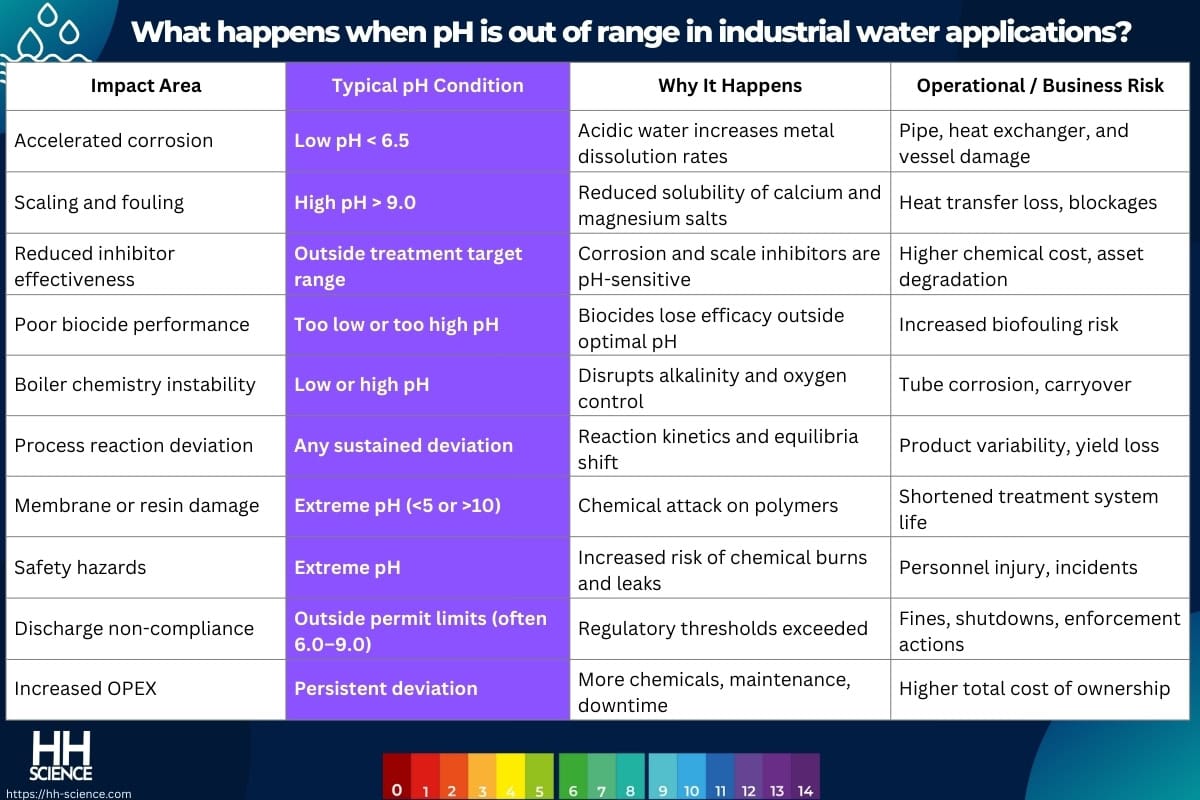
When pH is out of range in industrial water applications, it can cause accelerated corrosion, scaling and fouling, reduced chemical treatment efficiency, process instability, equipment damage, safety hazards, product quality issues, and regulatory non-compliance, because industrial water chemistry, materials, and reactions are highly pH-dependent.
| Impact Area | Typical pH Condition | Why It Happens | Operational / Business Risk |
| Accelerated corrosion | Low pH < 6.5 | Acidic water increases metal dissolution rates | Pipe, heat exchanger, and vessel damage |
| Scaling and fouling | High pH > 9.0 | Reduced solubility of calcium and magnesium salts | Heat transfer loss, blockages |
| Reduced inhibitor effectiveness | Outside treatment target range | Corrosion and scale inhibitors are pH-sensitive | Higher chemical cost, asset degradation |
| Poor biocide performance | Too low or too high pH | Biocides lose efficacy outside optimal pH | Increased biofouling risk |
| Boiler chemistry instability | Low or high pH | Disrupts alkalinity and oxygen control | Tube corrosion, carryover |
| Process reaction deviation | Any sustained deviation | Reaction kinetics and equilibria shift | Product variability, yield loss |
| Membrane or resin damage | Extreme pH (<5 or >10) | Chemical attack on polymers | Shortened treatment system life |
| Safety hazards | Extreme pH | Increased risk of chemical burns and leaks | Personnel injury, incidents |
| Discharge non-compliance | Outside permit limits (often 6.0–9.0) | Regulatory thresholds exceeded | Fines, shutdowns, enforcement actions |
| Increased OPEX | Persistent deviation | More chemicals, maintenance, downtime | Higher total cost of ownership |
Effects of low pH in industrial water applications
Low pH in industrial water applications causes accelerated corrosion, material degradation, reduced inhibitor effectiveness, process instability, increased metal solubility, safety risks, and potential compliance issues, because acidic conditions intensify electrochemical reactions and disrupt treatment chemistry.
| Effect of Low pH | Why It Occurs at Low pH | Operational / Business Impact |
| Accelerated corrosion | Acidic water increases metal dissolution rates | Damage to pipes, heat exchangers, vessels |
| Material degradation | Polymers, linings, and coatings are attacked by acids | Shortened equipment lifespan |
| Reduced corrosion inhibitor performance | Many inhibitors require near-neutral to alkaline pH | Higher chemical consumption, asset risk |
| Increased metal solubility | Metals dissolve rather than precipitate | Contamination, downstream fouling |
| Process instability | Reaction equilibria shift under acidic conditions | Product variability, yield loss |
| Boiler and heat system damage | Low pH attacks steel and copper alloys | Tube failure, efficiency loss |
| Safety hazards | Acidic water increases burn and leak risks | Personnel injury, incident potential |
| Compliance risk | Effluent pH may fall below permit limits | Fines, corrective actions |

Effects of high pH in industrial water applications
High pH in industrial water applications leads to scaling and precipitation, reduced heat transfer efficiency, decreased biocide effectiveness, process chemistry imbalance, material compatibility issues, safety risks, and potential compliance violations, because alkaline conditions shift solubility equilibria and interfere with treatment chemistry.
| Effect of High pH | Why It Occurs at High pH | Operational / Business Impact |
| Scaling and precipitation | High pH reduces solubility of calcium and magnesium salts | Heat exchanger fouling, blockages |
| Reduced heat transfer efficiency | Scale deposits act as thermal insulation | Increased energy consumption |
| Decreased biocide effectiveness | Some biocides lose efficacy at high pH | Increased biofouling risk |
| Process chemistry imbalance | Reaction equilibria shift under alkaline conditions | Product quality variation |
| Material compatibility issues | Certain alloys and coatings degrade in high pH | Equipment damage, leaks |
| Membrane and resin damage | Alkalinity attacks polymer-based materials | Shortened treatment system life |
| Sludge or solids formation | Hydroxides precipitate at elevated pH | Increased maintenance and cleaning |
| Safety hazards | Alkaline water increases chemical burn risk | Personnel injury potential |
| Compliance risk | Effluent pH may exceed permit limits | Fines, enforcement actions |

Operational, quality, and compliance risks
When pH is out of range in industrial water applications, operational, quality, and compliance risks increase simultaneously because pH governs corrosion–scaling balance, treatment chemistry, and discharge eligibility across interconnected systems.
- Operational risks: pH excursions disrupt corrosion and scale control programs, reduce heat-transfer efficiency, destabilize boilers and cooling systems, and increase chemical consumption, leading to higher OPEX and unplanned downtime.
- Quality risks: Incorrect pH compromises process water consistency, interferes with reactions or rinsing performance, accelerates material degradation, and can cause product defects or yield loss in water-dependent manufacturing.
- Compliance risks: Industrial permits and reuse standards specify allowable pH limits; deviations trigger violations, reporting obligations, fines, or discharge restrictions, increasing regulatory exposure and business risk.
pH measurement challenges in industrial water applications
pH measurement challenges in industrial water applications arise from aggressive chemistry, variable flow and temperature, high dissolved solids, and continuous chemical dosing across complex systems. Recognizing these challenges is essential for selecting durable sensor technologies, appropriate installation configurations, and maintenance strategies that ensure reliable control, asset protection, and regulatory compliance.
Temperature effects
Temperature effects are a major pH measurement challenge in industrial water applications because temperature directly influences electrode slope, chemical equilibria, corrosion rates, and treatment reactions in systems that often operate across wide thermal ranges. Rapid or sustained temperature changes can introduce apparent pH drift, slow sensor response, and misalignment between measured pH and actual process chemistry if temperature compensation, sensor materials, and placement are not properly engineered.
| Temperature Condition | How It Affects pH Measurement | Related Terms | Operational / Business Value |
| Variable process temperatures | Changes electrode slope and zero | Nernst equation, slope compensation | Measurement consistency across loads |
| Inadequate temperature compensation | Creates mismatch between true and indicated pH | ATC, compensation error | Prevents false control actions |
| High-temperature operation (>40–60 °C) | Accelerates glass aging and reference depletion | Glass hydration, reference drift | Extends sensor service life |
| Low-temperature operation (<10 °C) | Increases electrode impedance and response time | High-impedance glass | Faster stabilization and control |
| Temperature gradients in pipes/tanks | Sensor reads local rather than bulk conditions | Thermal stratification | Representative process data |
| Heat exchanger proximity | Local hot spots distort readings | Localized heating | Avoids biased measurements |
| Boiler and condensate systems | Elevated temperatures amplify pH error impact | Alkalinity control, condensate chemistry | Asset protection and efficiency |
| Seasonal temperature shifts | Gradual baseline drift in trends | Trend normalization | Accurate long-term analysis |

Fouling and contamination
Fouling and contamination are persistent pH measurement challenges in industrial water applications because sensors are exposed to suspended solids, scale-forming minerals, biofilms, oils, and chemical residues that interfere with electrode surfaces and reference systems. These deposits impede ion exchange, bias readings, slow response time, and accelerate sensor wear—undermining control accuracy in systems where pH directly affects corrosion, scaling, treatment efficiency, and compliance.
| Fouling / Contamination Source | How It Affects pH Measurement | Related Terms | Operational / Business Value |
| Suspended solids | Coat glass membrane and thicken boundary layer | TSS, mass transfer limitation | Slower response, reduced accuracy |
| Mineral scale | Deposits on glass and junction surfaces | CaCO₃ scaling, precipitation | Biased readings, increased maintenance |
| Biofilm growth | Creates diffusion barriers and junction clogging | Biofouling, EPS | Drift, frequent cleaning |
| Oils and hydrocarbons | Hydrophobic films isolate electrode surface | O&G contamination | Signal instability, loss of sensitivity |
| Chemical residues | React with glass or poison reference junction | Inhibitor films, passivation | Reference instability |
| Corrosion products | Iron oxides deposit on sensor surfaces | Rust fouling | Measurement bias, abrasion |
| Inadequate cleaning | Residual films remain after service | Maintenance residue | Persistent error post-maintenance |
| High-velocity abrasion | Solids erode glass and seals | Erosion, wear | Shortened sensor lifespan |

Pressure and flow conditions
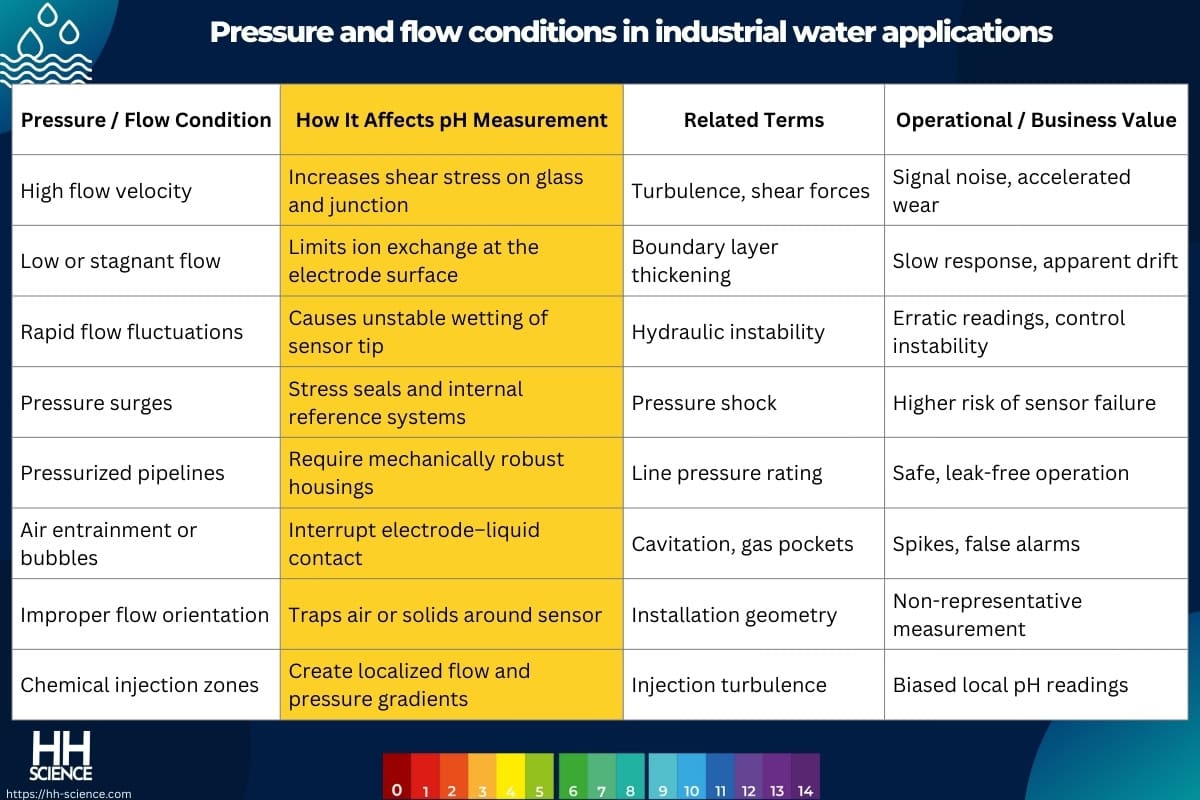
Pressure and flow conditions are a key pH measurement challenge in industrial water applications because variable hydraulics, turbulence, and pressurization directly influence sensor exposure, signal stability, and mechanical integrity. Rapid flow changes, pressure fluctuations, or poor hydraulic design can lead to non-representative readings, accelerated sensor wear, and increased measurement noise, reducing the effectiveness of pH-based control and protection strategies.
| Pressure / Flow Condition | How It Affects pH Measurement | Related Terms | Operational / Business Value |
| High flow velocity | Increases shear stress on glass and junction | Turbulence, shear forces | Signal noise, accelerated wear |
| Low or stagnant flow | Limits ion exchange at the electrode surface | Boundary layer thickening | Slow response, apparent drift |
| Rapid flow fluctuations | Causes unstable wetting of sensor tip | Hydraulic instability | Erratic readings, control instability |
| Pressure surges | Stress seals and internal reference systems | Pressure shock | Higher risk of sensor failure |
| Pressurized pipelines | Require mechanically robust housings | Line pressure rating | Safe, leak-free operation |
| Air entrainment or bubbles | Interrupt electrode–liquid contact | Cavitation, gas pockets | Spikes, false alarms |
| Improper flow orientation | Traps air or solids around sensor | Installation geometry | Non-representative measurement |
| Chemical injection zones | Create localized flow and pressure gradients | Injection turbulence | Biased local pH readings |
Chemical exposure
Chemical exposure is a major pH measurement challenge in industrial water applications because sensors are continuously exposed to disinfectants, corrosion inhibitors, acids, alkalis, oxidants, and treatment additives used to control scaling, corrosion, biofouling, and process chemistry. These chemicals can attack glass membranes, poison reference junctions, form surface films, or create localized pH gradients, leading to drift, slow response, shortened sensor life, and misleading measurements if sensor materials, placement, and maintenance are not properly engineered.
| Chemical Exposure Source | How It Affects pH Measurement | Related Terms | Operational / Business Value |
| Strong acids and bases | Chemically attack glass and seals | Neutralization chemicals, pH shock | Accelerated aging, higher replacement cost |
| Oxidizing disinfectants | Oxidize reference junction and internals | Chlorine, hypochlorite, ozone | Reference drift, reduced lifespan |
| Corrosion inhibitors | Form passivation films on electrodes | Film-forming inhibitors | Slower response, biased readings |
| Scale inhibitors | Alter surface chemistry at the glass | Phosphonates, polymers | Measurement instability |
| Biocides | Interact with membrane or reference materials | Oxidative / non-oxidative biocides | Signal noise, sensor stress |
| Chemical overdosing | Creates extreme local pH conditions | Dosing upset | False alarms, control errors |
| Injection point proximity | Localized concentration gradients | Mixing inefficiency | Non-representative pH values |
| CIP / cleaning chemicals | Repeated exposure stresses materials | Acid/alkali cleaning | Shortened service life |

Bio-load or process residues
Bio-load and process residues present ongoing pH measurement challenges in industrial water applications because organic matter, microbial growth, and residual process by-products interact continuously with sensor surfaces and reference systems. These deposits alter local chemistry at the electrode interface, restrict ion exchange, and accelerate fouling or abrasion, leading to drift, slow response, and non-representative pH readings in systems where pH directly governs corrosion, scaling, and treatment efficiency.
| Bio-load / Residue Source | How It Affects pH Measurement | Related Terms | Operational / Business Value |
| Microbial growth | Forms biofilms on glass and junction | Biofouling, microbiological growth | Drift reduction through proper cleaning |
| Organic process residues | Coat electrode surface and alter diffusion | TOC, organic films | Improved signal stability |
| Slime and deposits | Trap solids and chemicals near sensor tip | Fouling layer | Faster response after maintenance |
| Heat exchanger by-products | Release corrosion or scaling residues | Iron oxides, deposits | More representative measurements |
| Cooling tower biological load | Promotes algae and bacteria attachment | Bio-control programs | Reduced maintenance frequency |
| Industrial carryover solids | Abrasive contact damages glass and seals | Abrasion, wear | Extended sensor lifespan |
| Incomplete rinsing after cleaning | Leaves residual films on sensor | Cleaning residue | Faster post-service stabilization |
| Intermittent process upsets | Sudden residue spikes foul sensors | Process upset | Improved reliability with robust designs |

Common pH sensor types used in industrial water applications
Common pH sensor types used in industrial water applications include combination pH sensors, differential pH sensors, and digital or smart pH sensors, selected to balance measurement accuracy, durability, and maintenance effort under demanding operating conditions. These sensors are deployed in inline, immersion, or flow-through configurations to ensure representative measurement, reliable control of corrosion and scaling, and compliance across diverse industrial water systems.
Combination pH sensors
Combination pH sensors are widely used in industrial water applications because they integrate the measuring and reference electrodes into a single, rugged assembly that performs reliably under variable pH, temperature, flow, and chemical dosing conditions. Their proven design, broad compatibility with transmitters, and availability in chemically resistant materials make them a practical, cost-effective choice for continuous control of corrosion, scaling, and treatment efficiency.
| Combination pH sensors Feature | Description | Value in Industrial Water Systems |
| Integrated measuring & reference electrode | Single-body construction | Simplified installation and replacement |
| Wide pH operating range | Handles acidic to alkaline conditions | Suitable for cooling, boiler, and process water |
| Rugged glass membrane | Thicker or impact-resistant glass options | Improved durability under flow and solids |
| Double or open junction options | Reduces clogging and reference poisoning | More stable readings, longer service intervals |
| Chemical-resistant housings | PVDF, PPS, stainless steel options | Compatibility with inhibitors and biocides |
| Fast response time | Rapid equilibrium with process changes | Effective control of dosing and alarms |
| Broad transmitter compatibility | Works with standard analog transmitters | Easy integration into existing control systems |
| Cost-effective lifecycle | Lower initial cost than advanced designs | Scalable deployment across many points |

Differential pH sensors
Differential pH sensors are well suited for industrial water applications where fouling, chemical attack, or unstable references make conventional liquid-junction sensors unreliable. By measuring pH as the difference between two matched electrodes and eliminating the traditional reference junction, they deliver greater long-term stability, lower maintenance, and higher data confidence in aggressive, solids-laden, or chemically treated water systems.
| Differential pH sensors Feature | Description | Value in Industrial Water Systems |
| Differential measurement principle | Uses two matched electrodes instead of a liquid reference | Stable readings in harsh and variable chemistry |
| No liquid junction | Eliminates junction clogging and poisoning | Reduced maintenance and downtime |
| High fouling resistance | Less affected by solids, biofilms, and scale | Reliable long-term operation |
| Reduced reference drift | Reference stability independent of electrolyte | Improved trend accuracy |
| Chemical robustness | Tolerates oxidants, inhibitors, and biocides | Extended sensor lifespan |
| Stable performance under flow | Less sensitive to flow and pressure changes | Representative process measurements |
| Lower maintenance frequency | Fewer cleanings and recalibrations required | Lower OPEX and labor cost |
| Higher initial investment | More complex sensor design | Lower total cost of ownership in severe duties |

Digital or smart pH sensors
Digital or smart pH sensors are increasingly adopted in industrial water applications because they improve measurement reliability, diagnostics, and lifecycle management in electrically noisy, chemically aggressive, and maintenance-intensive environments. By converting the signal at the sensor and embedding intelligence, they support stable control, predictive maintenance, and compliance documentation across complex industrial water systems.
| Digital or smart pH sensors Feature | Description | Value in Industrial Water Systems |
| Digital signal processing at sensor | Converts high-impedance signal to digital locally | Reduced electrical noise and signal loss |
| Built-in sensor diagnostics | Monitors impedance, slope, and reference condition | Early detection of fouling or failure |
| Stored calibration data | Calibration and history stored in sensor memory | Faster replacement and traceability |
| Predictive maintenance indicators | Estimates remaining sensor life | Reduced unplanned downtime |
| Plug-and-play replacement | Automatic sensor recognition | Lower labor cost and faster commissioning |
| Immunity to cable length | Digital signals unaffected by long cables | Flexible plant-wide installation |
| Data integrity and logging | Secure transmission and record keeping | Audit and compliance confidence |
| Integration with PLC/SCADA | Standard digital communication protocols | Improved process visibility |

Inline, immersion, or portable configurations
Inline, immersion, and portable pH sensor configurations are all used in industrial water applications because industrial systems vary widely in pressure, flow, accessibility, fouling risk, and monitoring purpose (control, optimization, or verification). Selecting the appropriate configuration ensures representative measurement, protects sensors from damage, and aligns monitoring effort with process criticality and maintenance capability.
| Configuration | Description | Typical Use Cases | Key Features | Value in Industrial Water Systems |
| Inline configuration | Sensor installed directly in a pressurized pipe or flow-through housing | Cooling water loops, boiler feedwater, process lines | Continuous exposure, pressurized design | Real-time control and stable process regulation |
| Immersion configuration | Sensor submerged in tanks, sumps, or basins | Open cooling towers, treatment tanks, reservoirs | Simple mounting, direct contact | Flexible placement and easy servicing |
| Flow-through (bypass) cell | Sidestream sampling with controlled flow | High-pressure or high-fouling lines | Controlled hydraulics, isolation from main flow | Improved stability and easier maintenance |
| Retractable assemblies | Sensor can be withdrawn under pressure | Pressurized industrial pipelines | Safe removal without shutdown | Reduced downtime and safer maintenance |
| Portable configuration | Handheld meter with removable probe | Spot checks, troubleshooting, audits | Mobility, quick verification | Independent validation and diagnostics |
| Temporary installations | Short-term deployment during optimization | Commissioning, process studies | Non-permanent mounting | Flexible evaluation without system changes |
| Redundant configurations | Multiple sensors at critical points | Compliance or asset-protection locations | Backup measurement | Increased reliability and risk reduction |

Installation and maintenance considerations in industrial water applications
Installation and maintenance considerations are critical in industrial water applications because pH sensors operate under continuous flow, chemical dosing, temperature variation, and mechanical stress that directly affect measurement reliability and sensor lifespan. Proper sensor placement, protective mounting, accessible cleaning design, and realistic calibration intervals ensure stable pH control, protect assets from corrosion or scaling, and minimize total cost of ownership while supporting compliance requirements.
Typical installation locations
Typical installation locations for pH sensors in industrial water applications are selected to support corrosion and scaling control, optimize chemical treatment, protect equipment, and ensure compliance across different water circuits. Location choice balances representativeness, hydraulic conditions, chemical exposure, and maintenance accessibility.
| Installation Location | Industrial Water Context | Key Features | Value in Industrial Water Systems |
| Cooling water makeup line | Incoming water to cooling systems | Stable flow, lower fouling | Baseline control for treatment programs |
| Cooling tower basin | Open recirculating cooling systems | High evaporation, bio-load | Real-time control of scaling and biocides |
| Cooling water return line | After heat exchangers | Elevated temperature, corrosion indicators | Early detection of system imbalance |
| Boiler feedwater line | Upstream of boilers | Low solids, controlled chemistry | Protection of boilers and membranes |
| Boiler water drum | Internal boiler chemistry monitoring | High temperature, alkaline conditions | Corrosion and carryover prevention |
| Heat exchanger inlet/outlet | Process heat transfer equipment | Temperature gradients | Efficiency monitoring and fouling control |
| Chemical dosing control points | Neutralization or treatment injection zones | Strong local gradients | Accurate dosing and process control |
| Industrial process water loops | Manufacturing or processing circuits | Process-dependent chemistry | Product quality and process stability |
| Water treatment skid outlets | RO, softeners, demin systems | Treated water quality verification | System performance validation |
| Industrial effluent / discharge line | Pre-discharge monitoring | Compliance-critical | Permit compliance and risk reduction |
| Bypass or sample lines | Sidestream measurement points | Controlled flow, easy access | Improved stability and safer maintenance |

Calibration and cleaning frequency
Calibration and cleaning frequency in industrial water applications are determined by process severity, chemical dosing intensity, fouling potential, temperature, and compliance criticality, because these factors directly influence sensor drift and surface contamination. Defining realistic intervals maintains control accuracy, protects assets from corrosion or scaling, and minimizes downtime and total cost of ownership.
| Industrial Water Application / Condition | Typical Calibration Frequency | Typical Cleaning Frequency | Key Influencing Features | Operational / Business Value |
| Cooling water (open recirculating) | Monthly | Weekly to biweekly | Biofouling, scaling, evaporation | Stable corrosion/scale control |
| Cooling water (closed loop) | Quarterly | Monthly | Lower fouling, stable chemistry | Reduced maintenance cost |
| Boiler feedwater (pretreatment) | Monthly to quarterly | Monthly | Membranes/resins sensitivity | Protection of treatment assets |
| Boiler water (internal chemistry) | Monthly | Monthly | High temperature, alkalinity | Boiler integrity and efficiency |
| Process water loops | Monthly | Monthly | Process-dependent chemistry | Consistent product quality |
| Heat exchanger circuits | Monthly | Biweekly to monthly | Temperature gradients, fouling | Sustained heat transfer |
| Chemical dosing control points | Weekly to monthly | Weekly | Local pH gradients, strong chemicals | Accurate dosing, reduced chemical spend |
| Industrial rinse/wash water | Monthly | Monthly | Residues, surfactants | Reduced defects and rework |
| Water treatment skid outlets | Monthly to quarterly | Monthly | Treated water stability | Verification of treatment performance |
| Industrial effluent / discharge | Monthly (permit-driven) | Monthly | Compliance-critical | Audit readiness and risk reduction |
| High-fouling or aggressive chemistry | Weekly to biweekly | Weekly | Solids, oxidants, inhibitors | Prevents drift and failures |
| Portable measurements | Before use | After use | Handling and exposure | Reliable verification and audits |

Expected sensor lifespan
Expected pH sensor lifespan in industrial water applications depends on water chemistry severity, temperature, flow conditions, chemical dosing intensity, fouling load, installation method, and maintenance discipline, because these factors directly affect glass aging, reference stability, and mechanical wear. Setting realistic lifespan expectations supports spare planning, maintenance budgeting, and risk management for control- and compliance-critical points.
| Industrial Water Application / Condition | Typical Sensor Lifespan | Key Factors Affecting Lifespan | Operational / Business Value |
| Cooling water (open recirculating) | 6–18 months | Scaling, biofouling, oxidizing biocides | Predictable maintenance, stable control |
| Cooling water (closed loop) | 18–36 months | Stable chemistry, low solids | Lower replacement cost, long uptime |
| Boiler feedwater (pretreatment) | 12–24 months | Low solids, chemical conditioning | Protection of membranes and resins |
| Boiler water (internal chemistry) | 6–18 months | High temperature, high alkalinity | Boiler integrity and efficiency |
| Process water loops | 12–24 months | Process chemistry variability | Consistent product quality |
| Heat exchanger circuits | 6–18 months | Temperature gradients, fouling | Sustained heat transfer performance |
| Chemical dosing control points | 6–12 months | Local pH extremes, oxidants | Accurate dosing, reduced chemical waste |
| Industrial rinse/wash water | 12–24 months | Surfactants, residues | Reduced defects and rework |
| Water treatment skid outlets | 18–36 months | Treated, low-fouling water | Long-term verification stability |
| Industrial effluent / discharge | 18–36 months | Lower fouling, compliance focus | Reliable permit monitoring |
| High-fouling / aggressive chemistry | 3–9 months | Solids abrasion, oxidants, extremes | Risk mitigation with planned replacement |
| Portable pH sensors | 12–24 months | Handling, intermittent exposure | Reliable audits and spot checks |

Trade-offs between accuracy, maintenance, and durability
In industrial water applications, trade-offs between accuracy, maintenance, and durability arise because high-accuracy pH sensors with sensitive glass membranes and tight tolerances deliver better process control but are more susceptible to fouling, chemical attack, and mechanical wear. More rugged sensor designs reduce maintenance frequency and extend service life in harsh environments, but may sacrifice response speed or resolution, requiring application-specific balancing to optimize reliability, operating cost, and long-term performance.
Regulatory or quality considerations in industrial water applications
Regulatory and quality considerations in industrial water applications are critical because pH is often a controlled parameter in permits, internal quality systems, and customer specifications tied to environmental protection, product quality, and safe operation. Reliable pH monitoring supports compliance with discharge regulations, reuse standards, and contractual requirements while reducing regulatory risk, protecting downstream systems, and ensuring consistent industrial process performance.
Industry standards in industrial water applications
Industry standards in industrial water applications define acceptable pH ranges, monitoring practices, documentation requirements, and control expectations to protect equipment, processes, personnel, and the environment. These standards exist because pH directly affects corrosion, scaling, treatment efficiency, discharge safety, and product quality, making it a regulated and audited parameter across industrial sectors.
| Standard / Guideline | Scope / Region | Why It Matters for Industrial Water pH | Related Terms | Operational / Compliance Value | Key Features |
| ISO 9001 | International | Requires controlled monitoring of critical process parameters | Quality management, process control | Consistent production quality | Documented procedures, traceability |
| ISO 14001 | International | Controls environmental aspects of industrial operations | Environmental management system (EMS) | Reduced environmental risk | Monitoring, corrective actions |
| ISO 5667 (Water Quality – Sampling) | International | Defines proper water sampling and handling for pH testing | Representative sampling | Reliable and defensible data | Standardized methods |
| ASTM D1293 | International | Standard test method for pH of water | pH measurement methodology | Comparable and repeatable results | Defined measurement procedures |
| ASTM D5128 | International | On-line pH measurement practices | Continuous monitoring | Improved process control | Guidance for online sensors |
| ASME Boiler and Pressure Vessel Code | Global | Defines boiler water chemistry requirements | Boiler water treatment | Equipment protection | pH limits tied to pressure/temperature |
| VGB Guidelines | Europe / Power & Energy | Controls water chemistry in power plants | Power plant water chemistry | Asset protection | Application-specific pH ranges |
| Cooling Technology Institute (CTI) | Global | Guidance for cooling water chemistry | Cooling tower control | Reduced scaling and corrosion | Industry best practices |
| API Recommended Practices | Oil & Gas | Water treatment standards for upstream/downstream operations | Produced water, process water | Operational safety | Sector-specific limits |
| Local discharge permits | Regional / Local | Enforce pH limits for industrial effluent | Permit compliance | Legal discharge authorization | Enforceable numeric limits |
| Customer and contractual specifications | Global | Define water quality acceptance criteria | Process agreements | Business continuity | Contractually binding requirements |

Internal process and quality requirements in industrial water applications
Internal process and quality requirements in industrial water applications define how pH is measured, controlled, documented, and acted upon to protect equipment, stabilize processes, optimize chemical use, and ensure regulatory and contractual compliance. These requirements exist because industrial water conditions change continuously, and consistent internal controls are needed to translate external standards into reliable day-to-day operation.
| Internal Requirement | Why It Is Required | Related Terms | Operational / Business Value | Key Features |
| Defined internal pH control limits | Prevents corrosion, scaling, and process instability before damage occurs | Control bands, setpoints | Asset protection and process stability | Warning and action thresholds |
| Standard operating procedures (SOPs) | Ensures consistent response to pH deviations | SOPs, work instructions | Reduced human error | Documented corrective actions |
| Calibration and maintenance programs | Maintains measurement accuracy over time | Preventive maintenance, calibration intervals | Reliable control and audit readiness | Scheduled service plans |
| Chemical dosing control logic | Stabilizes pH during treatment and neutralization | PID control, feed-forward control | Optimized chemical consumption | Automated adjustment |
| Alarm management and escalation rules | Enables fast intervention during pH excursions | Alarm limits, escalation paths | Reduced downtime and risk | Defined response hierarchy |
| Data logging and traceability | Supports audits, investigations, and trend analysis | Data integrity, traceable records | Compliance confidence | Time-stamped historical data |
| Performance trending and KPIs | Detects gradual drift or system degradation | Trend analysis, KPIs | Predictive maintenance | Long-term performance visibility |
| Change management procedures | Controls impact of chemistry or process changes | MOC, validation | Reduced unintended upsets | Documented approvals |
| Operator training and competency | Ensures correct interpretation of pH data | Training records, certification | Safer and more reliable operation | Periodic skill updates |
| Internal audits and reviews | Verifies adherence to procedures and limits | QA/QC audits | Continuous improvement | Regular assessments |
| Emergency response protocols | Manages extreme pH events safely | Spill response, incident management | Safety and compliance protection | Predefined emergency actions |

Compliance-driven monitoring needs in industrial water applications
Compliance-driven monitoring needs in industrial water applications include continuous pH measurement, defined alarm limits, traceable calibration, secure data logging, reporting capability, verification sampling, redundancy at critical points, and documented response procedures, because pH is a regulated parameter tied to discharge permits, reuse standards, and contractual obligations. These needs ensure timely detection of deviations, defensible compliance evidence, and consistent corrective action across complex industrial water systems.
| Monitoring Need | Why It Is Required | Related Terms | Compliance / Business Value | Key Features |
| Continuous pH monitoring | Detects excursions in real time | Online monitoring | Prevents permit exceedance | Inline/immersion sensors |
| Defined alarm limits | Triggers corrective action before violations | Alarm thresholds, setpoints | Reduced regulatory risk | Configurable alarms |
| Traceable calibration records | Proves measurement accuracy during audits | Calibration traceability | Audit defensibility | Time-stamped logs |
| Secure data logging | Prevents data loss or tampering | Data integrity | Regulatory trust | Access control |
| Historical data retention | Supports inspections and investigations | Recordkeeping | Long-term compliance proof | Archived datasets |
| Standardized reporting | Meets regulatory reporting requirements | Effluent reports | Legal conformity | Automated reporting |
| Verification sampling | Confirms online sensor accuracy | Grab samples, lab tests | Reduced false compliance | Cross-check procedures |
| Redundancy at critical points | Maintains monitoring during failures | Backup sensors | Risk mitigation | Parallel measurement |
| Change tracking | Links pH shifts to process changes | Change management | Transparency | Logged modifications |
| Documented response procedures | Ensures consistent corrective actions | SOPs, CAPA | Controlled recovery | Predefined response plans |

Selecting the right pH measurement approach in industrial water applications
Selecting the right pH measurement approach in industrial water applications is essential because sensors must deliver reliable data under continuous flow, chemical dosing, temperature variation, and regulatory oversight. Aligning sensor technology, configuration, maintenance strategy, and data management with system severity and compliance risk ensures effective corrosion and scaling control, optimized chemical usage, and long-term operational reliability.
Decision support for industrial water applications
Decision support helps translate industrial water system requirements—such as corrosion risk, scaling tendency, chemical dosing intensity, temperature, pressure, and compliance exposure—into clear pH measurement criteria. By evaluating factors like sensor robustness, accuracy needs, maintenance capacity, and total cost of ownership, decision support reduces selection errors and ensures pH monitoring aligns with both operational reliability and regulatory obligations.
Application-driven measurement strategies
Application-driven measurement strategies focus on matching pH measurement design to specific industrial water use cases, such as cooling systems, boiler chemistry, process water loops, or discharge monitoring. This approach ensures that sensor type, configuration, placement, and maintenance frequency reflect real process conditions, delivering representative data that supports effective control rather than misleading or unstable readings.
Linking industrial water applications to sensor selection and oem solutions
Linking industrial water applications to sensor selection and OEM solutions connects process challenges directly with optimized sensor designs, materials, and integration options. This enables tailored solutions—such as chemical-resistant housings, differential measurement, smart diagnostics, custom fittings, or digital interfaces—that improve durability, reduce maintenance burden, and maximize long-term performance, compliance confidence, and lifecycle value across industrial water systems.


