
Why pH matters in soil applications?
Soil pH matters because it directly controls nutrient availability, microbial and enzymatic activity, root growth and structure, fertilizer efficiency, metal toxicity, and overall soil chemical balance, making it a primary driver of crop performance and soil health.
- Nutrient availability: Soil pH governs nutrient solubility and uptake, with most crops performing best around pH 5.5–7.5, while off-range pH causes nutrient lockout or excessive availability.
- Microbial and enzymatic activity: Core soil biology (e.g., nitrification, mineralization, organic matter decomposition) is strongly pH-dependent, so poor pH reduces nutrient cycling and soil function.
- Root growth and soil structure: Extreme acidity or alkalinity stresses roots and affects cation exchange capacity (CEC), limiting water/nutrient absorption and weakening plant resilience.
- Fertilizer efficiency: Incorrect pH increases losses and inefficiency through mechanisms like phosphorus fixation and reduced nutrient use efficiency, raising costs per unit yield.
- Metal toxicity and deficiencies: Low pH increases Al/Mn solubility and toxicity risk, while high pH raises Fe/Zn deficiency risk and can reduce phosphorus availability.
- Soil chemical balance: pH reflects and influences the equilibrium of soil minerals, organic matter, and amendments, making it the key parameter for liming/acidification decisions and stable productivity.
How does pH influence soil quality and safety?
Soil pH directly influences soil quality and safety by controlling chemical reactions, biological activity, and contaminant behavior within the soil matrix, thereby affecting crop health, food safety, and long-term land usability. Changes in pH alter nutrient solubility, metal mobility, microbial balance, and pollutant persistence, making pH a primary control parameter in both agricultural productivity and soil risk management.
| Influence Factor | How pH Influences It | Related Terms | Typical pH / Value Range |
| Nutrient availability | Controls solubility and uptake of macro- and micronutrients | N, P, K, Ca, Mg, Fe, Zn | Optimal: pH 5.5–7.5 |
| Microbial activity | Regulates nitrification, mineralization, decomposition rates | Nitrifiers, soil enzymes | Reduced <5.0 or >8.0 |
| Metal mobility | Affects solubility and toxicity of metals | Al³⁺, Mn²⁺, Cd, Pb | High mobility <5.5 |
| Root toxicity risk | Low pH increases toxic ion availability | Aluminum toxicity | Risk <5.2 |
| Fertilizer efficiency | Influences fixation, volatilization, and losses | P fixation, NH₃ loss | Best efficiency 6.0–7.0 |
| Soil buffering capacity | Determines resistance to pH change | CEC, organic matter | Higher OM = higher buffering |
| Pathogen suppression | Affects survival of soil-borne pathogens | Fungi, bacteria | Crop-specific optima |
| Contaminant persistence | Alters degradation and binding of pollutants | Pesticides, herbicides | Faster degradation near neutral |
| Food safety risk | Controls uptake of contaminants into crops | Heavy metals in crops | Lower uptake near neutral |

Why are soil systems sensitive to pH deviations?
Soil systems are highly sensitive to pH deviations because pH governs multiple interdependent chemical, biological, and physical processes simultaneously, meaning even small shifts (±0.3–0.5 pH units) can cascade into nutrient imbalance, biological disruption, and toxicity. When soil pH moves outside crop- and soil-specific optima (typically pH 5.5–7.5), it alters nutrient solubility, cation exchange reactions, microbial function, and metal mobility, leading to measurable declines in soil quality and plant safety.
- Nutrient imbalance: Incorrect pH causes phosphorus fixation (<5.5 or >7.5), reduced Ca/Mg availability in acidic soils, and Fe/Zn deficiency in alkaline soils (>7.8), directly limiting crop uptake.
- Metal toxicity: Low pH (<5.2) increases Al³⁺ and Mn²⁺ solubility, damaging root membranes and inhibiting root elongation.
- Biological disruption: Soil microbial processes such as nitrification slow sharply below pH 5.5, reducing nitrogen availability and organic matter turnover.
- Fertilizer inefficiency: Off-range pH reduces nutrient use efficiency, increasing leaching losses, volatilization (NH₃), and input costs.
- Food safety risk: pH-driven increases in heavy metal mobility (Cd, Pb) raise the risk of contaminant uptake into edible plant tissues.
- Reduced buffering stability: Repeated pH stress depletes buffering capacity (CEC, organic matter), making soils more prone to rapid degradation.
Typical pH ranges and control targets in soil applications
Typical pH ranges and control targets in soil applications are defined to balance nutrient availability, microbial activity, metal toxicity risk, and fertilizer efficiency, and they vary by crop type, soil texture, organic matter content, and buffering capacity (CEC). In practice, most agricultural soils are managed within pH 5.5–7.5, with narrower crop-specific targets and tighter control bands (±0.2–0.5 pH) applied to optimize yield, input efficiency, and long-term soil health.
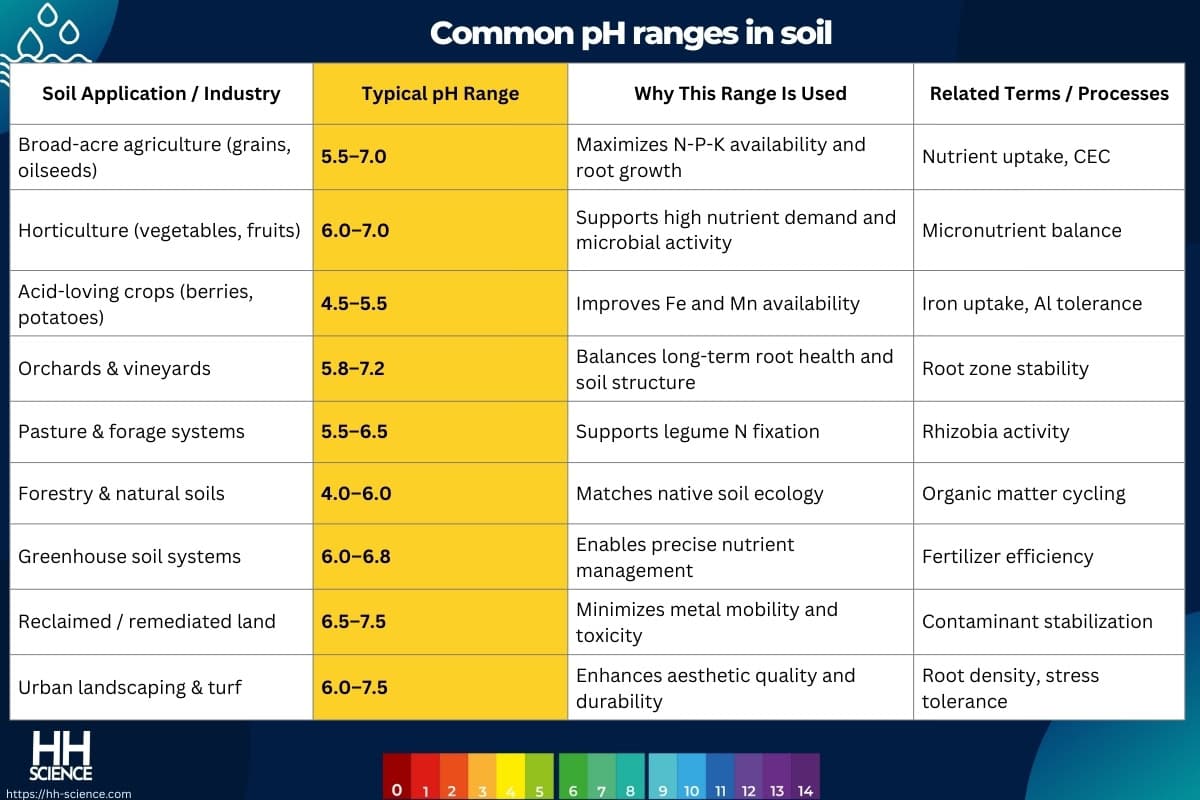
Common pH ranges in soil
Soil pH ranges differ because crop nutrient demand, soil mineralogy, microbial tolerance, and risk of metal toxicity or nutrient fixation vary across agricultural, horticultural, forestry, and land-use applications. Each range reflects a balance between nutrient solubility, biological activity, and long-term soil stability, rather than a single universal optimum.
| Soil Application / Industry | Typical pH Range | Why This Range Is Used | Related Terms / Processes |
| Broad-acre agriculture (grains, oilseeds) | 5.5–7.0 | Maximizes N-P-K availability and root growth | Nutrient uptake, CEC |
| Horticulture (vegetables, fruits) | 6.0–7.0 | Supports high nutrient demand and microbial activity | Micronutrient balance |
| Acid-loving crops (berries, potatoes) | 4.5–5.5 | Improves Fe and Mn availability | Iron uptake, Al tolerance |
| Orchards & vineyards | 5.8–7.2 | Balances long-term root health and soil structure | Root zone stability |
| Pasture & forage systems | 5.5–6.5 | Supports legume N fixation | Rhizobia activity |
| Forestry & natural soils | 4.0–6.0 | Matches native soil ecology | Organic matter cycling |
| Greenhouse soil systems | 6.0–6.8 | Enables precise nutrient management | Fertilizer efficiency |
| Reclaimed / remediated land | 6.5–7.5 | Minimizes metal mobility and toxicity | Contaminant stabilization |
| Urban landscaping & turf | 6.0–7.5 | Enhances aesthetic quality and durability | Root density, stress tolerance |
Factors that define pH control targets
pH control targets in soil applications are defined by crop requirements, soil type and texture, buffering capacity (CEC), organic matter content, climate and rainfall, irrigation water quality, fertilizer and amendment strategy, biological activity, and regulatory or quality constraints, because each factor influences how pH affects nutrient availability, toxicity risk, and long-term soil stability.
- Crop requirements: Different crops have specific optimal pH ranges that maximize nutrient uptake and root development while minimizing stress and deficiency risk.
- Soil type and texture: Sandy, loamy, and clay soils differ in mineral composition and surface charge, which affects pH stability and responsiveness to amendments.
- Buffering capacity (CEC): Soils with higher cation exchange capacity resist pH change, requiring larger or slower corrective inputs.
- Organic matter content: Organic matter influences pH through decomposition, organic acids, and improved buffering behavior.
- Climate and rainfall: High rainfall promotes leaching of base cations and gradual acidification, shifting long-term pH targets.
- Irrigation water quality: Alkalinity, bicarbonates, and dissolved salts in irrigation water directly impact soil pH drift.
- Fertilizer and amendment strategy: Nitrogen form (NH₄⁺ vs NO₃⁻), liming, and sulfur use determine acidifying or alkalizing effects.
- Biological activity: Microbial processes such as nitrification and residue decomposition continuously modify soil pH locally.
- Regulatory and quality constraints: Food safety, environmental protection, and land-use standards may impose pH limits or documentation requirements.
What happens when pH is out of range in soil applications?
When soil pH moves outside the optimal range, it leads to nutrient lockout or toxicity, reduced microbial activity, root damage, fertilizer inefficiency, increased metal mobility, yield loss, and elevated food-safety and environmental risks, because pH controls chemical solubility, biological processes, and ion exchange reactions in the soil.
| Impact Area | What Happens | Why It Occurs | Typical pH Range |
| Nutrient availability | Phosphorus fixation, micronutrient imbalance | pH alters nutrient solubility and adsorption | <5.5 or >7.5 |
| Metal toxicity | Aluminum and manganese toxicity | Increased metal solubility in acidic soils | <5.2 |
| Micronutrient deficiency | Iron, zinc, manganese deficiency | Reduced solubility in alkaline soils | >7.8 |
| Microbial activity | Reduced nitrification and decomposition | pH stress on soil microbes | <5.5 or >8.0 |
| Root health | Inhibited root elongation and function | Ion toxicity and membrane damage | <5.0 or >8.0 |
| Fertilizer efficiency | Increased losses and lower uptake | Fixation, volatilization, leaching | <5.5 or >7.5 |
| Crop yield | Reduced growth and productivity | Combined nutrient and root stress | Outside crop optimum |
| Food safety risk | Higher heavy metal uptake | Increased Cd, Pb mobility | <6.0 |
| Soil degradation | Loss of buffering capacity | Depletion of base cations | Prolonged low pH |

Effects of low pH in soil applications
Low soil pH causes nutrient deficiencies, metal toxicity, reduced microbial activity, impaired root growth, lower fertilizer efficiency, soil structural degradation, yield loss, and increased food safety risk, because acidic conditions alter ion solubility, damage biological systems, and deplete base cations.
| Effect of Low pH | What Happens at Low pH | Why It Occurs | Typical pH Threshold |
| Aluminum toxicity | Root damage, inhibited elongation | Increased Al³⁺ solubility | <5.2 |
| Manganese toxicity | Leaf chlorosis, growth suppression | Excess Mn²⁺ availability | <5.5 |
| Calcium & magnesium deficiency | Weak cell walls, poor root function | Leaching of base cations | <5.5 |
| Phosphorus fixation | Reduced P uptake | Binding with Al and Fe oxides | <5.5 |
| Reduced microbial activity | Slower nutrient cycling | Inhibited nitrifiers and decomposers | <5.5 |
| Nitrogen inefficiency | Reduced nitrification | Suppressed microbial conversion | <5.5 |
| Root system stress | Short, brittle roots | Acid injury and ion imbalance | <5.0 |
| Soil structure degradation | Poor aggregation | Loss of Ca-mediated flocculation | Prolonged acidity |
| Yield reduction | Lower biomass and quality | Combined nutrient and root stress | Crop-dependent |
| Food safety risk | Increased heavy metal uptake | Higher Cd, Pb mobility | <6.0 |

Effects of high pH in soil applications
High soil pH leads to micronutrient deficiencies, phosphorus precipitation, reduced microbial efficiency, impaired root nutrient uptake, lower fertilizer effectiveness, soil structural issues in sodic conditions, yield decline, and quality defects, because alkaline conditions reduce nutrient solubility and alter soil chemical equilibria.
| Effect of High pH | What Happens at High pH | Why It Occurs | Typical pH Threshold |
| Iron deficiency | Interveinal chlorosis | Fe becomes insoluble | >7.8 |
| Zinc deficiency | Stunted growth | Reduced Zn availability | >7.5 |
| Manganese deficiency | Leaf discoloration | Mn oxidation and precipitation | >7.5 |
| Phosphorus precipitation | Reduced P uptake | Ca–P compound formation | >7.5 |
| Reduced microbial activity | Slower organic matter breakdown | pH stress on microbes | >8.0 |
| Nitrogen inefficiency | Reduced N availability | Altered microbial processes | >8.0 |
| Root nutrient uptake limits | Weak nutrient absorption | Ion imbalance at root surface | >7.8 |
| Sodicity-related structure loss | Poor infiltration, crusting | High Na⁺ dispersion | High pH + sodic soils |
| Yield reduction | Lower biomass and quality | Combined nutrient stress | Crop-dependent |
| Quality defects | Poor color, size, uniformity | Chronic micronutrient stress | Persistent alkalinity |

Operational, quality, and compliance risks
When soil pH deviates from target ranges (typically pH 5.5–7.5 for most crops), it introduces operational inefficiencies, product quality variability, and compliance exposure, because pH directly affects nutrient efficiency, contaminant mobility, and process control consistency across agricultural systems.
- Operational risk: Reduced input efficiency – Off-range pH lowers fertilizer use efficiency through phosphorus fixation (<5.5 or >7.5), reduced nitrification (<5.5), and increased leaching, raising cost per unit yield.
- Operational risk: Yield instability – Root stress from Al³⁺ toxicity (<5.2) or micronutrient deficiencies (Fe/Zn deficiency >7.8) causes uneven growth and unpredictable harvest volumes.
- Quality risk: Nutritional and visual defects – pH-driven nutrient imbalance results in chlorosis, poor size uniformity, and reduced nutritional quality, impacting marketability.
- Quality risk: Food safety exposure – Acidic soils (<6.0) increase Cd and Pb mobility, elevating the risk of heavy metal uptake into edible tissues.
- Compliance risk: Regulatory non-conformance – Exceeding pH-related thresholds linked to GAP, food safety programs, or land-use guidelines can trigger audit findings or corrective actions.
- Compliance risk: Traceability and documentation gaps – Uncontrolled pH undermines documented soil management plans, amendment records, and corrective action logs, weakening audit defensibility.
pH measurement challenges in soil application
pH measurement in soil applications presents unique challenges because soil is a heterogeneous, partially solid matrix with variable moisture content, temperature, salinity, buffering capacity (CEC), and spatial variability, all of which affect measurement stability and repeatability. These challenges influence sampling method (in-situ vs extract), electrode response, calibration strategy, and achievable accuracy (typically ±0.1–0.3 pH), making method selection and process control critical for reliable soil pH data.
Temperature effects
Temperature is a critical challenge in soil pH measurement because it directly affects electrode response, ion activity, chemical equilibria, and biological processes, while soil temperatures can vary widely diurnally and seasonally (≈5–40 °C). If temperature effects are not controlled or compensated, they introduce systematic measurement error, poor repeatability, and misinterpretation of soil acidity or alkalinity, especially when comparing field, laboratory, and historical data.
| Temperature Factor | How It Affects pH Measurement | Related Terms | Typical Values / Conditions |
| Nernst response | Electrode slope changes with temperature | Nernst equation | ~59.16 mV/pH at 25 °C |
| Ion activity shift | Chemical equilibria shift with temperature | Activity coefficients | Error ±0.01–0.03 pH per 10 °C |
| ATC mismatch | Compensation assumes uniform temperature | Automatic Temperature Compensation | Soil gradients ±5–15 °C |
| Soil temperature variability | Field measurements fluctuate | Diurnal variation | 5–40 °C |
| Moisture–temperature coupling | Dry soil amplifies temp error | Soil water potential | High error in dry soils |
| Sample handling | Cooling/heating alters pH | Lab vs field mismatch | Extracts stabilize at 20–25 °C |
| Microbial activity | Temp affects biological pH shifts | Respiration, nitrification | Activity doubles per +10 °C |
| Sensor equilibration | Slow stabilization in cold soil | Response time (t₉₀) | Increases at <10 °C |

Fouling and contamination
Fouling and contamination are major challenges in soil pH measurement because soil particles, organic matter, salts, and biological residues readily coat the glass membrane and reference junction, disrupting ion exchange and electrical continuity. This leads to slower response time, unstable readings, offset drift, and false pH values, particularly in soils with high clay content, organic matter, fertilizers, or microbial activity.
| Fouling / Contamination Source | How It Affects Measurement | Related Terms | Typical Conditions / Values |
| Fine soil particles | Physically block glass surface | Boundary layer effect | Clay-rich soils |
| Organic matter | Forms hydrophobic films | Humic/fulvic acids | OM >3–5% |
| Fertilizer residues | Crystallize on junction | Salt precipitation | High EC soils |
| Biofilm formation | Alters diffusion pathways | Microbial fouling | Warm, moist soils |
| Reference junction clogging | Increases junction impedance | Liquid junction potential | Drift >0.1 pH |
| Cross-contamination | Transfers ions between samples | Carryover error | Poor cleaning practice |
| Oil/grease residues | Repel aqueous contact | Hydrophobic fouling | Compost-amended soils |
| Inadequate cleaning | Permanent surface damage | Glass aging | Aggressive scraping |

Pressure and flow conditions
Pressure and flow conditions present challenges in soil pH measurement because soil is a semi-static, heterogeneous medium where localized pressure, compaction, and water movement can disturb the electrode–soil interface and reference junction equilibrium. Variations in insertion force, pore-water flow, and transient hydraulic pressure affect ion diffusion and junction potential, leading to measurement noise, drift, or poor repeatability, especially in wet, compacted, or recently irrigated soils.
| Pressure / Flow Factor | How It Affects pH Measurement | Related Terms | Typical Conditions / Values |
| Insertion pressure | Alters contact at glass surface | Soil–electrode interface | High in compacted soils |
| Soil compaction | Restricts pore water movement | Bulk density | >1.6 g/cm³ |
| Pore water flow | Disturbs ion equilibrium | Hydraulic gradient | After irrigation/rain |
| Transient pressure | Causes junction instability | Junction potential | Drift ±0.05–0.2 pH |
| Saturated soils | Create micro-flow around probe | Darcy flow | Waterlogged conditions |
| Slurry agitation | Introduces flow artifacts | Mixing velocity | Lab extract prep |
| Reference leakage | Pressure-driven electrolyte loss | Reference depletion | High insertion force |
| Uneven contact | Creates air gaps | Poor wetting | Dry or coarse soils |

Chemical exposure
Chemical exposure is a significant challenge in soil pH measurement because soils may contain residual disinfectants, corrosion inhibitors, fertilizers, pesticides, and soil amendments that chemically attack or interfere with the pH electrode’s glass membrane and reference system. These chemicals can cause membrane poisoning, reference junction blockage, electrolyte contamination, and accelerated aging, leading to systematic offset, reduced slope, slow response, and shortened sensor lifespan, especially in intensively managed or remediated soils.
| Chemical Source | How It Affects pH Measurement | Related Terms | Typical Conditions / Values |
| Disinfectants | Oxidative damage to glass | Chlorine, peroxides | Treated soils, reuse water |
| Corrosion inhibitors | Junction fouling or poisoning | Phosphates, silicates | Industrial land |
| Nitrogen fertilizers | Localized pH shifts | NH₄⁺ nitrification | Acidification zones |
| Lime & alkaline amendments | Coating and precipitation | CaCO₃, hydroxides | High pH soils |
| Sulfur-based amendments | Aggressive acidity | Elemental S, sulfates | pH <5.0 zones |
| Pesticides & herbicides | Membrane adsorption | Organic solvents | Treated fields |
| Salts & ions | Increased junction impedance | High EC, TDS | Saline soils |
| Heavy metals | Glass surface interaction | Cu²⁺, Pb²⁺ | Contaminated sites |
| Improper cleaning chemicals | Permanent glass damage | Strong acids/bases | pH <2 or >11 |

Bio-load or process residues
Bio-load and process residues are major challenges in soil pH measurement because soils naturally contain microorganisms, root exudates, decomposing organic matter, and agricultural residues that interact continuously with the pH electrode surface and reference junction. These biological and process-derived materials cause biofilm formation, organic coating, junction clogging, localized biochemical pH shifts, and slow sensor response, reducing measurement accuracy and repeatability—especially in high-organic, biologically active, or intensively fertilized soils.
| Bio-load / Residue Source | How It Affects pH Measurement | Related Terms | Typical Conditions / Values |
| Microbial biofilms | Creates diffusion barriers | Biofouling, EPS | Warm, moist soils |
| Root exudates | Alters local pH near roots | Rhizosphere effect | pH shifts ±0.5 |
| Decomposing organic matter | Coats glass membrane | Humic substances | OM >3–5% |
| Crop residues | Physical blockage | Cellulose, lignin | Post-harvest soils |
| Manure & compost | High organic load | Biological oxygen demand | Organic farming |
| Nitrification zones | Local acidification | NH₄⁺ → NO₃⁻ | pH drop 0.2–0.6 |
| Denitrification zones | Local alkalinity | Anaerobic microbes | Waterlogged soils |
| Sludge or digestate | Severe junction clogging | Suspended solids | Remediated land |
| Infrequent cleaning | Persistent drift | Slope loss | Drift >0.1 pH |

Common pH sensor types used in soil applications
Common pH sensor types used in soil applications include glass electrode pH probes for soil slurries or extracts, rugged in-situ soil pH probes, flat-surface pH electrodes, ISFET pH sensors, and portable pH meters, each selected based on soil heterogeneity, moisture content, and required accuracy. Glass electrodes dominate laboratory and slurry methods due to high precision (±0.01–0.05 pH), in-situ probes are used for direct field measurement despite wider uncertainty (±0.1–0.3 pH), ISFET and flat-surface sensors offer improved durability and fast response in compacted or abrasive soils, and portable meters support field sampling, verification, and spatial mapping across variable soil conditions.
Combination pH sensors
Combination pH sensors are widely used in soil applications because they integrate the measuring electrode and reference electrode into a single body, simplifying handling, reducing setup variability, and improving measurement consistency in soil slurries, extracts, and in-situ field measurements. This all-in-one design improves robustness in heterogeneous soils while maintaining acceptable accuracy (±0.05–0.1 pH) and compatibility with both laboratory and portable field instruments.
| Feature | Description | Why It Matters in Soil Applications |
| Integrated measuring & reference electrode | Single sensor body | Reduces positioning errors in soil matrices |
| Compact design | Short electrode geometry | Easier insertion into soil or slurry |
| Single reference junction | Shared reference system | Simplifies maintenance and calibration |
| Glass membrane options | Standard or rugged glass | Balances sensitivity and durability |
| Electrolyte system | Gel or refillable | Supports variable soil moisture |
| Compatibility | Works with portable & lab meters | Enables field-to-lab consistency |
| Typical accuracy | ±0.05–0.1 pH | Suitable for agronomic decisions |
| Ease of calibration | Standard buffers (pH 4/7) | Streamlines routine soil testing |

Differential pH sensors
Differential pH sensors are used in soil applications where reference stability is difficult to maintain, such as high-salinity soils, contaminated land, high organic content soils, or long-term in-situ monitoring, because they eliminate the traditional single reference junction. By using two matched glass electrodes and measuring the potential difference, these sensors reduce junction clogging, contamination effects, and drift, improving reliability under harsh soil conditions.
| Feature | Description | Why It Matters in Soil Applications |
| Dual glass electrodes | Measures differential potential | Eliminates dependence on a single reference junction |
| No liquid junction | Reference-free design | Reduces clogging in fine or organic soils |
| Fouling resistance | Less sensitive to contamination | Improves stability in high bio-load soils |
| Long-term stability | Reduced drift over time | Suitable for continuous in-situ monitoring |
| Salinity tolerance | Performs well in high EC soils | Maintains accuracy where standard probes fail |
| Low maintenance | Minimal cleaning and refilling | Reduces field service frequency |
| Typical accuracy | ±0.1 pH | Adequate for soil management decisions |
| Installation style | In-situ or slurry compatible | Flexible deployment options |

Digital or smart pH sensors
Digital (smart) pH sensors are increasingly used in soil applications because they convert the high-impedance electrode signal into a digital output at the sensor, reducing noise, drift, and signal loss caused by long cables, variable moisture, temperature gradients, and electrically noisy field equipment. They are especially valuable for field monitoring, mobile testing, and networked soil sensing, where data integrity, diagnostics, and traceability matter as much as absolute accuracy.
| Feature | Description | Why It Matters in Soil Applications |
| On-sensor signal conversion | Analog signal digitized at probe | Minimizes noise from long cables and field interference |
| Digital communication | RS485, Modbus, UART, proprietary | Enables stable transmission over meters to hundreds of meters |
| Integrated temperature sensor | Built-in ATC | Compensates temperature effects (±0.01–0.03 pH / 10 °C) |
| Stored calibration data | Calibration coefficients in memory | Allows sensor replacement without full recalibration |
| Sensor diagnostics | Slope, offset, health status | Early detection of aging or fouling |
| Data logging compatibility | Time-stamped measurements | Supports trend analysis and traceability |
| Field robustness | Encapsulated electronics | Better resistance to moisture and contamination |
| Typical accuracy | ±0.05–0.1 pH | Suitable for agronomic soil management |

Inline, immersion, or portable configurations
Different pH sensor configurations are used in soil applications because soil pH is measured across laboratory extracts, field environments, and process streams (e.g., soil slurries, leachates, and irrigation return flows), each requiring a different balance of accuracy, durability, and practicality. Selecting the right configuration ensures representative measurement while minimizing handling error and maintenance burden.
| Configuration | Typical Use in Soil Applications | Key Features | Why It Is Used |
| Inline | Soil extract or leachate flow systems | Continuous flow measurement, stable conditions | Enables automated monitoring in labs or remediation systems |
| Immersion | Soil slurries, saturation pastes | Direct contact, stable equilibration | Standard method for laboratory soil pH testing |
| Immersion | In-situ soil probes | Rugged body, moisture tolerance | Allows direct field measurement without sample removal |
| Portable | Field sampling & mapping | Handheld, battery-powered | Supports rapid spatial variability assessment |
| Portable | Verification & calibration | Reference measurements | Confirms accuracy of fixed or in-situ sensors |
| Portable | Mobile soil testing | Flexible deployment | Reduces lab dependency and turnaround time |

Installation and maintenance considerations in soil applications
In soil applications, proper installation and maintenance of pH sensors are critical because soil heterogeneity, variable moisture content, temperature gradients (≈5–40 °C), and fouling from clay and organic matter directly affect electrode contact, reference stability, and response time. Correct practices—such as consistent sampling depth, adequate soil moisture, regular cleaning to remove fine particles and biofilms, routine calibration with pH 4.01/7.00 buffers, temperature compensation, and timely replacement when slope drops below ~85%—ensure reliable, comparable soil pH data for agronomic decision-making and compliance reporting.
Typical installation locations
In soil applications, pH sensors are installed at locations that best represent root-zone conditions, bulk soil chemistry, or controlled test environments, depending on whether the goal is field assessment, laboratory analysis, or process monitoring. Location selection is driven by soil depth, moisture availability, accessibility, and the need for repeatable and representative measurements.
| Installation Location | Application Area | Related Features | Why It Is Used |
| Root zone (field) | In-situ soil monitoring | Rugged probe, moisture tolerance | Reflects actual plant nutrient environment |
| Topsoil layer | Agronomic assessment | Easy access, high variability | Indicates fertilizer and amendment effects |
| Subsoil layer | Long-term soil health | Extended probe length | Detects acidification or alkalinity trends |
| Soil slurry / extract vessel | Laboratory testing | Controlled conditions | Standardized, repeatable measurements |
| Saturation paste | Soil salinity & pH tests | Stable moisture matrix | Reference method for soil analysis |
| Leachate collection point | Drainage monitoring | Inline or immersion sensor | Tracks nutrient and contaminant movement |
| Compost or amendment mix | Input material testing | Fouling-resistant design | Verifies amendment quality |
| Portable field sample | Spot testing | Handheld measurement | Supports spatial mapping and verification |

Calibration and cleaning frequency
In soil applications, calibration and cleaning frequency are critical because pH sensors are exposed to fine particles, organic matter, variable moisture, salts, and biological residues, all of which accelerate drift, junction clogging, and response-time degradation. Maintenance intervals depend on measurement method (in-situ vs slurry), soil type, organic matter content, and sensor design, making structured routines essential for reliable soil pH data.
| Maintenance Aspect | Typical Frequency | Related Features / Terms | Why It Is Required |
| pH calibration (routine) | Every 10–20 measurements or 1–2 weeks | pH 4.01 / 7.00 buffers | Corrects offset and slope drift |
| Calibration (field in-situ probes) | Weekly to biweekly | ATC, stored calibration data | Compensates environmental variability |
| Cleaning (light soils) | Every 1–2 weeks | Low clay, low OM | Removes fine particle coating |
| Cleaning (clay / organic soils) | Every 3–7 days | High OM (>3–5%), clay | Prevents junction clogging |
| Post-clean calibration | After every cleaning | Two-point calibration | Restores accuracy after fouling removal |
| Visual inspection | Before each use | Glass clarity, junction condition | Detects physical damage early |
| Storage maintenance | After each session | KCl storage solution | Prevents glass dehydration |
| Sensor replacement check | Ongoing | Slope <85%, unstable readings | Identifies end-of-life sensors |

Expected sensor lifespan
In soil applications, pH sensor lifespan is limited by abrasive particles, organic fouling, variable moisture, temperature cycling (≈5–40 °C), and repeated cleaning and calibration, all of which gradually degrade the glass membrane and reference system. Actual lifespan depends on sensor type, junction design, usage frequency, soil characteristics, and maintenance quality, making realistic replacement planning essential for consistent soil monitoring.
| Sensor Type / Condition | Expected Lifespan | Related Features | Why Lifespan Varies |
| Standard glass pH electrode | 6–12 months | Thin glass, single junction | Faster abrasion and clogging |
| Rugged soil pH probe | 12–18 months | Thicker glass, reinforced body | Better resistance to soil contact |
| Digital / smart pH sensor | 12–24 months | Signal conditioning, diagnostics | Reduced drift, monitored aging |
| Differential pH sensor | 18–24 months | No liquid junction | Less fouling-related failure |
| High clay / organic soils | 6–9 months | High abrasion, bio-load | Accelerated surface degradation |
| Well-maintained sensors | 18–24 months | Regular cleaning, proper storage | Slower chemical and mechanical aging |
| Poor maintenance | <6 months | Dehydration, aggressive cleaning | Rapid slope loss |
| End-of-life indicator | — | Slope <85%, unstable offset | Signals sensor replacement |

Trade-offs between accuracy, maintenance, and durability
In soil applications, the trade-off between accuracy, maintenance, and durability exists because high-accuracy pH sensors (±0.01–0.05 pH) rely on thin, sensitive glass membranes and low-impedance reference systems that are more vulnerable to abrasion, fouling, moisture variability, and temperature cycling (≈5–40 °C). More durable soil probes use thicker glass, protected or junction-free designs, and rugged housings to withstand physical stress and bio-load, reducing maintenance frequency but typically shifting practical field accuracy to ±0.1–0.3 pH, which is acceptable for agronomic decision-making but not laboratory-grade analysis.
Regulatory or quality considerations in soil applications
In soil applications, regulatory and quality considerations are important because soil pH directly affects nutrient management, environmental protection, food safety, and land-use compliance, requiring controlled target ranges and documented soil management practices. Requirements linked to GAP, sustainable agriculture programs, environmental impact assessments, soil quality standards, calibration records, and defined pH thresholds (commonly pH 5.5–7.5 for productive soils) ensure traceable, defensible decisions in fertilization, liming, remediation, and long-term land stewardship.
Industry and quality standards in soil applications
Industry and quality standards in soil applications exist to ensure data comparability, agronomic reliability, environmental protection, and food safety, since soil pH directly influences nutrient management, contaminant mobility, and land-use decisions. These frameworks define sampling methods, target pH ranges, calibration practices, documentation, and decision thresholds, making standardized pH measurement essential for laboratories, growers, regulators, and agri-technology providers.
| Standard / Framework | Scope | Related Terms / Values | Why It Matters for Soil pH | Key Measurement Features |
| ISO 10390 | Soil pH determination | pH in water, CaCl₂, KCl | Global reference method for soil pH | Standardized extraction, lab accuracy |
| ISO 18400 series | Soil quality & sampling | Field sampling protocols | Ensures representative soil pH data | Repeatable sampling depth |
| ISO 17025 | Testing laboratory competence | Traceability, uncertainty | Validates soil pH lab results | Calibration control, QA/QC |
| ASTM D4972 | Soil pH testing | Electrometric methods | Widely used in engineering & agri soils | Method consistency |
| USDA NRCS guidelines | Agricultural soil management | Liming thresholds, pH targets | Supports fertilizer and amendment decisions | Field + lab correlation |
| FAO soil guidelines | Global soil assessment | Soil fertility indicators | Harmonizes international soil data | Comparable pH datasets |
| GAP (Good Agricultural Practices) | Crop production | Soil management records | Links soil pH to food safety | Documented monitoring |
| Environmental soil regulations | Land & contamination control | Metal mobility vs pH | Prevents environmental risk | Defined pH limits |
| Organic farming standards | Organic soil management | Input restrictions | Requires controlled pH adjustment | Verified measurement methods |
| National soil classification systems | Land evaluation | Soil reaction classes | Guides crop suitability | Reference pH ranges |

Internal process and quality requirements in soil applications
In soil applications, internal process and quality requirements are defined to ensure consistent agronomic decisions, reliable trend analysis, cost-effective input use, and defensible documentation, even when regulations do not prescribe exact limits. These requirements translate soil science principles into measurable pH targets, control bands, sampling rules, maintenance routines, and data practices that directly govern how soil pH is measured, interpreted, and acted upon.
| Internal Requirement | Related Terms / Typical Values | Why It Is Required | Key Measurement / System Features |
| Target soil pH range | pH 5.5–7.5 (crop-specific) | Maximizes nutrient availability and root performance | Measurement accuracy ±0.1–0.3 pH |
| Acceptable deviation band | ±0.2–0.5 pH | Prevents over-correction and instability | Repeatable measurement method |
| Sampling consistency | Fixed depth, location, timing | Ensures data comparability over time | Standardized sampling SOP |
| Measurement method control | Slurry, extract, or in-situ | Avoids method-induced bias | Defined test protocol |
| Calibration discipline | Daily (lab) / weekly (field) | Maintains data integrity | Two-point calibration (pH 4/7) |
| Cleaning protocol | Soil-type dependent | Prevents fouling-related drift | Appropriate cleaning solutions |
| Data traceability | Time-, location-stamped results | Supports trend analysis and audits | Digital records, metadata |
| Decision thresholds | Lime or sulfur trigger values | Enables timely corrective action | Alarm or review limits |
| Verification checks | Portable or reference testing | Detects sensor or process error | Cross-check capability |
| Asset lifecycle planning | Sensor lifespan 6–24 months | Avoids degraded data use | Slope/offset monitoring |

Compliance-driven monitoring needs in soil applications
In soil applications, compliance-driven monitoring needs exist to demonstrate that soil management practices are safe, agronomically sound, and environmentally responsible, particularly where soil pH affects nutrient use, contaminant mobility, crop safety, and land-use decisions. These needs require verifiable pH measurement, documented methods, calibration records, and historical data, ensuring defensible compliance with agricultural, environmental, and food-quality frameworks.
| Monitoring Need | Related Terms / Typical Values | Why It Is Required | Key Measurement / System Features |
| Defined pH targets | pH 5.5–7.5 (crop/land-use specific) | Demonstrates controlled soil conditions | Method-aligned accuracy |
| Method traceability | ISO 10390, ASTM D4972 | Ensures comparable results | Documented procedures |
| Calibration records | pH 4.01 / 7.00 buffers | Verifies measurement validity | Calibration logging |
| Sampling documentation | Depth, location, timing | Prevents sampling bias | SOP-driven sampling |
| Accuracy verification | ±0.1–0.3 pH acceptance | Confirms data fitness | Reference or cross-check |
| Trend monitoring | Long-term pH drift | Supports corrective actions | Time-series data |
| Amendment justification | Lime/sulfur trigger pH | Defends management decisions | Threshold-based reporting |
| Environmental protection | Metal mobility vs pH | Prevents contamination risk | Defined pH limits |
| Food safety linkage | Cd, Pb uptake risk | Protects edible crops | Risk-based pH control |
| Audit readiness | Complete records | Supports inspections | Centralized data storage |

Selecting the right pH measurement approach in soil applications
Selecting the right pH measurement approach in soil applications is critical because soil pH varies spatially and temporally, and different methods—such as in-situ probes, soil slurries, saturation pastes, or extract-based measurements (water, CaCl₂, KCl)—produce systematically different results that directly affect agronomic and regulatory decisions. The chosen approach must align with soil texture, moisture content, buffering capacity (CEC), target accuracy (±0.1–0.3 pH), temperature conditions, and compliance requirements, ensuring that measured pH values are representative, comparable, and fit for fertilizer planning, amendment control, and long-term soil management.
Decision support for soil applications
Decision support provides a structured framework to translate soil science and agronomic objectives—such as crop-specific target pH (typically 5.5–7.5), acceptable deviation bands (±0.2–0.5 pH), and amendment trigger thresholds—into concrete measurement requirements. It plays a key role in selecting the right pH measurement approach by defining required accuracy (±0.1–0.3 pH), monitoring frequency, spatial sampling density, and data confidence level needed to support liming, acidification, and compliance decisions.
Application-driven measurement strategies
Application-driven measurement strategies determine how soil pH should be measured based on soil texture, moisture variability, organic matter content, land use (cropland, remediation, forestry), and operational context (field vs laboratory). This step guides the choice between in-situ probes, soil slurries, saturation paste methods, or extract-based measurements (water, CaCl₂, KCl), ensuring the selected method produces representative and comparable data for the intended agronomic or regulatory purpose.
Linking soil applications to sensor selection and oem solutions
Linking soil applications to sensor selection converts process and measurement requirements into specific sensor features and OEM offerings, such as rugged glass membranes, fouling-resistant or junction-free designs, digital signal conditioning, ATC, and portable or lab-grade form factors. This step ensures the chosen OEM solution matches environmental stress, maintenance capability, lifecycle cost, and data integration needs, delivering reliable soil pH data across field monitoring, laboratory testing, and long-term soil management programs.


