
Why does pH matter in Hydroponic Agriculture applications?
pH matters in hydroponic agriculture applications because it directly affects nutrient availability, root health, microbial activity, uptake efficiency, crop growth rate, yield quality, and system stability in soil-less cultivation where plants rely entirely on the nutrient solution.
- Nutrient availability: pH determines the solubility and ionic form of macro- and micronutrients such as nitrogen, phosphorus, iron, and calcium.
- Root health: Out-of-range pH stresses roots, damages root membranes, and reduces absorption efficiency.
- Nutrient uptake efficiency: Optimal pH enables plants to absorb nutrients at the intended ratios, preventing deficiencies or toxicities.
- Microbial activity: Beneficial microbes in the root zone function best within specific pH ranges that support nutrient cycling.
- Crop growth and yield: Stable pH supports consistent metabolism, leading to uniform growth and higher yields.
- Product quality: pH control influences flavor, texture, and nutrient density of harvested crops.
- System stability: Proper pH buffering prevents rapid chemistry swings in recirculating nutrient solutions.
How does pH influence the quality and safety of hydroponic agriculture?
pH influences the quality and safety of hydroponic agriculture by controlling nutrient chemistry in the root zone, plant stress response, microbial balance, and the risk of deficiencies or toxicities in recirculating nutrient solutions. Because plants have no soil buffer in hydroponic systems, even small pH shifts can quickly affect crop health, yield consistency, and food quality.
| Influence Area | How pH Affects Hydroponic Systems | Related Terms | Quality / Safety Value |
| Nutrient solubility | pH controls whether nutrients stay dissolved or precipitate | Solubility, chelation | Prevents hidden deficiencies |
| Micronutrient availability | Iron, manganese, zinc availability is pH-dependent | Fe-EDTA, Fe-DTPA | Healthy leaf color and growth |
| Macronutrient balance | pH affects nitrate, phosphate, and calcium uptake | N–P–K balance | Uniform crop development |
| Root membrane function | Extreme pH damages root cell membranes | Root permeability | Strong root systems |
| Nutrient toxicity risk | Incorrect pH increases ion toxicity | Ion antagonism | Reduced crop loss |
| Microbial balance | pH shifts favor harmful or beneficial microbes | Rhizosphere biology | Lower disease pressure |
| Biofilm formation | pH affects biofilm growth in systems | Fouling, slime | Cleaner systems, stable flow |
| Crop stress response | pH stress triggers metabolic disruption | Abiotic stress | Higher resilience |
| Yield consistency | Stable pH supports predictable uptake | Uptake kinetics | Reliable production planning |
| Food quality & safety | Balanced nutrition affects taste and residues | Nutrient density | Market-ready produce |

Why are hydroponic agriculture systems sensitive to pH deviations?
Hydroponic agriculture systems are highly sensitive to pH deviations because they operate without soil buffering, relying entirely on the nutrient solution to deliver water, minerals, and ions directly to plant roots. When pH drifts outside the optimal range, nutrient solubility and uptake are immediately disrupted, leading to deficiencies or toxicities, root stress, microbial imbalance, reduced growth rates, inconsistent yields, and lower crop quality—often within hours rather than days.
Typical pH ranges and control targets in Hydroponics Agriculture applications
Typical pH ranges and control targets in hydroponic agriculture define the optimal root-zone chemistry needed to maintain nutrient solubility, balanced uptake, and stable crop performance. Clear pH targets enable growers to prevent hidden deficiencies, optimize nutrient efficiency, and maintain consistent yields across different crop types and system designs.
Common pH Ranges in Hydroponic Agriculture
Common pH ranges in hydroponic agriculture generally fall between pH 5.5–6.5, with crop-specific targets chosen to maximize nutrient solubility, prevent ion lockout, and support healthy root physiology. Different crops and system designs (NFT, DWC, drip, aeroponics) require slightly different setpoints to balance micronutrient availability (e.g., Fe, Mn) against calcium and magnesium uptake.
| Crop / System Category | Typical pH Range | Why This Range Is Used | Crop / Operational Value |
| Leafy greens (lettuce, spinach) | 5.8 – 6.2 | Maximizes Fe and Mn availability | Fast growth, uniform leaves |
| Herbs (basil, mint, cilantro) | 5.5 – 6.5 | Broad tolerance with aromatic quality | Strong flavor, healthy foliage |
| Fruiting crops (tomato, pepper) | 5.8 – 6.3 | Balances Ca uptake and micronutrients | Reduced blossom-end rot |
| Cucumbers | 5.8 – 6.2 | Supports rapid vegetative growth | High yield consistency |
| Strawberries | 5.5 – 6.0 | Enhances Fe uptake and fruit quality | Improved color and sweetness |
| Cannabis (hydroponic) | 5.5 – 6.2 | Optimizes macro/micronutrient uptake | Potency and biomass control |
| Microgreens | 5.5 – 6.0 | Rapid nutrient absorption | Short-cycle uniformity |
| NFT systems | 5.8 – 6.2 | Thin film amplifies pH effects | Stable uptake in low volume |
| DWC / raft systems | 5.5 – 6.5 | Larger volume buffers minor swings | Root health and oxygen balance |
| Drip irrigation (hydroponic) | 5.8 – 6.3 | Prevents emitter clogging and lockout | System reliability |
| Aeroponics | 5.5 – 6.0 | Fine mist increases sensitivity | Precise nutrient delivery |
| Seedling / propagation stage | 5.6 – 6.0 | Sensitive early root development | Higher establishment success |

Factors that define pH control targets
pH control targets in hydroponic agriculture are defined by crop species, growth stage, nutrient formulation, system design, water source chemistry, temperature, microbial activity, and management objectives, because pH directly governs nutrient availability and root-zone stability.
- Crop species: Different crops have unique nutrient uptake profiles and optimal pH windows.
- Growth stage: Seedlings, vegetative growth, and fruiting stages require slightly different pH to support changing nutrient demand.
- Nutrient formulation: Chelation type and nutrient ratios (e.g., Fe-EDTA vs. Fe-DTPA) dictate effective pH range.
- System design: NFT, DWC, drip, and aeroponics differ in solution volume and buffering behavior.
- Water source chemistry: Source water alkalinity, hardness, and baseline pH set starting conditions and buffering capacity.
- Temperature: Root-zone temperature affects uptake rates and pH drift speed.
- Microbial activity: Beneficial and harmful microbes respond differently to pH, influencing root health.
- Management objectives: Yield maximization, quality traits, or resource efficiency drive tighter or broader control bands.
What happens when pH is out of range in Hydroponics Agriculture applications?
When pH is out of range in hydroponic agriculture applications, it leads to nutrient lockout or toxicity, root damage, reduced uptake efficiency, microbial imbalance, biofilm formation, uneven growth, yield loss, and quality defects, because plants depend entirely on solution chemistry with no soil buffering to moderate pH-driven reactions.
| Impact Area | Typical pH Condition | Why It Happens | Crop / Operational Impact |
| Micronutrient lockout (Fe, Mn, Zn) | High pH > 6.8 | Reduced solubility and chelation effectiveness | Chlorosis, stunted growth |
| Calcium & magnesium deficiency | Low pH < 5.5 | Ion competition and root membrane stress | Tip burn, blossom-end rot |
| Nutrient toxicity | Low pH < 5.3 | Increased solubility of certain ions | Root burn, growth inhibition |
| Reduced nutrient uptake efficiency | Outside target band | Imbalanced ion availability | Poor FCR for nutrients |
| Root damage & stress | Extreme pH < 5.0 or > 7.0 | Disrupted root cell integrity | Reduced water and nutrient absorption |
| Microbial imbalance | Sustained deviation | Shift toward harmful microbes | Higher disease pressure |
| Biofilm and slime buildup | Unstable pH | Favorable conditions for fouling organisms | Clogged emitters, uneven flow |
| Uneven crop growth | Frequent pH swings | Inconsistent nutrient delivery | Non-uniform harvests |
| Yield reduction | Chronic deviation | Compounded nutrient deficiencies | Lower productivity |
| Quality defects | Late-stage deviation | Incomplete nutrient uptake | Poor taste, texture, shelf life |

Effects of low pH in Hydroponic Agriculture applications
Low pH in hydroponic agriculture applications causes root damage, nutrient toxicity, calcium and magnesium deficiency, impaired nutrient uptake, microbial imbalance, reduced growth, yield loss, and quality defects, because acidic conditions alter ion availability, damage root membranes, and disrupt rhizosphere chemistry in soil-less systems.
| Effect of low pH | Why It Occurs at Low pH | Crop / Operational Impact |
| Root damage and stress | Acidic solution irritates root tissue and cell membranes | Reduced water and nutrient absorption |
| Micronutrient toxicity (Fe, Mn) | Increased solubility at low pH | Leaf spotting, growth inhibition |
| Calcium deficiency | Ca uptake is suppressed in acidic conditions | Tip burn, blossom-end rot |
| Magnesium deficiency | Ion competition limits Mg absorption | Interveinal chlorosis |
| Reduced nutrient uptake efficiency | Imbalanced ion availability | Slower growth, poor vigor |
| Microbial imbalance | Beneficial microbes decline; pathogens gain advantage | Higher disease pressure |
| Root-zone instability | Low buffering accelerates pH swings | Frequent corrective dosing |
| Reduced yield | Compounded nutrient stress over time | Lower productivity |
| Quality defects | Incomplete nutrient assimilation | Poor taste, texture, shelf life |
| System stress | Increased acid dosing and maintenance | Higher operating costs |

Effects of high pH in Hydroponic Agriculture applications
High pH in hydroponic agriculture applications causes micronutrient lockout (especially iron), reduced phosphorus availability, calcium precipitation, impaired root uptake, microbial imbalance, uneven growth, yield loss, and quality defects, because alkaline conditions reduce nutrient solubility and disrupt ion exchange in soil-less root zones.
| Effect of high pH | Why It Occurs at High pH | Crop / Operational Impact |
| Iron deficiency (chlorosis) | Fe becomes insoluble above ~pH 6.8 | Yellowing leaves, stunted growth |
| Manganese & zinc lockout | Reduced micronutrient solubility | Weak growth, leaf deformities |
| Phosphorus availability loss | Phosphate precipitates with Ca/Mg | Poor root and flower development |
| Calcium precipitation | Carbonate formation at higher pH | Emitter clogging, uneven dosing |
| Reduced root uptake efficiency | Altered ion gradients at the root surface | Slower nutrient absorption |
| Microbial imbalance | Shift toward less beneficial rhizosphere microbes | Higher disease susceptibility |
| Biofilm and scale buildup | Alkalinity favors deposits on surfaces | Maintenance burden, flow issues |
| Uneven crop growth | Variable nutrient access across the system | Non-uniform harvests |
| Yield reduction | Chronic deficiencies compound over time | Lower output per cycle |
| Quality defects | Incomplete nutrient assimilation | Poor flavor, texture, shelf life |

Operational, quality, and compliance risks
When pH is out of range in hydroponic agriculture applications, operational, quality, and compliance risks increase rapidly because nutrient delivery, plant health, and system performance are directly tied to solution chemistry.
- Operational risks: pH deviations cause nutrient imbalance, emitter clogging, biofilm formation, and frequent corrective dosing, increasing labor, chemical consumption, and the risk of system downtime or cascading failures.
- Quality risks: Crops experience nutrient deficiencies or toxicities, uneven growth, reduced yield, and defects in taste, texture, and shelf life, directly impacting marketability and revenue.
- Compliance and market risks: In commercial production, poor pH control can lead to failure in meeting food safety standards, buyer specifications, or certification requirements (e.g., GlobalG.A.P., organic or residue-related controls), resulting in rejected batches and reputational damage.
pH measurement challenges in the Hydroponics Agriculture application
pH measurement challenges in hydroponic agriculture arise from low buffering capacity, continuous nutrient dosing, biofilm formation, temperature variation, and recirculating system dynamics, all of which can cause rapid pH drift and localized gradients. Overcoming these challenges is essential to obtain reliable pH data for nutrient management, root health protection, and consistent crop performance in high-precision growing systems.
Temperature effects
Temperature effects are a major pH measurement challenge in hydroponic agriculture because temperature directly influences electrode response, nutrient chemistry, root uptake rates, and microbial activity, all of which affect both true pH and how it is measured. Fluctuations from ambient conditions, grow lights, nutrient solution circulation, and seasonal changes can cause apparent pH drift or hide developing nutrient imbalances if temperature compensation and sensor placement are not properly managed.
| Temperature Condition | How It Affects pH Measurement | Related Terms | Crop / Operational Value |
| Daily temperature fluctuations | Alters electrode slope and response speed | Nernst equation | Accurate trend interpretation |
| Inadequate temperature compensation | Measured pH deviates from actual chemistry | ATC (Automatic Temperature Compensation) | Prevents incorrect dosing |
| Warm nutrient solutions (>22 °C) | Accelerates nutrient reactions and uptake | Root metabolism | Stable growth and uptake control |
| Cold nutrient solutions (<16 °C) | Slows electrode response and root activity | High-impedance glass | Reliable readings in cool conditions |
| Heat from grow lights | Causes localized warming near sensors | Thermal gradients | Representative root-zone monitoring |
| Chiller or heater outlets | Creates sudden temperature changes | Thermal shock | Prevents false pH spikes |
| Temperature-driven pH drift | CO₂ solubility changes with temperature | Carbonate system | Correct interpretation of pH trends |
| Microbial activity changes | Warmer temperatures increase bioactivity | Rhizosphere biology | Balanced nutrient cycling |
| Seasonal temperature variation | Long-term shift in system behavior | Environmental load | Predictable crop planning |

Fouling and contamination
Fouling and contamination are key pH measurement challenges in hydroponic agriculture because nutrient-rich solutions promote biofilm growth, organic slime, algae, and mineral precipitation that interact directly with sensor surfaces. These deposits distort the micro-environment at the glass membrane and reference junction, causing drift, slow response, and non-representative readings that can lead to incorrect nutrient dosing and hidden deficiencies.
| Fouling / Contamination Source | How It Affects pH Measurement | Related Terms | Crop / Operational Value |
| Biofilm on sensor surface | Creates diffusion barriers at the glass membrane | Biofouling, EPS | Stable long-term pH trends |
| Algae growth | Causes localized pH shifts via photosynthesis | Diurnal pH swing | Accurate day/night control |
| Nutrient salt deposits | Precipitate on glass at high EC or high pH | Scaling, precipitation | Prevents false high pH readings |
| Iron and micronutrient residues | Coat electrode and alter surface chemistry | Chelates, Fe oxidation | Reliable micronutrient control |
| Organic root exudates | Form slimy films on probes | Rhizodeposition | Representative root-zone data |
| Biofilm in emitters and lines | Releases debris onto sensors | System fouling | Consistent solution chemistry |
| Poor circulation zones | Accumulate solids near probes | Dead zones | Accurate system-wide monitoring |
| Infrequent cleaning | Progressive buildup over time | Maintenance interval | Predictable sensor performance |
| High EC nutrient solutions | Accelerate scaling and residue formation | Electrical conductivity | Reduced drift and noise |
| Warm solution temperatures | Speed up biological growth | Microbial kinetics | Lower maintenance burden |

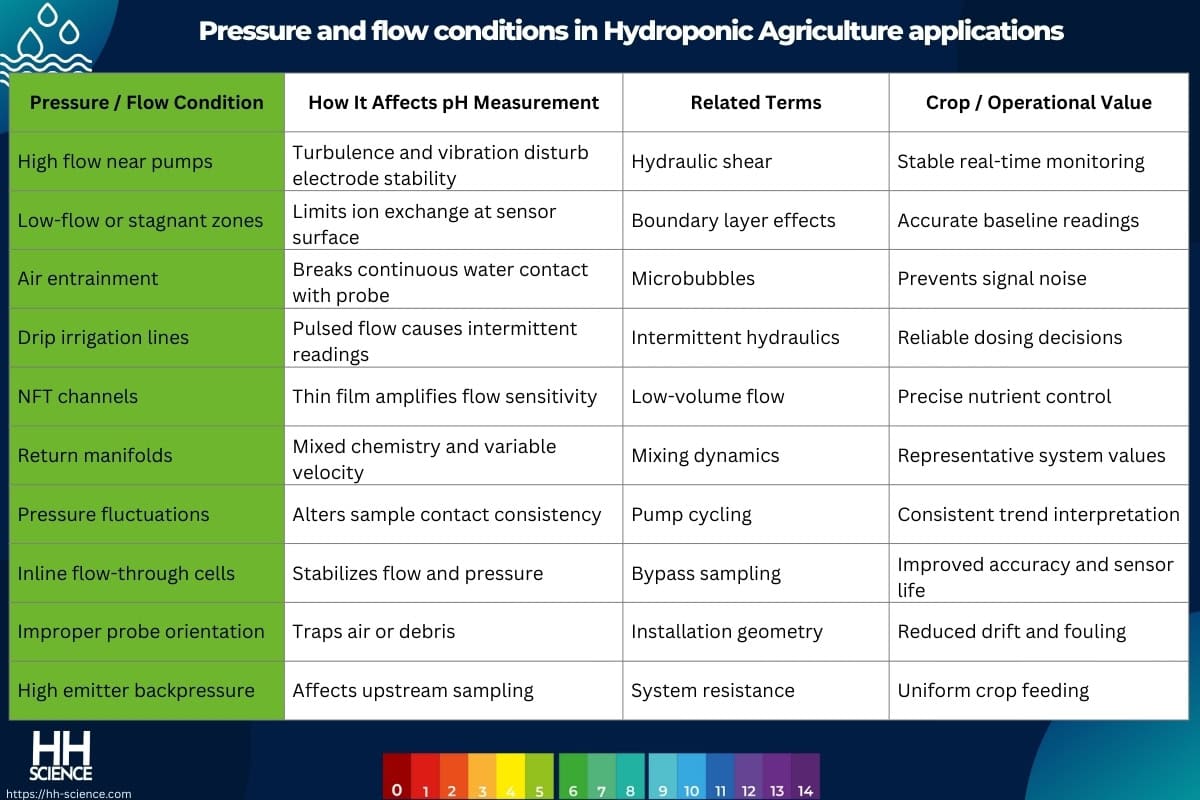
Pressure and flow conditions
Pressure and flow conditions are a pH measurement challenge in hydroponic agriculture because nutrient solutions are continuously circulated through pumps, emitters, channels, and return lines, creating variable flow velocity, turbulence, low-pressure zones, and air entrainment. Non-representative hydraulics can cause unstable readings, delayed response, or localized pH bias, leading to incorrect dosing and uneven nutrient delivery across crops.
| Pressure / Flow Condition | How It Affects pH Measurement | Related Terms | Crop / Operational Value |
| High flow near pumps | Turbulence and vibration disturb electrode stability | Hydraulic shear | Stable real-time monitoring |
| Low-flow or stagnant zones | Limits ion exchange at sensor surface | Boundary layer effects | Accurate baseline readings |
| Air entrainment | Breaks continuous water contact with probe | Microbubbles | Prevents signal noise |
| Drip irrigation lines | Pulsed flow causes intermittent readings | Intermittent hydraulics | Reliable dosing decisions |
| NFT channels | Thin film amplifies flow sensitivity | Low-volume flow | Precise nutrient control |
| Return manifolds | Mixed chemistry and variable velocity | Mixing dynamics | Representative system values |
| Pressure fluctuations | Alters sample contact consistency | Pump cycling | Consistent trend interpretation |
| Inline flow-through cells | Stabilizes flow and pressure | Bypass sampling | Improved accuracy and sensor life |
| Improper probe orientation | Traps air or debris | Installation geometry | Reduced drift and fouling |
| High emitter backpressure | Affects upstream sampling | System resistance | Uniform crop feeding |
Chemical exposure
Chemical exposure is a significant pH measurement challenge in hydroponic agriculture because sensors are regularly exposed to concentrated nutrient salts, acids and bases for pH correction, chelated micronutrients, disinfectants, and cleaning agents used to maintain system hygiene and nutrient balance. These chemicals can attack the glass membrane, poison or coat the reference junction, and create localized pH extremes near dosing points, resulting in drift, slow response, or misleading readings that directly affect nutrient availability and crop health.
| Chemical Exposure Source | How It Affects pH Measurement | Related Terms | Crop / Operational Value |
| Acid dosing (nitric, phosphoric acid) | Creates localized low-pH shock at probe | Acid injection, pH down | Prevents overdosing and root damage |
| Alkali dosing (potassium hydroxide) | Causes temporary high-pH zones | pH up dosing | Accurate correction control |
| Concentrated nutrient salts | Leave residues on glass and junction | EC, salt buildup | Stable nutrient delivery |
| Chelated micronutrients (Fe, Mn) | Interact with electrode surface chemistry | Chelation stability | Reliable micronutrient availability |
| Calcium and magnesium additives | Promote precipitation on probes | Scaling | Reduced drift and maintenance |
| Hydrogen peroxide / disinfectants | Oxidize reference systems | Oxidative stress | Sensor longevity protection |
| System sanitizers (CIP chemicals) | Leave residues if poorly rinsed | Cleaning-in-place | Faster post-cleaning stabilization |
| Shock treatments | Expose sensors to extreme chemistry | Corrective treatment | Early detection of upset conditions |
| Fertilizer formulation changes | Alter ionic strength and buffering | Nutrient recipe changes | Consistent crop performance |
| Poor mixing near dosing points | Causes non-representative readings | Mixing efficiency | Accurate system-wide control |

Bio-load or process residues
Bio-load and process residues are a pH measurement challenge in hydroponic agriculture because plant roots, microbes, and nutrient reactions continuously generate organic exudates, biofilms, precipitates, and suspended solids that interact with sensor surfaces and local solution chemistry. These residues create localized pH micro-environments, accelerate fouling of the glass membrane and reference junction, and cause drift or slow response—leading to delayed correction and nutrient imbalance at the root zone.
| Bio-load / Residue Source | How It Affects pH Measurement | Related Terms | Crop / Operational Value |
| Root exudates (sugars, acids) | Form organic films on probes | Rhizodeposition | Representative root-zone readings |
| Biofilm formation | Creates diffusion barriers at electrode surface | EPS, biofouling | Stable long-term trends |
| Microbial metabolism | Alters local pH near sensor | Rhizosphere activity | Accurate nutrient control |
| Nutrient precipitation | Deposits salts on glass/junction | Scaling, crystallization | Reduced drift and noise |
| Dead roots / plant debris | Increases particulate fouling | TSS | Faster sensor response |
| Algae growth in reservoirs | Causes day–night pH swings | Photosynthesis/respiration | Correct diurnal control |
| Slime in lines and channels | Releases debris intermittently | System fouling | Consistent measurements |
| High EC nutrient solutions | Accelerate residue buildup | Electrical conductivity | Longer sensor life |
| Warm solution temperatures | Speed biological growth rates | Microbial kinetics | Lower maintenance burden |
| Infrequent system cleaning | Allows residue accumulation | Sanitation interval | Predictable performance |

Common pH sensor types used in Hydroponics Agriculture applications
Common pH sensor types used in hydroponic agriculture applications include combination pH sensors, differential pH sensors, digital or smart pH sensors, and inline, immersion, or portable configurations, chosen to balance measurement accuracy, fouling resistance, ease of maintenance, and integration with automated nutrient dosing systems. These sensor types support precise root-zone chemistry control by delivering reliable pH data under continuous circulation, frequent chemical dosing, and low buffering capacity, directly impacting nutrient efficiency, crop health, and yield consistency.
Combination pH sensors
Combination pH sensors are widely used in hydroponic agriculture applications because they integrate the measuring electrode and reference electrode into a single probe, making them easy to install, replace, and standardize across multiple growing systems. Their versatility and cost-effectiveness make them suitable for routine monitoring in nutrient reservoirs, return lines, and grow channels where regular maintenance is feasible.
| Feature | Description | Value in Hydroponic Systems |
| Integrated glass and reference electrode | Single-body construction | Simple installation and replacement |
| Broad pH measurement range | Typically pH 0–14 | Supports diverse crop requirements |
| Fast response time | Thin glass membrane | Rapid detection of pH drift |
| Compatibility with controllers | Works with most dosing systems | Easy automation integration |
| Cost-effective design | Lower upfront cost | Scalable across large facilities |
| Immersion and inline capability | Flexible mounting options | Representative reservoir monitoring |
| Manual or ATC options | Supports temperature compensation | Accurate readings under variable temperature |
| Replaceable probes | No complex assemblies | Reduced downtime |
| Moderate fouling tolerance | Standard junction design | Suitable with routine cleaning |

Differential pH sensors
Differential pH sensors are well suited for hydroponic agriculture applications where biofilm formation, salt buildup, and frequent nutrient dosing can compromise traditional liquid-junction references. By using a differential measurement principle without a conventional reference junction, these sensors provide more stable readings and reduced maintenance in nutrient-rich, recirculating environments.
| Feature | Description | Value in Hydroponic Systems |
| Differential measurement design | Uses two matched electrodes | Stable readings in changing nutrient chemistry |
| No liquid reference junction | Eliminates clogging from salts and biofilm | Reduced maintenance frequency |
| High resistance to fouling | Less affected by organic residues | Longer service intervals |
| Minimal reference drift | No electrolyte depletion | Consistent pH control |
| Tolerant to high EC solutions | Performs well in concentrated nutrients | Reliable dosing decisions |
| Suitable for low buffering capacity | Reduced noise in recirculating systems | Accurate trend monitoring |
| Long service life | Lower aging rate in harsh solutions | Lower total cost of ownership |
| Continuous immersion capability | Designed for 24/7 operation | Stable reservoir monitoring |
| Higher initial cost | Advanced sensor design | Cost offset by reduced downtime |

Digital or smart pH sensors
Digital (or smart) pH sensors are particularly well-suited for hydroponics and modern agricultural systems because they convert the high-impedance analog signal from the pH electrode into a stable, noise-resistant digital output directly at the sensor head. This design dramatically improves measurement reliability in environments with long cable runs, pumps, solenoid valves, LED drivers, and high humidity, while also enabling plug-and-play replacement, remote monitoring, data logging, and automated nutrient control—all critical for precision crop management.
| Feature | Technical Description | Why It Matters in Hydroponics / Agriculture |
| Digital signal output | pH value converted to digital data at sensor (e.g., RS485, Modbus, CAN, UART) | Eliminates signal noise and drift over long distances and electrically noisy grow systems |
| Integrated temperature sensor | Built-in NTC or digital temperature probe | Enables automatic temperature compensation (ATC) for accurate pH control |
| On-sensor electronics | Amplifier, ADC, and microcontroller inside sensor body | Reduces dependency on transmitter quality and minimizes measurement error |
| Pre-calibrated / stored calibration data | Calibration coefficients stored in sensor memory | Allows fast sensor replacement without full recalibration downtime |
| Long cable support | Stable transmission over 10–100+ meters | Ideal for greenhouses, vertical farms, and centralized control panels |
| Digital diagnostics | Sensor health, slope, offset, error flags | Predictive maintenance and reduced crop risk |
| Controller / PLC compatibility | Direct integration with dosing systems and fertigation controllers | Enables closed-loop pH adjustment and automation |
| Data logging & IoT readiness | Compatible with cloud platforms and monitoring software | Supports precision agriculture, trend analysis, and remote supervision |
| Improved EMC resistance | Immune to EMI from pumps, VFDs, and lighting | Maintains stable readings in real-world grow environments |

Inline, immersion, or portable configurations
Inline, immersion, and portable pH sensor configurations are all used in hydroponic agriculture because pH monitoring needs differ between continuous nutrient solution control, localized root-zone verification, and manual checks during setup, calibration, or troubleshooting. Choosing the right configuration ensures representative measurements, practical maintenance, and accurate dosing decisions across different system designs and crop stages.
| Configuration | Why It Is Used | Typical Installation / Use | Key Features | Operational Value |
| Inline pH sensors | Enables continuous, real-time pH control | Nutrient return lines, dosing loops | Flow-through measurement, stable hydraulics | Precise automated dosing |
| Inline (bypass) cells | Protects sensors from turbulence and fouling | Side-stream from main loop | Controlled flow and pressure | Improved accuracy and longer sensor life |
| Immersion pH sensors | Directly measures reservoir or tank chemistry | Nutrient reservoirs, sumps | Simple mounting, constant contact | Representative bulk solution monitoring |
| Immersion with protective guards | Prevents physical damage and root contact | High-root-density tanks | Sensor cages, impact protection | Reduced breakage risk |
| Drip system monitoring points | Verifies pH before distribution to plants | Manifolds or return lines | System-level verification | Uniform nutrient delivery |
| Portable pH meters | Spot checks and verification | Multiple reservoirs or zones | Handheld, rapid deployment | Cross-checking and diagnostics |
| Portable probes for calibration | Validation of fixed sensors | On-site maintenance | Independent reference | Data confidence |
| Temporary immersion use | Short-term diagnostics | After recipe or crop change | Flexible placement | Fast problem isolation |
| Multi-point inline setups | Large-scale monitoring | Commercial facilities | Networked sensors | Consistent facility-wide control |

Installation and maintenance considerations in Hydroponics Agriculture applications
In hydroponics and agricultural systems, proper installation and maintenance of pH sensors are critical because continuous exposure to nutrient salts (EC 1.2–3.0 mS/cm), fluctuating temperatures (15–30 °C), biofilm formation, and fertilizer residues directly affects sensor slope, offset, and response time, leading to dosing errors if not controlled. Correct practices—such as vertical or 15–30° angled installation to prevent air bubbles, regular cleaning intervals (7–14 days depending on bio-load), routine calibration with pH 4.01 / 7.00 buffers, temperature compensation (ATC), and timely electrolyte or junction maintenance—ensure stable long-term accuracy, minimize drift, and protect crop health in automated nutrient management processes.
Typical installation locations
In hydroponics and agriculture, pH sensors are installed at points where the measurement best represents nutrient solution stability, mixing quality, and control effectiveness. Location choice is driven by flow condition (static vs flowing), response-time needs, maintenance access, and whether the measurement is used for monitoring or closed-loop dosing.
| Installation Location | System Area | Related Features | Why It’s Used |
| Nutrient reservoir | Storage tank / sump | Immersion mounting, stable bulk solution | Represents true average pH of the nutrient solution |
| Mixing tank | Fertilizer preparation zone | Fast response, chemical-resistant materials | Verifies proper nutrient and acid/alkali mixing |
| Fertigation pipeline | Pressurized irrigation line | Inline or flow-cell design, automation-ready | Enables real-time pH control during nutrient delivery |
| Return line | Recirculating systems | Continuous flow exposure, fouling-resistant junction | Detects pH drift caused by plant uptake and root activity |
| Drip irrigation manifold | Distribution point | Compact inline sensor, low dead volume | Confirms pH consistency before reaching plants |
| Bypass loop | Sampling loop off main pipe | Controlled flow, easy isolation | Improves accuracy and simplifies maintenance |
| Quality control / lab point | On-site testing area | Portable or bench measurement | Calibration checks and troubleshooting reference |

Calibration and cleaning frequency
In hydroponics and agriculture, calibration and cleaning frequency directly determine pH measurement accuracy because sensors are continuously exposed to nutrient salts, fertilizers, organic matter, biofilm, and temperature variation, all of which accelerate electrode aging and drift. Frequency depends on system automation level, bio-load, EC range, temperature stability, and sensor type, making proactive maintenance essential for reliable nutrient dosing and crop protection.
| Maintenance Aspect | Typical Frequency | Related Features / Terms | Why It’s Required |
| pH calibration | Every 7–14 days | pH 4.01 / 7.00 buffers, slope %, offset | Corrects measurement drift from chemical exposure |
| Calibration (high automation) | 14–30 days | Digital sensors, stored calibration data | Reduced drift due to stable electronics |
| Cleaning (light bio-load) | Every 2–4 weeks | Low EC systems, clean water | Prevents early fouling and response delay |
| Cleaning (high bio-load) | Every 7–14 days | Algae, organics, root exudates | Avoids clogged junctions and false readings |
| Post-clean calibration | After every cleaning | Two-point calibration | Restores accuracy after surface treatment |
| Visual inspection | Weekly | Glass bulb clarity, junction condition | Early detection of coating or damage |
| Sensor replacement | 6–18 months | Electrode aging, slope <85% | Maintains long-term system reliability |

Expected sensor lifespan
In hydroponics and agricultural systems, pH sensor lifespan is shortened by continuous immersion in nutrient solutions with high salt content (EC 1.2–3.0 mS/cm), fluctuating temperatures (15–30 °C), biofouling, and frequent cleaning/calibration cycles, all of which gradually degrade the glass membrane and reference junction. Lifespan depends on sensor type, junction design, electrolyte system, installation location, maintenance quality, and automation level, making realistic replacement planning essential for stable nutrient control.
| Sensor Type / Condition | Expected Lifespan | Related Features | Why Lifespan Varies |
| Standard analog pH sensor | 6–12 months | Single junction, gel electrolyte | Faster junction clogging and drift |
| Digital / smart pH sensor | 12–24 months | On-sensor electronics, diagnostics | Better signal stability and drift monitoring |
| Double or open junction sensor | 12–18 months | Fouling-resistant junction design | Improved tolerance to nutrients and bio-load |
| High bio-load systems | 6–9 months | Algae, organics, root exudates | Accelerated fouling and slower response |
| Well-maintained systems | 18–24 months | Regular cleaning, proper calibration | Reduced chemical and mechanical stress |
| Poor maintenance | <6 months | Infrequent cleaning, incorrect storage | Rapid loss of slope and accuracy |
| End-of-life indicator | — | Slope <85%, unstable offset | Signals replacement is required |

Trade-offs between accuracy, maintenance, and durability
In hydroponics and agricultural applications, higher pH accuracy (typically ±0.05–0.1 pH) relies on thin glass membranes and low-resistance reference systems that respond quickly but are more vulnerable to nutrient salts (EC 1.2–3.0 mS/cm), biofouling, and frequent cleaning, increasing maintenance frequency and shortening lifespan. More durable designs—using thicker glass, double or open junctions, pressurized electrolytes, and protective housings—reduce clogging and extend service life (12–24 months) but usually trade some response speed and precision, resulting in practical control accuracy closer to ±0.1–0.2 pH, which is acceptable for most crop nutrient management processes.
Regulatory or quality considerations in Hydroponics Agriculture applications
In hydroponics and agricultural applications, regulatory and quality considerations are important because pH directly affects nutrient availability, crop safety, and food quality, requiring controlled ranges (typically pH 5.5–6.5 for most crops) and documented process consistency. Compliance with GAP (Good Agricultural Practices), HACCP-based food safety programs, traceability requirements, calibration records, sensor accuracy validation (±0.1 pH), and stable operation under defined conditions (EC, temperature, bio-load) ensures reliable nutrient management, reduces crop loss risk, and supports audit readiness for commercial growers and export markets.
Industry and quality standards in Hydroponics Agriculture applications
In hydroponics and controlled agriculture, quality standards exist to ensure food safety, nutrient consistency, traceability, and process reliability, all of which depend heavily on stable and verifiable pH control. These standards define acceptable pH ranges, calibration practices, documentation, hygiene conditions, and system control requirements, making compliant pH sensing essential for commercial production and market access.
| Standard / Framework | Scope | Related Terms / Values | Why It Matters for pH Measurement | Key Sensor / System Features |
| GAP (Good Agricultural Practices) | Primary production | pH control, nutrient management, records | Ensures safe and consistent crop production | Stable accuracy (±0.1 pH), calibration logs |
| HACCP | Food safety risk control | Critical control points (CCP), process limits | pH deviations can create safety or quality risks | Continuous monitoring, alarms |
| GlobalG.A.P. | International agri-certification | Traceability, process control, audits | Required for export-oriented growers | Documented calibration, sensor reliability |
| ISO 22000 | Food safety management | Monitoring, verification, validation | pH is a key monitored process parameter | Data logging, audit-ready records |
| ISO 9001 | Quality management systems | Process consistency, corrective actions | Supports standardized nutrient control | Repeatability, diagnostics |
| EC Fertilizer Regulation (EU 2019/1009) | Fertilizer use | Nutrient formulation stability | pH affects nutrient solubility and availability | Accurate control in dosing systems |
| Local water quality guidelines | Input water quality | pH, alkalinity, hardness | Source water pH impacts nutrient buffering | Pre-treatment monitoring |
| Organic farming standards (where applicable) | Organic hydroponics | Input restrictions, documentation | Requires controlled, traceable adjustments | Manual + digital verification |
| Internal SOPs (grower-defined) | Operational control | Target pH 5.5–6.5 (typical) | Crop-specific optimization | Automation compatibility |

Internal process and quality requirements in Hydroponics Agriculture applications
In hydroponics and controlled agriculture, internal process and quality requirements exist to guarantee crop consistency, yield stability, nutrient efficiency, and system uptime, even when external regulations do not explicitly define technical limits. These requirements translate agronomic targets into measurable pH control rules, maintenance routines, alarm thresholds, and data practices that directly shape sensor selection and system design.
| Internal Requirement | Related Terms / Typical Values | Why It’s Required | Key Sensor / System Features |
| Target crop pH range | pH 5.5–6.5 (crop dependent) | Maximizes nutrient availability and uptake | Stable accuracy ±0.1 pH |
| pH stability band | ±0.1–0.2 pH | Prevents nutrient lockout and stress | Fast response, low drift |
| Continuous monitoring | Real-time measurement | Enables immediate corrective dosing | Inline / immersion capability |
| Alarm thresholds | High/low pH setpoints | Early fault detection | Relay outputs, digital alarms |
| Calibration discipline | 7–14 day intervals | Maintains measurement reliability | Easy calibration, stored data |
| Cleaning protocol | Bio-load dependent | Prevents fouling-related drift | Fouling-resistant junction |
| Data logging | Time-stamped pH history | Trend analysis and traceability | Digital output, memory |
| Redundancy / verification | Fixed + portable check | Detects sensor failure | Cross-check capability |
| Maintenance uptime | Minimal system downtime | Protects crop cycles | Hot-swap or quick replacement |
| Operator consistency | SOP-driven actions | Reduces human error | User-friendly interface |

Compliance-driven monitoring needs in Hydroponics Agriculture applications
In hydroponics and controlled agriculture, compliance-driven monitoring needs exist to prove that nutrient management and crop production are safe, consistent, and traceable under internal policies and external certification schemes. These needs translate into continuous or verifiable pH monitoring, documented calibration, alarmed deviations, and historical data retention, ensuring growers can demonstrate control rather than rely on spot checks.
| Monitoring Need | Related Terms / Typical Values | Why It’s Required | Key Sensor / System Features |
| Continuous pH monitoring | pH 5.5–6.5 target range | Demonstrates stable nutrient control | Inline / immersion sensors |
| Accuracy validation | ±0.1 pH acceptance | Confirms measurement reliability | Two-point calibration |
| Calibration records | 7–14 day intervals | Required for audits and traceability | Stored calibration data |
| Alarmed deviations | High / low pH limits | Prevents prolonged out-of-spec operation | Relay outputs, alerts |
| Data logging | Time-stamped records | Evidence of historical compliance | Digital output, memory |
| Trend analysis | Drift, instability detection | Supports corrective actions | Software integration |
| Sensor health checks | Slope %, offset | Confirms sensor fitness | Diagnostics, warnings |
| Verification testing | Portable cross-checks | Independent confirmation | Handheld reference meter |
| Maintenance documentation | Cleaning, replacement logs | Proves preventive control | SOP-aligned workflows |
| System integration | PLC / fertigation controller | Centralized compliance control | Modbus / digital protocols |

Selecting the right pH measurement approach in Hydroponic Agriculture applications
Selecting the right pH measurement approach in hydroponic agriculture is critical because crop nutrient availability is highly sensitive to narrow pH ranges (typically pH 5.5–6.5), and the choice between inline, immersion, or portable measurement, as well as analog vs digital sensing, directly affects response time, accuracy (±0.1 pH), and control reliability in automated dosing processes. The approach must match system scale, flow condition, bio-load, EC level, maintenance capability, and compliance needs, ensuring stable real-time monitoring for fertigation control while allowing verification, calibration, and troubleshooting without interrupting crop production.
Decision support for Hydroponics Agriculture applications
Decision support provides a structured way to translate agronomic targets—such as crop-specific pH ranges (typically 5.5–6.5), allowable deviation (±0.1–0.2 pH), uptime requirements, and compliance needs—into technical measurement requirements. It helps growers and system designers choose between continuous vs spot measurement, digital vs analog sensors, and redundancy levels, ensuring the selected pH solution supports stable nutrient availability, minimizes crop risk, and aligns with operational capabilities.
Application-driven measurement strategies
Application-driven strategies define how pH is measured based on system type (NFT, DWC, drip, recirculating), flow conditions (static tank vs flowing line), bio-load, EC level, and automation degree, rather than selecting sensors in isolation. This step determines whether inline, immersion, or portable measurement, response speed, calibration frequency, and diagnostics are required, directly shaping sensor performance expectations and long-term reliability in hydroponic nutrient control.
Linking Hydroponics Agriculture applications to sensor selection and oem solutions
Linking applications to sensor selection converts process requirements into specific sensor features and OEM offerings, such as fouling-resistant junctions, ATC, digital communication (e.g., RS485/Modbus), stored calibration data, and integration with fertigation controllers. This ensures the chosen OEM solution fits the technical, maintenance, and cost constraints of the hydroponic system while supporting scalability, serviceability, and consistent crop outcomes.


