
Why pH matters in water applications?
pH matters in water applications because it directly influences water chemistry balance, treatment effectiveness, infrastructure integrity, biological activity, and regulatory compliance, making it a central control parameter rather than a simple analytical value.
- Water chemistry balance: pH determines chemical equilibrium, solubility, and reaction behavior of dissolved substances throughout water treatment and distribution systems.
- Treatment effectiveness: Coagulation, disinfection, and chemical dosing efficiency are highly pH-dependent, requiring precise control to achieve consistent treatment performance.
- Infrastructure integrity: pH affects corrosion and scaling tendencies, influencing pipe longevity, equipment protection, and maintenance costs.
- Biological activity: In systems involving biological treatment, pH controls microbial metabolism, growth rates, and process stability.
- Regulatory compliance: Many water quality standards and discharge limits are defined or influenced by pH, making continuous monitoring essential for compliance and risk management.
How does pH influence water applications?
pH influences water applications by controlling chemical reactions, material interactions, biological processes, and treatment efficiency, making it a key operational variable that determines how water systems behave, respond to treatment, and remain stable over time. pH is not only a measured parameter, but a control lever that directly impacts performance, cost, safety, and compliance in water applications.
| Influence Areain Water Applications | How pH Affects It | Related Terms & Value |
| Chemical reactions | pH determines reaction rates, equilibrium, and solubility of chemicals used in treatment processes. | Reaction kinetics, solubility, chemical efficiency |
| Disinfection performance | The effectiveness of disinfectants such as chlorine is strongly pH-dependent. | Disinfection efficiency, pathogen control, safety |
| Corrosion and scaling | Low pH increases corrosion, while high pH promotes scale formation on pipes and equipment. | Infrastructure protection, asset lifespan, maintenance cost |
| Metal solubility | pH controls dissolution and precipitation of metals like iron, lead, and copper. | Metal leaching, water quality, compliance |
| Biological activity | Microbial growth and metabolism in biological treatment systems depend on stable pH conditions. | Biological treatment efficiency, process stability |
| Chemical dosing control | pH defines how much acid, alkali, or treatment chemical is required. | Chemical optimization, operating cost reduction |
| Regulatory compliance | Many water quality regulations specify acceptable pH ranges. | Compliance assurance, risk management |
| Sensor performance | Extreme or unstable pH conditions can affect sensor accuracy and lifespan. | Measurement reliability, total cost of ownership |

Why is water application sensitive to pH deviations?
Water applications are highly sensitive to pH deviations because pH directly controls chemical equilibria, material stability, biological activity, and treatment efficiency, meaning even small shifts can cascade into system-wide performance and safety issues. When pH is not maintained within target ranges, it can accelerate corrosion and metal leaching, reduce disinfection effectiveness, disrupt biological treatment processes, increase scaling and fouling, cause regulatory non-compliance, and raise operating and maintenance costs by forcing higher chemical usage and more frequent equipment replacement.
Typical ph ranges and control targets in water applications
Typical pH ranges and control targets in water applications define the acceptable operating window within which treatment processes, infrastructure, and downstream uses remain stable and efficient. Establishing and maintaining these targets provides a practical framework for chemical dosing, process optimization, and compliance management before examining application-specific requirements in detail.
Common ph ranges in water applications
Common pH ranges in water applications generally fall within pH 6.0–9.5, because this window balances chemical stability, biological performance, infrastructure protection, and regulatory acceptance across most water systems. Different water application subcategories operate within narrower targets inside this range, depending on treatment objectives, downstream use, material compatibility, and compliance requirements. pH targets are application-driven, not arbitrary, and are selected to optimize process performance, safety, compliance, and total cost of ownership across different water systems.
| Water Application | Typical pH Range | Why This Range Is Used | Related Value |
| Raw / Source Water | 6.0 – 8.5 | Reflects natural water chemistry influenced by geology, rainfall, and organic matter. | Baseline treatment planning, source monitoring |
| Drinking Water | 6.5 – 8.5 | Balances corrosion control, disinfection efficiency, and consumer safety. | Public health, infrastructure protection, compliance |
| Wastewater (Influent) | 6.0 – 9.0 | Supports biological treatment and prevents process inhibition. | Treatment stability, pollutant removal |
| Wastewater (Effluent) | 6.0 – 9.0 | Meets discharge regulations and protects receiving waters. | Environmental compliance, ecosystem protection |
| Industrial Process Water | 6.5 – 9.0 | Minimizes corrosion and scaling while supporting process chemistry. | Equipment longevity, process efficiency |
| Municipal Water Systems | 6.5 – 8.5 | Ensures consistent treatment performance across distribution networks. | Network stability, regulatory conformity |
| Cooling Towers | 7.0 – 9.0 | Controls scaling, corrosion, and biological growth under thermal stress. | Energy efficiency, asset protection |
| Boilers | 8.0 – 10.5 (application-dependent) | Elevated pH reduces corrosion at high temperatures and pressures. | Boiler integrity, operational safety |
| Ultrapure Water | ~6.8 – 7.2 (extremely controlled) | Indicates ionic purity rather than buffering capacity. | Process yield, contamination control |

Factors that define pH control targets in water applications
pH control targets in water applications are defined by source water chemistry, treatment objectives, downstream use requirements, material compatibility, biological process needs, and regulatory or quality standards, because each factor directly influences how tightly pH must be controlled to maintain safe, stable, and efficient operation.
- Source water chemistry: Natural alkalinity, dissolved minerals, and buffering capacity determine the baseline pH and how easily it shifts during treatment.
- Treatment objectives: Processes such as coagulation, disinfection, softening, or neutralization require specific pH conditions to achieve optimal performance.
- Downstream use requirements: The intended use of water, whether for consumption, industrial processes, or discharge, defines acceptable pH limits.
- Material compatibility: Pipe materials, linings, and equipment have pH tolerance ranges that influence corrosion and scaling risk.
- Biological process needs: Biological treatment systems depend on stable pH conditions to support microbial activity and process efficiency.
- Regulatory or quality standards: Legal limits and internal quality targets establish mandatory pH ranges that must be continuously met.
What happens when pH is out of range in water applications?
When pH is out of range in water applications, it can lead to corrosion and metal leaching, scaling and precipitation, reduced treatment and disinfection efficiency, biological process inhibition, equipment damage, regulatory non-compliance, and increased operating costs, because pH directly controls chemical equilibria, material stability, and biological activity throughout water systems. pH deviations are not isolated measurement issues but system-level risks that directly affect safety, cost, compliance, and long-term operational reliability in water applications.
| Impact Area | Typical pH Condition | Why It Happens | Operational Value / Risk |
| Corrosion and metal leaching | Low pH (< 6.5) | Acidic conditions increase metal solubility and electrochemical corrosion rates. | Pipe damage, metal contamination, higher maintenance cost |
| Scaling and precipitation | High pH (> 8.5–9.0) | Alkaline conditions promote calcium carbonate and mineral precipitation. | Reduced flow, heat transfer loss, equipment fouling |
| Reduced disinfection efficiency | High pH (> 8.0) | Disinfectants like chlorine become less effective as pH increases. | Pathogen control risk, public health concerns |
| Biological process inhibition | Low or high pH (< 6.0 or > 9.0) | Microorganisms are sensitive to pH changes affecting metabolism and growth. | Unstable biological treatment, reduced removal efficiency |
| Chemical overdosing | Unstable or drifting pH | Incorrect pH forces higher chemical addition to compensate. | Increased chemical cost, process inefficiency |
| Equipment and sensor damage | Extreme pH (< 5.0 or > 10.0) | Aggressive conditions degrade materials, seals, and sensor components. | Shortened equipment and sensor lifespan |
| Regulatory non-compliance | Outside permitted range | Discharge or drinking water standards specify acceptable pH limits. | Fines, shutdown risk, reputational damage |

Effects of low ph in water applications
Low pH in water applications causes corrosion, metal leaching, material degradation, reduced treatment efficiency, biological process stress, and increased operational costs, because acidic conditions accelerate electrochemical reactions, increase solubility of metals, and disrupt chemical and biological equilibria in water systems. The table below shows that low pH is not just a chemical deviation but a system-wide risk factor affecting safety, reliability, compliance, and long-term operating cost in water applications.
| Effect | Why It Occurs at Low pH | Impact on Water Systems |
| Corrosion | Acidic water increases electrochemical corrosion rates of metals. | Pipe damage, leaks, shortened equipment lifespan |
| Metal leaching | Low pH increases solubility of metals such as iron, copper, and lead. | Water quality degradation, health and compliance risks |
| Material degradation | Acidic conditions attack concrete, coatings, seals, and linings. | Structural damage, higher maintenance frequency |
| Reduced treatment efficiency | Many treatment chemicals and processes operate less effectively at low pH. | Higher chemical consumption, unstable process control |
| Biological process stress | Microorganisms are sensitive to acidic environments. | Reduced biological treatment performance |
| Increased operating costs | Corrosion, overdosing, and repairs escalate under acidic conditions. | Higher total cost of ownership |

Effects of high ph in water applications
High pH in water applications leads to scaling, mineral precipitation, reduced disinfection and treatment effectiveness, biological process inhibition, equipment fouling, and increased operating costs, because alkaline conditions shift chemical equilibria, reduce solubility of dissolved minerals, and interfere with chemical and biological reactions essential to water treatment. The table below illustrates that high pH conditions compromise treatment performance, system reliability, and cost efficiency, making controlled pH management essential in water applications.
| Effect | Why It Occurs at High pH | Impact on Water Systems |
| Scaling | High pH promotes calcium carbonate and mineral crystallization. | Pipe blockage, reduced flow, equipment damage |
| Mineral precipitation | Alkaline conditions reduce solubility of hardness minerals and metals. | Fouling of pipes, membranes, and heat exchangers |
| Reduced disinfection effectiveness | Disinfectants such as chlorine are less active at elevated pH. | Increased pathogen risk, higher disinfectant demand |
| Biological process inhibition | Many microorganisms operate optimally within narrow pH ranges. | Reduced biological treatment efficiency |
| Equipment fouling | Precipitated solids deposit on surfaces and sensors. | Increased maintenance, reduced measurement accuracy |
| Increased operating costs | Scaling, fouling, and overdosing require corrective action. | Higher chemical usage, energy loss, maintenance expense |

Operational, quality, and compliance risks
When pH is out of range in water applications, operational, quality, and compliance risks emerge simultaneously because pH deviations affect chemical performance, material stability, biological processes, and regulatory limits across the entire water system. Together, these risks increase total cost of ownership, threaten public and environmental safety, and reduce long-term system performance, making pH control a critical risk-management parameter in water applications.
- Operational risks: Uncontrolled pH leads to corrosion, scaling, fouling, and unstable treatment processes, increasing downtime, maintenance frequency, and overall operating costs.
- Quality risks: Incorrect pH compromises disinfection effectiveness, promotes metal leaching or precipitation, and reduces treatment consistency, directly impacting water quality and system reliability.
- Compliance risks: Many water regulations define acceptable pH ranges for drinking water and effluent discharge, so deviations can result in non-compliance, fines, reporting violations, or forced operational adjustments.
Ph measurement challenges in water application
pH measurement challenges in water applications arise from continuously changing process conditions, environmental exposure, and chemical variability that directly affect sensor stability and measurement reliability. Understanding these challenges provides the basis for selecting appropriate sensor technologies, installation methods, and maintenance strategies to ensure accurate, long-term pH monitoring and control.
Temperature effects
Temperature effects are a major challenge in pH measurement for water applications because temperature directly influences electrochemical behavior, reaction kinetics, and sensor response, causing measurement error if not properly compensated. Changes in water temperature alter both the true pH of the solution and the millivolt output of the pH electrode, making accurate temperature compensation essential for reliable control and decision-making. The table below illustrates why automatic temperature compensation (ATC), correct sensor placement, and temperature-resistant sensor design are critical for maintaining accurate and stable pH measurement in real-world water applications.
| Temperature Factor | How It Affects pH Measurement | Related Terms | Operational Value / Risk |
| Nernst slope variation | pH electrode sensitivity changes with temperature. | Nernst equation, slope error | Measurement accuracy, control reliability |
| Solution pH shift | Chemical equilibria shift as temperature changes. | Equilibrium constants, dissociation | Apparent pH drift, misinterpretation |
| Sensor response speed | Higher temperatures generally increase response speed. | Response time, stabilization | Faster readings vs. stability trade-off |
| Temperature gradients | Uneven temperature between sensor and process causes error. | Thermal lag, mismatch | Inconsistent readings, control instability |
| High-temperature stress | Elevated temperatures accelerate glass aging and seal degradation. | Sensor aging, lifespan | Reduced sensor life, higher replacement cost |
| Low-temperature conditions | Cold water increases impedance and slows sensor response. | High impedance, sluggish response | Delayed control actions, reduced accuracy |

Fouling and contamination
Fouling and contamination are major challenges in pH measurement for water applications because deposits on the glass membrane or reference junction interfere with ion exchange, electrolyte flow, and electrical stability, leading to drift, slow response, or complete sensor failure. As water systems often contain suspended solids, biofilm, oils, and treatment chemicals, unmanaged fouling directly reduces measurement accuracy, increases maintenance frequency, and raises total cost of ownership. This table highlights that fouling and contamination are not just cleanliness issues but measurement reliability risks that directly affect process control, compliance confidence, and maintenance cost in water applications.
| Fouling / Contamination Source | How It Affects the Sensor | Related Terms | Operational Value / Risk |
| Suspended solids and sediment | Physically coat the glass membrane and reference junction. | Abrasion, blockage | Slower response, unstable readings |
| Biofouling (algae, bacteria) | Forms biofilms that restrict ion exchange. | Biofilm growth, microbial fouling | Signal drift, frequent cleaning |
| Oils and grease | Create hydrophobic layers on sensor surfaces. | Surface contamination | Reduced sensitivity, delayed stabilization |
| Chemical precipitates | Deposit on membrane and junction under high pH conditions. | Scaling, crystallization | Measurement bias, junction clogging |
| Iron and manganese | Oxidize and form coatings on sensor surfaces. | Metal fouling, oxidation | Long-term drift, shortened sensor life |
| Treatment chemicals | Attack or contaminate junction materials. | Oxidizers, disinfectants | Accelerated aging, seal degradation |

Pressure and flow conditions
Pressure and flow conditions present significant challenges for pH measurement in water applications because mechanical forces, turbulence, and pressure fluctuations directly affect sensor exposure, reference stability, and signal consistency. Improperly managed flow or pressure can cause measurement noise, accelerated wear, and premature sensor failure, especially in pressurized pipelines and high-flow treatment systems.
| Pressure / Flow Condition | How It Affects pH Measurement | Related Terms | Operational Value / Risk |
| High flow velocity | Increases mechanical stress on the sensor surface. | Turbulence, shear force | Sensor damage, unstable readings |
| Low or stagnant flow | Reduces electrolyte exchange at the sensor interface. | Boundary layer, stagnation | Slow response, drift |
| Pressure fluctuations | Affect reference electrode stability. | Pressure shock, signal noise | Measurement inconsistency |
| High-pressure environments | Stress seals, housings, and junctions. | Pressure rating, mechanical integrity | Leakage risk, shortened lifespan |
| Air entrainment | Causes intermittent sensor exposure. | Cavitation, bubbles | Signal spikes, false readings |
| Improper installation orientation | Alters effective flow across the sensor. | Flow profile, mounting geometry | Reduced accuracy, increased maintenance |

Chemical exposure
Chemical exposure is a critical challenge in pH measurement for water applications because treatment chemicals, oxidizers, and aggressive process media can chemically attack the pH glass membrane, reference junction, electrolyte, and sensor housing. Continuous or improper exposure accelerates sensor aging, increases drift, and shortens service life, directly impacting measurement reliability and total cost of ownership.
| Chemical Exposure Condition | How It Affects pH Measurement | Related Terms | Operational Value / Risk |
| Oxidizing agents (e.g. chlorine, ozone) | Attack reference junction materials and electrolytes. | Oxidation, junction degradation | Signal drift, reduced sensor lifespan |
| Strong acids | Etch the glass membrane and damage seals. | Acid attack, glass corrosion | Loss of sensitivity, premature failure |
| Strong alkalis | Increase glass swelling and alkali error. | Alkali error, membrane stress | Measurement bias, reduced accuracy |
| Coagulants and flocculants | Deposit residues on membrane and junction. | Chemical fouling, precipitation | Slower response, frequent cleaning |
| Cleaning chemicals (CIP) | Cause chemical and thermal shock to sensor materials. | Chemical shock, material fatigue | Seal failure, calibration instability |
| Solvents or hydrocarbons | Degrade polymer housings and sealing materials. | Material compatibility | Leakage risk, mechanical failure |

Bio-load or process residues
Bio-load and process residues present ongoing challenges in pH measurement for water applications because organic matter, microorganisms, and residual by-products interfere with ion exchange at the sensor surface and disrupt reference stability. As bio-load fluctuates with source water quality and process conditions, it can cause gradual signal drift, slow response, and increased maintenance requirements if not properly managed.
| Bio-load / Residue Source | How It Affects pH Measurement | Related Terms | Operational Value / Risk |
| Organic matter (natural or process-derived) | Forms films on the glass membrane and reference junction. | Organic fouling, surface coating | Slower response, reduced accuracy |
| Microbial growth | Produces biofilms that block ion exchange. | Biofilm formation, microbial fouling | Signal drift, frequent cleaning |
| Sludge and suspended biomass | Physically obstruct sensor surfaces. | Biomass accumulation | Unstable readings, sensor blockage |
| Process by-products | Alter the local chemical environment near the sensor. | Localized pH shift, micro-environment | Measurement bias, control errors |
| Nutrient-rich water | Accelerates biological fouling rates. | Bio-activity, nutrient loading | Shortened maintenance intervals |
| Intermittent load changes | Cause sudden variation in fouling intensity. | Load fluctuation | Inconsistent readings, operational uncertainty |

Common pH sensor types used in water applications
Common pH sensor types used in water applications include combination pH sensors, differential pH sensors, and digital or smart pH sensors, selected to balance measurement accuracy, resistance to fouling, maintenance requirements, and integration with control systems under varying water conditions. These pH sensor types support inline, immersion, and portable configurations, providing flexibility for continuous monitoring, process control, and field verification while optimizing reliability, data quality, and total cost of ownership.
Combination ph sensors
Combination pH sensors are widely used in water applications because they integrate the pH-sensitive glass electrode and reference electrode into a single, compact body, providing reliable measurement with straightforward installation and maintenance. Their balanced performance, broad chemical compatibility, and cost efficiency make them suitable for drinking water, wastewater, industrial water, and general utility monitoring.
| Combination pH Sensor Feature | Description | Value in Water Applications |
| Integrated design | pH glass electrode and reference electrode housed together. | Simple installation, reduced wiring and setup time |
| Wide pH measurement range | Typically covers pH 0–14. | Suitable for diverse water conditions |
| Standard reference junction | Ceramic or polymer junction for electrolyte contact. | Stable readings in clean to moderately contaminated water |
| Moderate fouling resistance | Designed for general-purpose water quality monitoring. | Balanced accuracy and maintenance effort |
| Compatibility with transmitters | Works with most analog and digital pH meters. | Easy system integration |
| Cost-effective | Lower cost compared to differential designs. | Reduced upfront investment and total cost of ownership |

Differential ph sensors
Differential pH sensors are used in water applications where fouling, chemical interference, and reference instability are major concerns, because they employ two glass electrodes and a differential measurement principle that minimizes reference junction contamination. This design improves long-term stability, reduces drift, and extends service life in challenging environments such as wastewater, industrial effluent, and heavily contaminated water streams.
| Differential pH Sensor Feature | Description | Value in Water Applications |
| Differential measurement design | Uses two glass electrodes instead of a traditional reference. | Reduced reference poisoning and drift |
| No traditional reference junction | Eliminates liquid junction exposure to process media. | Improved stability in fouling environments |
| High resistance to contamination | Less affected by sulfides, proteins, and solids. | Reliable readings in wastewater and industrial water |
| Long-term measurement stability | Maintains calibration over extended periods. | Lower maintenance frequency |
| Robust construction | Designed for harsh, dirty, or variable water conditions. | Extended sensor lifespan |
| Higher initial cost | More complex design than combination sensors. | Lower total cost of ownership in demanding applications |

Digital or smart ph sensors
Digital or smart pH sensors are increasingly used in water applications because they integrate onboard electronics that convert the raw electrochemical signal into a stable digital output, reducing noise, installation errors, and dependence on external transmitters. Their ability to provide diagnostics, calibration data, and predictive maintenance information makes them well suited for modern water treatment facilities focused on reliability, automation, and lifecycle cost control.
| Digital or Smart pH Sensor Feature | Description | Value in Water Applications |
| Digital signal output | Converts analog mV signal to digital format inside the sensor. | Improved signal stability and noise immunity |
| Built-in diagnostics | Monitors sensor health, impedance, and response behavior. | Early fault detection, reduced unplanned downtime |
| Stored calibration data | Calibration information saved in sensor memory. | Faster replacement, reduced human error |
| Plug-and-play integration | Automatic recognition by compatible transmitters. | Simplified commissioning and maintenance |
| Predictive maintenance support | Tracks aging and performance trends. | Optimized maintenance scheduling, lower operating cost |
| Long cable tolerance | Digital signals are unaffected by cable length. | Flexible installation in large water facilities |

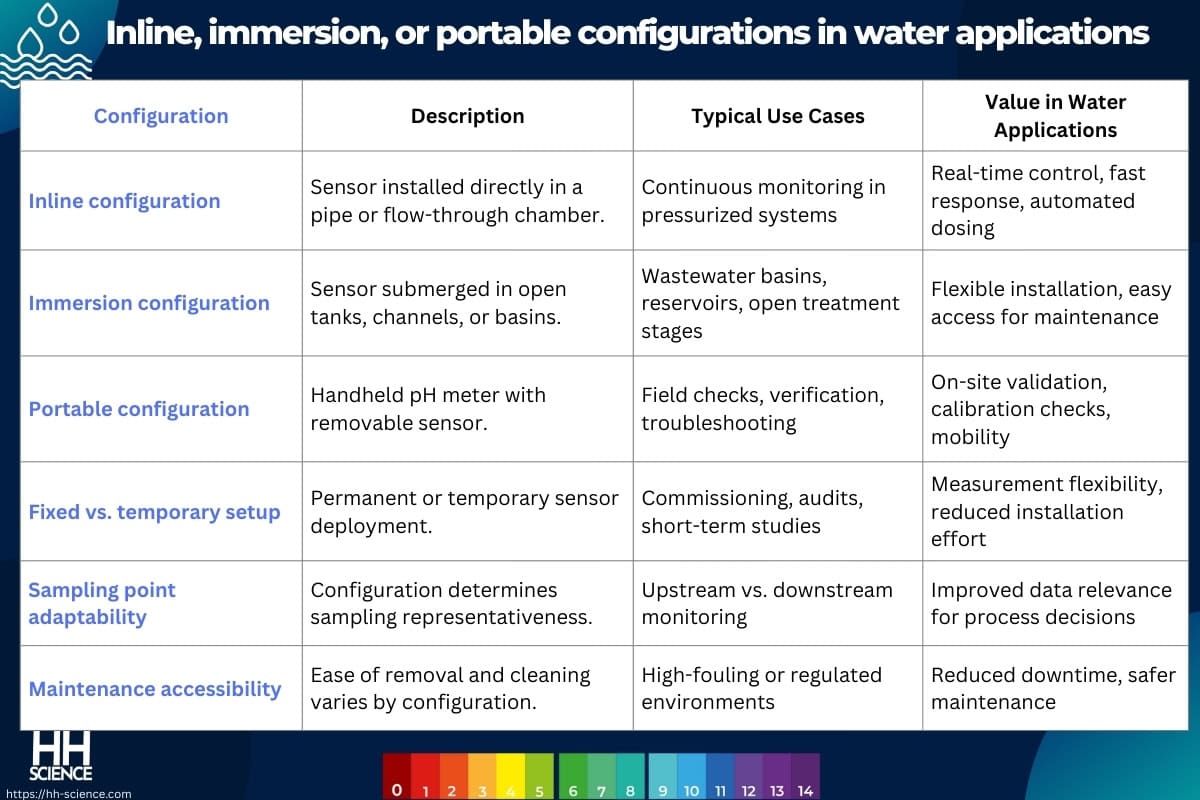
Inline, immersion, or portable configurations
Inline, immersion, and portable pH sensor configurations are used in water applications to match different monitoring objectives, installation constraints, and operational workflows, ensuring pH measurement is performed at the most representative point in the process. Selecting the appropriate configuration balances measurement accuracy, response time, maintenance accessibility, and cost across continuous monitoring, spot checks, and troubleshooting tasks.
| Configuration | Description | Typical Use Cases | Value in Water Applications |
| Inline configuration | Sensor installed directly in a pipe or flow-through chamber. | Continuous monitoring in pressurized systems | Real-time control, fast response, automated dosing |
| Immersion configuration | Sensor submerged in open tanks, channels, or basins. | Wastewater basins, reservoirs, open treatment stages | Flexible installation, easy access for maintenance |
| Portable configuration | Handheld pH meter with removable sensor. | Field checks, verification, troubleshooting | On-site validation, calibration checks, mobility |
| Fixed vs. temporary setup | Permanent or temporary sensor deployment. | Commissioning, audits, short-term studies | Measurement flexibility, reduced installation effort |
| Sampling point adaptability | Configuration determines sampling representativeness. | Upstream vs. downstream monitoring | Improved data relevance for process decisions |
| Maintenance accessibility | Ease of removal and cleaning varies by configuration. | High-fouling or regulated environments | Reduced downtime, safer maintenance |
Installation and maintenance considerations in water applications
Installation and maintenance considerations are critical in water applications because pH measurement reliability depends not only on sensor selection but also on correct placement, mechanical protection, and routine servicing under real process conditions. Proper installation design, accessible mounting, and planned calibration and cleaning routines help maintain measurement accuracy, reduce downtime, extend sensor lifespan, and control total cost of ownership in continuously operating water systems.
Typical installation locations
Typical installation locations for pH sensors in water applications are selected to ensure representative sampling, stable measurement conditions, and safe maintenance access across different treatment stages and system designs. Choosing the right location balances process relevance, sensor protection, flow conditions, and long-term measurement reliability.
| Installation Location | Description | Key Features | Value in Water Applications |
| Raw water intake | Installed at source water entry points. | Early exposure to natural variability | Baseline monitoring, early process adjustment |
| Treatment process lines | Located after coagulation, filtration, or chemical dosing. | Controlled flow and chemistry | Process optimization, dosing control |
| Distribution pipelines | Mounted inline within pressurized networks. | Continuous monitoring under real conditions | Corrosion control, quality assurance |
| Open tanks and basins | Immersed in clarifiers, aeration tanks, or reservoirs. | Easy access, variable flow | Flexible installation, simplified maintenance |
| Effluent discharge points | Installed before discharge or reuse. | Compliance-focused monitoring | Regulatory assurance, environmental protection |
| Bypass or sample lines | Sensor mounted in flow-through chambers. | Stable flow, reduced mechanical stress | Improved accuracy, easier calibration |
| Mobile or field locations | Portable measurement at multiple points. | Temporary and flexible setup | Verification, troubleshooting, audits |

Calibration and cleaning frequency
Calibration and cleaning frequency in water applications depend on water quality, fouling potential, process criticality, and sensor type, because these factors directly affect sensor drift, response time, and long-term measurement accuracy. Establishing appropriate calibration and cleaning intervals ensures reliable pH control, minimizes unplanned downtime, and optimizes total cost of ownership.
| Water Condition / Application | Typical Calibration Frequency | Typical Cleaning Frequency | Key Factors Influencing Frequency | Operational Value |
| Clean drinking water | Monthly to quarterly | Quarterly or as needed | Low fouling, stable chemistry | Low maintenance, stable long-term accuracy |
| Municipal distribution systems | Monthly | Monthly to quarterly | Pipe materials, disinfectants | Corrosion control, compliance assurance |
| Industrial process water | Weekly to monthly | Weekly to monthly | Chemical exposure, variable load | Process stability, reduced drift |
| Wastewater (secondary treatment) | Weekly | Weekly or more frequent | Bio-load, solids, microbial growth | Reliable biological process control |
| Wastewater (primary / influent) | Weekly to bi-weekly | Daily to weekly | High solids, heavy fouling | Prevent sensor failure, maintain data continuity |
| Cooling towers | Monthly | Monthly | Scaling tendency, thermal stress | Energy efficiency, equipment protection |
| Boilers | Monthly to quarterly | Quarterly | High temperature, controlled chemistry | Long sensor life, system integrity |
| Ultrapure water | Quarterly or verification-based | Rare or none | Extremely low contamination | Precision assurance, contamination detection |
| Portable measurements | Before use or daily | After each use | Field exposure, handling | Measurement confidence, data validity |

Expected sensor lifespan
Expected pH sensor lifespan in water applications varies widely depending on water quality, fouling level, chemical exposure, temperature, sensor type, and maintenance practices, because these factors directly affect glass aging, reference stability, and mechanical integrity. Understanding realistic lifespan expectations helps operators plan maintenance, control replacement costs, and avoid unexpected measurement failures.
| Water Application / Condition | Typical Sensor Lifespan | Key Factors Affecting Lifespan | Operational Value |
| Clean drinking water | 18–36 months | Low fouling, mild chemistry, stable temperature | Low replacement frequency, stable accuracy |
| Municipal distribution systems | 12–24 months | Disinfectants, pressure, pipe materials | Predictable maintenance planning |
| Industrial process water | 6–18 months | Chemical exposure, variable pH, temperature stress | Balance between durability and accuracy |
| Wastewater (secondary treatment) | 6–12 months | Bio-load, solids, microbial fouling | Continuous process reliability |
| Wastewater (primary / influent) | 3–9 months | Heavy fouling, abrasion, aggressive media | Prevent unexpected sensor failure |
| Cooling towers | 9–18 months | Scaling tendency, thermal cycling | Equipment protection, cost control |
| Boilers | 12–24 months | High temperature, controlled chemistry | Long-term system integrity |
| Ultrapure water | 12–24 months | Extremely low ionic strength, high impedance | Precision monitoring, contamination detection |
| Portable / field sensors | 12–24 months | Handling, exposure variability | Measurement confidence in field use |

Trade-offs between accuracy, maintenance, and durability
In water applications, trade-offs between accuracy, maintenance, and durability arise because highly sensitive pH sensors deliver faster response and higher precision but are more vulnerable to fouling, chemical attack, and frequent calibration requirements. More durable sensor designs improve resistance to harsh conditions and extend service life, but often at the cost of slower response, reduced sensitivity, or higher initial investment, making application-specific balance essential for optimizing reliability, maintenance workload, and total cost of ownership.
- Accuracy: High-sensitivity glass and fast response support tight process control but increase calibration frequency and fouling sensitivity.
- Maintenance: Reduced maintenance designs lower labor cost and downtime but may sacrifice measurement resolution or adaptability.
- Durability: Robust housings and resistant materials extend lifespan in aggressive water environments while potentially increasing upfront cost or reducing measurement responsiveness.
Regulatory or quality considerations in water application
Regulatory and quality considerations are critical in water applications because pH is a legally and operationally defined parameter that directly affects public health, environmental protection, and process accountability. Maintaining compliant pH levels supports adherence to drinking water standards, discharge permits, and internal quality targets, while reliable pH monitoring reduces compliance risk, audit findings, and operational disruptions.
Industry and water quality standards
Industry and water quality standards define acceptable pH ranges, measurement methods, and monitoring practices to protect public health, ensure environmental safety, and maintain process consistency, because pH directly influences corrosion, toxicity, treatment effectiveness, and regulatory compliance. These standards provide a common technical and legal framework that guides water utilities, industrial operators, and laboratories in how pH is measured, controlled, documented, and audited.
| Standard / Regulation | Scope | Why It Matters for pH | Related Terms | Value in Water Applications |
| WHO Guidelines for Drinking-water Quality | Global guidance | Defines recommended pH ranges for safe and acceptable drinking water. | Public health, water safety | International reference, health protection |
| U.S. EPA Drinking Water Regulations | United States | Establishes pH-related requirements for corrosion control and treatment. | Regulatory compliance, corrosion control | Legal compliance, infrastructure protection |
| EU Drinking Water Directive | European Union | Specifies pH limits to ensure water quality and consumer safety. | Water quality standards, compliance | Harmonized EU requirements |
| Discharge Permit Standards (e.g. NPDES, EU permits) | Wastewater and effluent | Sets allowable pH ranges for environmental discharge. | Effluent control, environmental protection | Avoid fines, protect ecosystems |
| ISO 10523 | Measurement standard | Defines reference methods for pH determination. | Measurement methodology, traceability | Consistent and comparable results |
| ASTM pH Measurement Standards | Testing and analysis | Provides standardized testing procedures for pH. | Analytical accuracy, repeatability | Reliable laboratory and field testing |
| APHA Standard Methods | Water and wastewater analysis | Specifies accepted analytical methods for pH measurement. | Laboratory best practices | Industry-accepted testing credibility |
| Internal Quality Standards (ISO 9001, plant SOPs) | Facility-level control | Defines operational pH targets and monitoring practices. | Quality management, process control | Consistent performance, audit readiness |

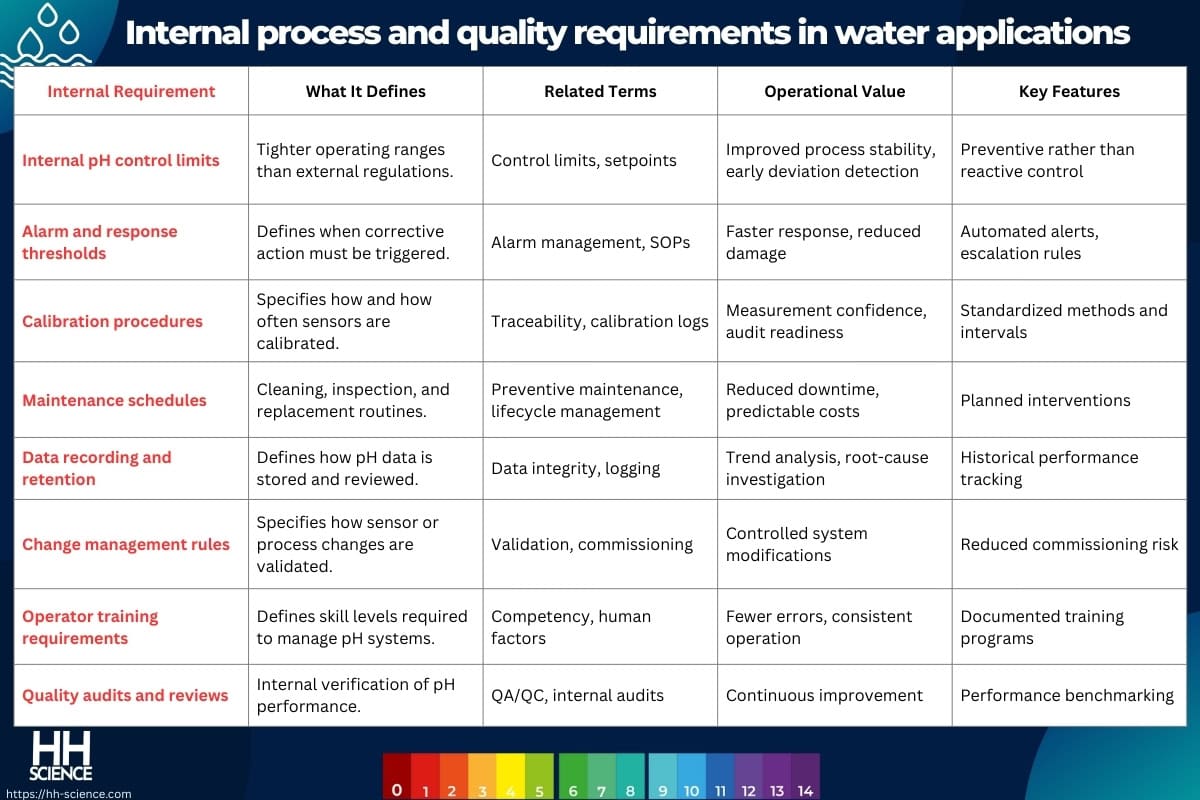
Internal process and quality requirements
Internal process and quality requirements define how pH is monitored, controlled, documented, and acted upon within water applications, because regulatory limits alone are not sufficient to ensure process stability, asset protection, and consistent operational performance. These internal requirements translate pH measurement into actionable control rules, maintenance routines, and quality assurance practices that reduce risk, variability, and long-term operating cost.
| Internal Requirement | What It Defines | Related Terms | Operational Value | Key Features |
| Internal pH control limits | Tighter operating ranges than external regulations. | Control limits, setpoints | Improved process stability, early deviation detection | Preventive rather than reactive control |
| Alarm and response thresholds | Defines when corrective action must be triggered. | Alarm management, SOPs | Faster response, reduced damage | Automated alerts, escalation rules |
| Calibration procedures | Specifies how and how often sensors are calibrated. | Traceability, calibration logs | Measurement confidence, audit readiness | Standardized methods and intervals |
| Maintenance schedules | Cleaning, inspection, and replacement routines. | Preventive maintenance, lifecycle management | Reduced downtime, predictable costs | Planned interventions |
| Data recording and retention | Defines how pH data is stored and reviewed. | Data integrity, logging | Trend analysis, root-cause investigation | Historical performance tracking |
| Change management rules | Specifies how sensor or process changes are validated. | Validation, commissioning | Controlled system modifications | Reduced commissioning risk |
| Operator training requirements | Defines skill levels required to manage pH systems. | Competency, human factors | Fewer errors, consistent operation | Documented training programs |
| Quality audits and reviews | Internal verification of pH performance. | QA/QC, internal audits | Continuous improvement | Performance benchmarking |
Compliance-driven monitoring needs
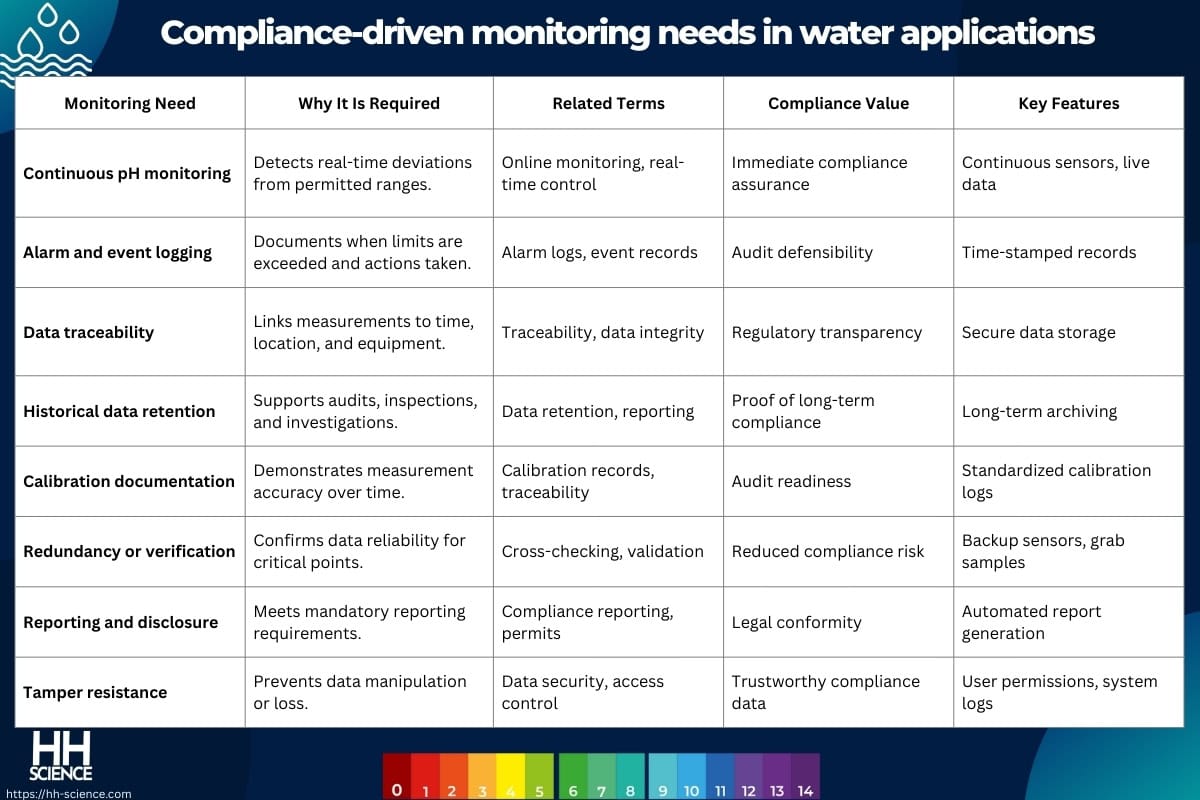
Compliance-driven monitoring needs in water applications arise from legal, environmental, and quality obligations that require pH to be continuously measured, documented, and auditable, because pH directly affects public health, environmental impact, and process safety. These needs ensure that pH data is not only accurate but also traceable, defensible, and aligned with regulatory and internal compliance frameworks.
| Monitoring Need | Why It Is Required | Related Terms | Compliance Value | Key Features |
| Continuous pH monitoring | Detects real-time deviations from permitted ranges. | Online monitoring, real-time control | Immediate compliance assurance | Continuous sensors, live data |
| Alarm and event logging | Documents when limits are exceeded and actions taken. | Alarm logs, event records | Audit defensibility | Time-stamped records |
| Data traceability | Links measurements to time, location, and equipment. | Traceability, data integrity | Regulatory transparency | Secure data storage |
| Historical data retention | Supports audits, inspections, and investigations. | Data retention, reporting | Proof of long-term compliance | Long-term archiving |
| Calibration documentation | Demonstrates measurement accuracy over time. | Calibration records, traceability | Audit readiness | Standardized calibration logs |
| Redundancy or verification | Confirms data reliability for critical points. | Cross-checking, validation | Reduced compliance risk | Backup sensors, grab samples |
| Reporting and disclosure | Meets mandatory reporting requirements. | Compliance reporting, permits | Legal conformity | Automated report generation |
| Tamper resistance | Prevents data manipulation or loss. | Data security, access control | Trustworthy compliance data | User permissions, system logs |
Selecting the right pH measurement approach for water applications
Selecting the right pH measurement approach for water applications is critical because measurement accuracy, reliability, and maintenance demands are strongly influenced by process conditions, regulatory requirements, and system design. Aligning sensor type, installation method, and maintenance strategy with water chemistry, fouling potential, and compliance needs ensures dependable pH control, reduced lifecycle costs, and long-term operational stability.
Decision support for water applications
Decision support provides a structured framework for evaluating pH measurement needs based on water chemistry, process criticality, regulatory exposure, and operational constraints rather than relying on generic sensor specifications. By translating application conditions into technical requirements—such as accuracy tolerance, fouling resistance, response time, and maintenance capacity—decision support reduces selection risk and improves long-term measurement reliability and total cost of ownership.
Application-driven measurement strategies
Application-driven measurement strategies align pH monitoring methods with specific water system conditions, including flow regime, contamination level, temperature variability, and compliance sensitivity. This approach ensures that sensor type, installation configuration, and maintenance planning are chosen to match real operating environments, enabling stable control, predictable performance, and efficient use of resources across different water applications.
Linking water applications to sensor selection and OEM solutions
Linking water applications to sensor selection and OEM solutions connects operational requirements directly to appropriate sensor designs, materials, and integration options. This linkage enables tailored solutions—such as customized glass formulations, housing materials, digital interfaces, or mounting systems—that improve durability, reduce maintenance burden, and support scalable deployment while aligning measurement performance with application-specific value and compliance goals.


