
Why pH matters in drinking water applications?
pH matters in drinking water applications because it directly affects public health protection, corrosion control, disinfection efficiency, water quality stability, and regulatory compliance, making it a foundational parameter in both treatment and distribution systems.
- Public health protection: pH influences the solubility of metals and by-products, helping prevent the release of harmful substances into drinking water.
- Corrosion control: Proper pH control reduces pipe corrosion and minimizes leaching of metals such as lead and copper from distribution infrastructure.
- Disinfection efficiency: The effectiveness of disinfectants, particularly chlorine-based treatments, is strongly dependent on pH levels.
- Water quality stability: Stable pH helps maintain consistent taste, clarity, and chemical balance throughout the distribution network.
- Regulatory compliance: Drinking water regulations specify acceptable pH ranges, making continuous monitoring essential for legal compliance and audit readiness.
How does pH influence drinking water quality and safety?
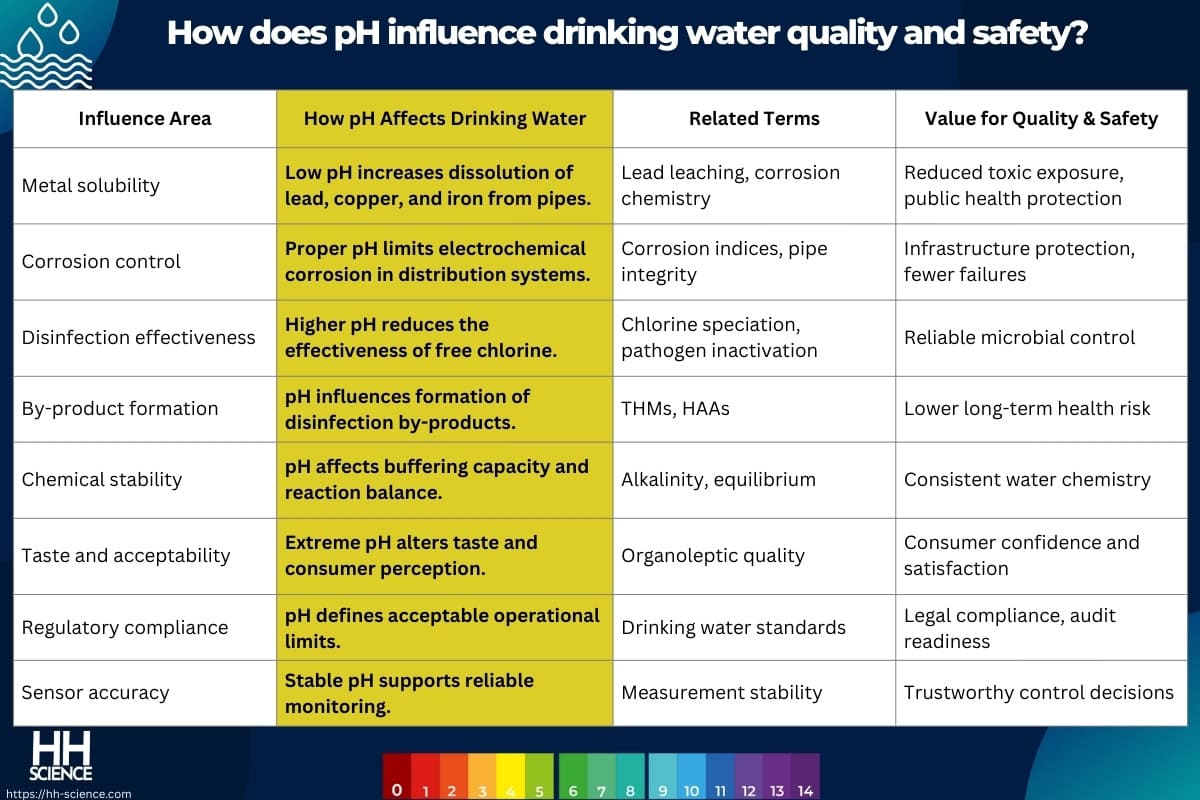
pH influences drinking water quality and safety by controlling chemical stability, metal solubility, disinfection performance, and consumer acceptability, making it a central factor in protecting public health and maintaining compliant water supply systems. Changes in pH affect how water interacts with treatment chemicals, distribution materials, and contaminants, directly shaping both short-term safety and long-term infrastructure integrity.
| Influence Area | How pH Affects Drinking Water | Related Terms | Value for Quality & Safety |
| Metal solubility | Low pH increases dissolution of lead, copper, and iron from pipes. | Lead leaching, corrosion chemistry | Reduced toxic exposure, public health protection |
| Corrosion control | Proper pH limits electrochemical corrosion in distribution systems. | Corrosion indices, pipe integrity | Infrastructure protection, fewer failures |
| Disinfection effectiveness | Higher pH reduces the effectiveness of free chlorine. | Chlorine speciation, pathogen inactivation | Reliable microbial control |
| By-product formation | pH influences formation of disinfection by-products. | THMs, HAAs | Lower long-term health risk |
| Chemical stability | pH affects buffering capacity and reaction balance. | Alkalinity, equilibrium | Consistent water chemistry |
| Taste and acceptability | Extreme pH alters taste and consumer perception. | Organoleptic quality | Consumer confidence and satisfaction |
| Regulatory compliance | pH defines acceptable operational limits. | Drinking water standards | Legal compliance, audit readiness |
| Sensor accuracy | Stable pH supports reliable monitoring. | Measurement stability | Trustworthy control decisions |
Why are drinking water systems sensitive to pH deviations?
Drinking water systems are highly sensitive to pH deviations because pH directly controls corrosion behavior, metal solubility, disinfectant effectiveness, and chemical stability throughout treatment and distribution networks. When pH is not properly maintained, it can accelerate pipe corrosion and lead leaching, reduce microbial disinfection efficiency, increase formation of disinfection by-products, degrade consumer water quality, trigger regulatory non-compliance, and ultimately undermine public health protection, infrastructure integrity, and utility credibility.
Typical pH ranges and control targets in drinking water applications
Typical pH ranges and control targets in drinking water applications define the operating window within which corrosion control, disinfection performance, and water quality stability are maintained. Establishing these targets provides a structured basis for treatment optimization, compliance management, and consistent delivery of safe drinking water before examining application-specific requirements in detail.
Common pH ranges in drinking water
Common pH ranges in drinking water typically fall between pH 6.5 and 8.5, because this range balance corrosion control, disinfection effectiveness, consumer acceptability, and regulatory compliance across treatment and distribution systems. Within this window, different drinking water sub-applications operate at slightly different targets depending on source water chemistry, treatment strategy, and infrastructure materials.
| Drinking Water Sub-Application | Typical pH Range | Why This Range Is Used | Related Terms & Value |
| Source / Raw Water | 6.0 – 8.5 | Reflects natural variability from geology and organic matter. | Baseline treatment design, source monitoring |
| Treated Drinking Water (Plant Outlet) | 6.5 – 8.5 | Balances corrosion control and disinfection efficiency. | Public health protection, regulatory compliance |
| Distribution System Water | 7.0 – 8.5 | Reduces pipe corrosion and metal leaching. | Infrastructure integrity, lead and copper control |
| Corrosion-Controlled Water | 7.2 – 8.5 (targeted) | Optimizes protective scale formation inside pipes. | Corrosion indices, asset protection |
| Chlorinated Drinking Water | 6.5 – 7.8 (often targeted) | Maximizes free chlorine disinfection effectiveness. | Pathogen control, microbial safety |
| Chloraminated Water | 7.5 – 8.5 | Improves disinfectant stability and reduces nitrification risk. | Distribution stability, reduced by-products |
| Blended or Treated Groundwater | 7.0 – 8.5 | Maintains chemical stability after blending or adjustment. | Consistent water quality |
| Finished Water at Consumer Tap | 6.5 – 8.5 | Ensures safety, taste, and regulatory compliance. | Consumer confidence, audit readiness |

Factors that define pH control targets in drinking water
pH control targets in drinking water are defined by source water chemistry, corrosion control requirements, disinfection strategy, distribution system materials, regulatory limits, and consumer quality expectations, because each factor directly influences safety, infrastructure integrity, and compliance.
- Source water chemistry: Natural alkalinity, hardness, and buffering capacity determine baseline pH behavior and treatment adjustment needs.
- Corrosion control requirements: pH targets are selected to minimize metal leaching and pipe degradation in distribution systems.
- Disinfection strategy: The choice between chlorine, chloramine, or other disinfectants influences optimal pH for microbial control and disinfectant stability.
- Distribution system materials: Pipe composition and age affect pH tolerance and corrosion risk.
- Regulatory limits: Drinking water regulations establish mandatory pH ranges that must be continuously met.
- Consumer quality expectations: Taste, odor, and aesthetic acceptability influence final pH targets delivered at the tap.
What happens when pH is out of range in drinking water applications?
When pH is out of range in drinking water applications, it can lead to increased corrosion and metal leaching, reduced disinfection effectiveness, formation of disinfection by-products, infrastructure damage, degraded consumer water quality, and regulatory non-compliance, because pH directly controls chemical equilibria, material interactions, and disinfectant chemistry within treatment and distribution systems.
| Impact Area | Typical pH Condition | Why It Happens | Value / Risk |
| Corrosion and metal leaching | Low pH (< 6.5) | Acidic water increases solubility of metals and accelerates electrochemical corrosion. | Lead and copper release, public health risk |
| Infrastructure degradation | Low pH (< 6.5) | Aggressive water attacks pipes, linings, and fittings. | Shortened asset life, higher maintenance cost |
| Reduced disinfection effectiveness | High pH (> 8.0) | Free chlorine becomes less effective as hypochlorous acid converts to hypochlorite. | Increased pathogen survival risk |
| Disinfection by-product formation | High or unstable pH | pH influences reaction pathways between disinfectants and organic matter. | Long-term health concerns, compliance risk |
| Scaling and precipitation | High pH (> 8.5) | Alkaline conditions promote calcium carbonate precipitation. | Pipe scaling, flow restriction |
| Taste and aesthetic issues | Low or high pH | Extreme pH alters sensory perception. | Consumer complaints, loss of trust |
| Regulatory non-compliance | Outside permitted range | Drinking water standards define acceptable pH limits. | Violations, fines, corrective action orders |

Effects of low pH in drinking water
Low pH in drinking water causes corrosion, metal leaching, material degradation, reduced disinfection stability, taste and color issues, and higher operational costs, because acidic conditions accelerate electrochemical reactions, increase metal solubility, and attack infrastructure materials throughout treatment and distribution systems.
| Effect | Why It Occurs at Low pH | Impact on Drinking Water Systems |
| Corrosion | Acidic water increases electrochemical corrosion rates. | Pipe damage, leaks, shortened asset life |
| Metal leaching | Low pH increases solubility of lead, copper, and iron. | Public health risk, regulatory violations |
| Material degradation | Acids attack concrete, linings, seals, and solder. | Infrastructure deterioration, higher maintenance |
| Reduced disinfection stability | Acidic conditions destabilize disinfectant residuals. | Inconsistent microbial control |
| Taste and color issues | Dissolved metals alter taste and appearance. | Consumer complaints, loss of trust |
| Higher operating costs | Corrosion control and corrective dosing increase. | Increased chemical and maintenance expenses |

Effects of high pH in drinking water
High pH in drinking water leads to scaling, mineral precipitation, reduced disinfection effectiveness, taste and aesthetic issues, treatment inefficiency, and increased operational costs, because alkaline conditions shift chemical equilibria, reduce solubility of hardness minerals, and alter disinfectant chemistry within treatment and distribution systems.
| Effect | Why It Occurs at High pH | Impact on Drinking Water Systems |
| Scaling | Elevated pH promotes calcium carbonate crystallization. | Pipe scaling, reduced flow, equipment fouling |
| Mineral precipitation | Alkaline conditions decrease solubility of hardness minerals. | Deposits in pipes and tanks, increased maintenance |
| Reduced disinfection effectiveness | High pH lowers the proportion of active hypochlorous acid. | Increased pathogen survival risk |
| Taste and aesthetic issues | Alkalinity alters taste and mouthfeel of water. | Consumer dissatisfaction, complaints |
| Treatment inefficiency | Higher chemical doses are required to achieve treatment targets. | Increased chemical consumption |
| Higher operating costs | Scaling and overdosing increase maintenance and energy use. | Elevated operational and lifecycle costs |

Operational, quality, and compliance risks
When pH is out of range in drinking water applications, operational, quality, and compliance risks arise simultaneously because pH deviations affect corrosion control, disinfection performance, infrastructure stability, and regulatory limits across the entire supply system. Together, these risks threaten public health protection, infrastructure integrity, and utility credibility, making precise pH control and reliable monitoring essential in drinking water applications.
- Operational risks: Uncontrolled pH accelerates corrosion or scaling, increases chemical consumption, destabilizes treatment processes, and raises maintenance frequency and lifecycle costs.
- Quality risks: Incorrect pH promotes metal leaching, reduces disinfectant effectiveness, alters taste and appearance, and undermines consistent delivery of safe drinking water.
- Compliance risks: Drinking water regulations define strict pH ranges and documentation requirements, so deviations can result in violations, mandatory corrective actions, public notifications, and loss of regulatory confidence.
pH measurement challenges in drinking water applications
pH measurement challenges in drinking water applications stem from continuously changing water chemistry, disinfectant exposure, hydraulic conditions, and strict accuracy requirements tied to public health and compliance. Recognizing these challenges provides the foundation for selecting appropriate sensor technologies, installation methods, and maintenance strategies that ensure reliable, defensible pH data across treatment and distribution systems.
Temperature effects
Temperature effects are a critical challenge for pH measurement in drinking water applications because temperature directly influences both the true pH of the water and the electrochemical response of the pH sensor. Variations in water temperature across treatment stages and distribution systems can introduce measurement error, drift, or delayed response if temperature compensation and sensor placement are not properly managed.
| Temperature Condition | How It Affects pH Measurement | Related Terms | Operational Value / Risk |
| Changing water temperature | Alters chemical equilibria and the actual solution pH. | Equilibrium shift, dissociation constants | Apparent pH drift, misinterpretation |
| Nernst slope variation | pH electrode sensitivity changes with temperature. | Nernst equation, slope error | Measurement accuracy, control reliability |
| Inadequate temperature compensation | Causes mismatch between measured and true pH. | ATC (automatic temperature compensation) | Compliance risk, dosing errors |
| Temperature gradients | Sensor temperature differs from process water. | Thermal lag, temperature mismatch | Inconsistent readings, unstable control |
| Cold water conditions | Increase electrode impedance and slow response. | High impedance, response time | Delayed stabilization, reduced accuracy |
| Warm or seasonal temperature shifts | Accelerate sensor aging and calibration drift. | Glass aging, sensor fatigue | Shortened sensor lifespan, higher maintenance |

Fouling and contamination
Fouling and contamination are significant challenges in pH measurement for drinking water applications because deposits on the glass membrane or reference junction interfere with ion exchange, electrical stability, and response time, even in relatively clean water systems. Disinfectants, trace metals, biofilm formation, and treatment residues can gradually degrade measurement accuracy, increase maintenance demands, and reduce confidence in compliance-related pH data.
| Fouling / Contamination Source | How It Affects pH Measurement | Related Terms | Operational Value / Risk |
| Biofilm formation | Microbial layers restrict ion exchange at the sensor surface. | Biofouling, surface blockage | Signal drift, frequent cleaning |
| Iron and manganese | Oxidized metals coat glass and junction surfaces. | Metal fouling, oxidation | Long-term drift, reduced accuracy |
| Disinfectant by-products | Chemical residues contaminate junction materials. | Chemical contamination | Calibration instability |
| Treatment chemicals | Residual coagulants or inhibitors adhere to sensors. | Chemical fouling | Slower response, increased maintenance |
| Particulate matter | Fine solids accumulate on sensor surfaces. | Sediment fouling | Noisy readings, delayed stabilization |
| Aging distribution biofilm | Gradual contamination develops inside pipelines. | Distribution system fouling | Hidden drift, compliance risk |

Pressure and flow conditions
Pressure and flow conditions are important challenges for pH measurement in drinking water applications because sensors are often installed in pressurized pipelines, variable-flow distribution systems, and treatment lines with changing hydraulics. Fluctuations in pressure and flow can affect sensor exposure, reference stability, and signal consistency, influencing both measurement accuracy and long-term sensor reliability.
| Pressure / Flow Condition | How It Affects pH Measurement | Related Terms | Operational Value / Risk |
| High flow velocity | Increases mechanical stress on the sensor and membrane. | Turbulence, shear force | Sensor wear, unstable readings |
| Low or stagnant flow | Reduces ion exchange at the sensor surface. | Boundary layer, stagnation | Slow response, drift |
| Pressure fluctuations | Disturb reference electrode equilibrium. | Pressure shock, signal noise | Measurement variability |
| Pressurized pipelines | Stress sensor seals and housings. | Pressure rating, mechanical integrity | Leakage risk, shortened lifespan |
| Air entrainment | Causes intermittent sensor exposure. | Entrained air, bubbles | Signal spikes, false readings |
| Improper installation geometry | Alters effective flow across the sensor. | Flow profile, mounting angle | Reduced accuracy, increased maintenance |

Chemical exposure (disinfectants, corrosion inhibitors)
Chemical exposure from disinfectants and corrosion inhibitors is a key challenge in pH measurement for drinking water applications because these chemicals continuously interact with the pH sensor’s glass membrane, reference junction, electrolyte, and housing materials. While essential for public health and infrastructure protection, long-term exposure can accelerate sensor aging, increase drift, and reduce measurement stability if sensor design and materials are not properly matched to the treatment chemistry.
| Chemical Exposure Source | How It Affects pH Measurement | Related Terms | Operational Value / Risk |
| Free chlorine | Oxidizes reference junction materials and electrolyte. | Oxidative stress, chlorine attack | Signal drift, shortened sensor life |
| Chloramine | Causes slower but continuous chemical stress. | Chloramination, disinfectant stability | Gradual accuracy loss |
| Ozone (where used) | Strong oxidizer damages membranes and seals. | Advanced oxidation | Rapid sensor degradation |
| Corrosion inhibitors (e.g., phosphates) | Form films on sensor surfaces. | Film formation, passivation | Slower response, calibration drift |
| pH adjustment chemicals (acid/alkali) | Create localized extreme pH near dosing points. | Chemical shock, transient pH | Measurement instability |
| Cleaning-in-place (CIP) chemicals | Expose sensors to concentrated reagents. | Chemical shock, material fatigue | Seal failure, shortened lifespan |

Bio-load or process residues
Bio-load and process residues pose ongoing challenges for pH measurement in drinking water applications because even low levels of biological growth or residual treatment by-products can interfere with ion exchange at the sensor surface and destabilize reference performance. Although drinking water is comparatively clean, long distribution times, nutrient traces, and treatment side effects can still cause gradual fouling, signal drift, and reduced confidence in compliance-related pH data.
| Bio-load / Residue Source | How It Affects pH Measurement | Related Terms | Operational Value / Risk |
| Distribution system biofilm | Thin microbial layers form on sensor surfaces. | Biofilm formation, biological fouling | Slow signal drift, hidden accuracy loss |
| Natural organic matter (NOM) | Organic compounds adsorb to glass and reference junction. | Organic fouling, adsorption | Slower response, calibration deviation |
| Nutrient traces (e.g., ammonia) | Support microbial growth under chloramination. | Nitrification, biological activity | Measurement instability, compliance risk |
| Treatment by-products | Residues from coagulation or disinfection processes. | Process residues, carryover | Reference contamination, drift |
| Long water residence time | Increases exposure to biological and chemical changes. | Water age, stagnation | Reduced data representativeness |
| Seasonal biological variation | Alters bio-load levels throughout the year. | Seasonal variability | Inconsistent maintenance demand |

Common pH sensor types used in drinking water applications
Common pH sensor types used in drinking water applications include combination pH sensors, differential pH sensors, and digital or smart pH sensors, selected to balance measurement accuracy, long-term stability, compliance reliability, and maintenance effort under regulated conditions. These sensors support inline, immersion, and portable configurations, allowing utilities to achieve continuous monitoring, verification testing, and audit-ready pH control while optimizing lifecycle cost and operational confidence.
Combination pH sensors
Combination pH sensors are widely used in drinking water applications because they offer a reliable, cost-effective solution for measuring pH under relatively clean, regulated conditions while meeting accuracy and compliance requirements. Their integrated design, broad compatibility with transmitters, and ease of maintenance make them well suited for treatment plants, distribution systems, and routine monitoring points.
| Feature | Description | Value in Drinking Water Applications |
| Integrated electrode design | pH glass and reference electrode combined in one body. | Simple installation, reduced wiring complexity |
| Standard glass membrane | Designed for neutral to slightly alkaline pH ranges. | Accurate measurement within drinking water targets |
| Conventional reference junction | Ceramic or polymer junction with stable electrolyte flow. | Reliable readings in low-fouling environments |
| Good long-term stability | Performs consistently under stable water chemistry. | Predictable calibration intervals |
| Broad transmitter compatibility | Works with most analog and digital pH transmitters. | Easy system integration |
| Cost-effective solution | Lower upfront cost than advanced sensor designs. | Optimized total cost of ownership |

Differential pH sensors
Differential pH sensors are used in drinking water applications where long-term measurement stability and resistance to reference contamination are critical, particularly in distribution systems and compliance monitoring points. Their differential measurement principle reduces sensitivity to junction fouling and chemical interference, making them suitable for utilities that prioritize low drift, reduced maintenance, and defensible pH data.
| Feature | Description | Value in Drinking Water Applications |
| Differential measurement principle | Uses two glass electrodes instead of a conventional reference. | Minimizes reference-related drift and failure |
| No exposed liquid junction | Eliminates direct junction contact with process water. | Improved reliability in long-term monitoring |
| High measurement stability | Maintains calibration over extended periods. | Reduced calibration frequency, audit confidence |
| Resistance to chemical interference | Less affected by disinfectants and corrosion inhibitors. | Consistent readings under treated water conditions |
| Low maintenance design | Fewer failure modes compared to traditional sensors. | Lower labor and service costs |
| Higher initial cost | More complex construction than combination sensors. | Lower total cost of ownership over sensor lifetime |

Digital or smart pH sensors
Digital or smart pH sensors are increasingly adopted in drinking water applications because they improve measurement reliability, traceability, and integration with modern control and monitoring systems required for regulatory compliance. By processing the electrochemical signal within the sensor and storing diagnostic and calibration data, they reduce human error, simplify maintenance, and support audit-ready pH monitoring across treatment and distribution networks.
| Feature | Description | Value in Drinking Water Applications |
| Digital signal processing | Converts the analog pH signal to digital inside the sensor. | Improved signal stability and noise immunity |
| Stored calibration data | Calibration history retained in sensor memory. | Traceability, faster sensor replacement |
| Built-in diagnostics | Monitors sensor health, impedance, and response behavior. | Early fault detection, reduced downtime |
| Plug-and-play connectivity | Automatic recognition by compatible transmitters. | Simplified installation and commissioning |
| Long cable tolerance | Digital signals are unaffected by cable length. | Flexible installation across large facilities |
| Compliance-ready data handling | Supports logging and audit documentation. | Regulatory confidence, defensible records |

Inline, immersion, or portable configurations
Inline, immersion, and portable pH sensor configurations are used in drinking water applications to match different monitoring objectives, regulatory needs, and operational workflows across treatment plants and distribution systems. Selecting the appropriate configuration ensures representative measurement, reliable compliance data, and efficient maintenance while balancing continuous control, verification, and field validation requirements.
| Configuration | Description | Typical Use Cases | Value in Drinking Water Applications |
| Inline configuration | Sensor installed directly in a pressurized pipe or flow cell. | Treatment plant outlets, distribution mains | Continuous, real-time compliance monitoring and automated control |
| Immersion configuration | Sensor submerged in open tanks or basins. | Clear wells, contact tanks, reservoirs | Easy access for maintenance with representative bulk-water measurement |
| Portable configuration | Handheld meter with removable sensor. | Field checks, audits, verification sampling | Independent validation, troubleshooting, regulatory spot checks |
| Fixed vs. temporary setup | Permanent or short-term installation. | Commissioning, investigations, seasonal studies | Measurement flexibility without permanent modifications |
| Sampling representativeness | Configuration determines how well water conditions are captured. | Upstream vs. downstream monitoring points | Accurate decision-making and defensible data |
| Maintenance accessibility | Ease of removal and servicing varies by configuration. | Regulated environments with SOPs | Reduced downtime and safer maintenance procedures |

Installation and maintenance considerations
Installation and maintenance considerations are especially critical in drinking water applications because pH measurements directly support public health protection, corrosion control, and regulatory compliance. Proper sensor placement, secure mounting, controlled sampling conditions, and well-defined calibration and cleaning procedures ensure measurement accuracy, audit defensibility, and long-term reliability while minimizing operational risk and lifecycle cost.
Typical installation locations
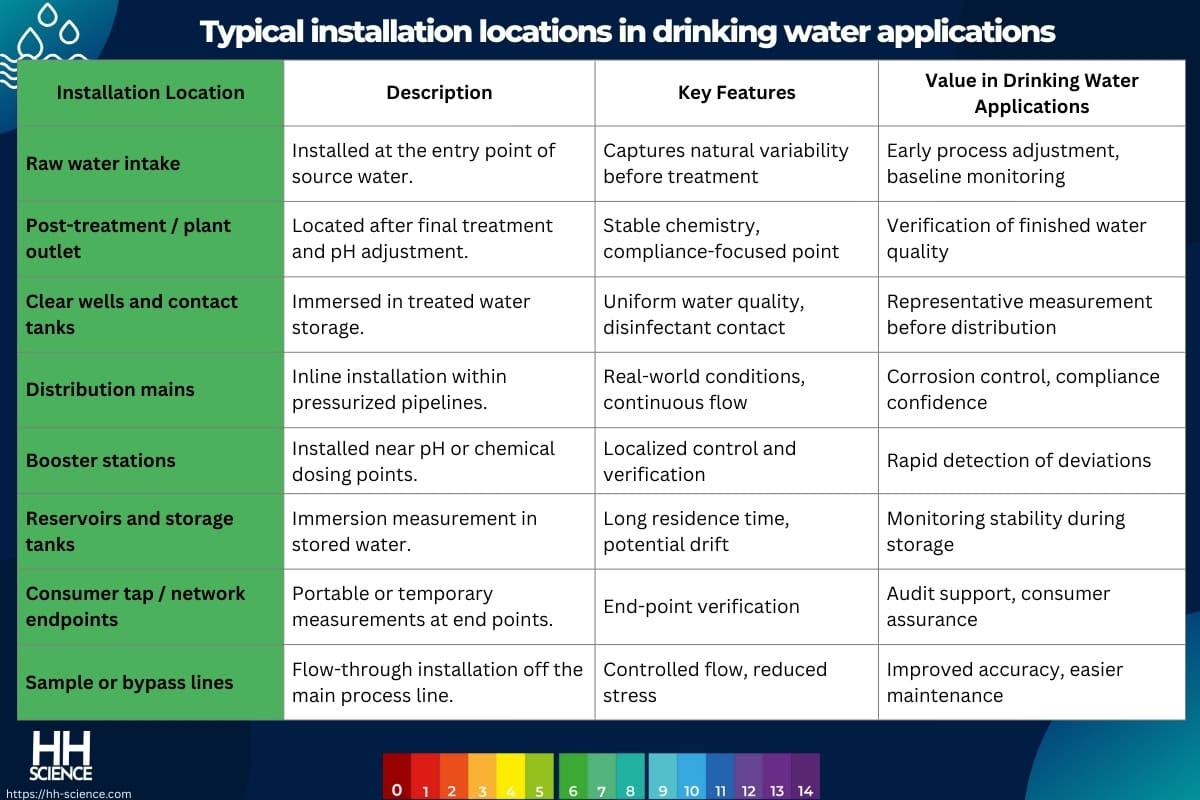
Typical installation locations for pH sensors in drinking water applications are selected to ensure representative measurement, compliance coverage, and stable operating conditions across treatment and distribution stages. Proper location selection balances regulatory relevance, hydraulic stability, chemical exposure, and maintenance accessibility.
| Installation Location | Description | Key Features | Value in Drinking Water Applications |
| Raw water intake | Installed at the entry point of source water. | Captures natural variability before treatment | Early process adjustment, baseline monitoring |
| Post-treatment / plant outlet | Located after final treatment and pH adjustment. | Stable chemistry, compliance-focused point | Verification of finished water quality |
| Clear wells and contact tanks | Immersed in treated water storage. | Uniform water quality, disinfectant contact | Representative measurement before distribution |
| Distribution mains | Inline installation within pressurized pipelines. | Real-world conditions, continuous flow | Corrosion control, compliance confidence |
| Booster stations | Installed near pH or chemical dosing points. | Localized control and verification | Rapid detection of deviations |
| Reservoirs and storage tanks | Immersion measurement in stored water. | Long residence time, potential drift | Monitoring stability during storage |
| Consumer tap / network endpoints | Portable or temporary measurements at end points. | End-point verification | Audit support, consumer assurance |
| Sample or bypass lines | Flow-through installation off the main process line. | Controlled flow, reduced stress | Improved accuracy, easier maintenance |
Calibration and cleaning frequency
Calibration and cleaning frequency in drinking water applications are determined by regulatory accuracy requirements, disinfectant exposure, water stability, sensor type, and installation location, because even small measurement errors can affect compliance, corrosion control, and public health protection. Establishing appropriate intervals ensures defensible pH data, predictable maintenance workload, and controlled lifecycle costs.
| Drinking Water Application / Condition | Typical Calibration Frequency | Typical Cleaning Frequency | Key Influencing Factors | Operational Value |
| Treated water at plant outlet | Monthly | Quarterly or as needed | Stable chemistry, compliance monitoring | Audit-ready accuracy, low maintenance burden |
| Distribution system monitoring | Monthly | Monthly to quarterly | Disinfectants, biofilm potential | Corrosion control, data reliability |
| Chlorinated systems | Monthly | Monthly | Oxidative chemical exposure | Stable disinfection control |
| Chloraminated systems | Monthly | Monthly | Biofilm and nitrification risk | Reduced drift, compliance confidence |
| Clear wells and reservoirs | Monthly to quarterly | Quarterly | Long residence time, low solids | Stable long-term monitoring |
| Booster or dosing stations | Bi-weekly to monthly | Monthly | Localized chemical exposure | Rapid deviation detection |
| Portable / field measurements | Before use or daily | After each use | Handling, field conditions | Verification accuracy, audit support |
| High-sensitivity compliance points | Monthly or tighter per SOP | Per SOP | Regulatory criticality | Defensible regulatory reporting |

Expected sensor lifespan
Expected pH sensor lifespan in drinking water applications depends on water chemistry stability, disinfectant type, installation location, sensor technology, and maintenance discipline, because these factors directly influence glass aging, reference stability, and material degradation. Understanding realistic lifespan expectations helps utilities plan replacements proactively, maintain compliance confidence, and control total cost of ownership.
| Drinking Water Application / Condition | Typical Sensor Lifespan | Key Factors Affecting Lifespan | Operational Value |
| Treated water at plant outlet | 18–36 months | Stable chemistry, controlled disinfectant levels | Predictable replacement planning |
| Distribution system monitoring | 12–24 months | Disinfectant exposure, biofilm presence | Reliable long-term compliance data |
| Chlorinated systems | 12–24 months | Oxidative stress from free chlorine | Balanced durability and accuracy |
| Chloraminated systems | 12–30 months | Lower oxidation, biofilm risk | Extended life with proper maintenance |
| Clear wells and reservoirs | 18–36 months | Low solids, uniform chemistry | Long-term stability, reduced maintenance |
| Booster or dosing stations | 9–18 months | Localized chemical shock, pH adjustment | Early drift detection, risk control |
| High-sensitivity compliance points | 12–24 months | Tight accuracy requirements | Audit-ready measurement integrity |
| Portable / field sensors | 12–24 months | Handling, storage, intermittent use | Measurement confidence in audits |

Trade-offs between accuracy, maintenance, and durability
In drinking water applications, trade-offs between accuracy, maintenance, and durability arise because high-accuracy pH sensors with sensitive glass membranes and tight tolerances provide precise compliance data but require more frequent calibration and careful handling. More durable sensor designs improve resistance to disinfectants, biofilm, and long-term exposure, reducing maintenance effort and downtime, but may involve higher initial cost or slightly slower response, making application-specific balance essential for compliance confidence, operational efficiency, and total cost of ownership.
Regulatory or quality considerations in drinking water
Regulatory and quality considerations are central to drinking water applications because pH is a regulated parameter directly linked to public health protection, corrosion control, and treatment effectiveness. Accurate, traceable pH monitoring supports compliance with drinking water standards, audit readiness, and consistent water quality delivery while reducing regulatory risk and maintaining public trust.
Industry and drinking water quality standards
Industry and drinking water quality standards define acceptable pH ranges, measurement methods, monitoring practices, and documentation requirements to protect public health, control corrosion, and ensure consistent water quality delivery. These standards exist because pH directly influences metal leaching, disinfection effectiveness, infrastructure integrity, and regulatory accountability, making it a legally and operationally critical parameter in drinking water systems.
| Standard / Regulation | Scope | Why It Matters for pH | Related Terms | Value in Drinking Water Applications | Key Features |
| WHO Guidelines for Drinking-water Quality | Global | Recommends acceptable pH ranges to ensure safety and acceptability. | Public health, water safety | International reference for safe drinking water | Health-based guidance, non-binding |
| U.S. EPA National Primary Drinking Water Regulations (NPDWR) | United States | Defines pH-related requirements for corrosion control. | Lead and Copper Rule, corrosion control | Legal compliance, infrastructure protection | Enforceable federal regulation |
| U.S. EPA Secondary Drinking Water Standards | United States | Addresses aesthetic effects of pH. | Taste, color, corrosivity | Consumer acceptance, reduced complaints | Non-mandatory but widely applied |
| EU Drinking Water Directive (EU 2020/2184) | European Union | Sets pH limits to protect consumers and materials. | Water quality compliance | Harmonized EU-wide standards | Mandatory for member states |
| Lead and Copper Rule (LCR) | United States | Uses pH as a primary corrosion control parameter. | Lead leaching, copper release | Public health protection, risk reduction | Action-level driven monitoring |
| ISO 10523 | International | Defines standardized reference methods for pH measurement. | Traceability, measurement accuracy | Comparable and defensible pH data | Laboratory and field methodology |
| APHA Standard Methods | Global | Specifies accepted analytical methods for pH testing. | QA/QC, laboratory practice | Industry-accepted testing credibility | Widely cited technical reference |
| Local drinking water permits & regulations | Regional / local | Define site-specific pH limits and monitoring needs. | Operating permits | Legal conformity at utility level | Jurisdiction-specific requirements |
| Internal utility standards (SOPs, ISO 9001) | Facility-level | Translate regulations into operational targets. | Quality management, process control | Consistent operation, audit readiness | Internal enforcement and documentation |

Internal process and quality requirements
Internal process and quality requirements in drinking water applications define how pH is monitored, controlled, documented, and verified beyond external regulations, because utilities must ensure consistent operation, audit readiness, and risk control across daily treatment and distribution activities. These requirements translate regulatory expectations into practical workflows that support stable water quality, infrastructure protection, and defensible decision-making.
| Internal Requirement | Why It Is Required | Related Terms | Value for Drinking Water Operations | Key Features |
| Standard operating procedures (SOPs) | Ensure consistent pH measurement and response actions. | SOPs, work instructions | Repeatable and controlled operations | Documented procedures, role clarity |
| Defined pH control targets | Align treatment goals with corrosion control and safety. | Control limits, setpoints | Stable water quality delivery | Application-specific targets |
| Calibration schedules | Maintain measurement accuracy over time. | Calibration intervals, traceability | Audit-ready data, reduced drift | Scheduled and recorded calibration |
| Cleaning and maintenance plans | Prevent fouling-related measurement errors. | Preventive maintenance | Reliable sensor performance | Planned service routines |
| Alarm and response protocols | Enable rapid correction of pH deviations. | Alarm limits, corrective action | Reduced operational risk | Defined escalation steps |
| Data logging and retention | Support audits, investigations, and reporting. | Data integrity, recordkeeping | Compliance confidence | Secure data storage |
| Change management | Control impacts of process or chemical changes. | Process control, validation | Reduced unintended consequences | Approval and documentation workflows |
| Staff training and competency | Ensure correct sensor handling and interpretation. | Operator training, competency | Reduced human error | Training records |
| Internal audits and reviews | Verify adherence to procedures and performance. | Internal audit, QA review | Continuous improvement | Periodic performance checks |

Compliance-driven monitoring needs
Compliance-driven monitoring needs in drinking water applications include continuous pH monitoring, traceable calibration records, alarm management, data integrity, reporting capability, and verification measurements, because regulators require defensible evidence that pH is consistently controlled to protect public health and infrastructure. These needs exist to ensure transparency, rapid response to deviations, and long-term accountability across treatment and distribution systems.
| Monitoring Need | Why It Is Required | Related Terms | Compliance Value | Key Features |
| Continuous pH monitoring | Detects real-time deviations from permitted pH ranges. | Online monitoring, real-time control | Immediate compliance assurance | Inline or immersion sensors, live data |
| Defined alarm limits | Triggers alerts when pH approaches or exceeds limits. | Alarm thresholds, setpoints | Rapid corrective action | Configurable alarms, escalation rules |
| Calibration traceability | Proves measurement accuracy over time. | Traceability, calibration logs | Audit defensibility | Time-stamped calibration records |
| Data integrity and security | Prevents data loss or manipulation. | Data integrity, access control | Regulatory trust | Secure storage, user permissions |
| Historical data retention | Supports inspections, audits, and investigations. | Data retention, reporting | Proof of long-term compliance | Long-term archiving |
| Standardized reporting | Meets mandatory disclosure and reporting obligations. | Compliance reports, permits | Legal conformity | Automated report generation |
| Verification and cross-checks | Confirms reliability of online measurements. | Grab samples, validation | Reduced compliance risk | Portable meters, lab comparison |
| Change documentation | Tracks impacts of process or chemical changes. | Change management | Transparency | Documented change logs |
| Redundancy at critical points | Ensures monitoring continuity. | Backup sensors | Risk mitigation | Parallel measurement points |

Selecting the right pH measurement approach
Selecting the right pH measurement approach in drinking water applications is essential because measurement accuracy, reliability, and documentation directly support public health protection, corrosion control, and regulatory compliance. Aligning sensor technology, installation configuration, maintenance strategy, and data management with water chemistry, disinfectant exposure, and compliance requirements ensures defensible pH control, reduced operational risk, and optimized total cost of ownership.
Decision support for drinking water applications
Decision support provides a structured method for translating drinking water system requirements—such as regulatory pH limits, corrosion control objectives, disinfectant chemistry, and audit expectations—into clear measurement specifications. By evaluating factors like accuracy tolerance, stability, maintenance capacity, and data traceability, decision support reduces selection risk and ensures that chosen pH solutions align with both compliance obligations and long-term operational value.
Application-driven measurement strategies
Application-driven measurement strategies tailor pH monitoring approaches to specific drinking water conditions, including treatment stage, hydraulic behavior, chemical exposure, and distribution system characteristics. This ensures that sensor type, installation method, calibration frequency, and maintenance practices are selected based on real operating environments rather than generic specifications, resulting in more reliable control and defensible data.
Linking drinking water applications to sensor selection and oem solutions
Linking drinking water applications to sensor selection and OEM solutions connects operational needs directly to appropriate sensor designs, materials, and integration options. This approach enables customized solutions—such as optimized glass formulations, corrosion-resistant housings, digital interfaces, or mounting systems—that improve durability, simplify compliance, and support scalable deployment while maximizing performance, reliability, and total cost of ownership.


