
What is a pH sensor?
A pH sensor is an electrochemical device that converts hydrogen-ion activity to a numeric pH (0–14) reading using a glass membrane or ISFET with an Ag/AgCl reference and ATC, obeying the Nernst slope ~59.16 mV/decade at 25 °C; it emerged when Søren Sørensen introduced pH (1909) and Haber & Klemensiewicz built the glass electrode (1909), later commercialized by Arnold Beckman’s pH meter in the 1930s, and is used where control of aqueous chemistry is critical—labs, plants, and field sites—by who: chemists, biologists, water operators, and technicians. A pH sensor today ranges from consumer pens to industrial probes with mV, 4–20 mA, Modbus, Bluetooth/Wi-Fi outputs for process control; its purpose is accurate, stable monitoring (typical accuracy ±0.01–0.1 pH), but limits include drift, fouling/junction clogging, HF attack on glass, temperature/pressure and solvent constraints, high-impedance cabling effects, and the need for regular calibration (buffers pH 4/7/10).
What is a pH electrode sensor?
A pH electrode sensor is an electrochemical probe that converts hydrogen-ion activity into a numeric pH (0–14) signal via a measuring electrode (classic glass membrane or ISFET) paired with an Ag/AgCl reference through a porous junction, producing a high-impedance mV output that follows the Nernst slope ≈ 59.16 mV/decade at 25 °C with automatic temperature compensation (ATC); it arose when Sørensen formalized pH (1909) and who: Haber & Klemensiewicz built the first glass electrode (1909), later commercialized by Arnold Beckman’s pH meter in the 1930s, and is used where aqueous chemistry must be controlled—labs, wastewater plants, bioprocess skids, food/pharma lines, pools, and field kits—how/for what reason: to monitor and control acidity/alkalinity for quality, safety, and compliance. Over time it evolved from fragile lab glass to today’s consumer pens and handhelds and industrial probes with rugged bodies (polymer or glass), wired outputs (mV, 4–20 mA, Modbus/RS-485) or wireless (Bluetooth/Wi-Fi) for PLC/SCADA integration, delivering typical accuracy ±0.01–0.1 pH; limits include drift and noise, junction fouling or poisoning, HF attack on glass, solvent/temperature/pressure constraints, cable-length/high-impedance issues, and the ongoing need for calibration (buffers pH 4/7/10) and maintenance (cleaning, storage, CIP/SIP compatibility).
What is a combination pH sensor?
A combination pH sensor is a single-body probe that houses both the measuring electrode (glass membrane or ISFET) and the Ag/AgCl reference with a porous junction in one cartridge, producing a high-impedance mV signal that follows the Nernst slope ≈ 59.16 mV/decade at 25 °C with automatic temperature compensation (ATC); it emerged in the mid-20th century as an integration of the separate glass and reference electrodes popularized after Sørensen (1909) and early glass-electrode work (Haber & Klemensiewicz), and is used where aqueous chemistry must be controlled—labs, wastewater plants, bioprocess skids, food/pharma lines, pools, and field kits—by who: technicians, operators, and researchers needing rapid pH readout. A modern combination sensor ranges from consumer pens/handhelds with BNC/DIN or Bluetooth/Wi-Fi to industrial rugged probes (single or double-junction, gel or liquid electrolyte, polymer or glass bodies, optional built-in temperature element) with mV, 4–20 mA, Modbus/RS-485 outputs; its purpose is accurate, stable monitoring (±0.01–0.1 pH typical), while limits include drift/noise, junction fouling/poisoning, HF attack on glass, solvent/temperature/pressure constraints, cable-length/high-impedance effects, and the need for regular calibration (buffers pH 4/7/10) and maintenance (cleaning, storage, CIP/SIP compatibility).
Is a pH sensor an input or output device?
A pH sensor is an input device because it measures hydrogen-ion activity and feeds a signal (high-impedance mV following the Nernst slope ~59.16 mV/decade at 25 °C, or conditioned 4–20 mA/Modbus/Bluetooth/Wi-Fi) into a meter, PLC, or controller. It does not actuate the process; it supplies the control system’s measurement data to drive outputs (e.g., acid/base dosing valves).
What is the output of the pH sensor?
The output of a pH sensor is an electrical signal proportional to hydrogen-ion activity—typically a high-impedance millivolt (mV) signal from the measuring electrode vs the Ag/AgCl reference, following the Nernst slope ~59.16 mV per pH unit at 25 °C (temperature-dependent), which many assemblies condition into pH units, 4–20 mA, 0–10 V, RS-485/Modbus, or Bluetooth/Wi-Fi; some probes also output a temperature channel (e.g., Pt100/Pt1000/NTC) for ATC.
What is the input of the pH sensor?
A pH sensor’s input is the solution’s H⁺ activity (the chemistry at the glass/ISFET membrane–electrolyte interface) plus temperature and a stable reference potential via the junction; practically, the sensor “takes in” the sample (its pH/ionic strength/flow/fouling conditions) through its wetted parts and converts that chemical input into the electrical output described above.
How accurate is the pH sensor?
The ph sensor’s achievable measurement accuracy is typically ±0.01–0.10 pH depending on grade and setup—best-in-class lab systems (fresh, NIST-traceable buffers; 3-point calibration; clean double-junction electrode; low-noise meter) reach about ±0.005–0.01 pH, industrial online instruments are usually ±0.02–0.05 pH, and handheld/field meters are often ±0.05–0.10 pH—because total error is the sum of electrode/Nernst-slope uncertainty, reference-junction potentials (≈ 1–3 mV ≙ ~0.02–0.05 pH at 25 °C), temperature/ATC effects, meter resolution/noise, and buffer calibration uncertainty. The accuracy you actually see is most affected by calibration quality (fresh, bracketed pH 4/7/10 or application-specific buffers; buffer uncertainty ≈ ±0.002–0.004 pH at 25 °C), temperature control (both slope and buffer pH shift with T), electrode condition (aging, drift, fouling/poisoning, HF/solvent attack), ionic strength/activity (sample non-ideality), junction design and cabling/high-impedance noise—so the absolute best practical accuracy in industry is about ±0.005–0.01 pH under well-controlled laboratory conditions, with ±0.02–0.05 pH a realistic target for robust process measurements.
What does a pH sensor do?
A pH sensor measures hydrogen-ion activity in an aqueous sample and converts it into a numeric pH (0–14) value by comparing the potential of a measuring electrode (glass membrane or ISFET) to a stable Ag/AgCl reference across a porous junction, producing a high-impedance millivolt signal that follows the Nernst slope ≈ 59.16 mV per pH unit at 25 °C with automatic temperature compensation (ATC). A built-in or connected meter then conditions this signal into pH units or industrial outputs (4–20 mA, 0–10 V, RS-485/Modbus, Bluetooth/Wi-Fi), enabling real-time monitoring and control of acidity/alkalinity in labs, water/wastewater, bioprocess, and food/pharma systems.
What are the advantages of a pH sensor?
A pH sensor’s advantages include real-time measurement, high accuracy/precision, wide operating range (pH 0–14), high sensitivity (≈59.16 mV/decade at 25 °C), automatic temperature compensation (ATC), fast response, chemical/mechanical robustness, easy integration (mV, 4–20 mA, Modbus, Bluetooth/Wi-Fi), calibration traceability, low cost per measurement, portability/inline options, self-diagnostics, and support for automation and compliance.
- Real-time measurement: Continuous sensing enables immediate process control and alarms, reducing out-of-spec product and downtime.
- High accuracy/precision: Modern systems achieve ±0.01–0.05 pH in practice by combining stable reference junctions, low-noise inputs, and proper calibration.
- Wide operating range (pH 0–14): Glass/ISFET designs cover most aqueous chemistries from strong acids to strong bases.
- High sensitivity (Nernst slope): Output changes by ≈59.16 mV per pH unit at 25 °C, giving fine resolution for tight control limits.
- Automatic temperature compensation (ATC): Built-in Pt100/Pt1000/NTC elements correct slope and buffer shifts, improving accuracy as temperature varies.
- Fast response: Typical t₉₀ in seconds to tens of seconds allows timely adjustments during titrations and dynamic processes.
- Chemical/mechanical robustness: Options like double-junctions, gel electrolytes, polymer or glass bodies, and CIP/SIP-rated designs resist fouling, poisoning, and cleaning cycles.
- Easy integration: Outputs span raw mV, 4–20 mA/0–10 V, RS-485/Modbus, and Bluetooth/Wi-Fi, simplifying PLC/SCADA and mobile app connectivity.
- Calibration traceability: Standard buffers (pH 4/7/10) and NIST-traceable kits support auditable QA/QC and method validation.
- Low cost per measurement: Reusable probes and quick calibrations drive down operating cost versus lab-only grab-sample methods.
- Portability/inline options: Sensors fit many measurement points, from handheld pens for field work to inline sanitary fittings for hygienic lines.
- Self-diagnostics: Advanced meters track slope, offset, impedance, and noise, flagging drift and predicting maintenance before failure.
- Supports automation & compliance: Stable, digitized pH signals close the loop for acid/base dosing, helping meet regulatory and product-spec limits.

What are the advantages of a combination pH sensor?
A combination pH sensor’s advantages include single-body integration (measuring + reference), plug-and-measure setup, smaller footprint, lower noise on the high-impedance path, fewer leak/junction points, faster stabilization/response, simpler calibration/maintenance, lower total cost of ownership, good portability/interchangeability, ATC and digital-output compatibility, and options like double-junction/gel electrolytes for fouling media.
- Single-body integration: Housing the glass/ISFET measuring electrode and Ag/AgCl reference in one cartridge minimizes wiring and keeps the Nernst-slope mV circuit short and stable.
- Plug-and-measure setup: One probe and one connector (e.g., BNC/DIN/RS-485) speeds installation and reduces integration errors versus two separate electrodes.
- Smaller footprint: A single insertion point or fitting simplifies placement in inline tees, flow cells, or beakers, useful where space or sample volume is limited.
- Lower noise on high-impedance path: Short internal leads and matched components cut pickup on the >100 MΩ mV signal, improving reading stability by ~1–3 mV (~0.02–0.05 pH).
- Fewer leak/junction points: One body means fewer seals and interfaces, lowering risks of reference electrolyte loss or contamination.
- Faster stabilization/response: Reduced loop volume and internal path lengths typically improve t90 (seconds–tens of seconds), aiding real-time control.
- Simpler calibration/maintenance: One probe to clean, store, and calibrate (pH 4/7/10) saves time and reduces handling variability.
- Lower total cost of ownership: Fewer parts to buy, stock, and replace, plus shorter downtime, often lowers lifecycle cost versus separate electrodes.
- Portability/interchangeability: Easy swap into handheld meters or PLC/SCADA transmitters enables field/bench versatility without rewiring.
- ATC & digital compatibility: Many combination probes include Pt100/Pt1000/NTC for automatic temperature compensation and offer 4–20 mA/Modbus/Bluetooth/Wi-Fi via smart transmitters.
- Options for tough media: Double-junction designs and gel electrolytes resist poisoning/fouling (e.g., sulfides, proteins), extending service life and measurement reliability.

What are the disadvantages of a pH sensor?
A pH sensor’s disadvantages include regular calibration/maintenance needs, drift and aging of slope/offset, fouling and junction clogging/poisoning, fragility/chemical limits (e.g., HF and some solvents), temperature/pressure constraints, high-impedance signal susceptibility (cable noise/ground loops), response-time and hysteresis errors, limited service life/consumables, matrix effects (ionic strength/activity, CO₂, redox), and integration costs/ATC dependence.
- Calibration & upkeep: Frequent 2–3 point calibration with fresh buffers (pH 4/7/10) is required to hold ±0.02–0.05 pH, adding time and consumable cost.
- Drift & aging: Nernst slope (ideal 59.16 mV·pH⁻¹ @ 25 °C) and offset degrade (typical acceptable slope 95–105%); unchecked drift yields 0.05–0.2 pH bias.
- Fouling & junction issues: Proteins, oils, sulfides, and particulates foul the glass/ISFET or Ag/AgCl junction, causing slow response or noise; double-junction/gel helps but doesn’t eliminate it.
- Fragility & chemical limits: Glass bulbs can crack; HF etches glass, and some organic solvents swell seals/electrolyte—necessitating ISFET or specialty probes.
- Temperature/pressure limits: Many probes are rated only to ~80–135 °C and modest bar; thermal shocks and CIP/SIP cycles shorten life and shift readings without proper ATC.
- High-impedance signal sensitivity: The mV output (>100 MΩ source) is vulnerable to cable length, humidity ingress, and ground loops, adding 1–3 mV (~0.02–0.05 pH) noise.
- Response time & hysteresis: t90 can be seconds–tens of seconds and may lag or overshoot after large pH steps or temperature changes.
- Limited service life: Typical electrodes last 6–18 months (process-dependent); reference electrolyte depletion and membrane aging are consumable failure modes.
- Matrix effects: Non-ideal activities (high ionic strength), CO₂ exchange (bicarbonate systems), and redox couples can bias readings vs. true hydrogen activity.
- Integration burden: Achieving stable, traceable performance needs ATC sensors (Pt100/Pt1000/NTC), quality transmitters (mV, 4–20 mA, Modbus), shielding, and proper installation—raising initial cost/complexity.

What are the disadvantages of a combination pH sensor?
A combination pH sensor’s disadvantages include single-point failure/replacement, reference junction fouling/poisoning risk, limited service life, temperature/pressure/chemical limits (e.g., HF), calibration and maintenance burden, high-impedance signal sensitivity, slower response in tough media, installation constraints (orientation/flow/grounding), accuracy drift with matrix effects (ionic strength/low conductivity/CO₂), and sterilization/CIP/SIP complications.
- Single-point failure/replacement: Because the measuring and Ag/AgCl reference are in one body, failure of either means replacing the entire probe, raising lifecycle cost versus modular setups.
- Junction fouling/poisoning: The porous junction can clog or be poisoned by proteins, oils, or sulfides, shifting offset/impedance and adding 1–3 mV (~0.02–0.05 pH) noise.
- Limited service life: Typical electrodes last ~6–18 months (process-dependent) as glass/ISFET surfaces age and electrolyte depletes, requiring periodic replacement.
- Temperature/pressure/chemical limits: Many combination probes are rated only to ~80–135 °C and modest bar; HF etches glass and some solvents attack seals/electrolyte.
- Calibration & maintenance load: Holding ±0.02–0.05 pH accuracy needs frequent 2–3-point calibration (pH 4/7/10), cleaning, proper storage solution, and junction care.
- High-impedance signal sensitivity: The raw mV output (>100 MΩ source) is vulnerable to cable length, moisture ingress, and ground loops unless well-shielded or locally conditioned.
- Slower response in fouling/viscous media: Double-junction or gel-electrolyte versions improve robustness but can increase internal resistance and slow t₉₀ (seconds→tens of seconds).
- Installation constraints: Horizontal/upward junctions, stagnant flow, or air bubbles at the bulb can cause drift; many probes require constant wetting and specific orientations.
- Matrix-effect accuracy drift: High ionic strength (activities ≠ concentrations), very low conductivity samples, or open CO₂ systems bias readings versus true H⁺ activity.
- CIP/SIP and sterilization challenges: Thermal shocks and steam cycles can shift slope/offset or force electrolyte loss unless the probe is specifically CIP/SIP-rated and re-qualified post-cycle.

How does a pH sensor work?
A pH sensor works by converting the sample’s hydrogen-ion activity into an electrical potential: a measuring electrode (glass membrane or ISFET) develops a voltage vs a stable Ag/AgCl reference through a porous junction, and the meter reads this high-impedance mV signal and converts it to pH via the Nernst equation, whose slope is ≈59.16 mV per pH unit at 25 °C (temperature-dependent). A pH meter/transmitter (handheld, lab, or PLC/SCADA) provides input conditioning (GΩ input amplifier, filtering, ATC from a built-in Pt100/Pt1000/NTC sensor), performs calibration (2–3 points with buffers pH 4/7/10 to set offset and slope 95–105% of ideal), and outputs in pH units or industrial signals (4–20 mA, 0–10 V, RS-485/Modbus, Bluetooth/Wi-Fi). The probe’s wetted path (membrane, junction, electrolyte—gel or liquid, single/double-junction) provides the input chemistry (H⁺ activity, ionic strength, temperature, flow) and must stay hydrated; connectors are typically BNC/DIN, M12, or digital heads, with cable length and shielding important due to the sensor’s very high source impedance. During measurement, added acid/base changes surface charge at the membrane, shifting potential per Nernst; the meter linearizes and temperature-compensates to display pH (0–14). Limits and care points include junction fouling/poisoning, drift, HF/solvent attack on glass, temperature/pressure ratings, and the need for routine cleaning, storage solution, and recalibration to maintain ±0.01–0.05 pH accuracy.

How do optical pH sensors work?
Optical pH sensors transduce hydrogen-ion activity into an optical signal using a pH-indicator dye immobilized in a permeable matrix (sol–gel, polymer, hydrogel) on a probe tip or foil; the dye’s acid (HA) and base (A⁻) forms have different absorbance/fluorescence spectra, so an LED (excitation) and photodiode/spectrometer (detection) measure either intensity or a ratiometric signal at two wavelengths that maps to pH. The chemistry follows the acid–base equilibrium
HA⇌H+ +A−
with fraction base fA- = 1 /(1 + 10(pKa – pH)
; in ratiometric form one commonly fits R = I1 / I2
and uses a calibration of the type
(instrument-specific constants Rmin, Rmax, pKa′ ), or an absorbance version via Beer–Lambert with dual-ε terms. The input is light into the dye layer that equilibrates with the sample solution through a gas/liquid-permeable membrane; no electrochemical reference/junction is required, so the probe is non-conductive and immune to ground loops. The meter/transmitter (handheld, benchtop, or inline) contains the LED driver, detector, and microcontroller that perform dark/blank correction, compute the ratio, apply the calibration curve, and output pH digitally (USB, RS-485/Modbus) or as 4–20 mA/Bluetooth/Wi-Fi; fiber versions use SMA-905 or similar connectors, and compact loggers use USB-C. Calibration is typically 2–3 points in certified buffers spanning the working range to determine Rmin, Rmax, pKa′ ; many systems store these coefficients and offer temperature compensation, since both dye response and buffer pH shift with T (either by measuring Pt100/Pt1000/NTC or by lifetime-based methods that are less intensity-dependent). Strengths include non-metallic, non-sparking, MRI-/EMI-immune, and non-contact/remote options (through windows or foils), good performance in low-conductivity media, and compatibility with high-impedance or HF-containing environments that attack glass electrodes. Limits include color/turbidity interference, photobleaching, dye leaching if the matrix is compromised, ionic-strength/solvent effects on apparent pKa′ , response time governed by diffusion through the film (often seconds to tens of seconds), tempe rature dependence if not compensated, and a finite service life of the optochemical layer; routine verification in pH 4/7/10 buffers is recommended to keep accuracy in the ±0.02–0.05 pH range for quality systems.

How does a pH sensor work with battery acid?
A pH sensor measures battery acid (sulfuric acid, typically ~30–38% w/w; SG ≈ 1.26–1.28) by developing a voltage at the glass (or ISFET) measuring membrane relative to an Ag/AgCl reference across a porous junction, and a meter converts the high-impedance mV signal to pH using the Nernst slope ≈ 59.16 mV per pH unit at 25 °C with automatic temperature compensation (ATC)—but in such strong acid (pH ≲ 0–1), standard glass can show acid error (reading slightly higher pH than true activity), so accuracy depends on using low-resistance, acid-type glass, a double-junction (to protect the reference), and low-pH calibration buffers (pH 1.00/2.00). A practical setup is a rugged, refillable, double-junction probe (PTFE/ceramic junction, 3 M KCl electrolyte, PVDF/epoxy body) with short, shielded cabling or a conditioned output (4–20 mA/RS-485) to minimize noise; observe chemical compatibility (no HF), rinse immediately after measurement, and note that state-of-charge in lead-acid batteries is usually assessed by specific gravity, with pH used for process checks rather than SOC because extreme acidity and ionic strength limit absolute pH accuracy in the field.
What is pH sensor temperature compensation?
A pH sensor’s temperature compensation (ATC) is the process of correcting the measured millivolt signal for the temperature-dependent Nernst slope and, during calibration, for the temperature dependence of buffer pH so the displayed value reflects the true pH at the sample temperature. The meter uses a built-in temperature sensor in the probe head (Pt100/Pt1000 RTD or NTC), together with the measuring electrode (glass/ISFET) and Ag/AgCl reference across a junction, to compute the slope
(≈ 59.16 mV·pH⁻¹ at 25 °C, ≈ 61.54 mV·pH⁻¹ at 37 °C; ~0.198 mV·pH⁻¹·°C⁻¹ near 25 °C) and apply buffer temperature tables (e.g., pH 7/4/10 standards).

- Meter math: It reads the high-impedance electrode potential and converts to pH with the temperature-corrected slope S(T)S(T)S(T); if you enter/measure temperature in calibration, the meter also corrects for the true pH of the buffers at that T (buffers are not exactly 7.00/4.00/10.00 except at their reference temperatures).
- MTC vs ATC: Manual temperature compensation (MTC) lets you type a temperature; ATC measures it continuously for better accuracy.
- Limits: ATC cannot “fix” real chemical shifts—many samples’ pH changes with temperature (e.g., Tris ≈ −0.028 pH/°C), so the compensated reading is still the correct pH at the current temperature, not at some standard temperature. Accuracy also depends on clean junctions, fresh calibration, and good shielding/short cables due to the high-impedance mV signal.
Why is a pH sensor so important for the water system?
A pH sensor is critical in water systems because nearly every key process depends on pH: disinfectants (free chlorine as HOCl/OCl⁻) lose ~10× efficacy from pH 7.0 → 8.0, corrosion and metal solubility (e.g., Pb/Cu release) rise outside the optimal range, and coagulation, softening, and scale control (e.g., Langelier Saturation Index) all hinge on tight pH control. Accurate, real-time pH (typically ±0.02–0.05 pH online with ATC) lets PLC/SCADA systems dose acid/alkali/CO₂ to maintain setpoints for drinking water, wastewater NPDES compliance, boilers/cooling towers, RO pretreatment, and aquaculture/pools, preventing pathogen breakthrough, pipe damage, scaling, taste/odor issues, and costly chemical overfeed while ensuring public health and regulatory compliance.
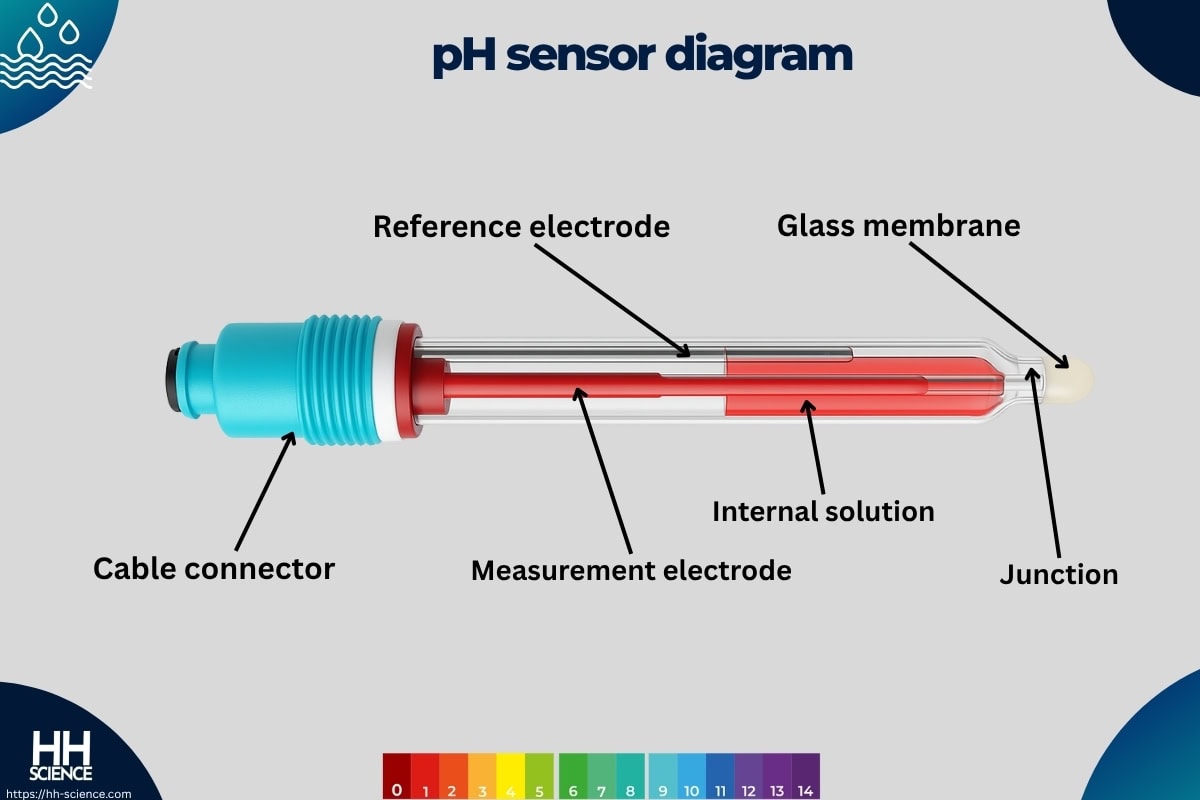
pH sensor diagram
A pH sensor diagram is valuable because it shows, at a glance, how chemistry becomes a number—from the sample contacting the measuring electrode (glass bulb or ISFET) and the Ag/AgCl reference through the porous junction, to the high-impedance mV signal that the meter/transmitter converts to pH via the Nernst slope (~59.16 mV/pH at 25 °C) with ATC (Pt100/Pt1000/NTC). By mapping the blocks—sample → membrane surface → reference/junction → electrolyte (gel/liquid) → cable/connector (BNC/DIN/M12) → high-Z input amplifier → temperature sensor → calibration (pH 4/7/10) → display/outputs (pH, 4–20 mA, RS-485/Modbus, Bluetooth/Wi-Fi)—the diagram clarifies installation points, common failure modes (fouling, junction clogging, drift), and where to tune accuracy (buffer calibration, shielding, temperature compensation), making troubleshooting and selection much easier.
What does a salt bridge do in a pH sensor?
A salt bridge in a pH sensor provides a stable ionic pathway between the sample and the Ag/AgCl reference by leaking a high-conductivity electrolyte (typically 3 M KCl) through a porous junction (ceramic/PTFE), thereby completing the circuit and minimizing liquid-junction potentials to only a few mV (≈ 1–3 mV ≙ ~0.02–0.05 pH at 25 °C). It also isolates the reference from sample contamination (often via double-junction designs), maintains a constant chloride activity around the Ag/AgCl element, and sets a controlled, low-noise reference impedance—though clogging, electrolyte depletion, or mismatched ionic strength will raise junction potential and drift, degrading accuracy until cleaned, refilled, or replaced.
What are the types of pH sensor junctions?
The types of pH sensor junctions include single-junction, double-junction, ceramic frit, porous PTFE (Teflon®), sleeve/annular-flow, open junction (solid-polymer/gel), ground-glass, fiber-wick (polymer/Pellon®), pinhole/capillary, and flowing/pressurized reference—because different junction chemistries and geometries trade off clogging resistance, leakage rate, junction potential (≈1–3 mV typical), and compatibility with dirty/low-conductivity/poisoning media.
- Single-junction: One junction between reference electrolyte and sample—low cost and fast, but more vulnerable to contamination/poisoning in harsh media.
- Double-junction: Adds an intermediate salt chamber to shield the Ag/AgCl—greatly reduces poisoning (e.g., sulfides/proteins) at the cost of slightly higher impedance.
- Ceramic frit: Fine, stable porosity with moderate leak (~1–5 µL/h), good general-purpose precision and low junction potentials.
- Porous PTFE (Teflon®): Hydrophobic, clog-resistant surface for slurries/oily matrices; slightly higher impedance but excellent fouling resistance.
- Sleeve / annular-flow: Large-area sliding sleeve creates a high-leak path that self-cleans; ideal for viscous or particulate samples; needs more electrolyte.
- Open junction (solid-polymer/gel): No discrete frit—polymer gel contacts sample directly, eliminating classic clogging; best in low-conductivity or biofouling streams.
- Ground-glass joint: Microporous glass interface with stable, low junction potential for lab glass electrodes; can salt-crystal clog if stored dry.
- Fiber-wick (Pellon®/polymer): Capillary wick meters electrolyte in very low-flow systems (micro-samples); compact but sensitive to dehydration.
- Pinhole / capillary: Micron-scale orifice yields very low leak and low drift; can be prone to blockage in dirty samples.
- Flowing/pressurized reference: Positive-pressure KCl feed (refillable) overwhelms sample ingress, giving ultra-stable junction potential in severe processes; higher maintenance.
| pH Sensor Junction type | Construction/material | Leak rate & impedance (typical) | Special features | Best for conditions | Limitations/notes |
| Single-junction | One porous interface from the reference (KCl) to the sample | Moderate leak; low–moderate impedance | Simple, low cost, fast wet-up | Clean, general-purpose aqueous samples | More contamination/poisoning risk in harsh media; shorter lifetime |
| Double-junction | Two chambers (inner Ag/AgCl, outer salt) with two junctions | Slightly higher impedance than a single | Shields Ag/AgCl from sample; resists sulfides/proteins | Dirty, reactive, or poisoning streams (wastewater, bioprocess) | Slightly slower response; larger body; more maintenance |
| Ceramic frit | Microporous ceramic plug | ~1–5 µL/h; stable, low junction potential | Precise, consistent flow; good baseline accuracy | Lab/bench, clean process water, QA/QC | Can clog with oils/fines; needs hydration |
| Porous PTFE (Teflon®) | Hydrophobic PTFE disc | Low–moderate flow; medium impedance | Excellent anti-fouling, non-wetting surface | Slurries, oily matrices, coatings, food/bev | Slightly higher noise/impedance; slower in very low conductivity |
| Sleeve / annular-flow | Sliding sleeve creates a wide annular gap | High, adjustable leak; low impedance | Self-cleaning by higher outflow; resists clogging | Viscous, particulate, pulp & paper, mining | Uses more electrolytes; may need periodic sleeve movement |
| Open junction (solid polymer/gel) | Polymer/solid-gel contacts sample directly (no discrete frit) | Very low leak; medium impedance | Clog-resistant, simple cleaning; small dead volume | Low-conductivity waters; biofouling risk | Gel aging/leaching over time; slower recovery after dry-out |
| Ground-glass joint | Microporous ground-glass seat | Low, stable leak; low impedance | Classic lab precision; low junction potential | Analytical labs, titrations, controlled matrices | Salt crystallization if stored dry; fragile interface |
| Fiber-wick (Pellon®/polymer) | Capillary wick meters electrolyte | Very low leak; can be higher impedance | Works with micro-samples; low flow control | Small-volume cells, microfluidics | Sensitive to dehydration; slower response |
| Pinhole/capillary | Micron-scale drilled/cast orifice | Very low leak; low–medium impedance | Minimal drift; compact tip geometry | Clean, filtered samples; inline micro-flow | Prone to blockage by fines; requires good pre-filtration |
| Flowing/pressurized reference | Refillable chamber with slight positive pressure | Controlled higher leak; very low junction potential | Overwhelms ingress; ultra-stable reference | Severe processes; high fouling/poisoning; CIP/SIP | More maintenance and electrolyte use; bulkier hardware |

What are the types of pH sensor connectors?
The types of pH sensor connectors include BNC, DIN 45322 (S7), S8 (threaded head), waterproof DIN/VP, M12 (A-coded, 4–8 pin), LEMO push-pull, TNC, fixed/potted cable (no connector), terminal-block/screw lugs (4–20 mA / RS-485), proprietary digital wet-mate (e.g., Memosens® inductive), and for optics SMA-905, because different environments (lab vs. industrial), signal types (high-impedance mV vs. conditioned 4–20 mA/RS-485), and ingress/IP requirements drive distinct mechanical and electrical interfaces.
- BNC: The lab workhorse for high-impedance mV signals; quick bayonet lock, ubiquitous on bench meters and handhelds.
- DIN 45322 (S7): Classic round DIN head on many glass electrodes; mates to DIN cables/adapters and offers strain relief for portable meters.
- S8 (threaded head): Metric threaded variant for a more secure mechanical coupling on some lab/portable probes.
- Waterproof DIN / VP-style: O-ring sealed DIN derivative that keeps moisture out in splashy field work and washdowns.
- M12 (A-coded, 4–8 pin): Industrial, IP-rated connector carrying mV+ATC or conditioned 4–20 mA/RS-485 to transmitters/PLCs.
- LEMO push-pull: Precision, quick-connect used in premium lab gear; secure latch with compact footprint.
- TNC: Threaded version of BNC for better vibration resistance on portable/industrial setups (less common than BNC).
- Fixed/potted cable (no connector): Factory-sealed cable avoids leakage and contact corrosion in harsh or submerged installs.
- Terminal-block / screw lugs: Bare-wire termination at a transmitter for 4–20 mA, 0–10 V, or RS-485/Modbus outputs.
- Proprietary digital wet-mate (e.g., Memosens®): Inductive, contactless head eliminates galvanic contact and moisture ingress for hygienic/CIP/SIP processes.
- SMA-905 (optical probes): Standard fiber-optic ferrule used on dye-based optical pH sensors with remote light sources/detectors.
| pH Sensor Connector type | Signal carried | Typical use | Ingress / mechanical | Notes & features |
| BNC | High-impedance mV (pH); sometimes separate lead for ATC | Lab benches, handheld meters | Friction/bayonet; not sealed by default | Ubiquitous; quick connect; sensitive to moisture & ground loops if unshielded |
| DIN 45322 (S7) | mV (pH); optional separate ATC leads | Glass electrodes on portable/lab instruments | Round DIN head; basic splash resistance | Strain relief on probe head; widely supported adapters to BNC |
| S8 (threaded head) | mV (pH) + optional ATC | Lab/field probes needing a more secure fit | Threaded coupling; better retention | Less common than S7; improved vibration resistance |
| Waterproof DIN / VP-style | mV (pH) + ATC | Field work, washdown areas | O-ring sealed; IP-rated variants | Prevents moisture ingress and contact corrosion |
| M12 (A-coded, 4–8 pin) | mV + ATC or conditioned 4–20 mA / 0–10 V / RS-485 (Modbus) | Industrial inline probes, PLC/SCADA | Threaded, IP65–IP67/69K options | Rugged, standardized pinouts; supports combined pH + temperature |
| LEMO (push–pull) | mV + ATC (multi-pin) | Premium lab systems, instrumentation | Positive-lock push–pull; some sealed models | Compact, reliable latch; higher cost |
| TNC | High-impedance mV | Portable/industrial where vibration is present | Threaded BNC variant; better retention | Less common; improved RF/mechanical robustness vs. BNC |
| Fixed / potted cable | mV + ATC (hardwired) | Submerged or harsh environments | Factory-sealed; highest moisture resistance | No user connector to fail; cable repair/replacement can be harder |
| Terminal block/screw lugs | Conditioned signals: 4–20 mA, 0–10 V, RS-485/Modbus | Panel transmitters, PLC inputs | Enclosed terminals; cabinet-mounted | For probes with local transmitters, not for raw mV signals |
| Proprietary digital wet-mate (e.g., Memosens®) | Digitized pH/ORP/ATC via inductive/contactless head | Hygienic/CIP/SIP, high-moisture processes | Contactless, fully sealed; high IP rating | Eliminates galvanic contact & moisture ingress; requires matching transmitter |
| SMA-905 (optical pH) | Fiber-optic light (excitation/return) | Optochemical dye probes, remote optics | Threaded ferrule; robust alignment | For optical pH sensors (no electrical mV path), immune to EMI/ground loops |

What are the types of pH sensor transmitters?
The types of pH sensor transmitters include benchtop/lab meters, panel-mount and DIN-rail units (both 2-wire loop-powered 4–20 mA and 4-wire line-powered multi-output), field-mount IP-rated transmitters, differential/high-impedance transmitters, digital/smart transmitters (RS-485/Modbus, HART, Profibus PA/FF, PROFINET/EtherNet/IP, IO-Link), wireless gateways (Bluetooth, Wi-Fi, LoRaWAN), intrinsic-safety/Ex-rated analyzers, hygienic/sanitary transmitters, multiparameter analyzers (pH/ORP/cond/DO), and edge/IIoT gateways—because different installations, signal standards, environmental ratings, and automation needs require distinct power, protocol, and packaging options.
- Benchtop/lab meters: High-impedance front ends read raw mV from BNC/DIN probes, apply ATC and multi-point calibration, and display pH with ±0.01–0.1 pH typical accuracy.
- Panel-mount 2-wire (loop-powered 4–20 mA): Minimal-power transmitters power themselves from the current loop and encode pH as 4–20 mA for long runs and simple PLC inputs.
- Panel-/DIN-rail 4-wire (line-powered): AC/DC powered units offer multiple outputs at once—4–20 mA, 0–10 V, relays, and digital buses—plus diagnostics and dual-channel options.
- Field-mount IP66/67/69K: Rugged housings with local displays for outdoor/washdown sites; sealed glands/M12 connectors resist moisture and vibration.
- Differential/high-impedance transmitters: Use differential inputs or preamps near the probe to reject ground loops and cable noise on the >100 MΩ mV signal in noisy plants.
- Digital/smart protocol transmitters: Natively speak RS-485/Modbus, HART, Profibus PA/FF, PROFINET/EtherNet/IP, or IO-Link for seamless PLC/SCADA integration and remote calibration/diagnostics.
- Wireless (Bluetooth/Wi-Fi/LoRaWAN): Add mobile/app access or long-range telemetry where cabling is hard; often battery or solar-assisted with edge buffering.
- Intrinsic-safety/Ex-rated analyzers: Certified for hazardous areas (ATEX/IECEx/CSA), using energy-limited loops and isolated barriers to safely read pH in explosive atmospheres.
- Hygienic/sanitary transmitters: 3-A/EHEDG-oriented designs with sanitary fittings and steam-sterilization (CIP/SIP) profiles for food/pharma skids.
- Multiparameter analyzers: One box conditions pH/ORP/temperature (and often conductivity/DO) with math blocks (e.g., compensation, dosing control) and shared comms.
- Edge/IIoT gateways: Bridge analog/digital pH signals to MQTT/HTTPS/cloud, adding local data logging, alarming, and fleet diagnostics for remote operations.

What are the materials of a pH sensor?
The materials of a pH sensor span the measuring membrane (specialty pH glass or ISFET stacks: Si₃N₄/SiO₂/Al₂O₃/Ta₂O₅), reference system (Ag/AgCl element, KCl/KNO₃/LiCl liquid/gel electrolytes), junction/diaphragm (ceramic frit, porous PTFE, sleeve/ground-glass, polymer gel, pinhole), body/shaft (lab glass, epoxy, PVDF, PEEK, PPS, 316L stainless, titanium), seals/O-rings (EPDM, FKM/Viton®, FFKM/Kalrez®, PTFE), temperature element (Pt100/Pt1000 RTD, NTC), cable & insulation (coax with PTFE/PE/PVC/EPDM jackets), and connectors/heads (BNC/DIN/M12/LEMO; nickel-plated brass, stainless, polymer)—chosen for chemistry, temperature/pressure, fouling resistance, electrical performance, and hygiene/CIP/SIP requirements.
| Sensor part | Common materials | Why used | Typical conditions/notes |
| Measuring membrane (glass) | pH glass (low-resistance, acid-resistant, alkali-resistant formulations) | Ion-exchange surface gives Nernst response; tuned resistivity and chemical durability | General aqueous use; acid glass for strong acids; low-R glass for cold/fast response; avoid HF |
| Measuring membrane (ISFET) | Si₃N₄, Al₂O₃, Ta₂O₅ gate; Si/SiO₂ substrate; passivation layers | Solid-state pH transduction; robust to breakage; small form factor | Good for viscous/dirty media; needs reference; solvent compatibility per coating |
| Reference element | Silver/silver-chloride (Ag/AgCl) | Stable reference potential with defined chloride activity | Sensitive to poisons (sulfides, proteins)—often isolated by double-junction |
| Reference electrolyte | 3 M KCl (aq), KNO₃, LiCl; gelled or liquid (polymer/agar) | High conductivity, stable junction potential, and chloride supply for Ag/AgCl | Gel reduces leakage/fouling; KNO₃ is used where Cl⁻ is problematic |
| Junction/diaphragm | Ceramic frit, porous PTFE (Teflon®), sleeve/annular flow, ground-glass, polymer gel, fiber-wick, pinhole | Controlled ionic path, low junction potential, anti-clog options | Pick per matrix: PTFE/sleeve for slurries & oils; ceramic for clean water; open-gel for low conductivity |
| Body/shaft | Lab glass, epoxy, PVDF, PEEK, PPS, 316L stainless, titanium | Mechanical strength, chemical/thermal resistance, sanitary/hygienic ratings | PVDF/PEEK for chemicals & CIP/SIP; stainless/titanium for pressure & hygiene; epoxy for economy |
| Protective guard/tip | PPS, PEEK, PVDF, stainless steel | Prevents bulb damage and impact | Inline/process probes; choose per corrosion and cleaning method |
| Seals / O-rings | EPDM, FKM (Viton®), FFKM (Kalrez®), PTFE | Chemical and thermal sealing of wetted joints | FFKM for solvents/steam; EPDM for water; FKM for hydrocarbons; check FDA/EHEDG needs |
| Temperature sensor | Pt100 / Pt1000 RTD, NTC thermistor | Automatic temperature compensation (ATC) of Nernst slope & buffer tables | Embedded near the membrane for fast response; wiring via a multi-pin head |
| Cable & insulation | Coaxial conductor; PTFE, PE, PVC, PUR, EPDM jackets | Shielding for high-impedance mV signal; chemical/abrasion resistance | PTFE/PUR for chemicals; PVC for lab; molded strain reliefs for IP ratings |
| Connector/head | BNC, DIN (S7/S8/VP), M12 (stainless/polymer), LEMO; inductive digital heads | Electrical interface to meter/transmitter; sealing and strain relief | Lab (BNC/DIN), industrial (M12, inductive wet-mate) with IP66–IP69K options |
| Adhesives & potting | Epoxy, silicone, polyurethane | Seals & immobilizes internal parts; moisture barrier | Chosen for chemical/thermal compatibility and low outgassing |
| Optical pH (alt. tech) | Indicator dyes (e.g., fluorescein derivatives) in sol–gel/polymer; optical windows (quartz/sapphire) | Optochemical transduction; EMI-immune; no Ag/AgCl needed | Use with LED/photodiode; sensitive to photobleach/solvent; great for low conductivity |

What material is the membrane that covers the pH sensor?
The membrane is typically a pH-sensitive glass bulb made from a specially doped alkali–silicate glass (low-resistance, acid- or alkali-resistant formulations), because its hydrated surface exchanges H⁺ selectively and yields a near-Nernstian response (~59.16 mV per pH at 25 °C) with good chemical durability across pH 0–14. Some probes instead use an ISFET solid-state membrane (e.g., Ta₂O₅/Si₃N₄/Al₂O₃ gate stacks) for break-resistance, fast wetting, and dirty/low-conductivity media; whichever is used, note limits—glass is attacked by HF and hot strong alkali, while ISFET coatings must match the solvent/temperature conditions.
Glass vs membrane pH sensor
Glass-electrode pH sensors and membrane (ISFET/solid-state) pH sensors both convert H⁺ activity to pH, but they differ in sensing physics, robustness, response in difficult matrices (low conductivity, viscous, oily), maintenance, and integration—so picking the right one affects accuracy, uptime, and total cost of ownership.
| Aspect | Glass-electrode pH sensor | Membrane (ISFET/solid-state) pH sensor | What this means for you |
| Sensing principle | Hydrated pH glass bulb exchanges H⁺, generating potential vs Ag/AgCl reference (≈59.16 mV/pH @25 °C). | ISFET gate (Ta₂O₅/Si₃N₄/Al₂O₃) modulates channel with pH; measured vs Ag/AgCl reference. | Both need a reference: electrochemical vs field-effect transduction. |
| Core sensor parts | Glass membrane, internal electrolyte, Ag/AgCl, junction (ceramic/PTFE/sleeve), glass/epoxy/PVDF body. | ISFET die with passivation, double-junction reference, robust PEEK/PVDF/stainless body. | ISFET removes fragile bulb; junction/reference quality still critical. |
| Signal & electronics | High-impedance mV; needs GΩ input, ATC (Pt100/Pt1000/NTC); outputs pH/4–20 mA/RS-485, etc. | Similar, often with on-probe preamp; easier long-cable/noisy-plant runs. | An ISFET with a preamp can be friendlier to EMI and cable length. |
| Accuracy (typical) | ±0.01–0.05 pH with good calibration and clean junctions. | ±0.01–0.05 pH; strong in low-conductivity/dirty media. | Parity in clean water; ISFET often wins in difficult matrices. |
| Response time (t₉₀) | Seconds → tens of seconds; slower in cold/viscous/low-ionic strength samples. | Often faster wet-up and stabilization; good in low-conductivity media. | Faster changes favor ISFET. |
| Mechanical robustness | Fragile glass bulb; impact/vibration sensitive. | No glass bulb; rugged tip; better shock/vibration tolerance. | ISFET for fieldwork/inline skids with rough handling. |
| Chemical limits | HF attacks glass; hot, strong alkali can etch; excellent in most aqueous media. | Coating/encapsulation must match solvent/cleaner; good with oils/viscous media. | Check compatibility charts for either type. |
| Low-conductivity samples | Can drift/slow due to junction potentials and source impedance. | Generally superior stability/speed in ultrapure/RO permeate. | ISFET has an edge for low-µS/cm water. |
| Fouling & junction issues | Junction clogging/poisoning (proteins, sulfides, oils) is common; double-junction helps. | Same junction physics; often anti-fouling surfaces and designs. | Junction health governs both; ISFET mainly helps the sensing element. |
| Temperature behavior | Nernst slope; needs ATC; special glass for cold/acid/alkali ranges. | Also temperature-dependent, many include fast on-tip sensors. | Both require accurate ATC near the tip. |
| Maintenance & calibration | Clean, store wet, 2–3-point cal (pH 4/7/10); hydration critical. | Similar calibration, easier cleaning of flat/small tips, no bulb hydration. | ISFET can reduce downtime in sticky/dirty processes. |
| Service life (typical) | ~6–18 months (process-dependent). | Comparable; can be longer in abrasive/impact-prone use. | Matrix, temperature, and cleaning dictate real life. |
| Cost & availability | Lowest upfront; ubiquitous accessories. | Higher upfront, growing availability; often “smart” heads. | Glass wins on price; ISFET may win on lifecycle. |
| Best-fit applications | Labs, clean water, standard process lines, titrations. | Low-conductivity water, viscous/oily/slurry media, high-vibration, hygienic inline. | Match to matrix + mechanics, not just specs. |
| Key limitations | Fragility; HF/strong-alkali attack; junction clogging; cable noise. | Solvent/coating compatibility; still needs a healthy reference; higher price. | Plan spares and cleaning SOPs for either choice. |

Bottom line: Choose glass for cost-effective, clean aqueous work and well-controlled lab/process environments; choose ISFET/solid-state membrane when you need robust mechanics, better behavior in low-conductivity or fouling matrices, or faster stabilization—and in both cases, the reference/junction quality, ATC, and calibration will ultimately set your real-world accuracy.
Types of pH sensors
Types of pH sensors group probes by what drives real-world performance and integration—sensing design (glass vs ISFET), tip geometry, combination vs separate electrodes, connectivity/communication, feature set (ATC, junction, electrolyte), working conditions, and industry fit—so you can match accuracy, robustness, maintenance, and PLC/SCADA needs to your application. In the sections below, use the category that mirrors your constraint first (process chemistry or installation), then refine by features to hit your target accuracy (±0.01–0.1 pH) and total cost of ownership.
pH sensor types based on design
pH sensor types based on design—combination, differential, laboratory, industrial, process, consumer-grade, research-grade, and portable—classify probes by architecture (single-body combination vs. differential noise-rejection), packaging/performance tier (lab, industrial, process, consumer, research), and mobility (portable). This framing matters because design choices set the achievable accuracy, robustness, maintenance burden, and integration path (meters, PLC/SCADA, field use).
| Type | Design/construction | Primary use case | Typical accuracy | Key advantages | Common limitations |
| Combination | Measuring electrode (glass/ISFET) and Ag/AgCl reference housed in a single body with a junction (single/double) | General lab/field/process measurements with minimal wiring | ±0.01–0.05 pH | Compact, low noise path, easy setup & calibration | Single-point failure; junction fouling/poisoning requires full probe replacement |
| Differential | Two measurement electrodes + separate reference (measures differential potential to reject ground loops) | Noisy industrial plants, high EMI, long cable runs, grounded tanks | ±0.02–0.05 pH | Excellent noise immunity; stable in difficult electrical environments | Higher cost, larger hardware, and more complex wiring |
| Laboratory | Glass or ISFET probe with BNC/DIN head, bench meter, multi-point calibration | Analytical work, QA/QC, titrations, method development | ±0.005–0.02 pH (best setups) | High precision, wide buffer support, easy maintenance | Less rugged; not suited to harsh/continuous inline duty |
| Industrial | Rugged probe (PVDF/PEEK/stainless), gel or refillable electrolyte, M12/field connector | Plant sampling, skids, tanks; moderate duty cycles | ±0.02–0.05 pH | Durable materials, broad chemical compatibility | Needs scheduled cleaning/calibration; junction care critical |
| Process | Inline/sanitary design, flow cells, retractable holders, transmitter (4–20 mA/RS-485), ATC | Continuous control loops (water, pharma, food, power, chemical) | ±0.02–0.05 pH online | Continuous monitoring, diagnostics, PLC/SCADA integration | Higher CAPEX/OPEX; requires proper installation & CIP/SIP strategy |
| Consumer-grade | Pen/tester style, fixed cable, simple single- or two-point calibration | Pools, aquariums, hydroponics, hobby labs | ±0.05–0.10 pH | Low cost, portable, easy to use | Lower stability, shorter life, limited calibration/diagnostics |
| Research-grade | Premium glass/ISFET, low-noise electronics, detailed slope/offset/impedance diagnostics | High-precision studies, method validation, metrology | ±0.005–0.01 pH | Top accuracy, traceability, and advanced features | Highest cost; careful handling and buffer discipline required |
| Portable | Handheld meter + probe, ruggedized case, battery power, often IP-rated | Field sampling, commissioning, troubleshooting, grab tests | ±0.02–0.10 pH (model-dependent) | Mobility, quick deployment, on-site calibration | Shorter probes/cables; accuracy depends on field conditions and upkeep |

pH sensor types based on tip shape
pH sensor types based on tip shape—ball, micro, flat, and spear—reflect how geometry controls membrane–sample contact (immersion vs surface/semisolids), which in turn drives wetting, response time, durability, and cleanability. Choosing the right tip matches the matrix (beakers, micro-vials, flat surfaces, foods/soils) to the required handling and performance.
| Tip shape | What it is | Best use/sample type | Key advantages | Limitations/notes |
| Ball (bulb) | Classic spherical glass bulb with high surface area and a good hydration layer. | General aqueous solutions in beakers, flow cells, and standard lab/process work. | Fast wetting, robust Nernst response, widest compatibility, and easiest calibration. | More fragile to impact; not ideal for surfaces, gels, or puncture tasks. |
| Micro | Miniature bulb or micro-ISFET with a very small tip diameter. | Small-volume vials, microreactors, biology wells, and narrow tubes. | Fits tiny spaces; minimal sample volume; good spatial resolution. | Higher impedance/slower response possible; more delicate; higher cost. |
| Flat | Planar membrane (glass or ISFET) flush with the body. | Surface pH (skins, plates), thin films, paper, semisolids; easy wipe-clean. | Great for wipe measurements; resists breakage; cleanable face. | Needs full wetting for accuracy; may be slower in low-conductivity samples. |
| Spear | Sharp or tapered tip (often reinforced) to penetrate semisolids. | Foods (meat, cheese, fruits), soils, gels, emulsions. | Direct insertion into semisolids; faster equilibration inside the matrix. | Tip can chip if misused; requires careful cleaning to avoid carryover. |

pH sensor types based on a combined probe
pH sensor types based on combined probe include chlorine, conductivity, moisture, temperature, and ORP, because co-locating pH with these parameters reduces ports and plumbing, improves compensation (e.g., ATC and pH-dependent chlorine speciation), saves space/cost, and gives tighter process control from a single insertion point.
| Combined type | What is combined with pH | Why combine | Typical applications | Notes/considerations |
| pH + Temperature | Embedded RTD/thermistor (Pt100/Pt1000/NTC) | Automatic temperature compensation (ATC) for Nernst slope & buffer tables | All pH measurements (lab, process, sanitary, field) | Fast, co-located T improves accuracy; verify sensor placement near the membrane |
| pH + ORP (Redox) | Separate ORP platinum/gold electrode + reference in the same body | Correlate acidity with oxidizing/reducing power for better control | Disinfection control, metal finishing, cyanide/chlorination, wastewater | Different calibration standards (pH vs mV); ensure compatible junction/electrolyte |
| pH + Conductivity | Contacting or inductive conductivity cell alongside pH | Pair pH with ionic strength/neutralization tracking; one port | Boilers/cooling, CIP return, neutralization skids, ultrapure water | Keep sensors thermally coupled; avoid cross-interference in tight flow cells |
| pH + Free/Total Chlorine | Amperometric chlorine sensor (membrane-covered) near pH | Chlorine speciation depends on pH (HOCl/OCl⁻); on-board pH correction improves dose control | Municipal drinking water, pools, cooling towers, and food sanitation | Requires stable flow and zero-chlorine calibration; maintain electrolyte/membrane on chlorine sensor |
| pH + Moisture (humidity) | Humidity sensor in the probe head or enclosure | Detect condensation/ingress that can bias high-impedance pH signals | Outdoor enclosures, washdown areas, remote stations | Use for diagnostics/alarms; still need proper IP sealing and cable glands |
| pH + Multiparameter | pH with two or more of: ORP, conductivity, temperature, chlorine, DO | Full chemistry picture for advanced control and fewer process penetrations | Water/wastewater panels, CIP skids, aquaculture, environmental sondes | Mind calibration workflow per channel; select compatible wetted materials and junctions |

pH sensor types based on connectivity
pH sensor types based on connectivity include wired, convertable (connector/adaptor-ready), immersion (submersible), insertion (inline), sanitary, Bluetooth, and wireless (Wi-Fi/LoRa), because installation method and data link determine how the probe physically mounts, how far it can run, what signal it delivers (raw mV vs conditioned 4–20 mA/RS-485 vs radio), and how it integrates with meters or PLC/SCADA.
| Type | Physical / connection style | Typical signal/link | Where it fits | Advantages | Limitations/notes |
| Wired | Fixed cable or standard head (BNC/DIN/M12) to meter/transmitter | Raw mV (+ ATC) or conditioned 4–20 mA / 0–10 V / RS-485 | Labs, panels, skids | Lowest latency, no batteries, EMI-robust with proper shielding | Cable length/ingress management; potential ground loops if not isolated |
| Convertable | Interchangeable heads/adapters (e.g., BNC↔M12, quick-swap) | Matches chosen adaptor (mV or conditioned) | Multi-instrument labs; service swaps | Flexible integration, easy probe changeout | Adapters add failure points; maintain IP rating and strain relief |
| Immersion (submersible) | Probe on the drop tube/wand immersed in tanks/wells | mV to the local transmitter, or 4–20 mA / RS-485 up the cable | Open tanks, sumps, and environmental monitoring | Simple deployment, minimal piping | Cable management, sealing against moisture, and ensuring flow past the junction |
| Insertion (inline) | Threaded/tri-clamp holder, flow cell, retractable assembly | Typically conditioned 4–20 mA / RS-485 to PLC | Closed pipes, recirculating loops, process lines | Continuous control, stable flow/temperature environment | Needs taps/bypasses; retractable holders for safe service |
| Sanitary | Hygienic body (Tri-Clamp), CIP/SIP-rated, polished wetted parts | Conditioned outputs (4–20 mA, RS-485) to PLC/SCADA | Food, dairy, pharma, biotech | Compliance, cleanability, steam-sterilizable assemblies | Higher cost; strict gasket/material and surface-finish specs |
| Bluetooth | Short-range radio to phone/tablet/logger | BLE app (pH, temperature, diagnostics) | Field spot checks, portable QA | Cable-free convenience, quick logging, and sharing | Short rang,; battery power, metal enclosures can attenuate signal |
| Wireless (Wi-Fi/LoRa) | Radio module/gateway; often paired with local transmitter | Wi-Fi (LAN/cloud) or LoRaWAN (long-range, low bandwidth) | Remote sites, retrofits without new cabling | Long runs without trenching; remote monitoring/alarming | Power management, IT/security policies, bandwidth/latency vs control needs |

pH sensor types based communication interface
pH sensor types based on communication interface include analog and digital, because control systems either ingest a raw or conditioned electrical signal (simple, universal) or a protocolized data stream (diagnostics, multi-parameter, remote configuration).
- Analog: Outputs raw mV (Nernst ~59.16 mV/pH @ 25 °C) or conditioned 4–20 mA / 0–10 V to PLCs/meters—simple, low-latency, widely compatible, but limited diagnostics and more susceptible to noise/ground loops on long high-impedance runs.
- Digital: Speaks RS-485/Modbus, HART, Profibus PA/FF, PROFINET/EtherNet/IP, IO-Link, Bluetooth/Wi-Fi—adds device ID, slope/offset/impedance health, remote calibration, and multi-channel data with better noise immunity, at the cost of protocol configuration and network/IT integration.
When are digital sensores more suitable than analaoge probes pH?
Digital pH sensors are more suitable than analog probes when you need remote configuration/diagnostics (slope, offset, impedance, calibration logs), long runs in noisy plants with better noise immunity (e.g., RS-485/Modbus, HART, PROFINET/EtherNet/IP, IO-Link), multi-parameter data (pH, temperature, health), or fleet/cloud integration, because protocolized packets preserve data integrity, support condition-based maintenance, and simplify SCADA/CMMS workflows over shared networks.
When are analog sensores more suitable than digital probes pH?
Analog pH sensors are more suitable than digital probes when you want simple, deterministic control into legacy PLC cards via 4–20 mA/0–10 V (or short, shielded mV into a nearby transmitter), ultra-low latency/fail-safe signaling (live-zero 4 mA), lower cost and easier commissioning without IT setup, or hazardous-area loops with intrinsic-safety barriers, because current loops run long distances robustly and are universally supported while avoiding protocol configuration overhead.
pH sensor types based on features
pH sensor types based on features include refillable, semiconductor, smart, unbreakable, underwater, USB, inline, and ISFET, because specific build/features (electrolyte serviceability, solid-state sensing, onboard diagnostics, rugged housings, submersible designs, direct PC connectivity, process insertion, and field-effect transduction) directly determine robustness, maintenance, integration, and accuracy in different applications.
| Type (feature) | What it means | Why it matters / key benefit | Typical applications | Notes & limitations |
| Refillable | Reference chamber with liquid electrolyte (e.g., 3 M KCl) that can be refilled. | Restores junction flow and extends life in dirty/poisoning media. | Wastewater, plating baths, pulp & paper, harsh process streams. | Requires upkeep; keep fill level above sample and use matching electrolyte. |
| Semiconductor | Solid-state pH sensing (ISFET or similar) instead of fragile glass bulb. | Rugged, fast wet-up, works well in low-conductivity or viscous matrices. | Ultrapure water, food pastes, slurries, high-vibration field work. | Still needs a good reference/junction; check solvent/temperature compatibility. |
| Smart | Electronics in probe/head store slope/offset/impedance, IDs, and calibration. | Diagnostics, plug-and-play replacement, remote calibration & traceability. | PLC/SCADA plants, GMP/regulated labs, multi-probe fleets. | Requires matching transmitter/protocol; higher upfront cost. |
| Unbreakable | Reinforced or glass-free construction (epoxy/PEEK body, protected tip). | Greatly reduced breakage risk and downtime in rough handling. | Field kits, education, packaging lines, high-impact areas. | May trade some ultimate precision; verify chemical resistance. |
| Underwater | Submersible, sealed assemblies with long cables and IP-rated glands. | Continuous monitoring in tanks, wells, open channels without taps. | Environmental sondes, sumps, lagoons, aquaculture. | Moisture ingress is critical—use proper strain relief and vented cables if needed. |
| USB | Probe or head that connects directly to a PC/mobile via USB. | Simple data logging and power from a single cable; portable QA/QC. | Lab benches, teaching, field notes with laptops/tablets. | Usually short cables; not ideal for high-EMI or long-run industrial installs. |
| Inline | Process-mount (threaded/tri-clamp/flow cell) with transmitter output. | Real-time control with 4–20 mA / RS-485 into PLC/SCADA. | Water treatment, CIP/SIP skids, boilers/cooling, chemical reactors. | Needs proper insertion, flow, and retractable holders for safe service. |
| ISFET | Field-effect transistor gate senses pH (a specific semiconductor class). | Flat/mini tips, break-resistant, fast response; good in low-conductivity samples. | Food contact surfaces, micro-vials, RO/DI water, portable meters. | Overlaps “semiconductor” category; still relies on reference/junction quality. |

pH sensor types based on working conditions
pH sensor types based on working condition include high-temperature, low-temperature, hydrofluoric-acid (HF), high-salt, low-ionic, aqueous, non-aqueous, solids, and semi-solids, because process conditions dictate the membrane material (glass vs ISFET), junction style (ceramic/PTFE/open), electrolyte (gel vs refillable), body/seals (PVDF/PEEK/FFKM), and mounting needed to maintain accuracy, response time, lifetime, and safety.
| Working condition | Recommended sensor design | Key materials/parts | Why this works | Typical notes & limits |
| High temperature | High-temp glass electrode or ISFET with CIP/SIP-rated assembly | Low-resistance high-T glass, PVDF/PEEK body, FFKM seals, Pt100/Pt1000 ATC | Maintains slope and low impedance at elevated T; materials survive steam/thermal cycles | Check rating (e.g., 120–135 °C); recalibrate post-CIP/SIP; avoid thermal shock |
| Low temperature | Low-resistance glass or ISFET for fast wet-up | Low-R glass, gel electrolyte, close-coupled ATC | Reduces response time and noise in cold, viscous samples | Allow extra equilibration; watch for sluggish junctions |
| Hydrofluoric acid (HF) | Glass-free ISFET or protected optical pH sensor | ISFET (Ta2O5/Si3N4) with HF-resistant coatings; PTFE/PVDF body; FFKM seals | HF attacks glass; solid-state or optical avoids membrane etch | Confirm coating compatibility and reference protection; never use standard glass |
| High salt / high ionic strength | Robust glass or ISFET with ceramic/sleeve junction | Ceramic or sleeve junction, refillable 3 M KCl electrolyte | Stable junction potentials and good flow in concentrated brines | Activity ≠ concentration—expect small matrix biases; maintain electrolyte level |
| Low ionic (ultrapure/RO/DI) | ISFET or glass with an open/porous PTFE junction and preamp | Open/PTFE junction, gel electrolyte, differential or preamplified head | Minimizes junction potential drift and improves stability in µS/cm waters | Ensure flow past the tip; longer stabilization times are normal |
| Aqueous (general) | Standard combination glass electrode | pH glass bulb, ceramic junction, gel or liquid KCl | Reliable, economical Nernst response for most water-based samples | Avoid HF; select double-junction for fouling/poisons |
| Non-aqueous / solvents | ISFET or specialty glass with solvent-resistant construction | PEEK/PVDF body, FFKM seals, open junction; solvent-compatible coatings | Handles low conductivity and solvent attack better than standard glass | pH concept shifts with activity in non-aqueous media; verify method |
| Solids | Flat-tip ISFET or spear with surface/press contact | Flat membrane, rugged guard, strong body (PEEK/PPS) | Measures surface pH without beakers; suitable for papers/skins/films | Needs moist interface for accuracy; clean between spots |
| Semi-solids | Spear-tip or flat ISFET for insertion | Spear/tapered tip, PTFE/PEEK body, open/large-area junction | Pierces gels/foods/soils for faster equilibration inside the matrix | Risk of tip damage; thorough cleaning to prevent carryover |

pH sensor types based on industry
pH sensor types based on industry include Industrial Water & Wastewater Treatment, Municipal Water & Wastewater Treatment, Environmental Monitoring, Laboratory & Analytical, Pool & Spa, Aquaculture & Aquarium, Hydroponics & Agriculture, Food & Beverage, and Metallurgy & Mining, because each sector imposes distinct chemistry, hygiene, durability, and integration demands that drive the sensor’s materials, junction style, mounting, ratings, and outputs.
| Industry | Typical sensor design | Key features/specs | Mounting/installation | Notes & considerations |
| Industrial Water & Wastewater Treatment | Rugged combination glass or ISFET with double-junction | PVDF/PEEK body, gel or refillable 3 M KCl, IP66/67, 4–20 mA / RS-485 | Inline flow cell, immersion, or retractable holder | Resist fouling/poisons; prefer differential inputs in noisy plants |
| Municipal Water & Wastewater | Process-grade combination probe with diagnostics | Low maintenance, auto-clean options, ATC, SCADA-friendly | Bypass loop/flow cell; enclosure-rated transmitters | Stable at variable loadings; coordinate with chlorine monitoring |
| Environmental Monitoring | Submersible/sonde-style pH (glass or ISFET) | Long cables, low-power, datalogging/telemetry (LoRa/Wi-Fi) | Immersion in wells, rivers, lakes; cages/guards | Handle low conductivity and temperature swings; anti-biofouling coatings |
| Laboratory & Analytical | High-precision glass or ISFET with bench meter | ±0.005–0.02 pH, BNC/DIN, multi-point calibration, ATC | Beaker/flow cell, magnetic stir, electrode stands | Use fresh buffers (pH 4/7/10); avoid HF; hydrate/store properly |
| Pool & Spa | Consumer/industrial light-duty combination probe | Economical, temperature readout, basic transmitters | Inline in the recirculation line or handheld testers | Chlorine alters ORP; keep probe clean of oils/conditioners |
| Aquaculture & Aquarium | Low-drift, temperature-compensated pH with ORP option | ATC near tip, biofouling resistance, continuous logging | Inline/immersion with gentle flow past the junction | Stable near-neutral pH; avoid CO₂ degassing artifacts |
| Hydroponics & Agriculture | Robust probe for nutrient solutions/soil slurries | Flat or spear tips, ATC, fertilizer-resistant materials | Inline in fertigation loop; handheld for soils | High salts: prefer refillable/sleeve junctions; frequent rinsing |
| Food & Beverage | Sanitary (Tri-Clamp) glass or ISFET; spear/flat tips for semisolids | 3-A/EHEDG, CIP/SIP capable, polished wetted parts, ATC | Inline sanitary fittings, retractable housings | Cleanability and documentation critical; avoid glass breakage risks |
| Metallurgy & Mining | Heavy-duty, abrasion-resistant, double-junction | Sleeve/annular junction, protective guards, differential transmitters | Insertion in slurry lines or rugged flow cells | Handle slurries/low pH/high ionic strength; frequent cleaning expected |

How to choose a pH sensor?
Choose a pH sensor by matching the sample matrix (aqueous/solvent, low/high ionic strength, slurries, HF), pH & temperature/pressure range, accuracy/response targets, installation style (immersion/insertion/sanitary/retractable), tip geometry (ball/flat/spear/micro), reference/junction/electrolyte (single/double, ceramic/PTFE, gel/refillable), body/seal materials (glass/epoxy/PVDF/PEEK; EPDM/FKM/FFKM), connectivity & interface (mV, 4–20 mA, RS-485/Modbus, Bluetooth/Wi-Fi), noise/grounding environment (combination vs differential, cable length), regulatory compliance (ATEX/IECEx, 3-A/EHEDG, CIP/SIP), ATC/temperature element, smart/diagnostics features, maintenance & calibration burden, expected service life/TCO, and budget, because each factor directly affects real-world accuracy (±0.01–0.10 pH), uptime, safety, and integration with meters or PLC/SCADA.
- Sample matrix: Pick glass vs ISFET and junction style for clean water, solvents, slurries, proteins/oils, or low-conductivity (<10–50 µS/cm) media to minimize drift and fouling.
- Chemical compatibility (HF/solvents/salts): Avoid glass in HF or hot, strong alkali; choose ISFET/optical or specialty materials (PEEK/PVDF, FFKM seals) to prevent attack.
- pH range & target accuracy: Align sensor grade with needed precision—lab/research for ±0.005–0.02 pH, process for ±0.02–0.05 pH, consumer/field for ±0.05–0.10 pH.
- Temperature & pressure: Ensure ratings (e.g., up to 120–135 °C for CIP/SIP, suitable bar rating) and include ATC (Pt100/Pt1000/NTC) since the Nernst slope changes (~59.16 mV/pH at 25 °C).
- Response time: Choose low-resistance glass, ISFET, or proper flow cells if you need fast t90 (seconds) for dynamic control.
- Installation style: Decide on immersion, insertion/inline, retractable, or sanitary fittings to match piping, safety, and service access.
- Tip geometry: Use a ball for general solutions, a flat for surfaces, spear for semi-solids, or micro for tiny volumes to ensure proper contact/wetting.
- Reference/junction/electrolyte: Double-junction, ceramic/PTFE/open junction, and gel vs refillable electrolyte balance clog resistance, maintenance, and stability.
- Body & seals: Pick glass/epoxy/PVDF/PEEK/PPS bodies and EPDM/FKM/FFKM/PTFE seals for the chemicals, temperature, and hygiene needed.
- Connectivity & interface: Choose raw mV to a nearby transmitter or conditioned 4–20 mA/0–10 V/RS-485 (or Bluetooth/Wi-Fi) for distance, diagnostics, and PLC integration.
- Noise/grounding environment: Use differential or preamplified heads for long cables/ground loops/EMI; keep high-impedance runs short and shielded.
- Compliance & sanitation: For hygienic lines select 3-A/EHEDG, steam-sterilizable designs; for hazardous areas choose ATEX/IECEx certified analyzers.
- ATC/temperature element: Ensure the temperature sensor is close to the membrane for accurate slope and buffer-table compensation.
- Smart features/diagnostics: Health metrics (slope, offset, impedance), stored calibration, and ID simplify condition-based maintenance and fleet management.
- Maintenance & calibration: Match calibration workflow (2–3 point pH 4/7/10), cleaning method, and storage to staffing and SOPs to sustain accuracy.
- Service life & TCO: Consider expected probe life (often 6–18 months process-dependent), spare parts, cleaning time, and electrolyte use when comparing cost.
- Budget & availability: Balance upfront price against downtime risk, required accuracy, and replacement cadence to minimize total cost of ownership.

What are the key features for choosing a pH sensor?
The key features for choosing a pH sensor are accuracy & stability (target ±0.01–0.05 pH in process; verify slope near the Nernst 59.16 mV/pH @ 25 °C and low drift), temperature handling & ATC (built-in Pt100/Pt1000/NTC and ratings for your °C/bar), chemical/matrix compatibility (glass vs ISFET, avoid glass in HF; pick PVDF/PEEK/PPS bodies and EPDM/FKM/FFKM seals to match solvents/salts), reference/junction design (single vs double-junction; ceramic/PTFE/open/sleeve to balance clogging resistance and junction potential ≈ 1–3 mV), tip geometry (ball/flat/spear/micro for beakers, surfaces, semisolids, microvolumes), and installation & connectivity (immersion/inline/sanitary/retractable; outputs mV, 4–20 mA, RS-485/Modbus, Bluetooth/Wi-Fi for PLC/SCADA). These matter because they directly set response time (t₉₀ in seconds), real-world accuracy across pH 0–14, uptime and maintenance (refillable vs gel electrolyte, cleaning/calibration workload), compliance (3-A/EHEDG, ATEX/IECEx), and ultimately the total cost of ownership over the probe’s typical 6–18 month service life.
What are the sizes of pH sensor?
The sizes of ph sensors are 120 mm, 225 mm, 250 mm, 325 mm, 425 mm, and 450 mm because different installation geometries and process needs—like required immersion depth to reach representative flow, clearance past tees/valves/splash zones, tank/pipe diameters, and safe service/access above the liquid—demand specific lengths to balance accuracy, durability, and maintainability.
| pH Sensor Length | Typical purpose | Where it’s used | Typical mounting | Why this length exists |
| 120 mm | Bench/lab work | Beakers, small flow cells, titrators | BNC/DIN to bench meter; electrode stand | Short, easy handling; places bulb/junction a few cm below liquid without tipping small vessels. |
| 225 mm | Compact process & field | Small bypass lines, skids, sampling ports | 12 mm flow cell, short insertion holder | Extra reach through tees/valves while staying manageable in tight panels. |
| 250 mm | General industrial “short” | Standard pipelines, small tanks | Threaded insertion, short retractable holder | Clears fittings/splash zones; gets the junction into the flowing core. |
| 325 mm | Medium immersion | Sumps, open channels, mid-size tanks | Immersion wand/tube, longer retractable | More depth for stable readings away from walls/stratification. |
| 425 mm | Deep immersion / larger lines | Clarifiers, large tanks, deep manholes | Long immersion assemblies with cable gland | Reaches representative layers without custom scaffolding. |
| 450 mm | Extra-deep / difficult access | Lagoons, reactor hoods, wide basins | Heavy-duty immersion or retractable lance | Maximizes reach to safe, serviceable zones; keeps connectors above splash/washdown. |

How should I inspect a new lab pH electrode for completeness and quality?
Use this quick intake to confirm a new lab pH electrode is ready: unbox & check completeness, inspect the tip/junction & cable, pre-soak in KCl, run a 2-point calibration, verify response on a third buffer, and store correctly with KCl while recording slope/offset/date. These steps catch shipping damage or junction issues, ensure the membrane is hydrated, confirm slope (~59 mV/pH) and offset (~0 mV) are in spec, and create a baseline for future QC.
- Unbox & completeness: Electrode with storage cap (KCl), tip guard, correct connector (BNC/DIN/M12), and a quick sheet/specs.
- Quick visual check: No cracks or chips on the glass/ISFET tip; junction (ceramic/PTFE/open) clean; cable and BNC pin straight; labels readable.
- Pre-soak: Remove cap and soak 15–30 min in 3 M KCl (or maker’s storage solution) to hydrate; never DI water.
- Fast calibration test: Do a 2-point calibration (pH 7 & 4 or 7 & 10) at room temp; aim for slope ~59 mV/pH (95–105%) and offset ~0 mV.
- Verify & response: Check the third buffer; error ≤ ±0.05 pH and t90 ≤ ~30 s indicates a healthy probe.
- Store correctly: Cap with KCl storage solution, not dry; note slope/offset/date as your baseline for future checks.
Are there any specialized laboratory pH electrodes for the food and beverage segment?
Yes, there are specialized lab pH electrodes for food & beverage—e.g., spear-tip probes for semisolids (meat, cheese), flat-surface tips for dough/skins, low-temperature glass for refrigerated samples, and open/porous-PTFE or double-junction references with food-safe gel electrolyte to resist protein/fat fouling—typically in PVDF/PEEK bodies with ATC (Pt100/Pt1000), delivering around ±0.01–0.05 pH accuracy across ~0–80 °C and designed for easy cleaning and hygienic workflows.
How can a laboratory pH electrode be regenerated?
A laboratory pH electrode can be regenerated by cleaning for the fouling type (e.g., salts: soak 5–10 min in 0.1 M HCl; proteins: 15–30 min in pepsin–HCl ~0.1% pepsin in 0.1 M HCl; oils/organics: 5–10 min in 0.5–1% nonionic detergent or brief ethanol/IPA rinse), then reopening the junction (warm 3 M KCl soak 15–30 min, gently tap to dislodge bubbles), and finally rehydrating/conditioning the glass in 3 M KCl for 1–12 h before a 2- or 3-point calibration (target slope 95–105% of 59.16 mV/pH and offset near 0 mV); never polish the bulb or store in DI water, and avoid HF or harsh solvents that attack the membrane.
Can the temperature be compensated for when measuring using a laboratory pH electrode?
Yes, temperature can be compensated because pH electrodes follow the Nernst slope S(T)=2.303RT/F, which changes with temperature (≈ 59.16 mV/pH at 25 °C, ≈ 61.54 mV/pH at 37 °C), so using ATC with a built-in Pt100/Pt1000/NTC (or manual entry) lets the meter correct the slope and buffer temperature tables to display the correct pH at the sample’s temperature.
How to use a pH sensor?
Use a pH sensor by: inspect & pre-soak, connect & set ATC, calibrate (2–3 points), rinse & blot, measure (proper depth/flow, gentle stir), wait to stabilize & record, and store/maintain—because each step protects the high-impedance mV signal, ensures the Nernst slope (~59.16 mV/pH @ 25 °C) and offset are in spec, and prevents junction fouling or drift.
- Inspect & pre-soak: Check for cracks, clean junction, straight connector; soak the tip 15–30 min in 3 M KCl (never DI) to hydrate the membrane and wet the junction.
- Connect & set ATC: Plug into the meter/transmitter (BNC/DIN/M12) and enable automatic temperature compensation (Pt100/Pt1000/NTC) or enter temperature manually.
- Calibrate (2–3 points): Use fresh pH 7 and 4 or 10 (add a third buffer to verify); target slope 95–105% of ideal and offset near 0 mV at room temperature.
- Rinse & blot: After each solution, rinse with DI and blot (don’t wipe) with lint-free tissue to avoid carryover and static.
- Measure correctly: Immerse to cover the bulb and junction, provide gentle mixing/flow, and avoid bubbles or wall contact for a representative reading.
- Stabilize & record: Wait to t₉₀ (usually seconds–tens of seconds), then log pH, temperature, time, and any sample notes.
- Store & maintain: Rinse, cap in 3 M KCl/storage solution, clean per fouling type (detergent/pepsin-HCl/acid rinse), and re-check calibration routinely.
How to use a pH sensor with a pH meter?
You can use a pH sensor with a pH meter by (1) hydrating the probe 15–30 min in 3 M KCl (never DI), (2) connecting the sensor (BNC/DIN/M12) and enabling ATC (Pt100/Pt1000/NTC), (3) doing a 2–3 point calibration with fresh pH 7/4/10 buffers (target slope 95–105% of 59.16 mV/pH @25 °C and offset ≈ 0 mV), (4) rinsing & blotting between solutions, (5) immersing to cover bulb + junction with gentle mixing, waiting to stabilize (t90: seconds–tens of seconds), and (6) storing in KCl solution and logging slope/offset for QC.
How to use a pH sensor with Arduino?
You can use a pH sensor with Arduino by (1) placing a high-impedance front end between the probe and MCU—either a pH interface board (electrometer op-amp + temp input) or a transmitter that outputs 0–5 V / 4–20 mA / RS-485 (Modbus); (2) wiring: probe → interface, interface → Arduino ADC (or an external ADS1115 16-bit ADC), temperature sensor (DS18B20 / NTC / PT100 via amplifier) for ATC, common GND, and shielded cable; (3) sampling at ≥ 10–50 Hz and averaging to reduce noise, then converting mV to pH using the Nernst slope (calibrate in pH 7 & 4/10 to solve for slope/offset); and (4) protecting the signal path (short leads, proper shielding, differential inputs if possible), plus power/ground isolation when pumps/solenoids switch—store the probe in 3 M KCl, not dry, and re-calibrate regularly for ±0.05–0.10 pH practical accuracy on hobby setups.
How to connect a pH sensor to Arduino?
You can connect a pH sensor to Arduino by using a pH interface board (electrometer op-amp) or a digital pH circuit (e.g., Atlas EZO, DFRobot Gravity) because the probe’s signal is high-impedance mV and cannot go straight to an ADC; wire probe → pH board, then pH board → Arduino (either A0 for 0–5 V analog, or I²C/SERIAL for digital), add a temperature sensor (DS18B20/NTC/PT100 via amplifier) for ATC, power from 5 V (or 3.3 V if your board requires), use short, shielded cable and a common ground, then calibrate in pH 7 and 4/10 to solve slope/offset (target ~59.16 mV/pH @ 25 °C) and store the probe in 3 M KCl.
Typical parts & pins: Gravity Analog pH → VCC(5 V), GND, AO→A0; Atlas EZO pH (I²C) → V+ (5 V), GND, SDA/SCL; optional ADS1115 external 16-bit ADC if you need higher precision; DS18B20 → D2 + 4.7 kΩ pull-up.
How to connect a pH sensor to NodeMCU?
You can connect a pH sensor to NodeMCU (ESP8266/ESP32) by choosing a 3.3 V-friendly interface and avoiding the weak on-chip ADC range (ESP8266 A0 is limited, ESP32 ADC needs calibration); best is a digital pH circuit over I²C/UART (Atlas EZO I²C, Gravity I²C) or an ADS1115 (I²C) ADC in front of an analog pH board; wire VCC 3.3 V (or 5 V if level-shifted per module), GND, SDA→D2, SCL→D1 (ESP8266) or GPIO21/22 (ESP32), keep cables short/shielded, add DS18B20 (one-wire) for ATC, and perform 2-/3-point calibration in buffers with temperature logged.
Tip: If you must use an analog pH board outputting 0–5 V, either pick a version that outputs 0–3.0/3.3 V, or use a resistive divider and verify noise with averaging/median filters.
How to connect a pH sensor to Raspberry Pi 3?
You can connect a pH sensor to Raspberry Pi 3 by using either a digital pH circuit (I²C/UART) or an external ADC (e.g., ADS1115 16-bit) with an analog pH interface board, since the Pi has no analog inputs; wire SDA/SCL to GPIO2/3 (I²C), 5 V/3.3 V power as required, common GND, and optionally add a DS18B20 on GPIO4 for ATC, then read values via Python libraries (smbus/serial), convert mV to pH using your calibration (slope/offset), and isolate grounds if you drive pumps/relays.
Best practice: Use I²C digital pH modules or ADC + preamp located near the probe, shielded cable, and perform pH 7/4/10 calibration at the measurement temperature to reach ±0.05–0.10 pH on hobby hardware.
How to calibrate a pH sensor?
Calibrate a pH sensor by: preparing fresh buffers, inspecting and pre-soaking the electrode, setting temperature/ATC, rinsing & blotting between buffers, running a 2–3 point calibration, adjusting slope/offset, verifying with a third buffer, documenting results, and storing the probe correctly—because each step ensures the Nernst response (~59.16 mV/pH @ 25 °C), minimizes junction errors, and keeps accuracy within ±0.01–0.05 pH.
- Prepare fresh buffers: Use certified pH 7.00 and 4.00 or 10.00 (plus the third as a check) at measurement temperature to reduce systematic error from aged/contaminated standards.
- Inspect & pre-soak: Check for chips/kinks and soak 15–30 min in 3 M KCl (never DI water) to hydrate the membrane and wet the junction for fast, stable response.
- Set temperature/ATC: Enable automatic temperature compensation (Pt100/Pt1000/NTC) or enter T manually so the meter applies the correct slope S(T)=2.303RT/F and buffer tables.
- Rinse & blot between buffers: Rinse with DI and blot (don’t wipe) to avoid carryover films that shift readings by ≥0.01–0.02 pH.
- Run a 2–3 point calibration: Calibrate at pH 7 first (offset), then pH 4 or 10 (slope), optionally adding the third to cover your working range.
- Adjust slope/offset: Accept only if slope is 95–105% of ideal (≈ 56.2–62.1 mV/pH @ 25 °C) and offset is near 0 mV in pH 7; otherwise clean/soak and repeat.
- Verify with the third buffer: Read the unused buffer; a good system shows ≤±0.02–0.05 pH error and stabilizes within seconds–tens of seconds (t90).
- Document results: Record date, buffers, temperature, slope, offset, response time to build a QC baseline and spot drift over time.
- Store correctly: Rinse and cap in 3 M KCl/storage solution (not dry/DI) to preserve the hydrated gel layer and maintain readiness for the next use.

How to calibrate a pH sensor Arduino?
You can calibrate a pH sensor with Arduino by (1) preparing fresh pH 7.00 and 4.00 (or 10.00) buffers at room temperature, (2) wiring the probe to a pH interface (e.g., Gravity Analog pH → A0, or Atlas EZO pH → I²C/UART) plus a temperature sensor (DS18B20/PT100 via amplifier) for ATC, (3) writing a simple routine that reads the raw value (mV or ADC counts), averages 1–5 s, and solves slope and offset from two points (target slope ≈59.16 mV/pH @ 25 °C, accept 95–105%) and optionally checks a third buffer, (4) storing the calibration constants in EEPROM and applying pH = (mV – offset)/slope + pH_ref (or the library’s equivalent), and (5) verifying the third buffer error ≤ ±0.05–0.10 pH (typical hobby accuracy) before rinsing and capping in 3 M KCl.
Tools: pH 7/4/10 buffers, 3 M KCl storage solution, DI rinse, beakers, Arduino + interface (Gravity/Atlas or ADS1115 + op-amp), short shielded cable, code/library supporting 2- or 3-point calibration.
How to calibrate a wireless pH sensor?
You can calibrate a wireless pH sensor by (1) ensuring the probe is hydrated (15–30 min in 3 M KCl) and the transmitter/battery is healthy, (2) using the vendor app/web UI to start a 2- or 3-point calibration workflow, (3) immersing in pH 7.00 first (offset), then pH 4.00 or 10.00 (slope), with gentle stirring and rinse & blot between buffers, (4) confirming the app-reported slope is 95–105% of ideal and offset ≈ 0 mV (or pH 7.00 within ±0.02–0.05 after cal), (5) optionally verifying with the third buffer and saving the constants to the probe/transmitter, and (6) documenting date, slope, offset, temperature and returning the electrode to KCl storage.
Tools: certified buffers (7/4/10), 3 M KCl storage solution, DI rinse, phone/tablet/PC with the sensor’s BLE/Wi-Fi app, and a gentle stirrer; for process versions, make sure the device has ATC enabled or the app allows manual temperature entry.
What factors affect pH sensors?
The factors that affect pH sensors include sample matrix & ionic strength, temperature & ATC, calibration quality, reference/junction design & condition, fouling/cleanliness, chemical compatibility (e.g., HF, solvents, proteins/oils), flow & hydration at the tip, electrical environment (noise, ground loops, cable length), sensor aging & storage, installation/orientation/immersion depth, pressure & gas exchange (CO₂), and buffer/standard quality, because each one changes the electrode potential, junction stability, or the meter’s ability to convert a fragile high-impedance mV signal into an accurate pH value.
- Sample matrix & ionic strength: High salt (or very low conductivity) shifts activities vs concentrations and can increase junction potentials, biasing readings.
- Temperature & ATC: The Nernst slope varies with T (~59.16 mV/pH at 25 °C), so poor temperature sensing or compensation produces pH error.
- Calibration quality: Old/contaminated buffers or rushed 2–3 point calibration degrade slope/offset, leading to systematic bias.
- Reference/junction design & condition: Clogged, poisoned, or low-flow junctions (vs. clean ceramic/PTFE/open or double-junction) cause drift and slow response.
- Fouling/cleanliness: Proteins, oils, scale, and particulates coat the membrane/junction, increasing noise and response time.
- Chemical compatibility: HF etches glass; strong alkali/solvents attack seals/electrolyte—choose ISFET/special materials when needed.
- Flow & hydration at the tip: Stagnant, poorly wetted bulbs or trapped bubbles give unstable, non-representative readings.
- Electrical environment: Long unshielded cables, EMI, or ground loops corrupt the high-impedance mV signal; differential/preamps help.
- Sensor aging & storage: Membrane dehydration or depleted electrolyte increases impedance and drift; store in KCl, not dry/DI water.
- Installation/orientation/immersion depth: Shallow insertion or wrong orientation can expose the junction to air/sediment, causing noise and lag.
- Pressure & gas exchange (CO₂): Pressure swings and open CO₂ systems shift true sample pH and junction flow characteristics.
- Buffer/standard quality: Using incorrect grade or off-temperature buffers adds ±0.01–0.05 pH error before you even start measuring.

How to clean a pH sensor?
Clean a pH sensor based on the foulant and sensor design—do a quick DI rinse & blot, then choose: detergent (oils/grease), acid (salts/scale), pepsin–HCl (proteins), alcohol (light organics), dilute bleach (biofilm), EDTA/thiourea–HCl (metal/sulfide poisons), followed by a warm 3 M KCl soak to reopen the junction, rehydration in 3 M KCl, and a 2–3-point recalibration—because each step targets a specific fouling mechanism while restoring the hydrated gel layer, junction flow, and Nernst slope (~59.16 mV/pH @ 25 °C).
- Rinse & blot (always first): Rinse with DI water and blot (don’t wipe) to remove loose residues and avoid static films.
- Oils/grease/emulsions: Soak 5–10 min in 0.5–1% nonionic detergent, then rinse; for light organics, a brief ethanol/IPA rinse helps.
- Salts/scale (carbonate, hardness): Soak 5–10 min in 0.05–0.1 M HCl, then rinse to dissolve mineral deposits without attacking glass.
- Proteins/foods: Clean 15–30 min in pepsin–HCl (≈ 0.1% pepsin in 0.1 M HCl), then rinse to remove protein films that slow response.
- Biofilm/microbial slime: Dip 1–2 min in 0.5–1% NaOCl (bleach), then rinse thoroughly to avoid residual oxidant.
- Metal oxides / chelatable soils: Use 0.01–0.1 M EDTA for a few minutes, then rinse to lift metal fouling from the membrane/junction.
- Sulfide/poisoned junctions: Clean in thiourea–HCl (vendor recipe; e.g., ~10 g thiourea in 100 mL 0.1 M HCl), then rinse to restore reference performance.
- Reopen the junction: Soak 15–30 min in warm 3 M KCl; for refillables, open the fill hole and flush/refresh electrolyte to re-establish flow.
- Rehydrate & condition: Soak 1–12 h in 3 M KCl/storage solution to rebuild the hydrated gel layer on the glass.
- Recalibrate: Perform a 2–3-point cal (pH 7 & 4/10); accept slope 95–105% of ideal and offset near 0 mV before returning to service.
- Do nots (protect the sensor): Don’t store in DI water or dry, don’t polish/abrade the bulb, and never expose glass electrodes to HF or incompatible solvents.
How to store a flat pH sensor?
You can store a flat pH sensor with the membrane kept hydrated—cap the tip with a sponge or well filled with 3 M KCl/storage solution (never DI water), keep the junction submerged and the fill hole closed, seal the connector end up at room temperature, and if it’s an ISFET flat tip follow the maker’s guidance (many store dry under a protective cap, others in KCl)—then rinse and recalibrate before the next use to maintain a 95–105% Nernst slope.
Where should you place a pH sensor?
You can place a pH sensor where the sample is well-mixed, representative, and bubble-free—in the main flow (not dead zones), downstream of injectors by ≥10–20 pipe diameters or in a bypass flow cell with 0.3–1.0 m/s velocity—so the bulb and junction stay fully wetted for a stable Nernst response and low junction potential.
Where should you place a pH sensor in a solution?
You can place a pH sensor in a solution by immersing it deep enough to cover both the glass/ISFET membrane and the reference junction (typically ≥2–3 cm below the surface), avoiding walls, vortexes, and sediments, using gentle stirring (magnetic stir bar) or a slow recirculation loop to ensure rapid t90 and repeatable readings.
Where should you place the pH sensor electrode?
You can place the pH sensor electrode (the probe) in a vertical or slightly downward-tilted orientation with the tip lowest so trapped air escapes, use a holder/stand or inline fitting (threaded, tri-clamp, or retractable), keep ATC (Pt100/Pt1000/NTC) close to the tip, and ensure electrical grounding/shielding (short, shielded cable; avoid ground loops) for accurate, low-noise measurements.
What are the applications of a pH sensor?
pH sensor applications span Ballast Water, Boiler Water, Cooling Water, Discharge, Filtration, Groundwater, Industrial Wastewater, Influent for Wastewater, Membrane Protection, Municipal Water, Nutrient Monitoring, Potable Water, Pre-Treatment, Primary Treatment, Production Water, Regulations, Sea Water, Secondary Treatment, Source Water, Surface Water, Tertiary Treatment, Ultrapure Water, Water Cycle, and Water Reuse, because pH controls corrosion/scale, disinfectant efficacy, nutrient speciation, biological process performance, membrane integrity, and regulatory compliance across the entire water chain.
- Ballast Water: Tracks pH for treatment efficacy (e.g., oxidation) and to meet discharge limits protecting marine ecosystems.
- Boiler Water: Keeps pH in alkaline windows to minimize corrosion and control the caustic/steam cycle chemistry.
- Cooling Water: Balances scale and corrosion control chemicals and optimizes biocide effectiveness tied to pH.
- Discharge: Verifies effluent meets pH permit limits (often 6–9) before release to receiving waters.
- Filtration: Monitors upstream/downstream pH to stabilize coagulation, media performance, and post-filtration chemistry.
- Groundwater: Measures natural acidity/alkalinity for remediation design and long-term aquifer health.
- Industrial Wastewater: Guides neutralization, precipitation, and oxidation steps to treat complex waste streams.
- Influent for Wastewater: Screens incoming pH swings that can shock biological treatment or damage infrastructure.
- Membrane Protection: Keeps RO/UF feed within safe pH to avoid membrane hydrolysis/scaling and to set antiscalant dosing.
- Municipal Water: Controls treatment steps—coagulation, softening, disinfection—where pH dictates process yields.
- Nutrient Monitoring: Links pH to NH₄⁺/NH₃ and phosphate speciation, steering aeration and chemical dosing.
- Potable Water: Maintains distribution system pH for corrosion control (Pb/Cu), taste, and residual disinfectant stability.
- Pre-Treatment: Tunes pH for optimal coagulant/polymer performance and upstream equipment protection.
- Primary Treatment: Adjusts pH to enhance solids settling and grease removal efficiency.
- Production Water: Ensures consistent process water quality for product specs and equipment longevity.
- Regulations: Provides auditable pH records to demonstrate compliance with environmental and product standards.
- Sea Water: Monitors pH amid high ionic strength for desalination intake/pretreatment and ecological assessments.
- Secondary Treatment: Stabilizes pH for nitrification/denitrification biology and sludge health.
- Source Water: Characterizes raw water variability to set treatment targets and chemical feed.
- Surface Water: Tracks ecosystem health and acidification trends in rivers and lakes.
- Tertiary Treatment: Controls polishing steps (e.g., phosphate removal, advanced oxidation) that are pH-sensitive.
- Ultrapure Water: Manages low-conductivity systems where small pH shifts signal contamination or CO₂ ingress.
- Water Cycle: Integrates pH data across intake, treatment, distribution, and return flows for systemwide control.
- Water Reuse: Verifies reclaimed water conditioning (disinfection, scaling control) to protect reuse infrastructure.
Can you leave a pH sensor in the aquarium?
Yes, you can leave a pH sensor in the aquarium if it’s rated for continuous immersion, has a double-junction/gel electrolyte to resist biofouling, includes ATC, and you perform routine cleaning & 2-point calibration (expect drift from algae/proteins and replace/storage in KCl).
Can you use a regular pH sensor in soil?
Yes, you can use a regular pH sensor in soil if you measure a soil–water slurry (e.g., 1:1 or 1:2 w/v with DI water) in a beaker; direct insertion needs a spear/flat ISFET tip, while standard bulb electrodes are for liquids and can crack or read unreliably in semisolids.
What is the cost of a pH sensor?
The cost of pH sensors ranges from USD 30–650 / EUR 30–650 / GBP 25–180 depending on grade (hobby → industrial), whether you’re buying a raw probe or a kit with electronics, and the required ratings (temperature/pressure, hygiene, digital protocols), because higher robustness, accuracy, and integration features raise bill of materials and calibration/QC costs.
| Category | Typical contents | Price (USD) | Price (EUR) | Price (GBP) | Why it costs this much |
| Entry hobby / DIY kits | Basic probe + analog interface board | USD 25–50 | EUR 25–45 | GBP 20–40 | Economy materials, limited diagnostics, for short cables and hobby accuracy (≈±0.05–0.10 pH). |
| Consumer handheld/pen | Fixed-probe tester with simple calibration | USD 120–140 | EUR 110–130 | GBP 120–180 | Integrated electronics/display, convenience features; still light-duty construction. |
| Lab combination electrode (probe only) | Glass/ISFET probe with BNC/DIN | USD 150–240 | EUR 140–220 | GBP 120–200 | Better glass/junctions, tighter specs, longer life; no meter included. |
| Modular / digital kits | Probe + smart circuit (I²C/UART/RS-485) | USD 125–490 | EUR 120–460 | GBP 100–380 | Onboard calibration storage, diagnostics, easier PLC/MCU integration. |
| Industrial / process digital sensors | Rugged probe; often with smart/differential head | USD 380–650+ | EUR 380–650+ | GBP 320–550+ | PVDF/PEEK bodies, double-junctions, CIP/SIP ratings, M12/inductive heads, protocol support (4–20 mA/RS-485). |

Do Bluelab pH meters have replaceable sensors?
Yes, you can replace Bluelab pH sensors if the model uses a detachable probe (e.g., meter/controller with BNC probe); note that pen/tester styles typically do not have replaceable electrodes—check your specific model.
Does a carbon monoxide detector have a pH sensor?
No, you cannot use a carbon monoxide detector’s pH sensor because CO detectors use a dedicated electrochemical CO cell (not a glass/ISFET pH electrode), so there is no pH sensor inside.
Does a pH sensor have a stopwatch?
No, you cannot expect a pH sensor to have a stopwatch because timing is a meter/app feature; the sensor provides a high-impedance mV signal that the meter converts to pH.
Does a pH-bta pH sensor test in liquid?
Yes, you can test liquids with a pH-BTA sensor if you use it in aqueous samples (beakers/flow cells) per its specs, with rinse–blot technique and 2–3 point calibration for accuracy.
Do alert pH sensors check water hardness?
No, you cannot use an alert pH sensor to check water hardness because hardness (Ca²⁺/Mg²⁺ as mg/L CaCO₃) is measured by EDTA titration or ion-selective/conductivity methods, whereas a pH sensor only measures hydrogen-ion activity.
Why is a pH sensor important for marine animals?
A pH sensor is important for marine animals because precise, continuous tracking of seawater pH (typically ~8.0–8.2) protects physiology and habitat chemistry—pH shifts alter ammonia toxicity (NH₃/NH₄⁺), disrupt fish acid–base regulation at the gill, and reduce coral/shellfish carbonate saturation (e.g., aragonite), so real-time sensors (±0.02–0.05 pH, with ATC) let aquaria, aquaculture, and reefs adjust CO₂/aeration/alkalinity dosing and avoid stress or mortality.
What purpose do blood pH sensors serve?
A blood pH sensor serves to monitor and control human/animal acid–base status—normal pH 7.35–7.45—guiding ventilation (PaCO₂), fluids/bicarbonate therapy, and critical-care decisions in ICU/OR, dialysis, or ECMO, because even small deviations (e.g., ≤7.20 acidosis or ≥7.55 alkalosis) impair enzyme function, oxygen delivery, and cardiac rhythm, so high-accuracy sensors in blood-gas analyzers provide rapid, actionable values.
pH sensor brands and manufacturers
The pH-sensor market spans lab, process/industrial, and embedded/DIY segments—global instrument makers (ABB, E+H, Yokogawa, Mettler Toledo, Emerson/Rosemount), focused electrochemistry brands (Hamilton, Hach, Sensorex, Hanna, YSI), pool/water OEMs (Hayward, Pentair), dosing/control specialists (Walchem, ProMinent/Dulcotest, EMEC), and education/DIY (Vernier, DFRobot, Atlas Scientific); differences show up in hygienic/CIP-SIP ratings, digital protocols (4–20 mA, HART, Modbus, Memosens), rugged junctions, ISFET/optical options, and after-sales ecosystems.
| pH Sensor Brand / Manufacturer | Since (est.) | Country / Region HQ | Notable specialties / features |
| Hanna Instruments (hanna pH sensor) | 1978 | USA (global mfg. in EU) | Lab/field electrodes, testers, portable meters; wide buffer kits. |
| Hayward OmniLogic (hayward omnilogic pH sensor) | 1925 (Hayward) | USA | Pool/spa automation; pH/ORP integration for dosing and chlorination. |
| Mettler Toledo (ph sensor mettler toledo) | 1945/1989 | Switzerland/USA | InLab lab electrodes; process analytics (Ing. Jensen/Thornton heritage); ISM digital. |
| Hamilton (hamilton pH sensor / EasyFerm) | 1953 | USA/Switzerland | Hygienic EasyFerm series, ARC smart heads, CIP/SIP, bioprocess focus. |
| Pentair (pentair pH sensor) | 1966 | Ireland/USA | Pool/industrial water; controllers and probe kits for dosing. |
| ABB (abb pH sensor) | 1988 (ABB) | Switzerland | Industrial analyzers; digital comms (HART/Fieldbus), robust process probes. |
| Endress+Hauser (e&h / endress hauser pH sensors) | 1953 | Switzerland | Memosens digital inductive heads; extensive hygienic/process portfolio. |
| Honeywell (honeywell pH sensor) | 1906 | USA | Process analyzers, differential inputs, integration to Experion/PLC. |
| Rosemount (Emerson) (rosemount pH sensor / emerson pH sensors) | 1956 | USA | Industrial pH/ORP with Smart transmitters; harsh-service designs. |
| Sensorex (sensorex pH sensor) | 1968 | USA | Broad catalog of combination, low-conductivity, and flat/spear tips. |
| Van London (van london pH sensor) | 1963 | USA | Custom/harsh media electrodes; rebuilds and specialty junctions. |
| Vernier (vernier pH sensor) | 1981 | USA | Education-grade probes (BTA/Bluetooth), classroom software ecosystem. |
| Walchem (walchem pH sensor) | 1974 | USA | Controllers + probes for cooling/boiler/WW; integrated dosing control. |
| Yokogawa (yokogawa pH sensor) | 1915 | Japan | Process analyzers with SENCOM smart sensors; heavy-industry focus. |
| YSI (ysi pH sensor) | 1948 | USA | Environmental sondes; submersible multi-parameter systems. |
| DFRobot (df robot pH sensor) | 2008 | China | DIY/education kits (Gravity), Arduino-friendly analog/I²C modules. |
| Dulcotest (ProMinent) (dulcotest pH sensor) | 1960 (ProMinent) | Germany | Dosing + sensors; CIP-capable probes for water/WW and CIP loops. |
| Foxboro (foxboro pH sensor) | 1908 | USA/Global | Process analytics heritage; pH/ORP for legacy systems (now Schneider). |
| Haoshi (haoshi pH sensor) | — | China | Economy lab/DIY electrodes; cost-focused replacements. |
| KROHNE (krohne pH sensor) | 1921 | Germany | Process analytics integrated with flow/level; industrial housings. |
| Myron L (myron pH sensor) | 1957 | USA | Portable meters for water/RO/industrial with robust field probes. |
| Omron (omron pH sensor) | 1933 | Japan | Automation ecosystem; pH interfaces/transmitters for PLC lines. |
| Hach (ph sensor hach) | 1947 | USA | Water-quality panels, lab/process probes, drinking-water focus. |
| Aquasol (aquasol pH sensor) | — | India | Water test kits/meters; value segment for pools/WW. |
| Atlas Scientific (atlas pH sensor) | 2005 | USA | EZO digital circuits; I²C/UART modules with stored calibration & diagnostics. |
| Biotech (biotech pH sensors) | — | EU (varies) | Bioprocess/LC components; niche pH offerings depending on vendor. |
| Digi-Key (digikey pH sensor) | 1972 | USA | Distributor (many brands); fast sourcing for OEMs and labs. |
| EMEC (emec pH sensor) | 1982 | Italy | Chemical dosing + sensors; compact controllers for water/WW. |
| Endress+Hauser (endress hauser pH sensors) | 1953 | Switzerland | (See E+H row) Memosens digital, hygienic/process breadth. |


