-
SKU: HH4400HH4000 ORP Sensor Electrode| Glass Body Electrodes | 99% High-Purity Platinum Ring | Interface-compatible with Mettler Toledo ORP Models Original price was: US$300.00.US$220.00Current price is: US$220.00.Select options
A durable process ORP electrode for oxidation-reduction potential measurement from −2000 to +2000 mV. The HH4000 combines a large-area 99.99% platinum ring, double-junction reference system, glass housing, and customizable PG13.5 construction for chemical processing, industrial wastewater, and equipment integration.
Key features
- Large-area 99.99% platinum-ring measuring element
- Wide −2000 to +2000 mV measurement range
- Double-junction reference system
- Operation at temperatures up to 130 °C
- PG13.5 connection with customizable insertion lengths
- Optional ceramic-junction and cable configurations
-
SKU: HH4500HH4500 Two-Electrode Conductivity Sensor| 316L Stainless Steel Body US$180.00Select options
A 316L stainless-steel, two-electrode conductivity sensor available in four measurement ranges from 0.01 to 20,000 μS/cm. The HH4500 combines selectable cell configurations, optional temperature elements, a G3/4 process connection, and IP68 construction for pure water, reverse osmosis, tap water, surface water, and compatible industrial water systems.
Key features
- Four selectable conductivity ranges
- Two-electrode measurement design
- 316L stainless-steel housing and electrodes
- Optional NTC, Pt100, or Pt1000 temperature element
- Operation at temperatures up to 100 °C and pressures up to 8 bar
- G3/4 process connection with integrated cable
-
SKU: HH5400iHH5400i Four-Electrode Digital Conductivity Sensor| Four-Electrode Graphite Digital Conductivity Sensor US$180.00Select options
A wide-range digital conductivity sensor with integrated signal processing and direct Modbus RTU communication. The HH5400i measures up to 500 mS/cm and combines four-electrode technology, automatic temperature compensation, a G3/4 process connection, and RS485 output for wastewater, seawater, and compatible industrial processes.
Key features
- Wide measurement range up to 500 mS/cm
- Four-electrode measurement technology
- Integrated transmitter and microprocessor
- Direct Modbus RTU over RS485 output
- 6–30 VDC power supply
- POM housing with IP68 construction
- Pipeline or immersion installation options
-
SKU: HH5200iHH5200i Conductivity Electrode| Two-Electrode Graphite Digital Conductivity Sensor US$180.00Select options
A digital graphite conductivity sensor with integrated signal processing and direct Modbus RTU communication. The HH5200i measures up to 70 mS/cm and combines a two-electrode design, automatic temperature compensation, G3/4 connection, and RS485 output for water, wastewater, aquaculture, seawater, and compatible industrial processes.
Key features
- Conductivity measurement up to 70 mS/cm
- Durable two-electrode graphite measuring element
- Integrated transmitter and microprocessor
- Direct Modbus RTU over RS485 output
- 6–30 VDC power supply
- POM housing with IP68 construction
- Pipeline and immersion installation options
-
SKU: HH6000HH6000 Sealed-Gel Dissolved Oxygen Electrode| DO Electrode Maintenance-Free |Acid/Alkali Resistance US$150.00Select options
A membrane-based dissolved oxygen electrode designed to reduce routine servicing in wastewater and water-treatment systems. The HH6000 combines a sealed solidified-gel electrolyte, protected membrane structure, stainless-steel housing, integrated temperature element, and PG13.5 connection for measurement up to 40 mg/L or 400% saturation.
Key features
- Sealed solidified-gel electrolyte design
- No routine on-site electrolyte refilling
- Protected membrane structure for process use
- Measurement up to 40 mg/L or 400% saturation
- Integrated NTC 22K temperature element
- Stainless-steel housing with PG13.5 connection
- IP68-rated construction
-
SKU: HH6100HH6100 Fluorescence Dissolved Oxygen Sensor| DO Electrode High Resistance to Corrosion and Abrasion US$150.00Select options
A digital optical dissolved oxygen sensor for water and wastewater monitoring. The HH6100 combines fluorescence-based measurement, salinity compensation up to 50 ppt, an integrated RS485 Modbus interface, and a replaceable optical sensing cap for aquaculture, seawater, municipal water, and biological treatment systems.
Key features
- Fluorescence-based dissolved oxygen measurement
- No electrolyte filling or polarization time
- Measurement up to 50 mg/L or 500% saturation
- Salinity compensation from 0 to 50 ppt
- Direct Modbus RTU over RS485 output
- Replaceable long-life optical sensing cap
- POM housing with IP68-rated construction
-
SKU: HH6300HTHH6300HT Sterilizable Dissolved Oxygen Sensor | DO Electrode Steam Sterilization Compatibility (120–130 °C) US$150.00Select options
A sterilizable dissolved oxygen sensor intended for fermentation, pharmaceutical, food, beverage, and cell-culture vessels. The HH6300HT uses a hygienic-style 316L stainless-steel body and VP connector and is designed for compatible CIP, autoclave, and 120–130 °C steam-sterilization cycles.
Key features
- Designed for fermentation and hygienic process vessels
- Intended to withstand 120–130 °C steam sterilization
- 316L stainless-steel process body
- VP cable connection
- Replaceable high-temperature membrane cap
- Customizable insertion depth
- Suitable for compatible CIP and SIP processes
-
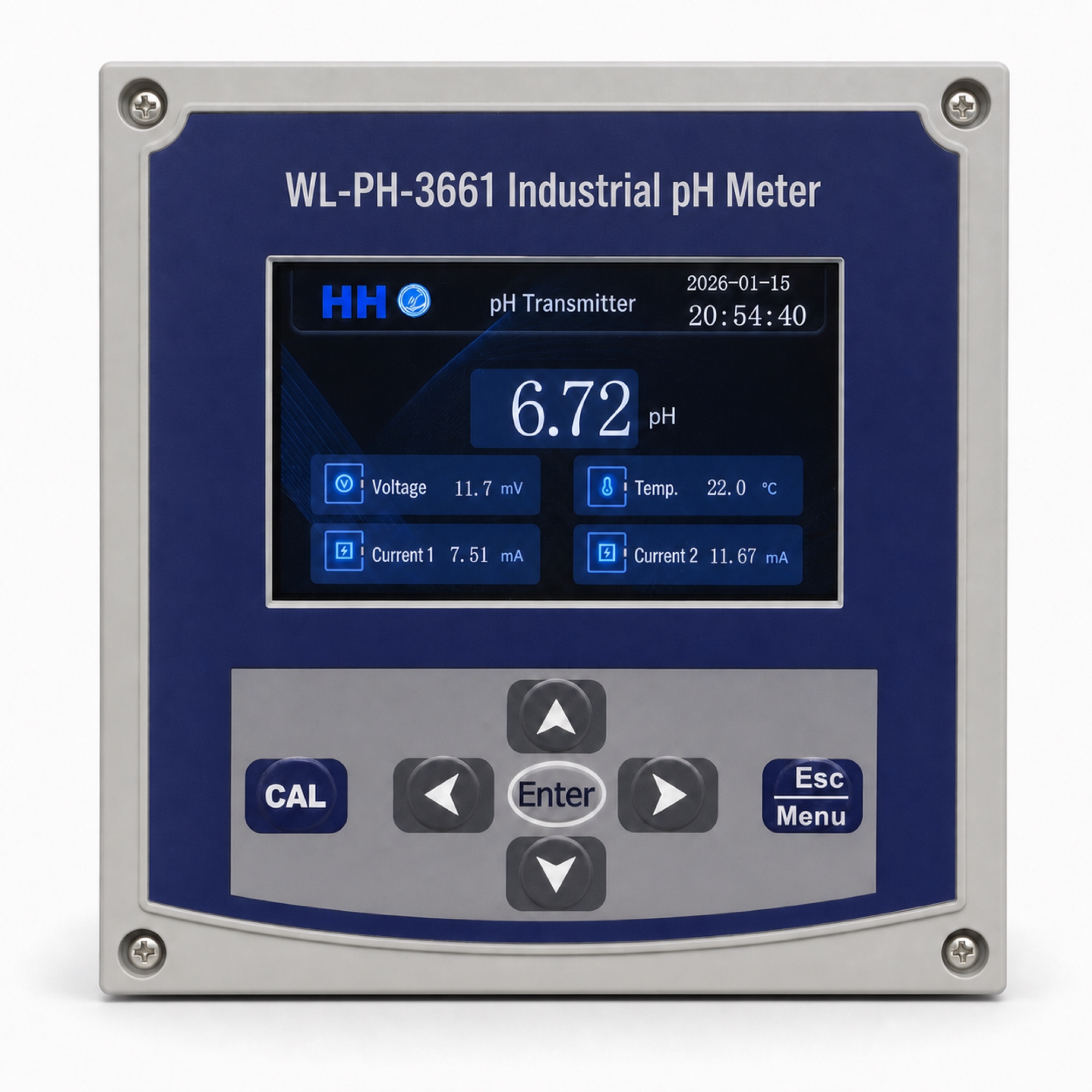
SKU: WL-PH-3661WL-PH-3661 Industrial pH Meter US$1,300.00Add to cart
A panel-mounted industrial pH meter for continuous online measurement and process control in water treatment and industrial applications. It combines high-input-impedance signal processing, automatic temperature compensation, isolated analog outputs, alarm control, and Modbus RTU communication.
Key features
- 0–14.00 pH measurement with ±0.05 pH stated accuracy
- Automatic temperature compensation from 5 to 60 °C
- Two configurable isolated 4–20 mA outputs
- RS485 communication with Modbus RTU protocol
- Adjustable high and low alarms with relay outputs