pH Calculator
Calculate pH using either the concentration, weight, or volume method.
1. Concentration Method
2. Weight Method (Solid Chemicals)
3. Volume Method (Liquid Chemicals)
Shop our HH SCIENCE pH sensors
Use this pH Calculator to estimate solution acidity from concentration, weight, or volume when dealing with dilute, monoprotic weak acids/bases (inputs use pKₐ, convert to Kₐ = 10⁻ᵖᴷᵃ, and apply the weak-acid/base approximation, e.g., [H⁺] ≈ √(Kₐ·C) → pH = −log₁₀[H⁺]), keeping in mind that temperature, ionic strength/activities, and dilution can shift results. For the most accurate pH, solve the full equilibrium with charge/mass balance (or use Henderson–Hasselbalch for buffers near pH ≈ pKₐ, strong-acid/base limits pH ≈ −log C or pH ≈ 14 + log C, and polyprotic systems with stepwise pKₐ’s), and use this quick calculator primarily for screening and recipe prep before detailed validation.
How does HH SCIENCE pH calculator work?
1) Concentration mode (you already know molarity, M)
- Choose the chemical from the dropdown (this loads its formula, molar mass, and pKₐ).
- Enter the solution concentration (mol/L) in “Concentration of solution (mol/L)”.
- Click CALCULATE to compute pH using the weak acid/base approximation (internally: Kₐ=10⁻ᵖᴷᵃ, [H⁺]≈√(Kₐ·C) for acids; a similar relation is used for bases).
- Read the result under “pH” and verify the context: very dilute or very concentrated solutions, polyprotic acids, or strong acids/bases can deviate—treat this as a quick estimate.
Tip: For buffers near pH ≈ pKₐ, Henderson–Hasselbalch often gives a better estimate if you know the [base]/[acid] ratio.
2) Weight mode (you weighed a solid and know final volume)
- Choose the chemical (loads formula, molar mass, pKₐ).
Enter the solid weight (grams) you dissolved.
Enter the total solution volume (liters) after dilution. - Click CALCULATE; the tool converts to molarity = mass / (MW × volume), then estimates pH from pKₐ as above.
- Check plausibility: If you used a strong acid/base (e.g., HCl, NaOH), the simple weak-equilibrium formula may over/underestimate; rule-of-thumb baselines are pH ≈ −log₁₀ C for strong acids and pOH ≈ −log₁₀ C → pH = 14 − pOH for strong bases.
Tip: For polyprotic acids (citric, phosphoric), the first dissociation dominates at low pH, but full accuracy needs stepwise equilibria; use this as a first pass.
3) Volume mode (you dispensed a liquid reagent from a stock)
- Choose the chemical (loads formula, molar mass, pKₐ).
- Enter the stock concentration (mol/L) of the liquid reagent.
**Enter the volume added (liters) of that reagent to your mix.
**Enter the total final volume (liters) after mixing/dilution. - Click CALCULATE; the tool computes final molarity = (C_stock × V_added) / V_total, then estimates pH using pKₐ.
Interpretation: If you are mixing acid with base (or vice versa), this simple mode does not do stoichiometric neutralization—use it when a single acid/base defines the solution. For acid–base mixtures or buffers, switch to buffer math (Henderson–Hasselbalch, charge balance) for accuracy.
General tips for all modes
- Keep units consistent (L, mol/L, g).
- Results assume 25 °C and modest ionic strength; temperature or high ionic strength can shift pKₐ and activities.
- For buffers near pH ≈ pKₐ, knowing the [A⁻]/[HA] ratio yields better predictions; for capacity questions use β ≈ 2.303·C·(Kₐ[H⁺])/(Kₐ+[H⁺])².
- Treat outputs as screening estimates; for critical work, solve the full equilibrium (mass/charge balance) or validate with a calibrated pH meter.
HH SCIENCE pH Sensors
-
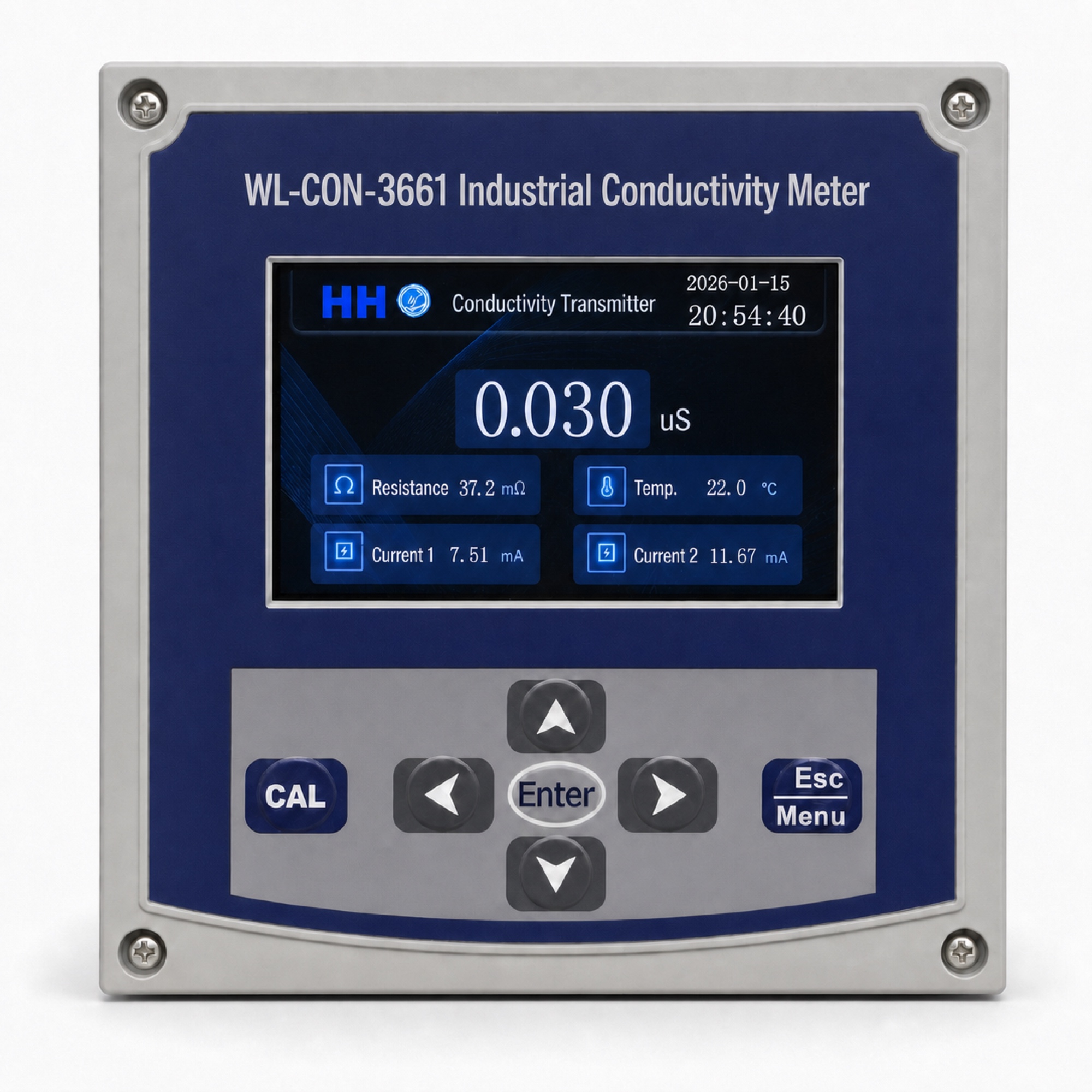
SKU: WL-CON-3661WL-CON-3661 Industrial Conductivity Meter US$1,400.00Add to cart
A panel-mounted industrial conductivity meter for continuous online monitoring of conductivity, resistivity, and temperature in pure water and general process water. Compatible with multiple conductivity-cell constants, it provides automatic range switching, configurable temperature compensation, isolated analog outputs, alarms, and Modbus RTU communication.
Key Features
- Four sensor configurations covering 0–20 μS/cm to 0–20.00 mS/cm
- Automatic range switching and configurable temperature compensation
- Dedicated compensation mode for pure-water conductivity measurement
- Two isolated 4–20 mA outputs and RS485 Modbus RTU communication
- Adjustable alarms, non-volatile parameter storage, and watchdog protection
-
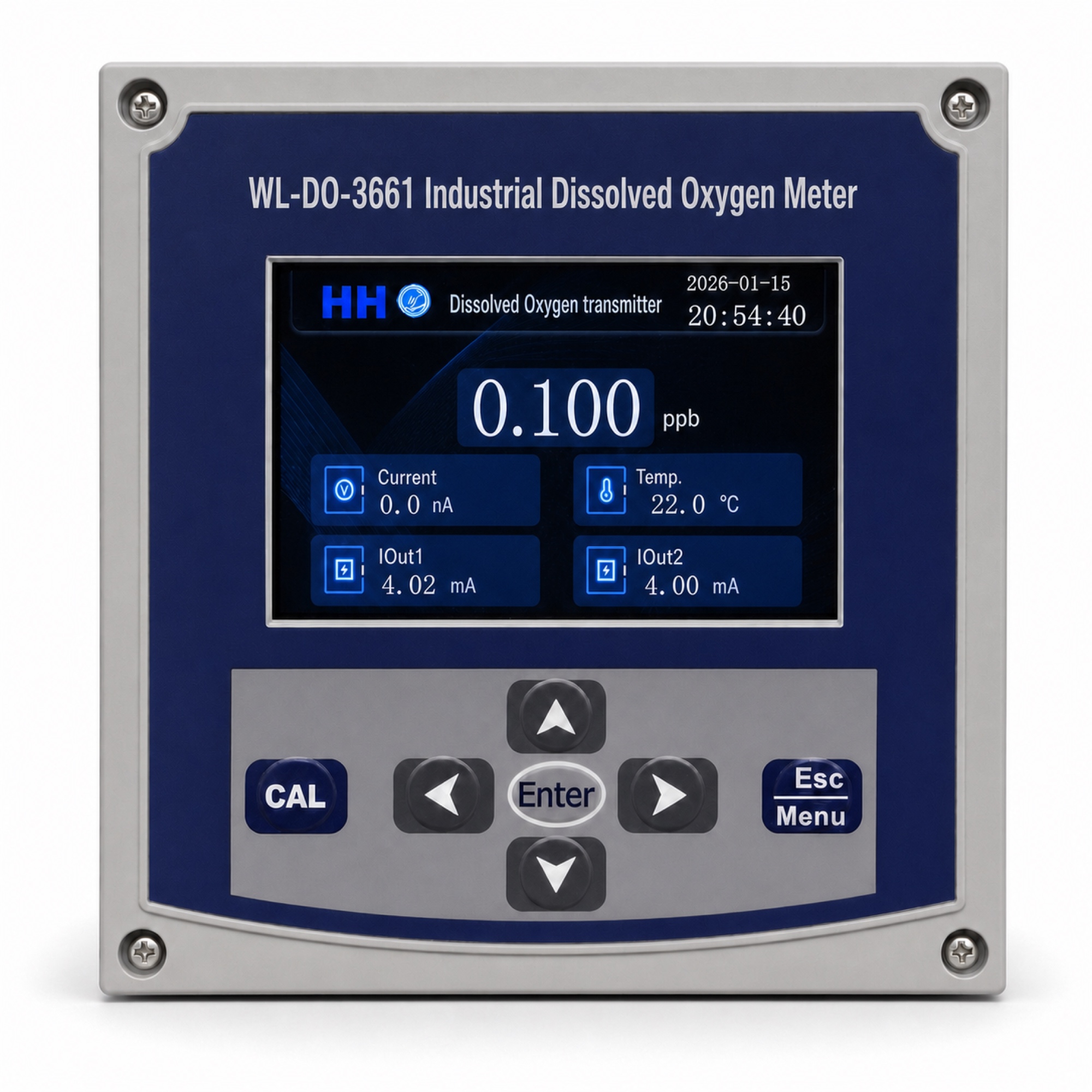
SKU: WL-DO-3661WL-DO-3661 Industrial Dissolved Oxygen Meter US$1,400.00Add to cart
A panel-mounted industrial dissolved oxygen meter for continuous online monitoring across μg/L and mg/L concentration ranges. The WL-DO-3661 combines automatic range switching, temperature compensation, two-point calibration, isolated 4–20 mA output, alarms, self-diagnostics, and Modbus RTU communication.
Key Features
- Dual measuring ranges: 0–200.0 μg/L and 0.200–20.00 mg/L
- Automatic range switching and temperature compensation
- Zero-point and full-scale two-point calibration
- Isolated 4–20 mA output and RS485 Modbus RTU communication
- Adjustable alarms, self-diagnostics, and watchdog protection
-
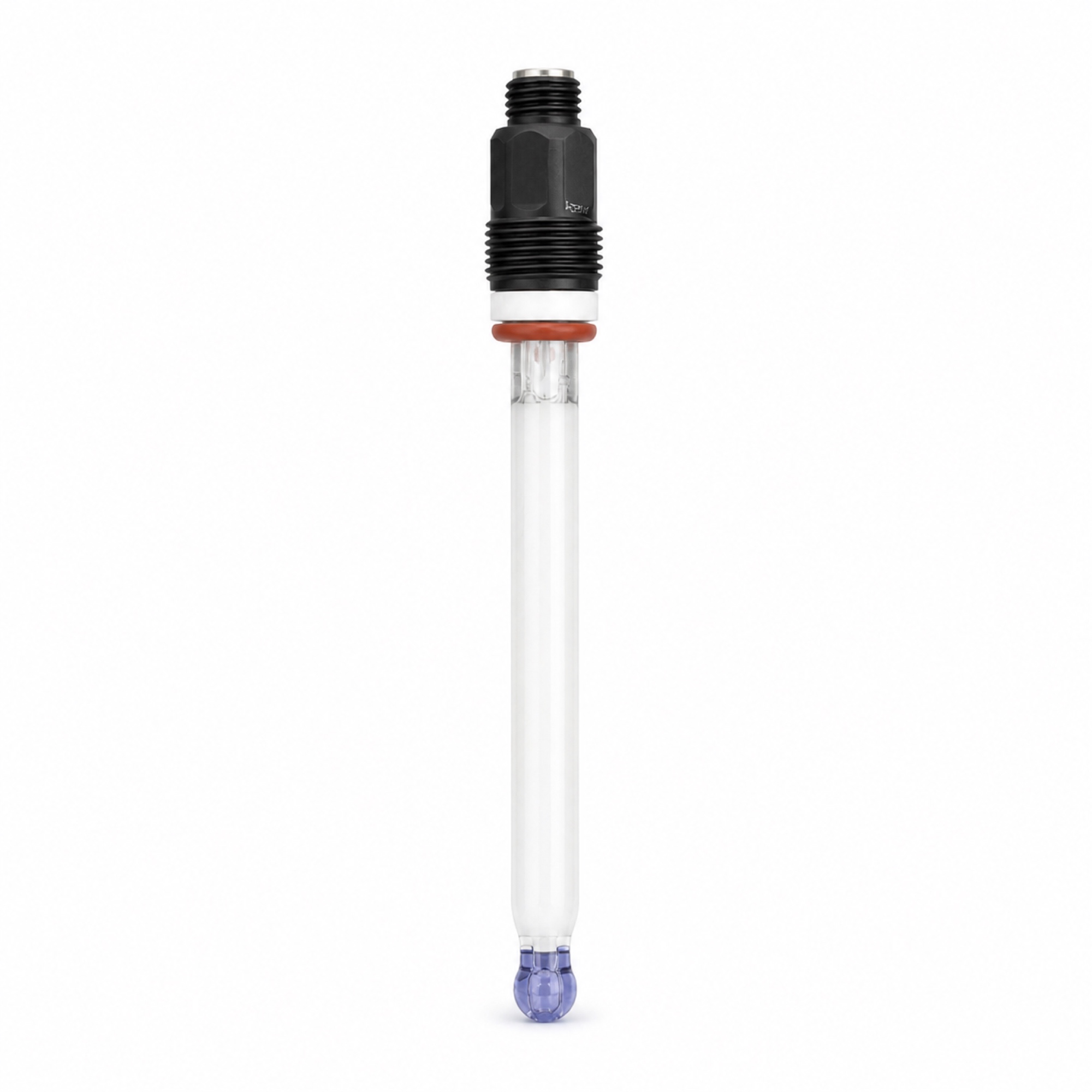
SKU: HH6500HH6500 Open-Junction pH Electrode for Viscous and Highly Contaminated Media US$600.00Select options
The HH6500 is an industrial pH electrode designed for viscous, solids-containing, and highly contaminated process liquids. Its single-hole open junction eliminates the microporous diaphragm found in conventional electrodes, helping maintain reference contact where ceramic or PTFE junctions are prone to blockage.
Key Features
- Single-hole open junction without a porous diaphragm
- Designed for viscous, fouling-prone, and solids-containing media
- Double-junction reference with specialized solidified synthetic gel
- HA acid/alkali-resistant glass membrane covering pH 0–14
- PG13.5 glass body with customizable length, temperature sensor, and connector