
Why pH matters in ultrapure water applications?
pH matters in ultrapure water (UPW) applications because it directly influences surface chemistry, material compatibility, contamination control, process stability, and product yield in ultra-high-purity environments where even trace ionic changes are significant.
- Surface chemistry control: pH affects surface charge and reactions on wafers, components, and substrates, directly impacting cleaning efficiency and process outcomes.
- Material compatibility: Incorrect pH accelerates corrosion or leaching from high-purity piping, tanks, and valves, introducing unwanted ionic contamination.
- Contamination control: In UPW systems, small pH shifts often indicate ionic breakthrough or system imbalance, serving as an early warning of purity loss.
- Process stability: Stable pH supports repeatable process conditions in semiconductor, electronics, and pharmaceutical manufacturing.
- Product yield and quality: Tight pH control minimizes defects, variability, and rework, protecting yield in high-value manufacturing processes.
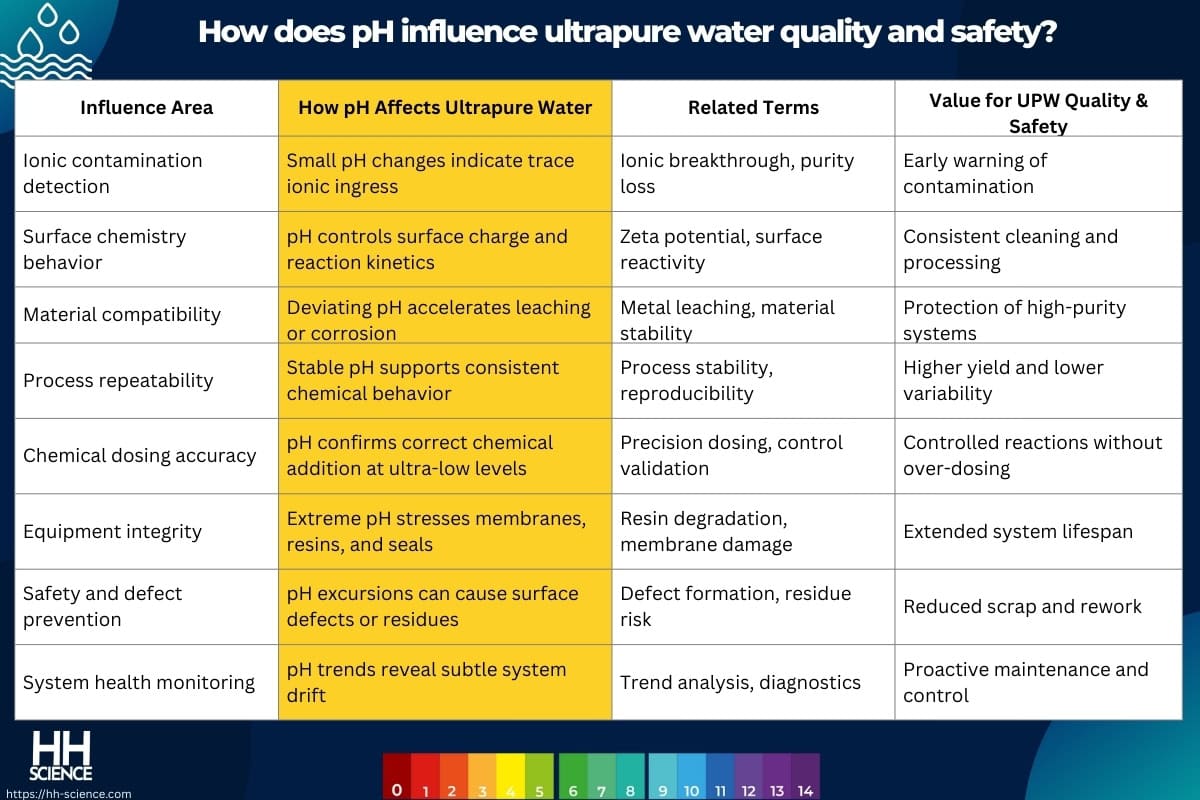
How does pH influence ultrapure water quality and safety?
pH influences ultrapure water (UPW) quality and process safety by reflecting ionic balance, surface reactivity, material stability, and contamination events, even though UPW has extremely low buffering capacity and conductivity. In these systems, very small pH shifts often signal chemical imbalance, material interaction, or purity loss that can directly affect sensitive manufacturing processes.
| Influence Area | How pH Affects Ultrapure Water | Related Terms | Value for UPW Quality & Safety |
| Ionic contamination detection | Small pH changes indicate trace ionic ingress | Ionic breakthrough, purity loss | Early warning of contamination |
| Surface chemistry behavior | pH controls surface charge and reaction kinetics | Zeta potential, surface reactivity | Consistent cleaning and processing |
| Material compatibility | Deviating pH accelerates leaching or corrosion | Metal leaching, material stability | Protection of high-purity systems |
| Process repeatability | Stable pH supports consistent chemical behavior | Process stability, reproducibility | Higher yield and lower variability |
| Chemical dosing accuracy | pH confirms correct chemical addition at ultra-low levels | Precision dosing, control validation | Controlled reactions without over-dosing |
| Equipment integrity | Extreme pH stresses membranes, resins, and seals | Resin degradation, membrane damage | Extended system lifespan |
| Safety and defect prevention | pH excursions can cause surface defects or residues | Defect formation, residue risk | Reduced scrap and rework |
| System health monitoring | pH trends reveal subtle system drift | Trend analysis, diagnostics | Proactive maintenance and control |
Why are ultrapure water systems sensitive to pH deviations?
Ultrapure water systems are highly sensitive to pH deviations because they have extremely low ionic strength, minimal buffering capacity, and tight purity requirements, meaning even trace chemical changes can cause measurable and process-relevant pH shifts. When pH is not tightly controlled, it can signal ionic contamination, trigger surface chemistry changes, accelerate material leaching, destabilize membranes or resins, introduce defects in high-value processes, and ultimately reduce yield, reliability, and process safety in industries where contamination tolerance is near zero.
Typical pH ranges and control targets in ultrapure water applications
Typical pH ranges and control targets in ultrapure water applications define the narrow operating window required to preserve ionic purity, surface stability, and process repeatability in ultra-low conductivity systems. Establishing these targets provides a reference framework for monitoring system health, detecting contamination events, and maintaining consistent performance in high-purity manufacturing environments.
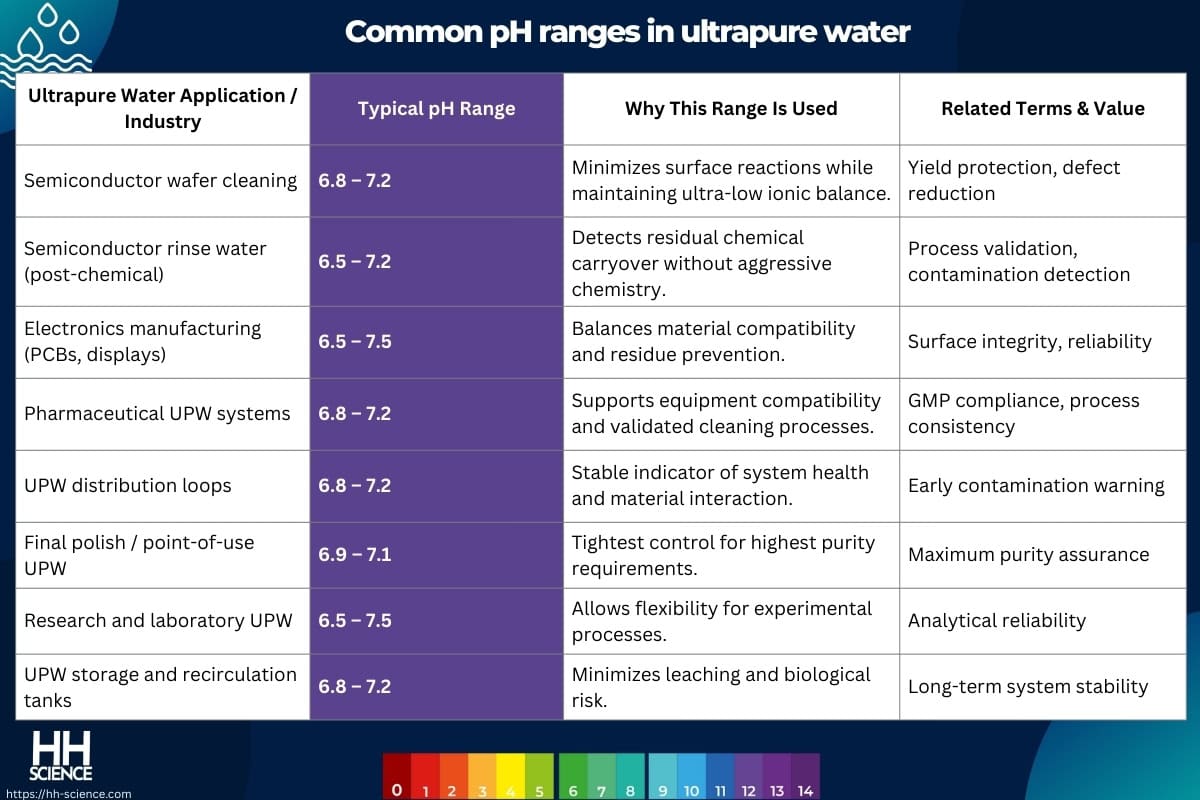
Common pH ranges in ultrapure water
Common pH ranges in ultrapure water (UPW) are typically maintained very close to neutral (approximately pH 6.8–7.2) because UPW has almost no buffering capacity and even trace ionic contamination can cause measurable pH shifts. Different UPW sub-applications operate within slightly adjusted targets depending on process chemistry, materials of construction, and sensitivity to surface reactions or contamination signals.
| Ultrapure Water Application / Industry | Typical pH Range | Why This Range Is Used | Related Terms & Value |
| Semiconductor wafer cleaning | 6.8 – 7.2 | Minimizes surface reactions while maintaining ultra-low ionic balance. | Yield protection, defect reduction |
| Semiconductor rinse water (post-chemical) | 6.5 – 7.2 | Detects residual chemical carryover without aggressive chemistry. | Process validation, contamination detection |
| Electronics manufacturing (PCBs, displays) | 6.5 – 7.5 | Balances material compatibility and residue prevention. | Surface integrity, reliability |
| Pharmaceutical UPW systems | 6.8 – 7.2 | Supports equipment compatibility and validated cleaning processes. | GMP compliance, process consistency |
| UPW distribution loops | 6.8 – 7.2 | Stable indicator of system health and material interaction. | Early contamination warning |
| Final polish / point-of-use UPW | 6.9 – 7.1 | Tightest control for highest purity requirements. | Maximum purity assurance |
| Research and laboratory UPW | 6.5 – 7.5 | Allows flexibility for experimental processes. | Analytical reliability |
| UPW storage and recirculation tanks | 6.8 – 7.2 | Minimizes leaching and biological risk. | Long-term system stability |
Factors that define pH control targets in ultrapure water applications
pH control targets in ultrapure water (UPW) applications are defined by ionic purity requirements, buffering capacity, materials of construction, process chemistry sensitivity, system configuration, and contamination risk, because even minimal chemical variation can impact system integrity and process outcomes.
- Ionic purity requirements: Extremely low allowable ion levels mean pH targets must be tightly centered to reveal contamination or breakthrough events quickly.
- Minimal buffering capacity: UPW lacks natural buffering, so small inputs cause large pH shifts that must be tightly controlled.
- Materials of construction: High-purity plastics, metals, and elastomers have narrow pH compatibility ranges to prevent leaching.
- Process chemistry sensitivity: Semiconductor and pharmaceutical processes are highly sensitive to surface reactions influenced by pH.
- System configuration: Distribution loops, recirculation rates, and point-of-use designs affect pH stability and measurement location.
- Contamination risk profile: pH targets are selected to maximize early detection of chemical ingress or system upset.
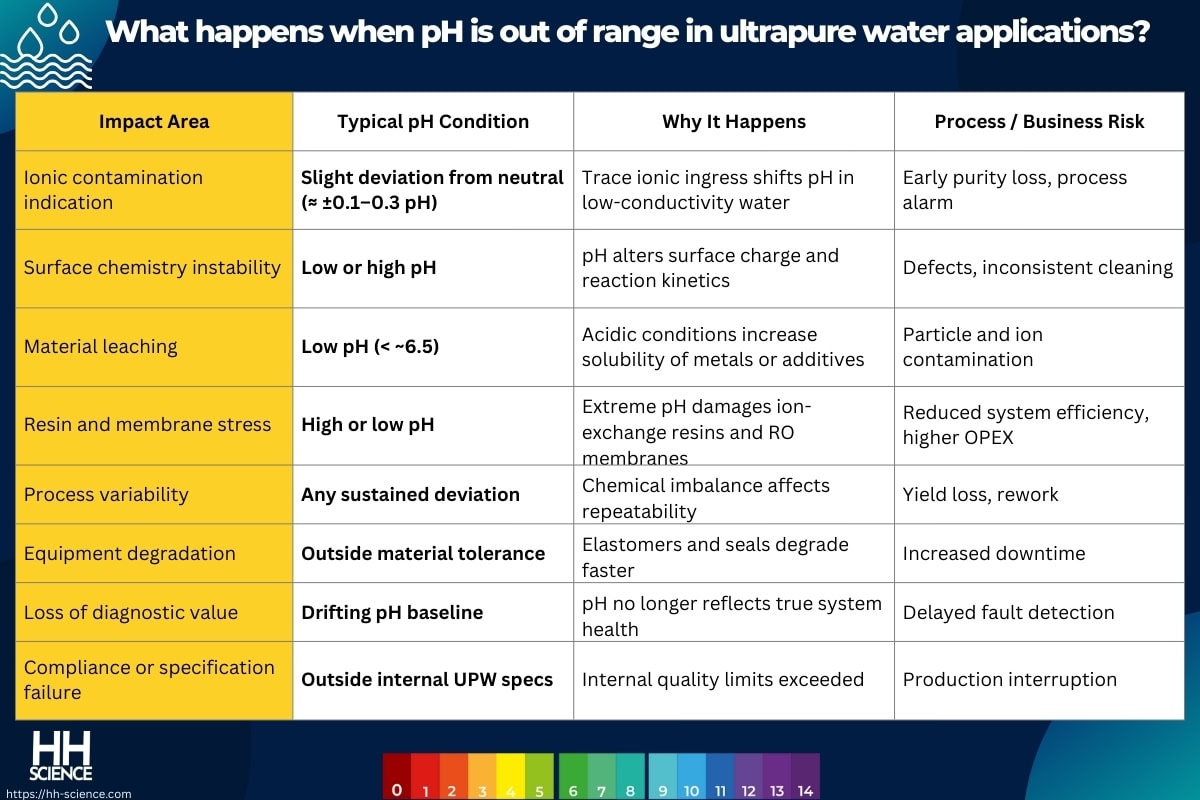
What happens when pH is out of range in ultrapure water applications?
When pH is out of range in ultrapure water (UPW) applications, it can lead to ionic contamination signals, surface chemistry instability, material leaching, membrane or resin degradation, process defects, and reduced product yield, because UPW systems have extremely low buffering capacity and are highly sensitive to even trace chemical disturbances.
| Impact Area | Typical pH Condition | Why It Happens | Process / Business Risk |
| Ionic contamination indication | Slight deviation from neutral (≈ ±0.1–0.3 pH) | Trace ionic ingress shifts pH in low-conductivity water | Early purity loss, process alarm |
| Surface chemistry instability | Low or high pH | pH alters surface charge and reaction kinetics | Defects, inconsistent cleaning |
| Material leaching | Low pH (< ~6.5) | Acidic conditions increase solubility of metals or additives | Particle and ion contamination |
| Resin and membrane stress | High or low pH | Extreme pH damages ion-exchange resins and RO membranes | Reduced system efficiency, higher OPEX |
| Process variability | Any sustained deviation | Chemical imbalance affects repeatability | Yield loss, rework |
| Equipment degradation | Outside material tolerance | Elastomers and seals degrade faster | Increased downtime |
| Loss of diagnostic value | Drifting pH baseline | pH no longer reflects true system health | Delayed fault detection |
| Compliance or specification failure | Outside internal UPW specs | Internal quality limits exceeded | Production interruption |
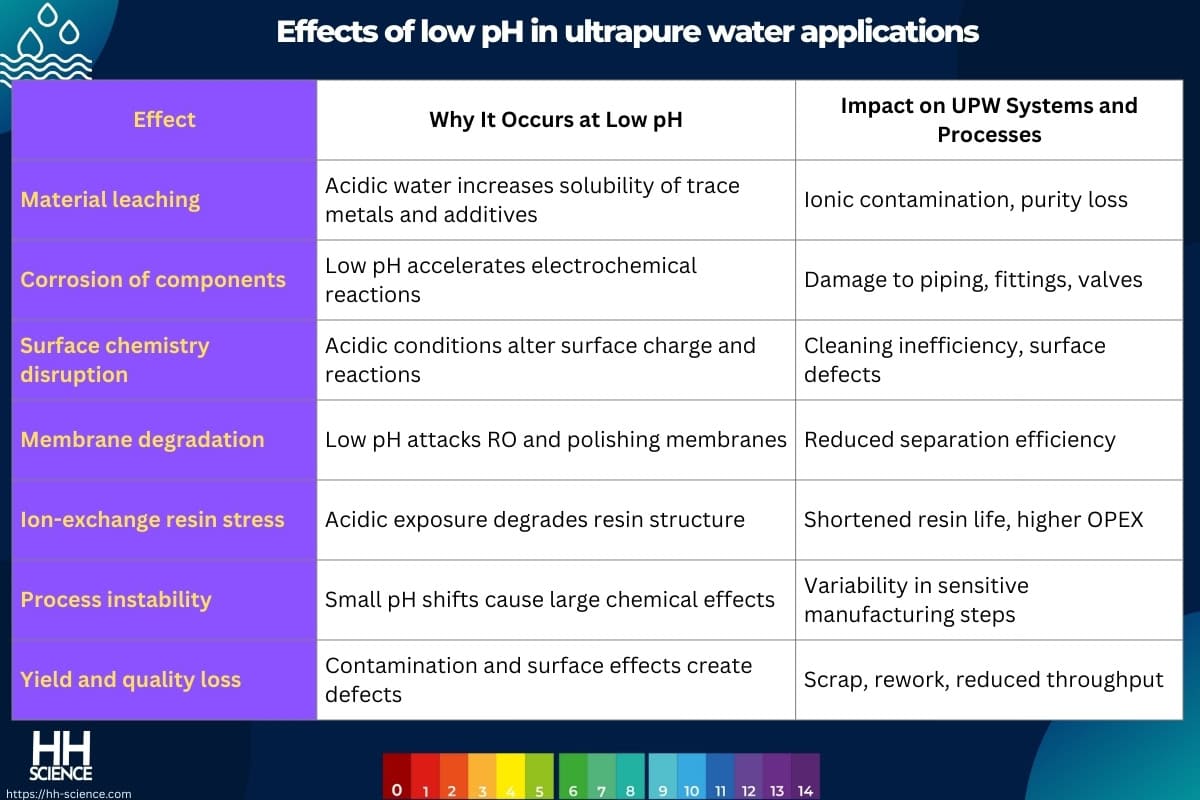
Effects of low pH in ultrapure water applications
Low pH in ultrapure water (UPW) applications leads to material leaching, corrosion of high-purity components, surface chemistry disruption, membrane and resin degradation, process instability, and loss of yield, because acidic conditions dramatically increase chemical reactivity in systems with extremely low buffering capacity.
| Effect | Why It Occurs at Low pH | Impact on UPW Systems and Processes |
| Material leaching | Acidic water increases solubility of trace metals and additives | Ionic contamination, purity loss |
| Corrosion of components | Low pH accelerates electrochemical reactions | Damage to piping, fittings, valves |
| Surface chemistry disruption | Acidic conditions alter surface charge and reactions | Cleaning inefficiency, surface defects |
| Membrane degradation | Low pH attacks RO and polishing membranes | Reduced separation efficiency |
| Ion-exchange resin stress | Acidic exposure degrades resin structure | Shortened resin life, higher OPEX |
| Process instability | Small pH shifts cause large chemical effects | Variability in sensitive manufacturing steps |
| Yield and quality loss | Contamination and surface effects create defects | Scrap, rework, reduced throughput |
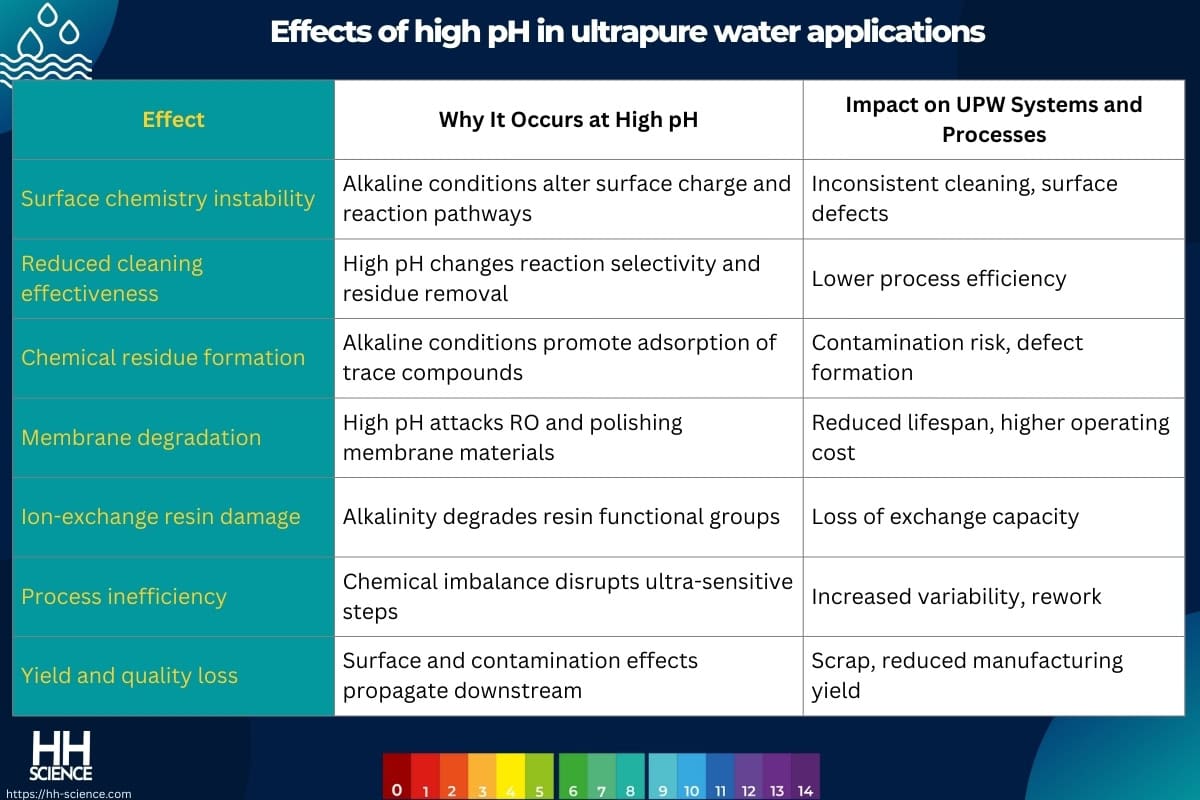
Effects of high pH in ultrapure water applications
High pH in ultrapure water (UPW) applications causes surface chemistry instability, reduced cleaning effectiveness, membrane and resin degradation, chemical residue formation, process inefficiency, and yield loss, because alkaline conditions amplify reactivity in ultra-low ionic systems and disrupt tightly controlled surface and material interactions.
| Effect | Why It Occurs at High pH | Impact on UPW Systems and Processes |
| Surface chemistry instability | Alkaline conditions alter surface charge and reaction pathways | Inconsistent cleaning, surface defects |
| Reduced cleaning effectiveness | High pH changes reaction selectivity and residue removal | Lower process efficiency |
| Chemical residue formation | Alkaline conditions promote adsorption of trace compounds | Contamination risk, defect formation |
| Membrane degradation | High pH attacks RO and polishing membrane materials | Reduced lifespan, higher operating cost |
| Ion-exchange resin damage | Alkalinity degrades resin functional groups | Loss of exchange capacity |
| Process inefficiency | Chemical imbalance disrupts ultra-sensitive steps | Increased variability, rework |
| Yield and quality loss | Surface and contamination effects propagate downstream | Scrap, reduced manufacturing yield |
Operational, quality, and compliance risks
When pH is out of range in ultrapure water applications, operational, quality, and compliance risks escalate rapidly because UPW systems function with minimal chemical tolerance and extremely tight internal specifications.
- Operational risks: pH excursions disrupt system balance, accelerate membrane and resin degradation, increase corrective interventions, and raise operating and maintenance costs.
- Quality risks: Even small pH deviations signal ionic contamination or surface chemistry instability, leading to defects, variability, and reduced yield in high-precision manufacturing processes.
- Compliance risks: UPW systems operate under strict internal quality standards, customer specifications, and validation protocols, so pH deviations can trigger batch rejection, process shutdowns, or audit findings.
pH measurement challenges in ultrapure water application
pH measurement challenges in ultrapure water applications arise from extremely low conductivity, minimal buffering capacity, and the need to detect very small chemical changes with high confidence. Understanding these challenges is essential for selecting specialized sensor technologies, installation strategies, and data interpretation methods that preserve measurement reliability, diagnostic value, and process control in ultra-high-purity environments.
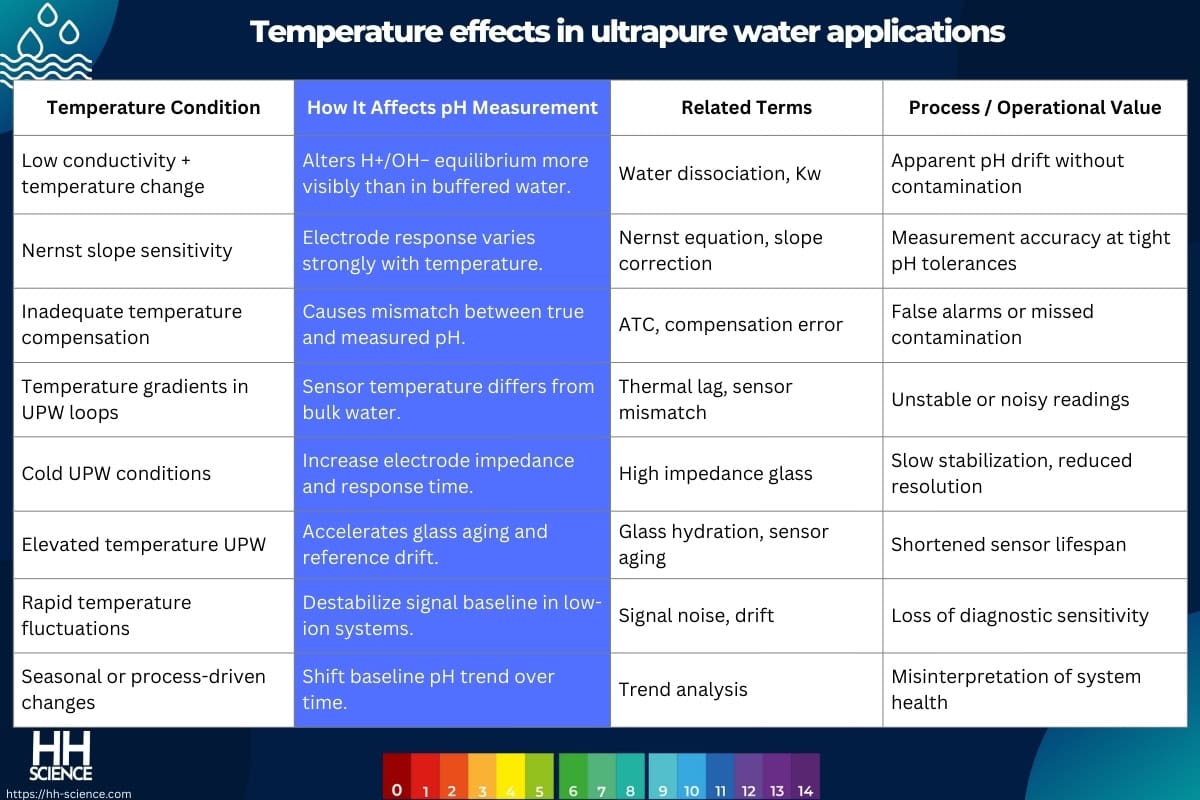
Temperature effects
Temperature effects are a major challenge for pH measurement in ultrapure water (UPW) applications because temperature strongly influences electrode response, water dissociation, and measurement stability in ultra-low conductivity environments. Since UPW has almost no buffering capacity, even small temperature changes can cause disproportionate pH shifts or apparent drift, reducing the diagnostic value of the measurement if temperature compensation and sensor design are not optimized.
| Temperature Condition | How It Affects pH Measurement | Related Terms | Process / Operational Value |
| Low conductivity + temperature change | Alters H+/OH− equilibrium more visibly than in buffered water. | Water dissociation, Kw | Apparent pH drift without contamination |
| Nernst slope sensitivity | Electrode response varies strongly with temperature. | Nernst equation, slope correction | Measurement accuracy at tight pH tolerances |
| Inadequate temperature compensation | Causes mismatch between true and measured pH. | ATC, compensation error | False alarms or missed contamination |
| Temperature gradients in UPW loops | Sensor temperature differs from bulk water. | Thermal lag, sensor mismatch | Unstable or noisy readings |
| Cold UPW conditions | Increase electrode impedance and response time. | High impedance glass | Slow stabilization, reduced resolution |
| Elevated temperature UPW | Accelerates glass aging and reference drift. | Glass hydration, sensor aging | Shortened sensor lifespan |
| Rapid temperature fluctuations | Destabilize signal baseline in low-ion systems. | Signal noise, drift | Loss of diagnostic sensitivity |
| Seasonal or process-driven changes | Shift baseline pH trend over time. | Trend analysis | Misinterpretation of system health |
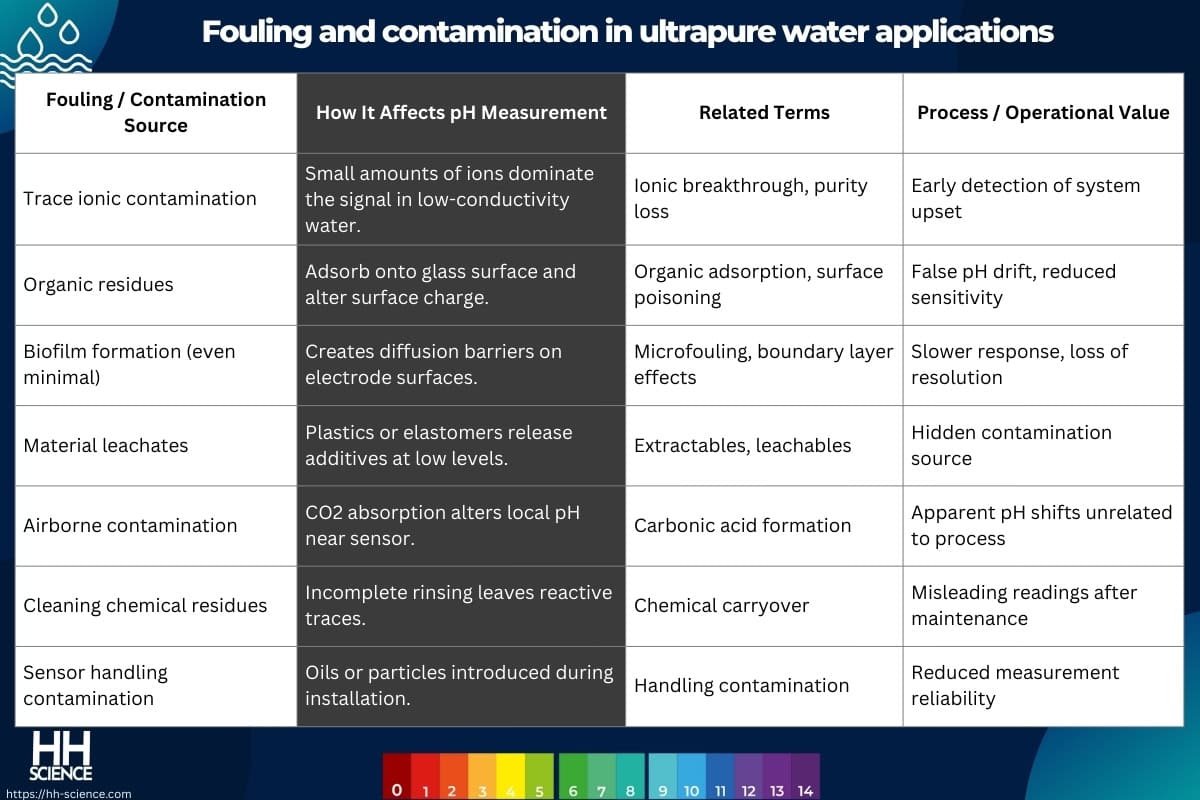
Fouling and contamination
Fouling and contamination present unique challenges for pH measurement in ultrapure water (UPW) applications because even microscopic deposits or trace contaminants can overwhelm the extremely low ionic background and distort sensor response. In UPW systems, what would be negligible fouling in conventional water can significantly alter electrode behavior, mask true system health, and reduce the diagnostic sensitivity of pH as an early contamination indicator.
| Fouling / Contamination Source | How It Affects pH Measurement | Related Terms | Process / Operational Value |
| Trace ionic contamination | Small amounts of ions dominate the signal in low-conductivity water. | Ionic breakthrough, purity loss | Early detection of system upset |
| Organic residues | Adsorb onto glass surface and alter surface charge. | Organic adsorption, surface poisoning | False pH drift, reduced sensitivity |
| Biofilm formation (even minimal) | Creates diffusion barriers on electrode surfaces. | Microfouling, boundary layer effects | Slower response, loss of resolution |
| Material leachates | Plastics or elastomers release additives at low levels. | Extractables, leachables | Hidden contamination source |
| Airborne contamination | CO2 absorption alters local pH near sensor. | Carbonic acid formation | Apparent pH shifts unrelated to process |
| Cleaning chemical residues | Incomplete rinsing leaves reactive traces. | Chemical carryover | Misleading readings after maintenance |
| Sensor handling contamination | Oils or particles introduced during installation. | Handling contamination | Reduced measurement reliability |
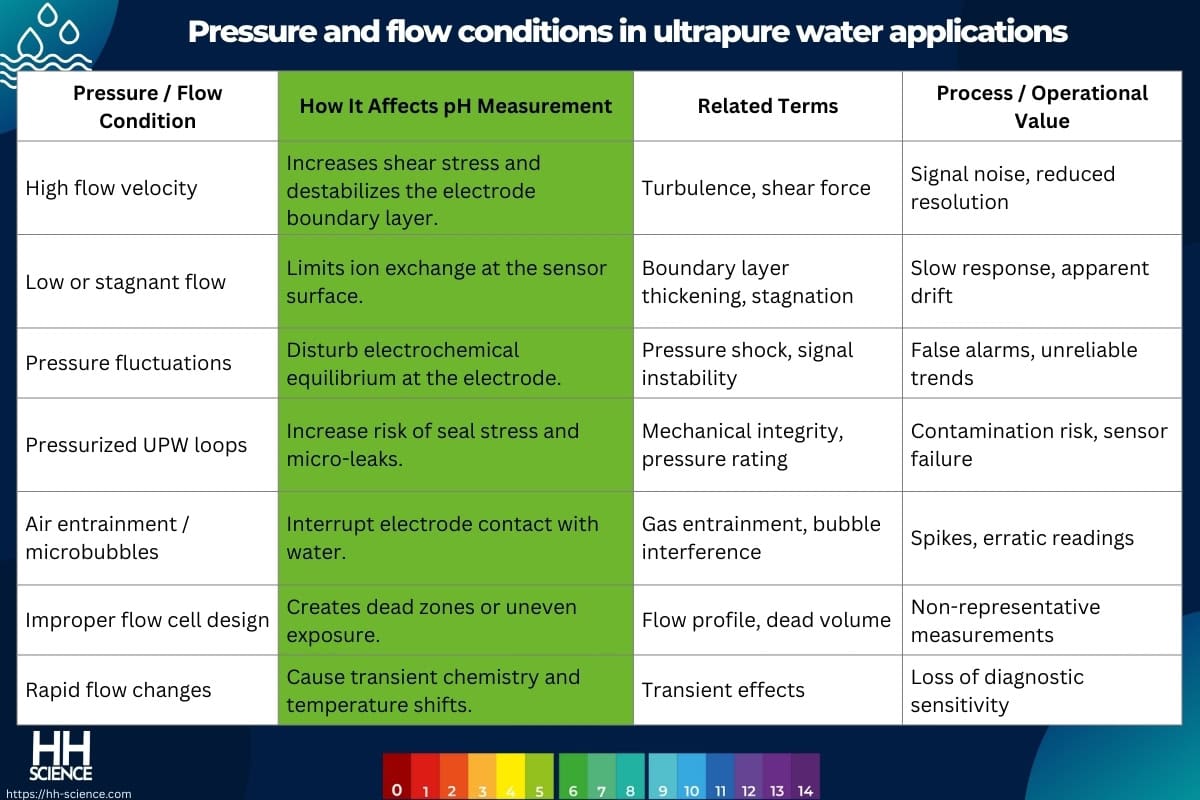
Pressure and flow conditions
Pressure and flow conditions are a critical challenge for pH measurement in ultrapure water (UPW) applications because ultra-low conductivity water is highly sensitive to hydraulic disturbances that affect sensor exposure, signal stability, and contamination risk. Variations in flow velocity, pressure, and hydrodynamics can introduce noise, air ingress, or localized chemistry changes that mask true pH behavior and reduce the diagnostic value of pH as a purity indicator.
| Pressure / Flow Condition | How It Affects pH Measurement | Related Terms | Process / Operational Value |
| High flow velocity | Increases shear stress and destabilizes the electrode boundary layer. | Turbulence, shear force | Signal noise, reduced resolution |
| Low or stagnant flow | Limits ion exchange at the sensor surface. | Boundary layer thickening, stagnation | Slow response, apparent drift |
| Pressure fluctuations | Disturb electrochemical equilibrium at the electrode. | Pressure shock, signal instability | False alarms, unreliable trends |
| Pressurized UPW loops | Increase risk of seal stress and micro-leaks. | Mechanical integrity, pressure rating | Contamination risk, sensor failure |
| Air entrainment / microbubbles | Interrupt electrode contact with water. | Gas entrainment, bubble interference | Spikes, erratic readings |
| Improper flow cell design | Creates dead zones or uneven exposure. | Flow profile, dead volume | Non-representative measurements |
| Rapid flow changes | Cause transient chemistry and temperature shifts. | Transient effects | Loss of diagnostic sensitivity |
Chemical exposure
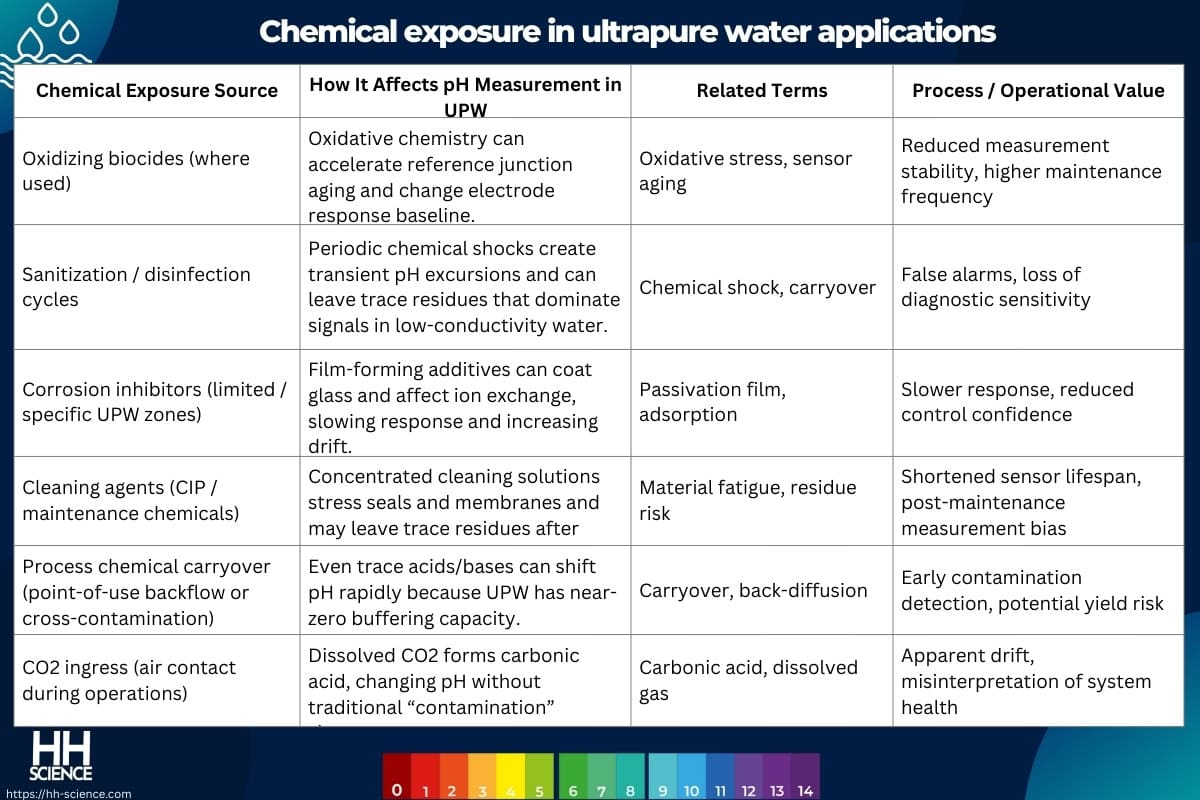
Chemical exposure is a critical pH measurement challenge in ultrapure water (UPW) applications because UPW systems operate with extremely low ionic strength and almost no buffering capacity, making even trace chemical interactions highly influential. Exposure to disinfectants, sanitization chemicals, corrosion inhibitors, or residual process chemicals can rapidly shift pH, accelerate sensor aging, alter electrode surface chemistry, and introduce apparent pH changes that may reflect chemical interaction rather than true system contamination, complicating interpretation and increasing the risk of false alarms or delayed fault detection.
| Chemical Exposure Source | How It Affects pH Measurement in UPW | Related Terms | Process / Operational Value |
| Oxidizing biocides (where used) | Oxidative chemistry can accelerate reference junction aging and change electrode response baseline. | Oxidative stress, sensor aging | Reduced measurement stability, higher maintenance frequency |
| Sanitization / disinfection cycles | Periodic chemical shocks create transient pH excursions and can leave trace residues that dominate signals in low-conductivity water. | Chemical shock, carryover | False alarms, loss of diagnostic sensitivity |
| Corrosion inhibitors (limited / specific UPW zones) | Film-forming additives can coat glass and affect ion exchange, slowing response and increasing drift. | Passivation film, adsorption | Slower response, reduced control confidence |
| Cleaning agents (CIP / maintenance chemicals) | Concentrated cleaning solutions stress seals and membranes and may leave trace residues after rinsing. | Material fatigue, residue risk | Shortened sensor lifespan, post-maintenance measurement bias |
| Process chemical carryover (point-of-use backflow or cross-contamination) | Even trace acids/bases can shift pH rapidly because UPW has near-zero buffering capacity. | Carryover, back-diffusion | Early contamination detection, potential yield risk |
| CO2 ingress (air contact during operations) | Dissolved CO2 forms carbonic acid, changing pH without traditional “contamination” signatures. | Carbonic acid, dissolved gas | Apparent drift, misinterpretation of system health |
Bio-load or process residues
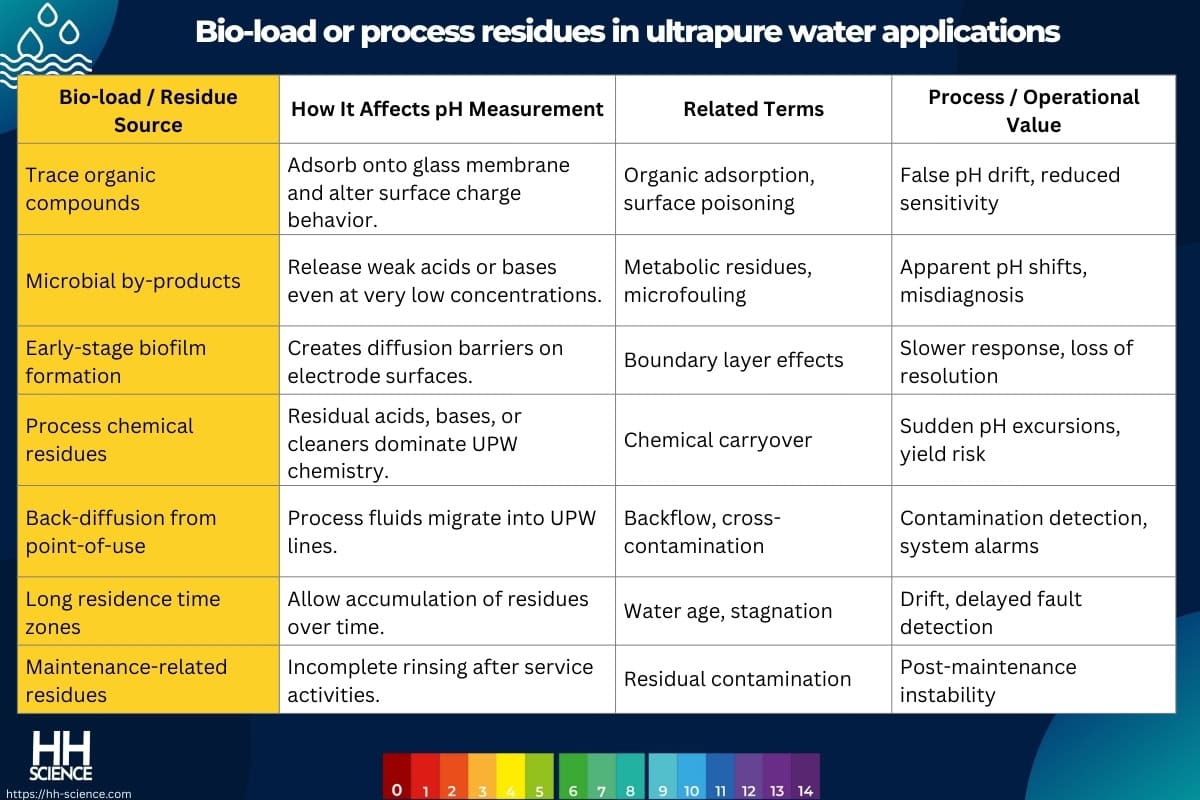
Bio-load and process residues are subtle but high-impact challenges for pH measurement in ultrapure water (UPW) applications because UPW systems are designed for near-zero biological and chemical presence, making even trace residues disproportionately influential. Small amounts of organic matter, microbial by-products, or residual process chemicals can dominate the electrochemical environment, distort pH signals, reduce diagnostic sensitivity, and mask true system health in ultra-low conductivity water.
| Bio-load / Residue Source | How It Affects pH Measurement | Related Terms | Process / Operational Value |
| Trace organic compounds | Adsorb onto glass membrane and alter surface charge behavior. | Organic adsorption, surface poisoning | False pH drift, reduced sensitivity |
| Microbial by-products | Release weak acids or bases even at very low concentrations. | Metabolic residues, microfouling | Apparent pH shifts, misdiagnosis |
| Early-stage biofilm formation | Creates diffusion barriers on electrode surfaces. | Boundary layer effects | Slower response, loss of resolution |
| Process chemical residues | Residual acids, bases, or cleaners dominate UPW chemistry. | Chemical carryover | Sudden pH excursions, yield risk |
| Back-diffusion from point-of-use | Process fluids migrate into UPW lines. | Backflow, cross-contamination | Contamination detection, system alarms |
| Long residence time zones | Allow accumulation of residues over time. | Water age, stagnation | Drift, delayed fault detection |
| Maintenance-related residues | Incomplete rinsing after service activities. | Residual contamination | Post-maintenance instability |
Common pH sensor types used in ultrapure water applications
Common pH sensor types used in ultrapure water applications include specialized low-ionic-strength combination pH sensors, differential pH sensors, and digital or smart pH sensors, selected to maintain stability and sensitivity in ultra-low conductivity environments. These sensors are deployed in inline, flow-through, or carefully controlled immersion configurations to preserve diagnostic value, minimize contamination risk, and deliver reliable pH trend data that supports purity monitoring, process protection, and yield assurance.
Combination pH sensors
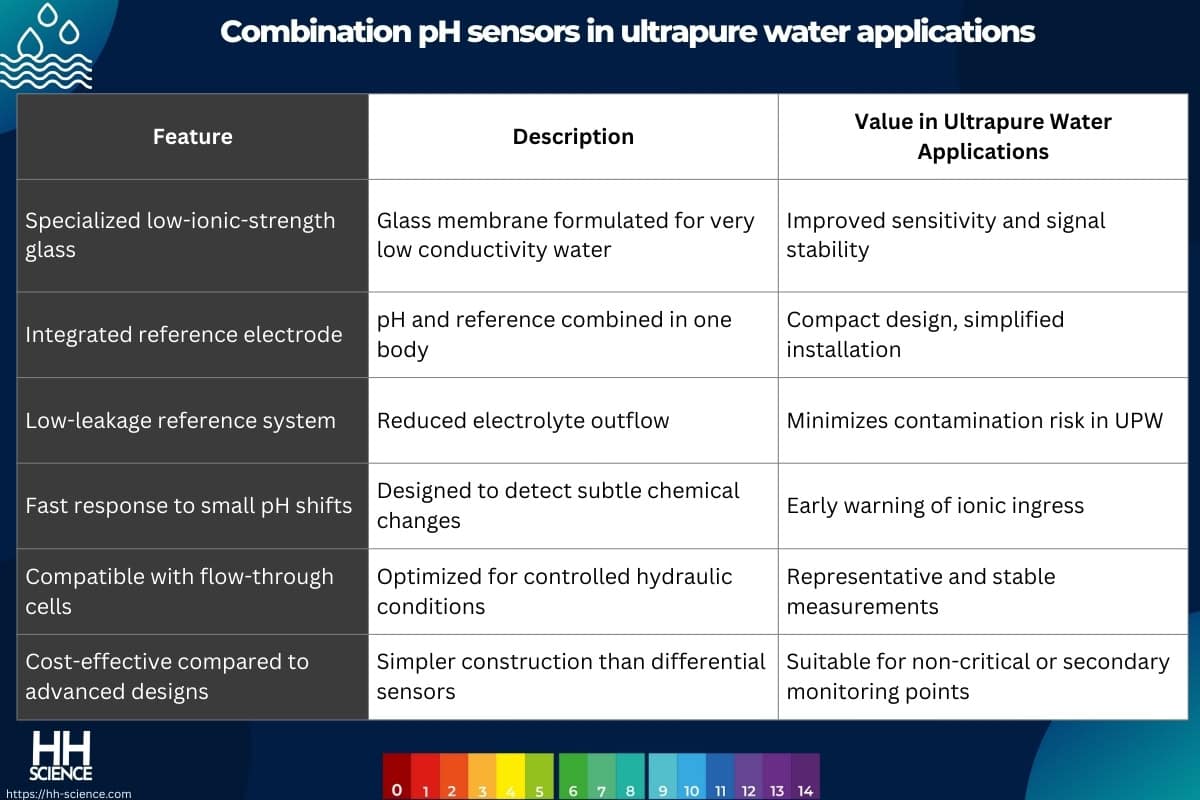
Combination pH sensors are used in ultrapure water (UPW) applications because they offer a compact measurement solution capable of detecting subtle pH changes when specifically designed for low ionic strength and ultra-low conductivity environments. When optimized with specialized glass formulations and reference systems, they provide sufficient sensitivity and stability for purity monitoring, trend analysis, and early contamination detection in UPW loops.
| Feature | Description | Value in Ultrapure Water Applications |
| Specialized low-ionic-strength glass | Glass membrane formulated for very low conductivity water | Improved sensitivity and signal stability |
| Integrated reference electrode | pH and reference combined in one body | Compact design, simplified installation |
| Low-leakage reference system | Reduced electrolyte outflow | Minimizes contamination risk in UPW |
| Fast response to small pH shifts | Designed to detect subtle chemical changes | Early warning of ionic ingress |
| Compatible with flow-through cells | Optimized for controlled hydraulic conditions | Representative and stable measurements |
| Cost-effective compared to advanced designs | Simpler construction than differential sensors | Suitable for non-critical or secondary monitoring points |
Differential pH sensors
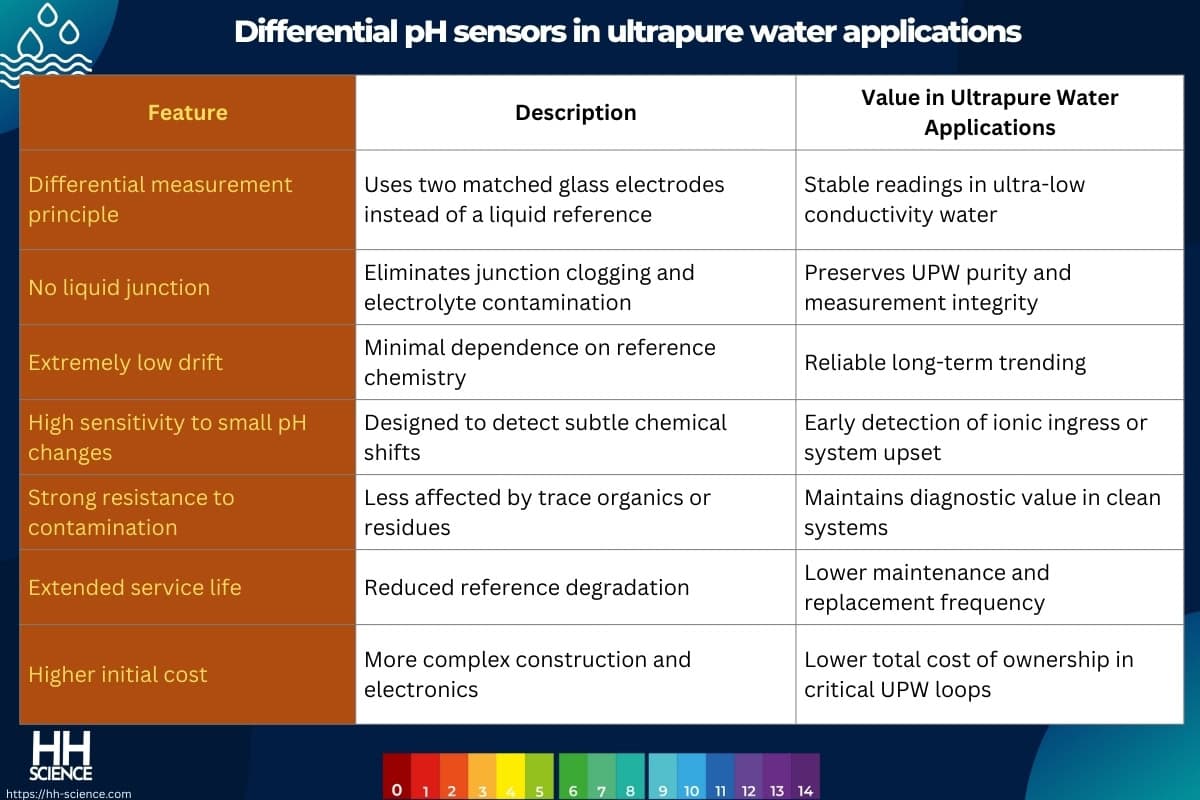
Differential pH sensors are particularly well suited for ultrapure water (UPW) applications because they eliminate many of the limitations of conventional reference electrodes in ultra-low conductivity environments. By using a differential measurement principle rather than a traditional liquid junction, they deliver superior stability, lower drift, and higher diagnostic reliability where even trace contamination or reference instability can invalidate pH data.
| Feature | Description | Value in Ultrapure Water Applications |
| Differential measurement principle | Uses two matched glass electrodes instead of a liquid reference | Stable readings in ultra-low conductivity water |
| No liquid junction | Eliminates junction clogging and electrolyte contamination | Preserves UPW purity and measurement integrity |
| Extremely low drift | Minimal dependence on reference chemistry | Reliable long-term trending |
| High sensitivity to small pH changes | Designed to detect subtle chemical shifts | Early detection of ionic ingress or system upset |
| Strong resistance to contamination | Less affected by trace organics or residues | Maintains diagnostic value in clean systems |
| Extended service life | Reduced reference degradation | Lower maintenance and replacement frequency |
| Higher initial cost | More complex construction and electronics | Lower total cost of ownership in critical UPW loops |
Digital or smart pH sensors
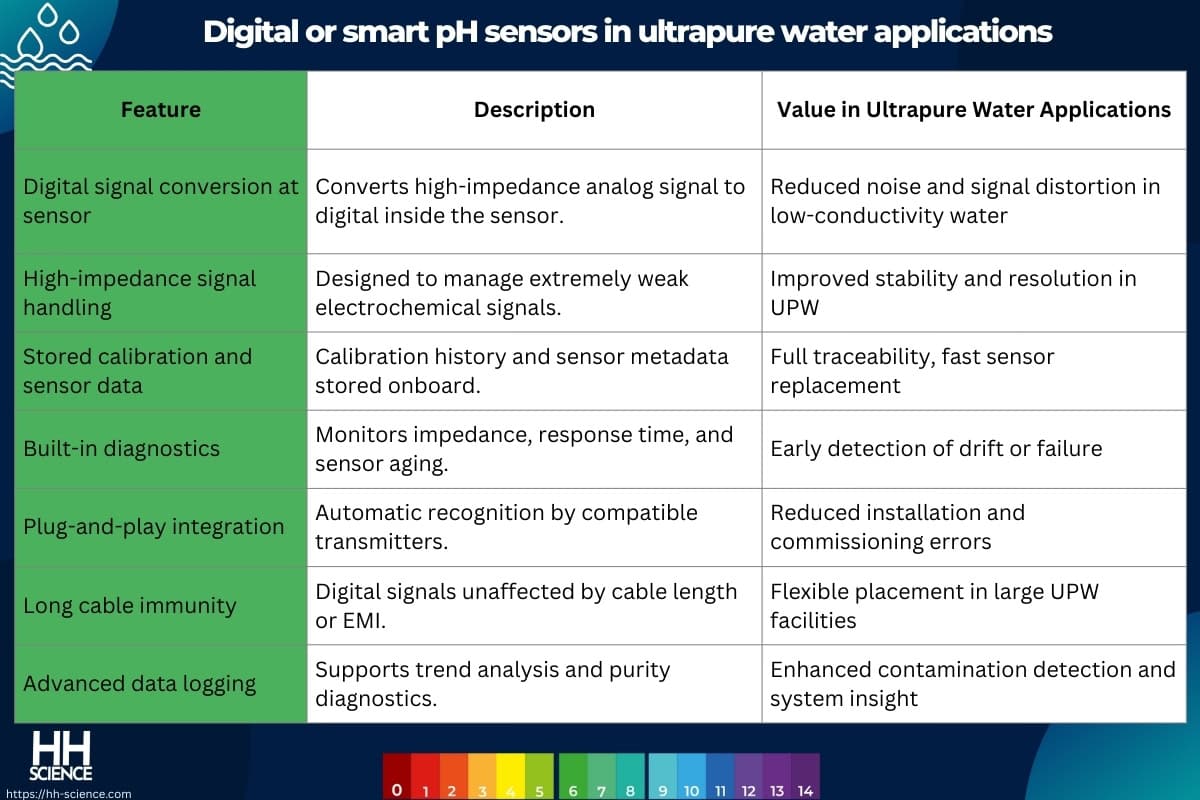
Digital or smart pH sensors are especially valuable in ultrapure water (UPW) applications because they improve signal integrity, traceability, and diagnostic capability in environments where extremely low conductivity makes traditional analog measurements unstable or difficult to interpret. By digitizing the signal at the sensor and embedding calibration and health data, they help preserve the diagnostic value of pH as a purity indicator while supporting stringent documentation and process control requirements.
| Feature | Description | Value in Ultrapure Water Applications |
| Digital signal conversion at sensor | Converts high-impedance analog signal to digital inside the sensor. | Reduced noise and signal distortion in low-conductivity water |
| High-impedance signal handling | Designed to manage extremely weak electrochemical signals. | Improved stability and resolution in UPW |
| Stored calibration and sensor data | Calibration history and sensor metadata stored onboard. | Full traceability, fast sensor replacement |
| Built-in diagnostics | Monitors impedance, response time, and sensor aging. | Early detection of drift or failure |
| Plug-and-play integration | Automatic recognition by compatible transmitters. | Reduced installation and commissioning errors |
| Long cable immunity | Digital signals unaffected by cable length or EMI. | Flexible placement in large UPW facilities |
| Advanced data logging | Supports trend analysis and purity diagnostics. | Enhanced contamination detection and system insight |
Inline, immersion, or portable configurations
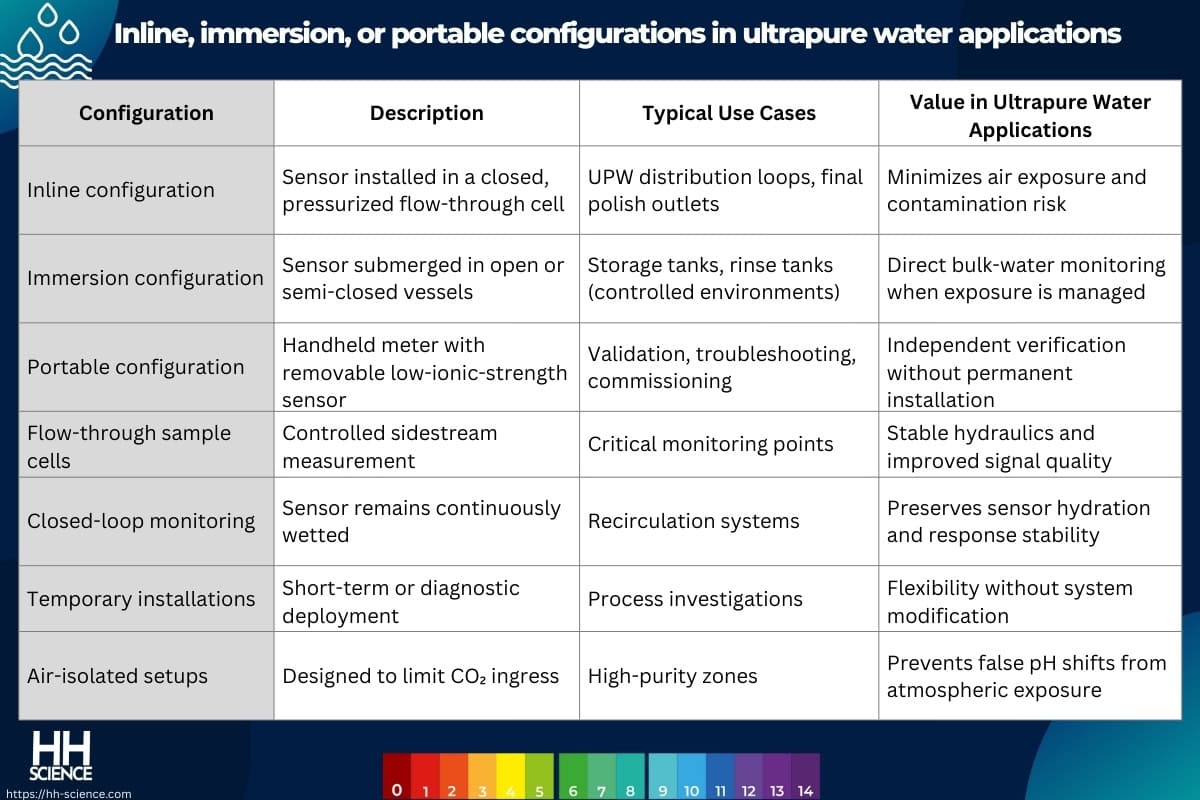
Inline, immersion, or portable pH sensor configurations are used in ultrapure water (UPW) applications to match different purity risks, monitoring objectives, and operational constraints across production, distribution, and point-of-use systems. Choosing the right configuration ensures representative measurement, minimizes contamination risk, and preserves the diagnostic value of pH in ultra-low conductivity environments.
| Configuration | Description | Typical Use Cases | Value in Ultrapure Water Applications |
| Inline configuration | Sensor installed in a closed, pressurized flow-through cell | UPW distribution loops, final polish outlets | Minimizes air exposure and contamination risk |
| Immersion configuration | Sensor submerged in open or semi-closed vessels | Storage tanks, rinse tanks (controlled environments) | Direct bulk-water monitoring when exposure is managed |
| Portable configuration | Handheld meter with removable low-ionic-strength sensor | Validation, troubleshooting, commissioning | Independent verification without permanent installation |
| Flow-through sample cells | Controlled sidestream measurement | Critical monitoring points | Stable hydraulics and improved signal quality |
| Closed-loop monitoring | Sensor remains continuously wetted | Recirculation systems | Preserves sensor hydration and response stability |
| Temporary installations | Short-term or diagnostic deployment | Process investigations | Flexibility without system modification |
| Air-isolated setups | Designed to limit CO₂ ingress | High-purity zones | Prevents false pH shifts from atmospheric exposure |
Installation and maintenance considerations
Installation and maintenance considerations are especially critical in ultrapure water applications because pH measurements operate at the limits of sensitivity, where improper handling, exposure, or servicing can compromise both measurement accuracy and system purity. Careful control of installation geometry, material compatibility, cleaning procedures, and calibration practices preserves diagnostic value, minimizes contamination risk, and ensures reliable long-term pH monitoring in ultra-high-purity environments.
Typical installation locations
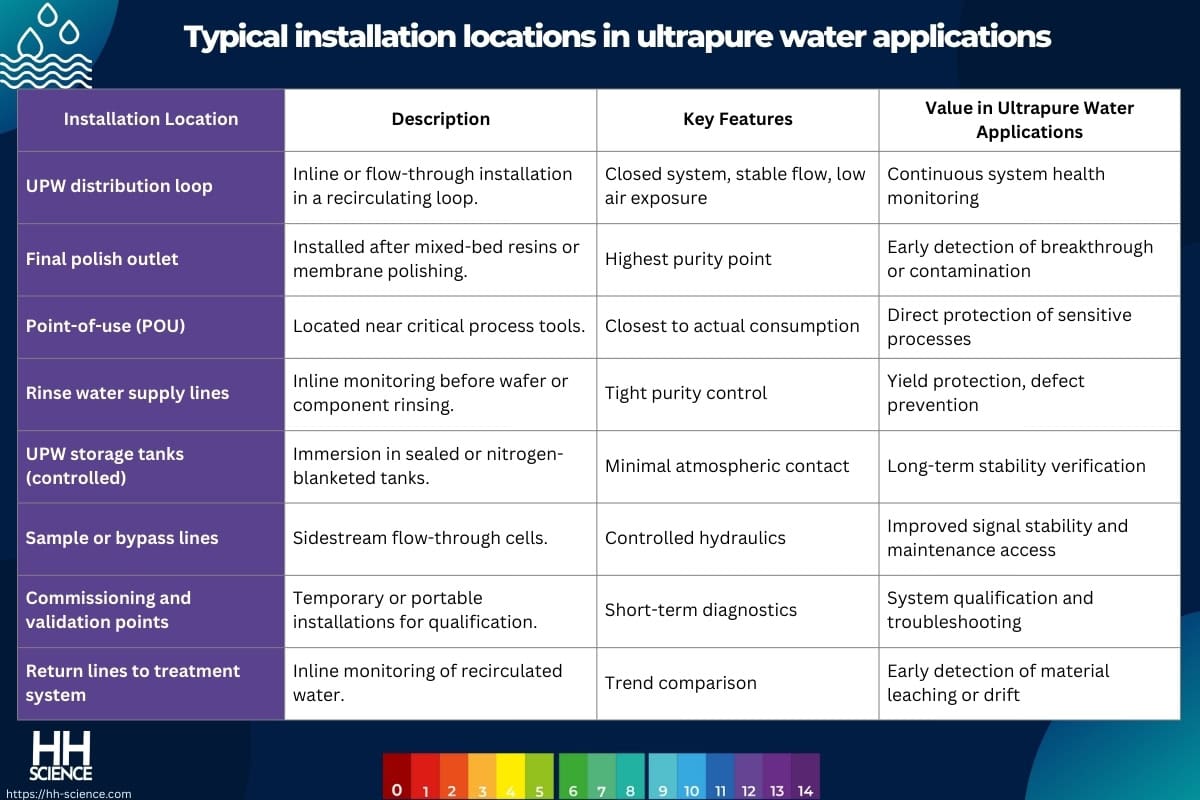
Typical installation locations for pH sensors in ultrapure water (UPW) applications are selected to maximize diagnostic sensitivity, minimize contamination risk, and provide early detection of system imbalance across production and distribution stages. Placement prioritizes closed systems, controlled hydraulics, and representative sampling points where even minor pH shifts have high process value.
| Installation Location | Description | Key Features | Value in Ultrapure Water Applications |
| UPW distribution loop | Inline or flow-through installation in a recirculating loop. | Closed system, stable flow, low air exposure | Continuous system health monitoring |
| Final polish outlet | Installed after mixed-bed resins or membrane polishing. | Highest purity point | Early detection of breakthrough or contamination |
| Point-of-use (POU) | Located near critical process tools. | Closest to actual consumption | Direct protection of sensitive processes |
| Rinse water supply lines | Inline monitoring before wafer or component rinsing. | Tight purity control | Yield protection, defect prevention |
| UPW storage tanks (controlled) | Immersion in sealed or nitrogen-blanketed tanks. | Minimal atmospheric contact | Long-term stability verification |
| Sample or bypass lines | Sidestream flow-through cells. | Controlled hydraulics | Improved signal stability and maintenance access |
| Commissioning and validation points | Temporary or portable installations for qualification. | Short-term diagnostics | System qualification and troubleshooting |
| Return lines to treatment system | Inline monitoring of recirculated water. | Trend comparison | Early detection of material leaching or drift |
Calibration and cleaning frequency
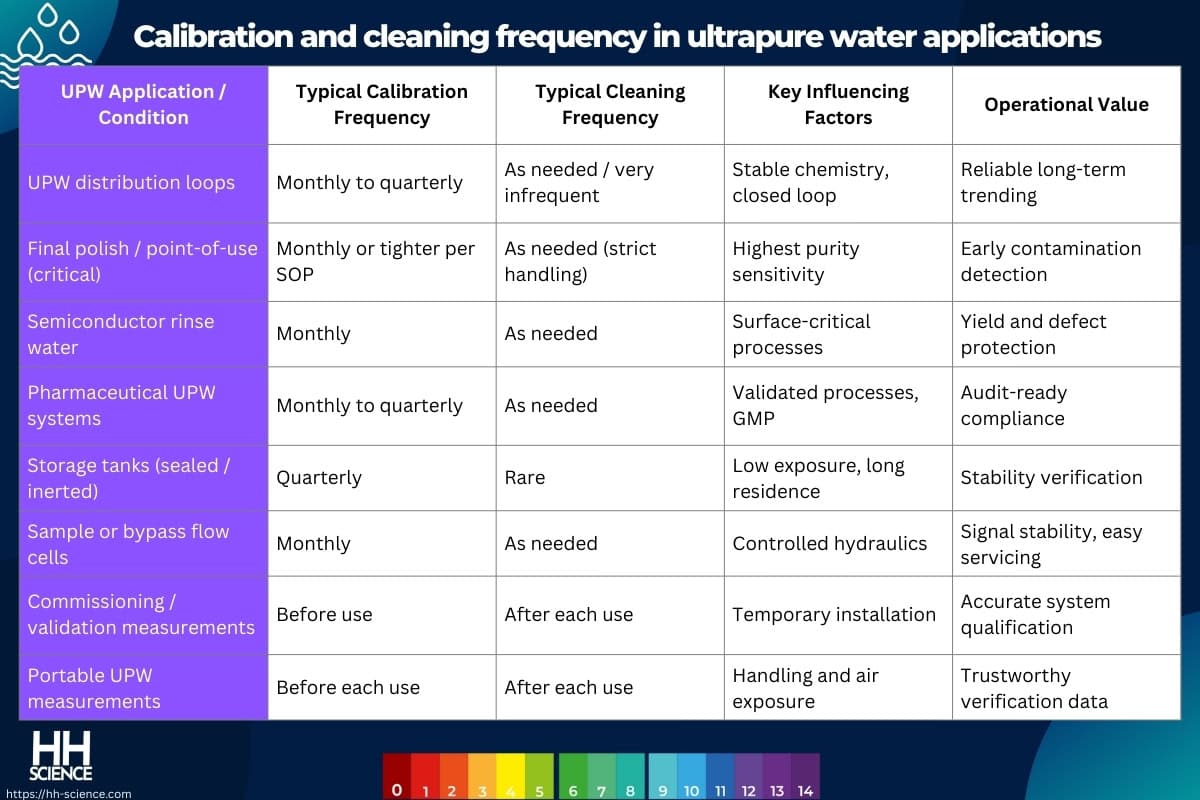
Calibration and cleaning frequency in ultrapure water (UPW) applications are driven by extremely low conductivity, lack of buffering, sensor technology, installation exposure, and process criticality, because even minor drift or contamination can invalidate pH as a diagnostic signal. Properly defined intervals protect measurement sensitivity, preserve trend reliability, and prevent false interpretation of system health.
| UPW Application / Condition | Typical Calibration Frequency | Typical Cleaning Frequency | Key Influencing Factors | Operational Value |
| UPW distribution loops | Monthly to quarterly | As needed / very infrequent | Stable chemistry, closed loop | Reliable long-term trending |
| Final polish / point-of-use (critical) | Monthly or tighter per SOP | As needed (strict handling) | Highest purity sensitivity | Early contamination detection |
| Semiconductor rinse water | Monthly | As needed | Surface-critical processes | Yield and defect protection |
| Pharmaceutical UPW systems | Monthly to quarterly | As needed | Validated processes, GMP | Audit-ready compliance |
| Storage tanks (sealed / inerted) | Quarterly | Rare | Low exposure, long residence | Stability verification |
| Sample or bypass flow cells | Monthly | As needed | Controlled hydraulics | Signal stability, easy servicing |
| Commissioning / validation measurements | Before use | After each use | Temporary installation | Accurate system qualification |
| Portable UPW measurements | Before each use | After each use | Handling and air exposure | Trustworthy verification data |
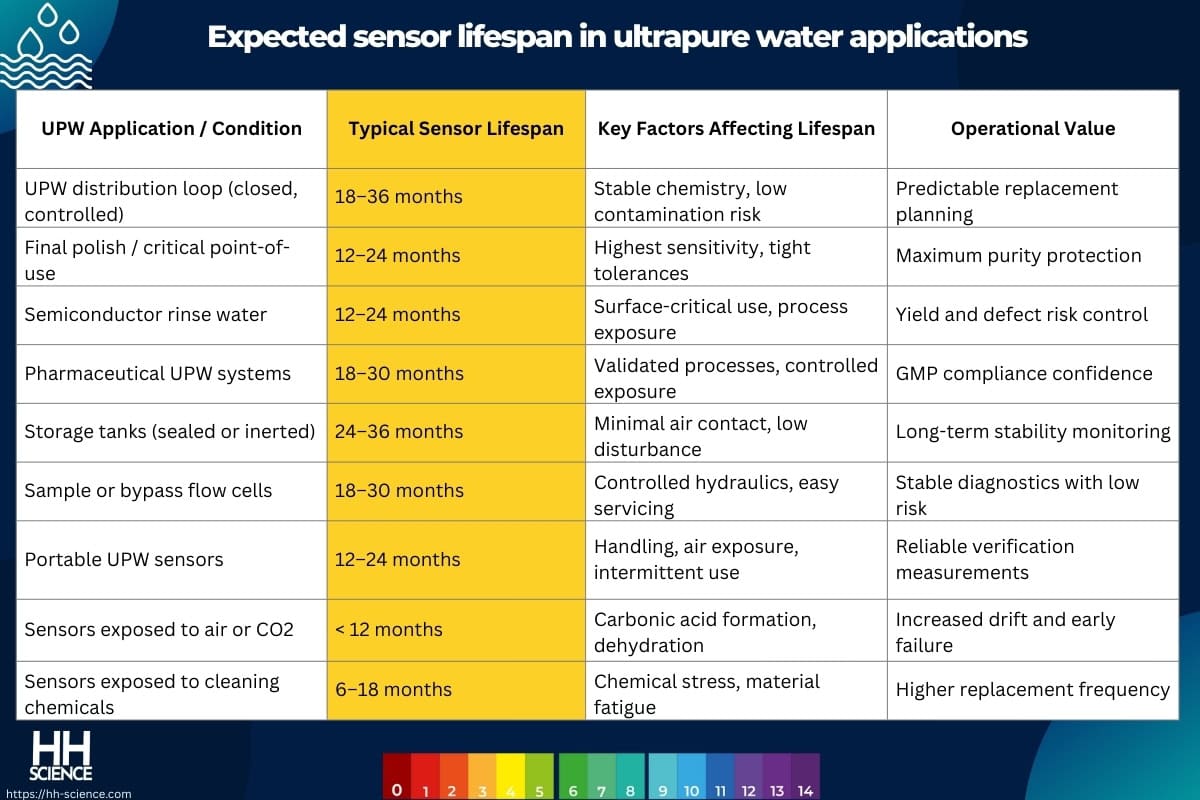
Expected sensor lifespan
Expected pH sensor lifespan in ultrapure water (UPW) applications is governed by sensor design for low conductivity, material compatibility, exposure to chemicals or air, installation configuration, and maintenance discipline, because UPW environments stress sensors differently than conventional water systems. Understanding realistic lifespan expectations helps high-purity facilities plan replacements, preserve measurement integrity, and control risk to yield and process stability.
| UPW Application / Condition | Typical Sensor Lifespan | Key Factors Affecting Lifespan | Operational Value |
| UPW distribution loop (closed, controlled) | 18–36 months | Stable chemistry, low contamination risk | Predictable replacement planning |
| Final polish / critical point-of-use | 12–24 months | Highest sensitivity, tight tolerances | Maximum purity protection |
| Semiconductor rinse water | 12–24 months | Surface-critical use, process exposure | Yield and defect risk control |
| Pharmaceutical UPW systems | 18–30 months | Validated processes, controlled exposure | GMP compliance confidence |
| Storage tanks (sealed or inerted) | 24–36 months | Minimal air contact, low disturbance | Long-term stability monitoring |
| Sample or bypass flow cells | 18–30 months | Controlled hydraulics, easy servicing | Stable diagnostics with low risk |
| Portable UPW sensors | 12–24 months | Handling, air exposure, intermittent use | Reliable verification measurements |
| Sensors exposed to air or CO2 | < 12 months | Carbonic acid formation, dehydration | Increased drift and early failure |
| Sensors exposed to cleaning chemicals | 6–18 months | Chemical stress, material fatigue | Higher replacement frequency |
Trade-offs between accuracy, maintenance, and durability
In ultrapure water applications, trade-offs between accuracy, maintenance, and durability are especially pronounced because achieving ultra-high sensitivity and stability in low-conductivity environments requires delicate sensor designs with tight tolerances. High-accuracy sensors provide superior diagnostic value and early contamination detection but demand stricter handling and controlled installation, while more durable designs reduce maintenance and exposure risk at the cost of slightly lower sensitivity, making application-specific balance essential for yield protection, process reliability, and total cost of ownership.
Regulatory or quality considerations in ultrapure water applications
Regulatory and quality considerations in ultrapure water applications are driven by internal specifications, customer requirements, and validated process controls rather than public drinking water regulations, because UPW quality directly affects product yield and process reliability. Precise, traceable pH monitoring supports compliance with internal quality standards, semiconductor and pharmaceutical validation protocols, and customer audits, while reducing the risk of batch rejection, process excursions, and unplanned downtime.
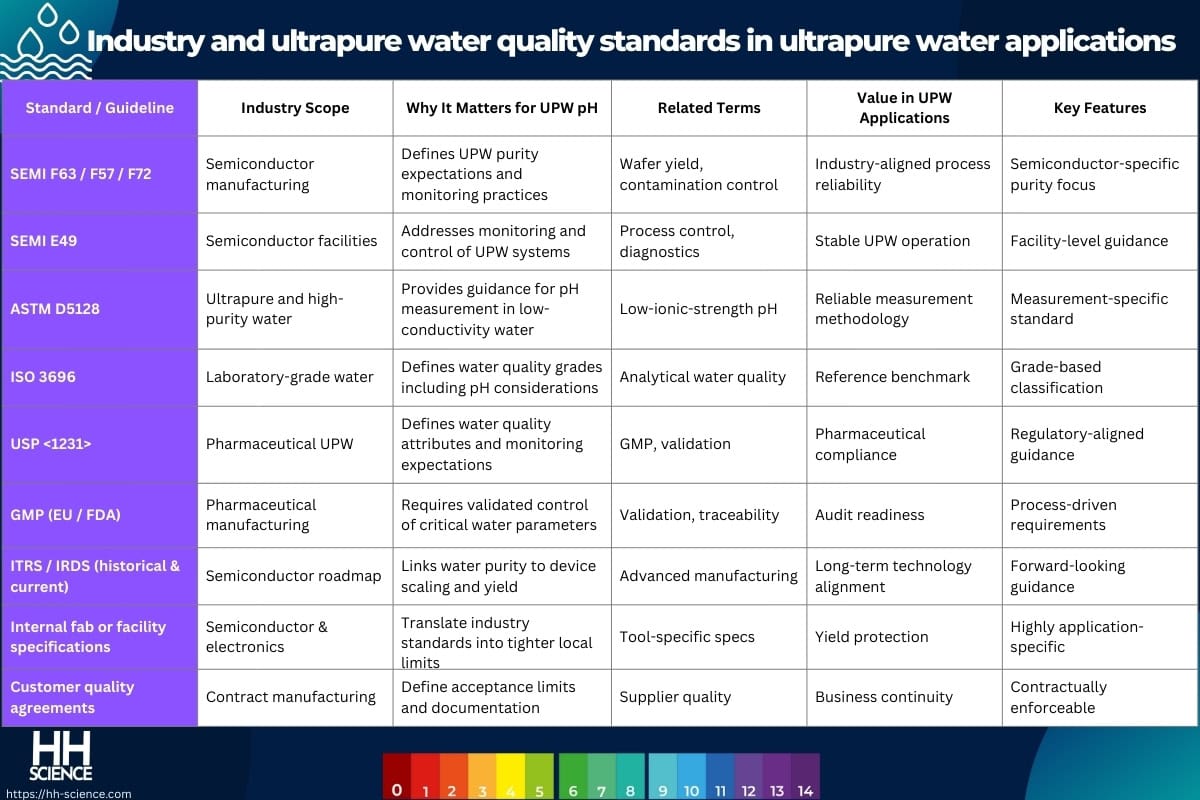
Industry and ultrapure water quality standards
Industry and ultrapure water (UPW) quality standards define pH expectations, measurement practices, documentation, and validation requirements to ensure that ultra-high-purity water consistently supports defect-free manufacturing and validated processes. These standards exist because in UPW systems, pH is not a bulk compliance parameter but a high-sensitivity indicator of purity, material interaction, and system health, directly affecting yield, reliability, and audit outcomes.
| Standard / Guideline | Industry Scope | Why It Matters for UPW pH | Related Terms | Value in UPW Applications | Key Features |
| SEMI F63 / F57 / F72 | Semiconductor manufacturing | Defines UPW purity expectations and monitoring practices | Wafer yield, contamination control | Industry-aligned process reliability | Semiconductor-specific purity focus |
| SEMI E49 | Semiconductor facilities | Addresses monitoring and control of UPW systems | Process control, diagnostics | Stable UPW operation | Facility-level guidance |
| ASTM D5128 | Ultrapure and high-purity water | Provides guidance for pH measurement in low-conductivity water | Low-ionic-strength pH | Reliable measurement methodology | Measurement-specific standard |
| ISO 3696 | Laboratory-grade water | Defines water quality grades including pH considerations | Analytical water quality | Reference benchmark | Grade-based classification |
| USP <1231> | Pharmaceutical UPW | Defines water quality attributes and monitoring expectations | GMP, validation | Pharmaceutical compliance | Regulatory-aligned guidance |
| GMP (EU / FDA) | Pharmaceutical manufacturing | Requires validated control of critical water parameters | Validation, traceability | Audit readiness | Process-driven requirements |
| ITRS / IRDS (historical & current) | Semiconductor roadmap | Links water purity to device scaling and yield | Advanced manufacturing | Long-term technology alignment | Forward-looking guidance |
| Internal fab or facility specifications | Semiconductor & electronics | Translate industry standards into tighter local limits | Tool-specific specs | Yield protection | Highly application-specific |
| Customer quality agreements | Contract manufacturing | Define acceptance limits and documentation | Supplier quality | Business continuity | Contractually enforceable |
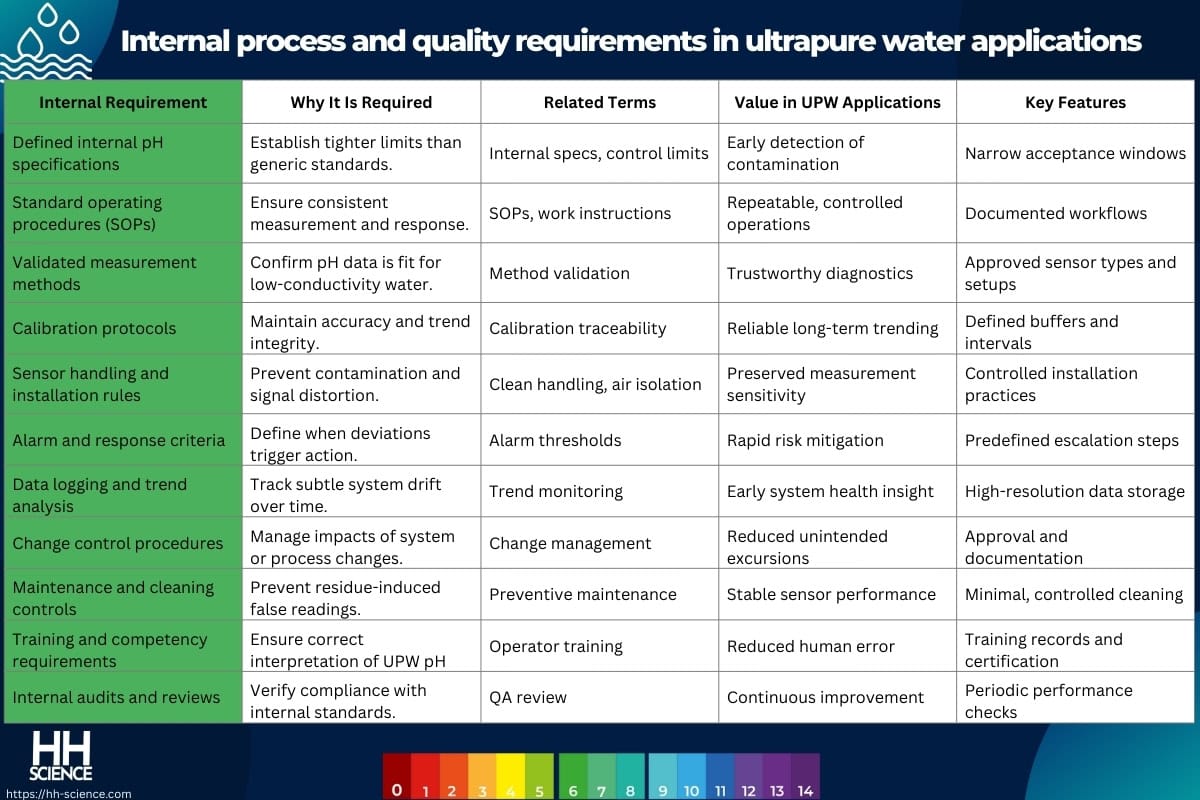
Internal process and quality requirements
Internal process and quality requirements in ultrapure water (UPW) applications define how pH is measured, interpreted, documented, and acted upon to protect yield, process stability, and audit readiness, because external regulations are often replaced by tighter internal and customer-driven specifications. These requirements exist to ensure that pH functions as a reliable diagnostic and control indicator rather than a simple numeric value in ultra-low conductivity systems.
| Internal Requirement | Why It Is Required | Related Terms | Value in UPW Applications | Key Features |
| Defined internal pH specifications | Establish tighter limits than generic standards. | Internal specs, control limits | Early detection of contamination | Narrow acceptance windows |
| Standard operating procedures (SOPs) | Ensure consistent measurement and response. | SOPs, work instructions | Repeatable, controlled operations | Documented workflows |
| Validated measurement methods | Confirm pH data is fit for low-conductivity water. | Method validation | Trustworthy diagnostics | Approved sensor types and setups |
| Calibration protocols | Maintain accuracy and trend integrity. | Calibration traceability | Reliable long-term trending | Defined buffers and intervals |
| Sensor handling and installation rules | Prevent contamination and signal distortion. | Clean handling, air isolation | Preserved measurement sensitivity | Controlled installation practices |
| Alarm and response criteria | Define when deviations trigger action. | Alarm thresholds | Rapid risk mitigation | Predefined escalation steps |
| Data logging and trend analysis | Track subtle system drift over time. | Trend monitoring | Early system health insight | High-resolution data storage |
| Change control procedures | Manage impacts of system or process changes. | Change management | Reduced unintended excursions | Approval and documentation |
| Maintenance and cleaning controls | Prevent residue-induced false readings. | Preventive maintenance | Stable sensor performance | Minimal, controlled cleaning |
| Training and competency requirements | Ensure correct interpretation of UPW pH data. | Operator training | Reduced human error | Training records and certification |
| Internal audits and reviews | Verify compliance with internal standards. | QA review | Continuous improvement | Periodic performance checks |
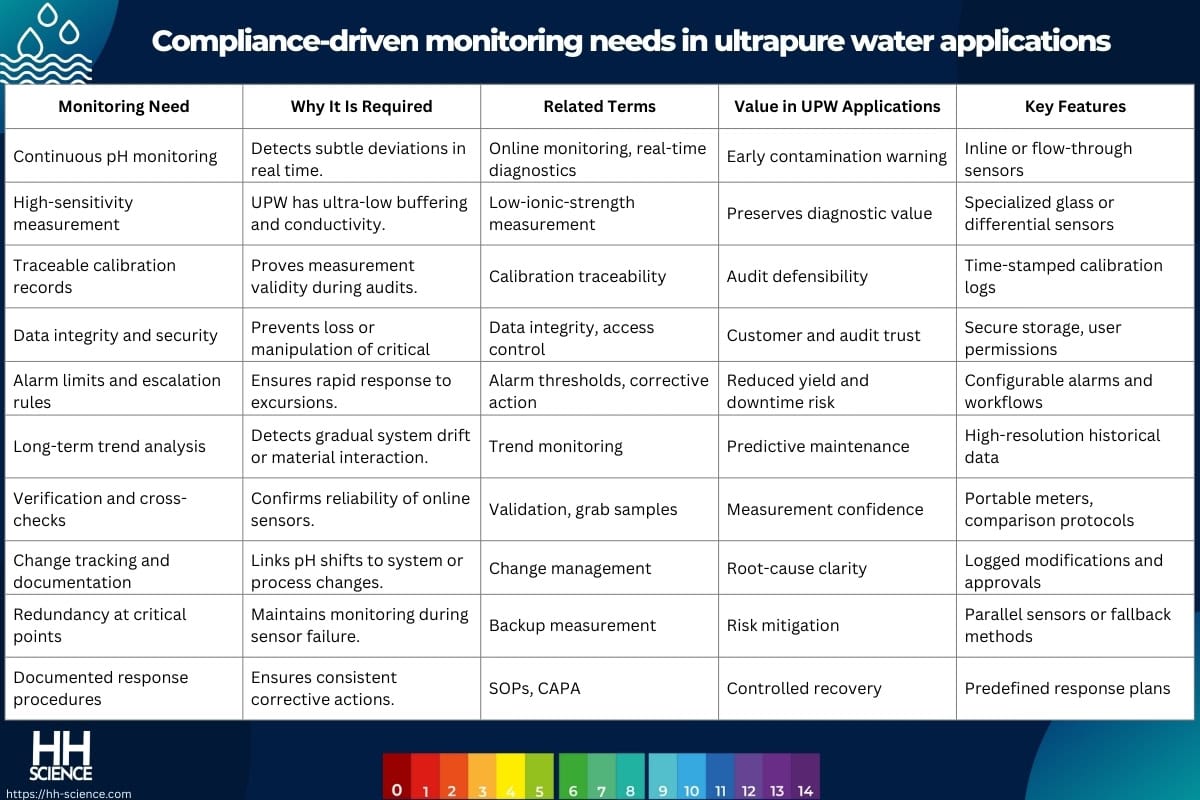
Compliance-driven monitoring needs
Compliance-driven monitoring needs in ultrapure water (UPW) applications include continuous monitoring, high-sensitivity measurement, traceable calibration, data integrity, alarm management, trend analysis, and documented response procedures, because UPW systems are governed by strict internal specifications, customer audits, and validated manufacturing requirements rather than public regulations. These needs ensure that pH functions as a defensible process assurance and contamination detection signal, supporting yield protection, audit readiness, and business continuity.
| Monitoring Need | Why It Is Required | Related Terms | Value in UPW Applications | Key Features |
| Continuous pH monitoring | Detects subtle deviations in real time. | Online monitoring, real-time diagnostics | Early contamination warning | Inline or flow-through sensors |
| High-sensitivity measurement | UPW has ultra-low buffering and conductivity. | Low-ionic-strength measurement | Preserves diagnostic value | Specialized glass or differential sensors |
| Traceable calibration records | Proves measurement validity during audits. | Calibration traceability | Audit defensibility | Time-stamped calibration logs |
| Data integrity and security | Prevents loss or manipulation of critical data. | Data integrity, access control | Customer and audit trust | Secure storage, user permissions |
| Alarm limits and escalation rules | Ensures rapid response to excursions. | Alarm thresholds, corrective action | Reduced yield and downtime risk | Configurable alarms and workflows |
| Long-term trend analysis | Detects gradual system drift or material interaction. | Trend monitoring | Predictive maintenance | High-resolution historical data |
| Verification and cross-checks | Confirms reliability of online sensors. | Validation, grab samples | Measurement confidence | Portable meters, comparison protocols |
| Change tracking and documentation | Links pH shifts to system or process changes. | Change management | Root-cause clarity | Logged modifications and approvals |
| Redundancy at critical points | Maintains monitoring during sensor failure. | Backup measurement | Risk mitigation | Parallel sensors or fallback methods |
| Documented response procedures | Ensures consistent corrective actions. | SOPs, CAPA | Controlled recovery | Predefined response plans |
Selecting the right pH measurement approach
Selecting the right pH measurement approach in ultrapure water applications is critical because pH functions as a high-sensitivity indicator of ionic contamination, material interaction, and system health rather than a simple control variable. Aligning sensor technology, installation configuration, calibration strategy, and data management with ultra-low conductivity conditions and process criticality ensures reliable diagnostics, yield protection, and defensible quality control.
Decision support for ultrapure water applications
Decision support provides a structured framework for translating ultrapure water requirements—such as ultra-low conductivity, tight internal pH specifications, contamination sensitivity, and audit expectations—into clear measurement criteria. By evaluating factors like sensor stability, diagnostic sensitivity, installation risk, calibration traceability, and total cost of ownership, decision support reduces selection uncertainty and ensures pH monitoring aligns with yield protection and process assurance goals.
Application-driven measurement strategies
Application-driven measurement strategies tailor pH monitoring to specific UPW use cases, including distribution loops, final polish outlets, and point-of-use locations, each with different exposure risks and diagnostic priorities. This approach ensures the chosen sensor type, configuration, temperature compensation, and maintenance model reflect real operating conditions rather than generic specifications, preserving pH as a reliable early-warning indicator rather than a noisy signal.
Linking ultrapure water applications to sensor selection and oem solutions
Linking UPW applications to sensor selection and OEM solutions connects process requirements directly to optimized sensor designs, materials, and integration options. This enables customized solutions—such as low-ionic-strength glass, differential measurement principles, digital diagnostics, specialized flow cells, or private-labeled assemblies—that improve stability, simplify validation, and support scalable deployment while maximizing long-term performance and value.


