
What does the pH of a buffer indicate?
The pH of a buffer indicates the ratio of the concentrations of the weak acid (HA) and its conjugate base (A⁻) in solution, as defined by the Henderson–Hasselbalch equation: pH = pKa + log([A⁻]/[HA]). The pH therefore reflects the buffer’s ability to resist changes in hydrogen ion concentration [H⁺], with its most effective control occurring within ±1 pH unit of the buffer’s pKa value.
What is a buffer solution?
A buffer solution is a mixture of a weak acid and its conjugate base, or a weak base and its conjugate acid, that maintains a nearly constant pH when small amounts of strong acids or bases are added. In chemistry and biology, buffers such as phosphate (pKa ≈ 7.2) and bicarbonate (pH 7.35–7.45 in blood) are essential because they stabilize hydrogen ion activity [H⁺], ensuring proper chemical reactions, enzyme function, and physiological balance.
How does a buffer solution work?
A buffer solution works by resisting changes in pH when small amounts of acid or base are added, through the equilibrium reaction between its weak acid–conjugate base (or weak base–conjugate acid) pair. The weak acid neutralizes added hydroxide ions (OH⁻), while the conjugate base neutralizes added hydrogen ions (H⁺), maintaining the solution’s pH close to its defined buffer capacity range.
Is water a buffer solution?
No, water is not a buffer solution because it lacks a conjugate acid–base pair to resist changes in pH, and even slight additions of acid or base can significantly shift its hydrogen ion concentration. Pure water has a neutral pH of around 7, but without a buffering system it cannot stabilize that pH against external disturbances.
Why is a buffer solution important?
A buffer solution is important because it stabilizes pH within a narrow range, typically ±1 unit around its pKa, ensuring that biochemical reactions, enzyme activity, and industrial processes occur under optimal conditions. In applications such as blood (maintained at pH ~7.35–7.45 by the bicarbonate buffer), pharmaceuticals, fermentation, and environmental monitoring, buffers prevent harmful pH fluctuations that could otherwise disrupt stability, product quality, or biological function.
What is a buffer composed of?
A buffer is composed of a weak acid and its conjugate base, or a weak base and its conjugate acid, typically present in comparable concentrations (often in the range of 0.01–1.0 M) to maintain effective buffer capacity. This pairing allows the solution to neutralize added H⁺ or OH⁻ ions, and examples include acetic acid/acetate in biochemical assays, or bicarbonate/carbonic acid in blood plasma, where stable pH is critical for enzyme function and metabolic processes.
How is buffer capacity defined?
Buffer capacity (β = dB/dpH) is defined as the amount of strong acid or base (in moles) that must be added to 1 liter of buffer solution to change its pH by one unit. It reflects the resistance of the buffer to pH changes and is maximized when the solution’s pH equals the pKa of the buffering acid, with higher total buffer concentration giving greater β values.
What are the types of buffer solutions?
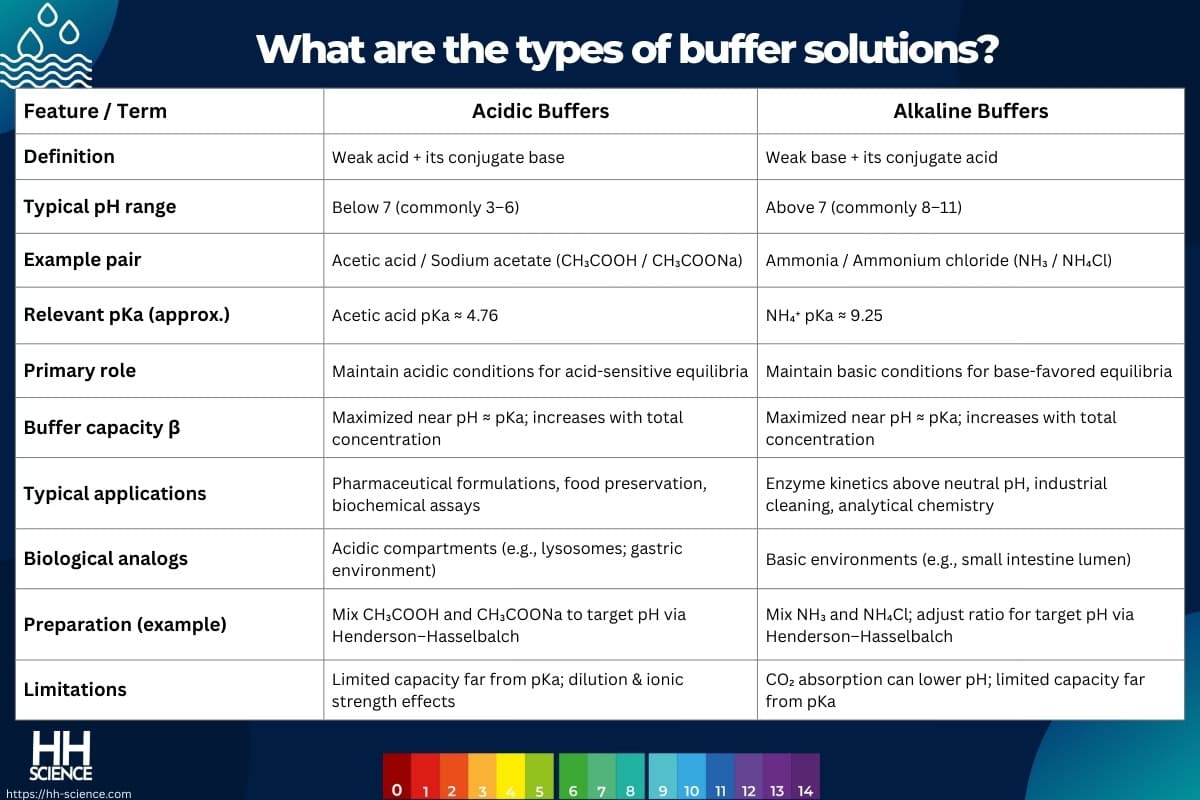
The types of buffer solutions are acidic buffers and alkaline buffers, classified based on whether they maintain pH values below or above 7 to suit different chemical and biological environments.
- Acidic buffers: Made from a weak acid and its conjugate base (e.g., acetic acid and sodium acetate), they maintain pH below 7 and are widely used in biochemical and pharmaceutical applications.
- Alkaline buffers: Made from a weak base and its conjugate acid (e.g., ammonia and ammonium chloride), they maintain pH above 7 and are commonly used in industrial processes, enzyme studies, and analytical chemistry.
| Feature / Term | Acidic Buffers | Alkaline Buffers |
| Definition | Weak acid + its conjugate base | Weak base + its conjugate acid |
| Typical pH range | Below 7 (commonly 3–6) | Above 7 (commonly 8–11) |
| Example pair | Acetic acid / Sodium acetate (CH₃COOH / CH₃COONa) | Ammonia / Ammonium chloride (NH₃ / NH₄Cl) |
| Relevant pKa (approx.) | Acetic acid pKa ≈ 4.76 | NH₄⁺ pKa ≈ 9.25 |
| Primary role | Maintain acidic conditions for acid-sensitive equilibria | Maintain basic conditions for base-favored equilibria |
| Buffer capacity β | Maximized near pH ≈ pKa; increases with total concentration | Maximized near pH ≈ pKa; increases with total concentration |
| Typical applications | Pharmaceutical formulations, food preservation, biochemical assays | Enzyme kinetics above neutral pH, industrial cleaning, analytical chemistry |
| Biological analogs | Acidic compartments (e.g., lysosomes; gastric environment) | Basic environments (e.g., small intestine lumen) |
| Preparation (example) | Mix CH₃COOH and CH₃COONa to target pH via Henderson–Hasselbalch | Mix NH₃ and NH₄Cl; adjust ratio for target pH via Henderson–Hasselbalch |
| Limitations | Limited capacity far from pKa; dilution & ionic strength effects | CO₂ absorption can lower pH; limited capacity far from pKa |
What are the buffer solution examples?
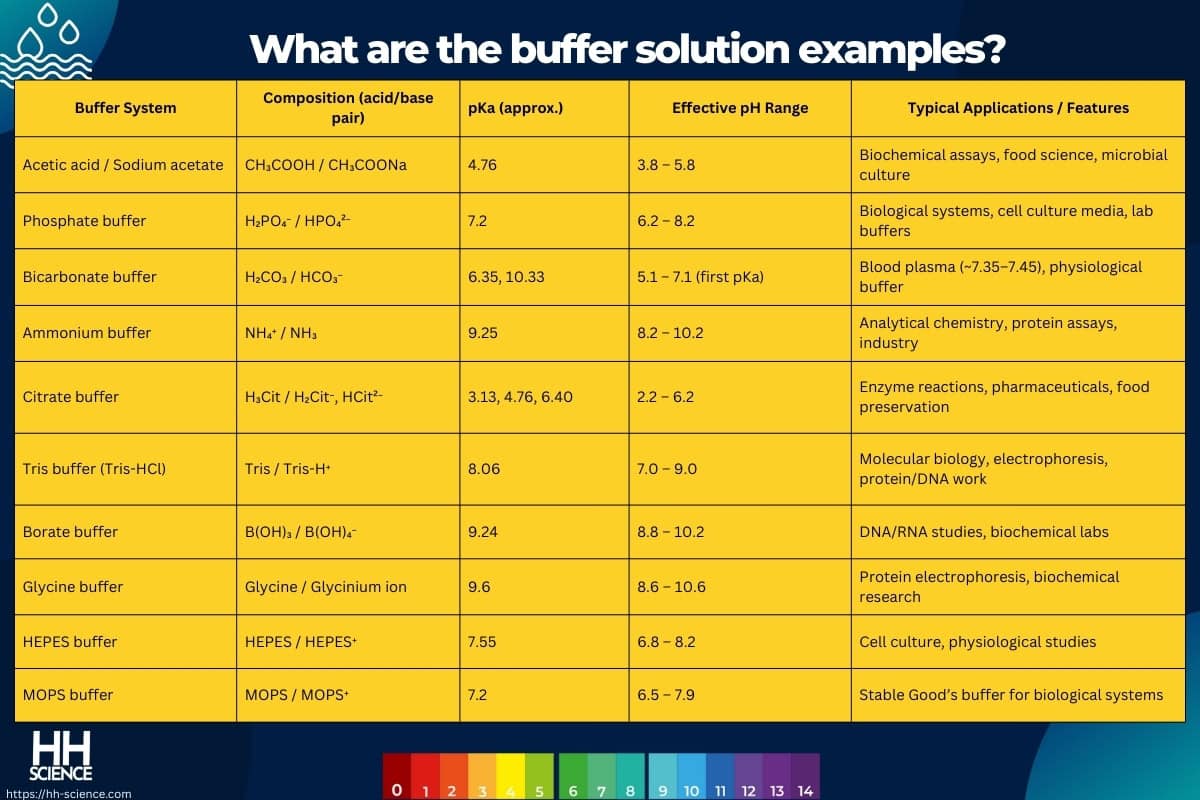
Buffer solutions are chosen based on their pH range, pKa value, and stability, making them suitable for chemical, biological, medical, and industrial applications. Below are 10 typical examples, with their key values and features. These are chosen because they cover a wide pH spectrum (2–11), are well-characterized in terms of pKa, and are commonly applied in chemistry, biology, medicine, and industry.
| Buffer System | Composition (acid/base pair) | pKa (approx.) | Effective pH Range | Typical Applications / Features |
| Acetic acid / Sodium acetate | CH₃COOH / CH₃COONa | 4.76 | 3.8 – 5.8 | Biochemical assays, food science, microbial culture |
| Phosphate buffer | H₂PO₄⁻ / HPO₄²⁻ | 7.20 | 6.2 – 8.2 | Biological systems, cell culture media, lab buffers |
| Bicarbonate buffer | H₂CO₃ / HCO₃⁻ | 6.35, 10.33 | 5.1 – 7.1 (first pKa) | Blood plasma (~7.35–7.45), physiological buffer |
| Ammonium buffer | NH₄⁺ / NH₃ | 9.25 | 8.2 – 10.2 | Analytical chemistry, protein assays, industry |
| Citrate buffer | H₃Cit / H₂Cit⁻, HCit²⁻ | 3.13, 4.76, 6.40 | 2.2 – 6.2 | Enzyme reactions, pharmaceuticals, food preservation |
| Tris buffer (Tris-HCl) | Tris / Tris-H⁺ | 8.06 | 7.0 – 9.0 | Molecular biology, electrophoresis, protein/DNA work |
| Borate buffer | B(OH)₃ / B(OH)₄⁻ | 9.24 | 8.8 – 10.2 | DNA/RNA studies, biochemical labs |
| Glycine buffer | Glycine / Glycinium ion | 9.60 | 8.6 – 10.6 | Protein electrophoresis, biochemical research |
| HEPES buffer | HEPES / HEPES⁺ | 7.55 | 6.8 – 8.2 | Cell culture, physiological studies |
| MOPS buffer | MOPS / MOPS⁺ | 7.20 | 6.5 – 7.9 | Stable Good’s buffer for biological systems |
What is the pH of a buffer solution?
The pH of a buffer solution is determined by the Henderson–Hasselbalch equation:
pH = pKa + log([A⁻] / [HA])
The pH typically lies within about ±1 unit of the buffer’s pKa value, which is the range where the concentrations of the weak acid (HA) and its conjugate base (A⁻) are comparable, giving maximum buffer capacity. For example, an acetate buffer (pKa ≈ 4.76) maintains pH effectively between 3.8 and 5.8, while a phosphate buffer (pKa ≈ 7.20) controls pH between 6.2 and 8.2.
What is the effective pH range of a buffer?
The effective pH range of a buffer is typically within ±1 unit of its pKa value, where the weak acid and conjugate base concentrations are comparable, ensuring maximum buffer capacity and stability.
What is the unique characterization of a pH buffer?
The unique characterization of a pH buffer is its ability to resist changes in pH upon the addition of small amounts of strong acid or base, due to the equilibrium between its weak acid–conjugate base (or weak base–conjugate acid) pair.
What is the pH of the bicarbonate buffer?
The pH of the bicarbonate buffer in blood plasma is maintained at around 7.35–7.45, controlled by the H₂CO₃/HCO₃⁻ system with a primary pKa of 6.35.
What is the pH of the buffer 0.10 M Na₂HPO₄?
The pH of a buffer prepared with 0.10 M Na₂HPO₄ (sodium hydrogen phosphate) depends on its conjugate acid H₂PO₄⁻; assuming equimolar conditions with NaH₂PO₄, the pH is close to the phosphate buffer pKa₂ value of 7.20.
What is the pH of the resulting buffer?
The pH of the resulting buffer is determined by the Henderson–Hasselbalch equation (pH = pKa + log([base]/[acid])), and will be near the buffer’s pKa when [base] ≈ [acid], typically within the effective buffer range of pKa ±1.
What is the pH of an acidic buffer?
The pH of an acidic buffer is below 7, typically maintained within the effective range of the weak acid used, for example acetic acid/acetate buffer at pH ≈ 3.8–5.8 (pKa 4.76).
What is the pH of a neutral buffer?
The pH of a neutral buffer is around 7, most commonly represented by the phosphate buffer system (H₂PO₄⁻/HPO₄²⁻) with a pKa near 7.20, which maintains pH effectively between 6.2 and 8.2.
What is the pH of a base(alkaline) buffer?
The pH of a base (alkaline) buffer is above 7, typically maintained within the effective range of the weak base used, for example ammonia/ammonium buffer at pH ≈ 8.2–10.2 (pKa 9.25).
Can the pH of a buffer be 7?
Yes, the pH of a buffer can be 7 because a neutral buffer system such as the phosphate buffer (H₂PO₄⁻/HPO₄²⁻, pKa ≈ 7.20) is able to stabilize pH close to neutrality, typically in the range 6.2–8.2.
Is the pH of all buffer solutions 7?
No, the pH of all buffer solutions is not 7 because buffers are designed to maintain pH around their specific pKa values, which can be acidic (e.g., acetate buffer at pH 3.8–5.8), neutral (phosphate buffer around 7), or alkaline (ammonia buffer at pH 8.2–10.2).
pH scale of buffers
The pH scale of buffers represents the specific pH ranges within which different buffer systems effectively maintain stability, typically centered around the pKa of the acid–base pair. Understanding these ranges is essential for selecting the right buffer for chemical, biological, and industrial applications.
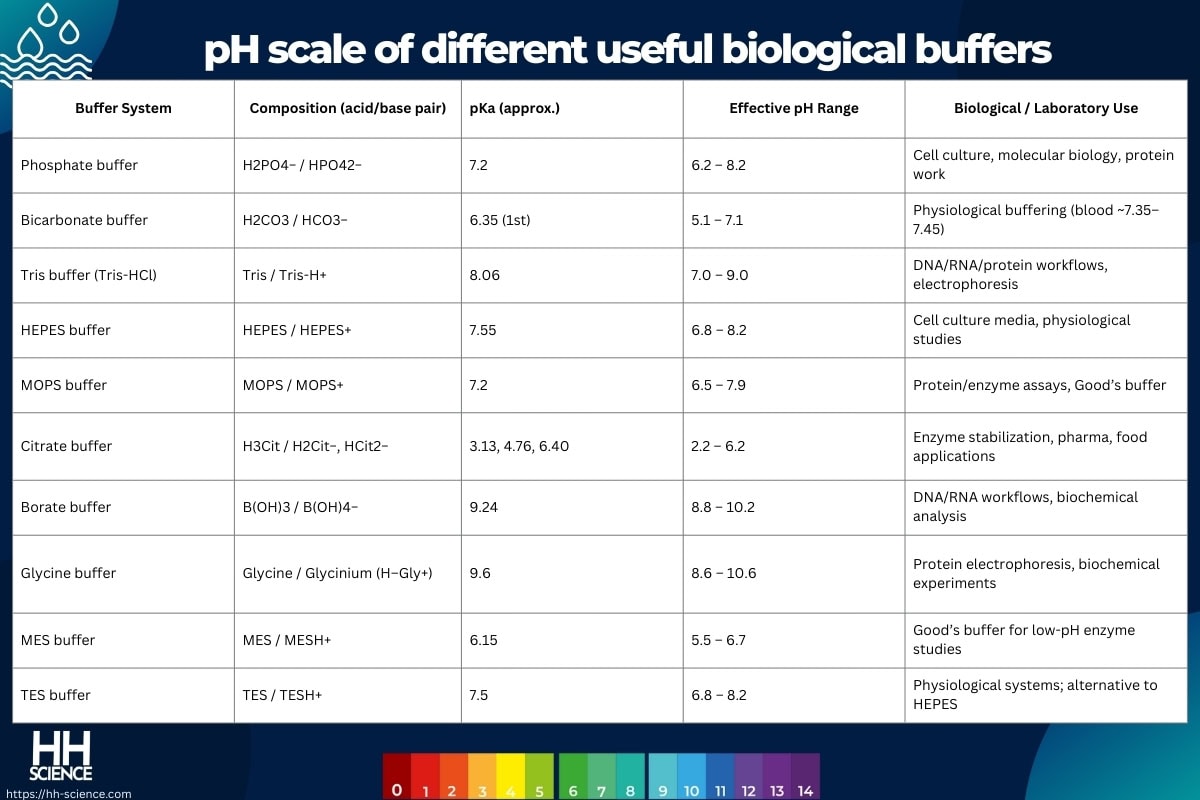
pH scale of different useful biological buffers
The pH scale of different useful biological buffers reflects their ability to maintain stable environments for biochemical and physiological processes. Each buffer is chosen according to its pKa value and effective pH range, ensuring compatibility with enzyme activity, metabolic pathways, and cellular stability. Biological systems rely heavily on buffers such as phosphate, bicarbonate, and Good’s buffers (HEPES, MOPS, Tris, etc.) to maintain homeostasis and experimental reproducibility.
| Buffer System | Composition (acid/base pair) | pKa (approx.) | Effective pH Range | Biological / Laboratory Use |
| Phosphate buffer | H2PO4− / HPO42− | 7.20 | 6.2 – 8.2 | Cell culture, molecular biology, protein work |
| Bicarbonate buffer | H2CO3 / HCO3− | 6.35 (1st) | 5.1 – 7.1 | Physiological buffering (blood ~7.35–7.45) |
| Tris buffer (Tris-HCl) | Tris / Tris-H+ | 8.06 | 7.0 – 9.0 | DNA/RNA/protein workflows, electrophoresis |
| HEPES buffer | HEPES / HEPES+ | 7.55 | 6.8 – 8.2 | Cell culture media, physiological studies |
| MOPS buffer | MOPS / MOPS+ | 7.20 | 6.5 – 7.9 | Protein/enzyme assays, Good’s buffer |
| Citrate buffer | H3Cit / H2Cit−, HCit2− | 3.13, 4.76, 6.40 | 2.2 – 6.2 | Enzyme stabilization, pharma, food applications |
| Borate buffer | B(OH)3 / B(OH)4− | 9.24 | 8.8 – 10.2 | DNA/RNA workflows, biochemical analysis |
| Glycine buffer | Glycine / Glycinium (H–Gly+) | 9.60 | 8.6 – 10.6 | Protein electrophoresis, biochemical experiments |
| MES buffer | MES / MESH+ | 6.15 | 5.5 – 6.7 | Good’s buffer for low-pH enzyme studies |
| TES buffer | TES / TESH+ | 7.50 | 6.8 – 8.2 | Physiological systems; alternative to HEPES |
Can the pH of a buffer be negative?
No, the pH of a buffer can not be negative because buffers rely on a weak acid–conjugate base pair (or weak base–conjugate acid pair) whose pKa values typically fall within the range of about 2 to 12, allowing effective buffering within pKa ±1 unit. At extremely high hydrogen ion concentrations (pH < 0), only strong acids are present without a weak acid/base equilibrium, so no stable buffer action is possible.
What determines the pH of a buffer solution?
The pH of a buffer solution is determined by the pKa of the weak acid, the ratio of conjugate base to acid concentrations ([A⁻]/[HA]) as described by the Henderson–Hasselbalch equation, and the absolute concentrations of both components, which affect buffer capacity. Additional factors such as temperature, ionic strength, and dilution can shift equilibrium constants and ion activity, thereby influencing the exact pH stability of the buffer system.
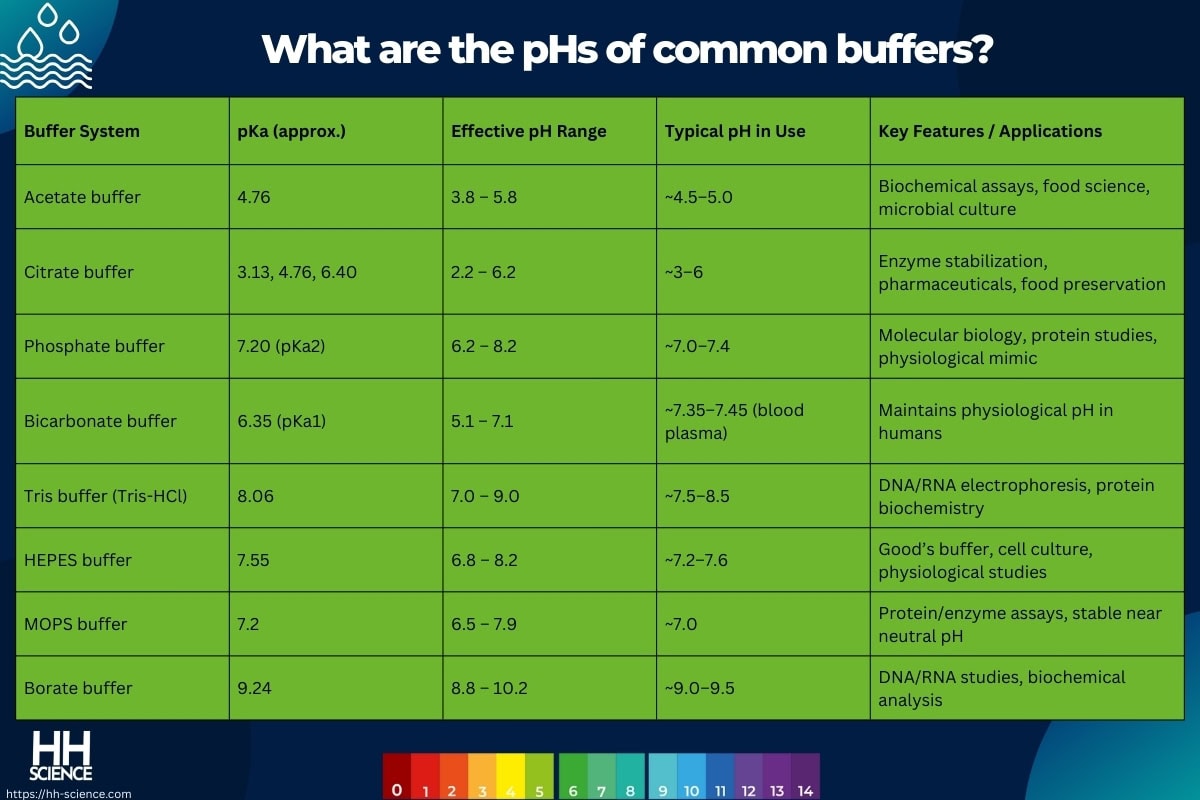
What are the pHs of common buffers?
Common laboratory and biological buffers are chosen based on their pKa values and effective buffering ranges. They ensure stable conditions for biochemical reactions, molecular biology workflows, and physiological processes.
| Buffer System | pKa (approx.) | Effective pH Range | Typical pH in Use | Key Features / Applications |
| Acetate buffer | 4.76 | 3.8 – 5.8 | ~4.5–5.0 | Biochemical assays, food science, microbial culture |
| Citrate buffer | 3.13, 4.76, 6.40 | 2.2 – 6.2 | ~3–6 | Enzyme stabilization, pharmaceuticals, food preservation |
| Phosphate buffer | 7.20 (pKa2) | 6.2 – 8.2 | ~7.0–7.4 | Molecular biology, protein studies, physiological mimic |
| Bicarbonate buffer | 6.35 (pKa1) | 5.1 – 7.1 | ~7.35–7.45 (blood plasma) | Maintains physiological pH in humans |
| Tris buffer (Tris-HCl) | 8.06 | 7.0 – 9.0 | ~7.5–8.5 | DNA/RNA electrophoresis, protein biochemistry |
| HEPES buffer | 7.55 | 6.8 – 8.2 | ~7.2–7.6 | Good’s buffer, cell culture, physiological studies |
| MOPS buffer | 7.20 | 6.5 – 7.9 | ~7.0 | Protein/enzyme assays, stable near neutral pH |
| Borate buffer | 9.24 | 8.8 – 10.2 | ~9.0–9.5 | DNA/RNA studies, biochemical analysis |
What are the pHs of common acidic buffers (pH < 7)?
The pHs of common acidic buffers are typically in the ~2–6.8 range, centered around each system’s pKa (±1): acetate (~4.5–5.5, pKa 4.76), citrate (~3–6, pKa 3.13/4.76/6.40), MES (~5.5–6.7, pKa 6.15), succinate (~4.2–6.0, pKa 4.21/5.64), phthalate/KHP (~4.0 standard, pKa₂ ≈ 5.41), lactate (~3.5–4.9, pKa 3.86), and formate (~2.8–4.5, pKa 3.75). The acidic classification reflects [A⁻]/[HA] ratios that hold pH below 7 while maximizing buffer capacity near the acid’s pKa.
What are the pHs of common basic buffers (pH > 7)?
The pHs of common basic buffers lie above 7, often ~7.5–11, tied to bases with pKa values in the 8–10.5 range: Tris (~7.5–8.5, pKa 8.06), ammonia/ammonium (~8.2–10.2, pKa 9.25), borate (~8.8–10.2, pKa ≈ 9.24), glycine (~8.6–10.6, pKa 9.60), TAPS (~7.7–9.1, pKa 8.4), CHES (~8.6–10.0, pKa 9.3), CAPS (~9.7–11.1, pKa 10.4), and carbonate/bicarbonate in alkaline mode (~9.2–10.6, pKa₂ 10.33). These systems maintain [base]/[acid] ratios that stabilize pH above neutrality according to the Henderson–Hasselbalch relation.
What are the pHs of common neutral or near-neutral buffers?
The pHs of common neutral or near-neutral buffers cluster around ~6.5–7.6, aligning with pKa values near 7: phosphate (~6.8–7.4, pKa₂ 7.20), HEPES (~7.2–7.6, pKa 7.55), MOPS (~6.8–7.4, pKa 7.20), PIPES (~6.6–7.2, pKa 6.76), TES (~7.0–7.6, pKa 7.50), imidazole (~6.5–7.5, pKa ≈ 6.95), and BES (~6.8–7.6, pKa 7.15). These buffers are preferred when physiological or enzyme-optimal pH near neutrality is required, offering strong capacity within pKa ±1.
How do you select a buffer based on pKa and target pH?
You can select a buffer by choosing a conjugate acid–base pair whose pKa lies within ±1 pH unit of your target pH (best at pH ≈ pKa), then set the [A⁻]/[HA] ratio via the Henderson–Hasselbalch equation (pH = pKa + log([A⁻]/[HA])): at pH = pKa, the ratio is 1:1, at pH = pKa + 1, it’s ≈10:1, and at pH = pKa-1, it’s ≈1:10.
You can next choose an appropriate total buffer concentration (commonly 0.01–1.0 M) to achieve capacity, while accounting for temperature-dependent pKa shifts (e.g., Tris ≈ −0.028 pH/°C), ionic strength, CO₂ absorption/volatility, metal chelation/enzymatic compatibility, and any optical or downstream application constraints.
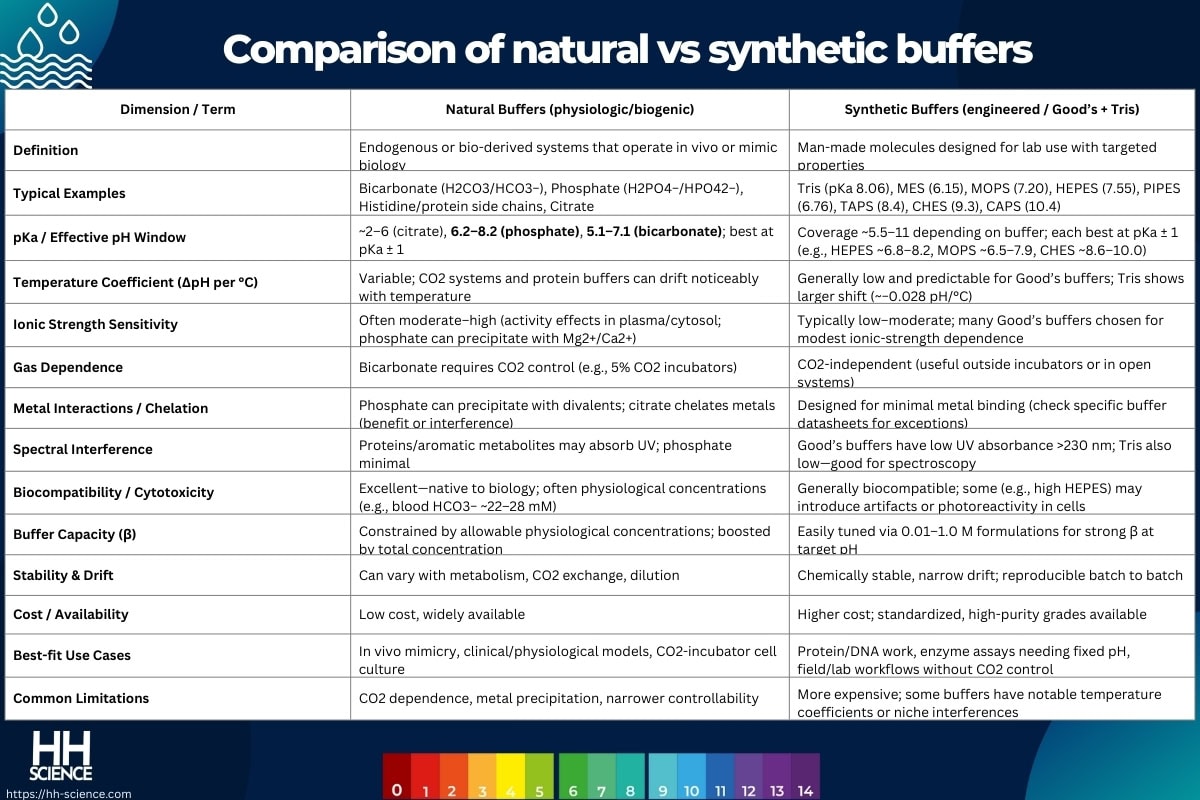
Comparison of natural vs synthetic buffers
Natural buffers are those found in biological systems (e.g., bicarbonate, phosphate, amino-acid/protein histidine, citrate) and are prized for biocompatibility but can be sensitive to CO₂, temperature, ionic strength, and metal ions. Synthetic buffers (e.g., Tris and Good’s buffers like HEPES, MOPS, MES, PIPES, TAPS, CHES, CAPS) are engineered for defined pKa values, low reactivity, and stable performance across lab conditions, trading higher cost for tighter control.
| Dimension / Term | Natural Buffers (physiologic/biogenic) | Synthetic Buffers (engineered / Good’s + Tris) |
| Definition | Endogenous or bio-derived systems that operate in vivo or mimic biology | Man-made molecules designed for lab use with targeted properties |
| Typical Examples | Bicarbonate (H2CO3/HCO3−), Phosphate (H2PO4−/HPO42−), Histidine/protein side chains, Citrate | Tris (pKa 8.06), MES (6.15), MOPS (7.20), HEPES (7.55), PIPES (6.76), TAPS (8.4), CHES (9.3), CAPS (10.4) |
| pKa / Effective pH Window | ~2–6 (citrate), 6.2–8.2 (phosphate), 5.1–7.1 (bicarbonate); best at pKa ± 1 | Coverage ~5.5–11 depending on buffer; each best at pKa ± 1 (e.g., HEPES ~6.8–8.2, MOPS ~6.5–7.9, CHES ~8.6–10.0) |
| Temperature Coefficient (ΔpH per °C) | Variable; CO2 systems and protein buffers can drift noticeably with temperature | Generally low and predictable for Good’s buffers; Tris shows larger shift (~−0.028 pH/°C) |
| Ionic Strength Sensitivity | Often moderate–high (activity effects in plasma/cytosol; phosphate can precipitate with Mg2+/Ca2+) | Typically low–moderate; many Good’s buffers chosen for modest ionic-strength dependence |
| Gas Dependence | Bicarbonate requires CO2 control (e.g., 5% CO2 incubators) | CO2-independent (useful outside incubators or in open systems) |
| Metal Interactions / Chelation | Phosphate can precipitate with divalents; citrate chelates metals (benefit or interference) | Designed for minimal metal binding (check specific buffer datasheets for exceptions) |
| Spectral Interference | Proteins/aromatic metabolites may absorb UV; phosphate minimal | Good’s buffers have low UV absorbance >230 nm; Tris also low—good for spectroscopy |
| Biocompatibility / Cytotoxicity | Excellent—native to biology; often physiological concentrations (e.g., blood HCO3− ~22–28 mM) | Generally biocompatible; some (e.g., high HEPES) may introduce artifacts or photoreactivity in cells |
| Buffer Capacity (β) | Constrained by allowable physiological concentrations; boosted by total concentration | Easily tuned via 0.01–1.0 M formulations for strong β at target pH |
| Stability & Drift | Can vary with metabolism, CO2 exchange, dilution | Chemically stable, narrow drift; reproducible batch to batch |
| Cost / Availability | Low cost, widely available | Higher cost; standardized, high-purity grades available |
| Best-fit Use Cases | In vivo mimicry, clinical/physiological models, CO2-incubator cell culture | Protein/DNA work, enzyme assays needing fixed pH, field/lab workflows without CO2 control |
| Common Limitations | CO2 dependence, metal precipitation, narrower controllability | More expensive; some buffers have notable temperature coefficients or niche interferences |
How do you calculate the pH of a buffer?
To calculate the pH of a buffer, use the Henderson–Hasselbalch equation, which links pH to the pKa of the weak acid and the ratio of conjugate base to acid after mixing (accounting for any neutralization):
pH = pKa + log10([A-]/[HA])
Below are the steps of applying the equation.
- Choose the buffer pair and the correct pKa at your temperature.
- Compute [A−] and [HA] (or use moles/volumes to get concentrations) after any acid–base neutralization on mixing.
- Insert into the equation to get pH; buffer capacity increases with total concentration, but pH is set by the ratio.
Example: Acetate buffer with pKa = 4.76, [A−] = 0.20 M (acetate), [HA] = 0.10 M (acetic acid):
pH = 4.76 + log10(0.20/0.10) = 4.76 + log10(2) ≈ 4.76 + 0.301 = 5.06.
How do you calculate the pH of a buffer solution when a base is added?
You can do a stoichiometric neutralization step first (HA + OH⁻ → A⁻ + H₂O): update moles as n_A−,new = n_A−,initial + n_OH− and n_HA,new = n_HA,initial − n_OH−, then compute pH with Henderson–Hasselbalch: pH = pKa + log10(n_A−,new / n_HA,new). You can only apply this while n_OH− ≤ n_HA,initial; if OH⁻ exceeds available HA, the buffer is overwhelmed and you must switch to a strong-base excess calculation.
How do you calculate the composition of a buffer of a given pH?
You can pick a buffer pair with pKa close to the target pH (rule of thumb: best within ±1 pH unit), then set the ratio using Henderson–Hasselbalch rearranged: [A−]/[HA] = 10^(pH − pKa). You can then choose a total buffer concentration C_T = [A−] + [HA] and solve [A−] = C_T·(ratio/(1+ratio)), [HA] = C_T·(1/(1+ratio)), converting to required masses/volumes using molar masses and stock concentrations.
How do you calculate the pH of a buffer solution obtained by dissolving?
You can compute concentrations from moles and final volume after dissolving the weak acid (HA) and its conjugate base (A⁻) salts, then apply pH = pKa + log10([A−]/[HA]). You can also account for any pre-neutralization (e.g., dissolving only the salt A⁻ plus a measured strong acid to generate HA in situ), using the same mole-balance → Henderson workflow.
How do you calculate the pH of a buffer using a weak base?
You can use the base-form Henderson–Hasselbalch with pKb via pOH: pOH = pKb + log10([BH⁺]/[B]), then pH = 14.00 − pOH at 25 °C (use pH = pKw − pOH at other temperatures). You can equivalently convert to acid form with pKa(BH⁺) = pKw − pKb and use pH = pKa(BH⁺) + log10([B]/[BH⁺]).
How do you calculate the pH of a buffer after adding HCl?
You can first do stoichiometry for strong acid consumption of base: A− + H⁺ → HA, so n_A−,new = n_A−,initial − n_HCl and n_HA,new = n_HA,initial + n_HCl. You can then compute pH = pKa + log10(n_A−,new / n_HA,new) (buffer valid while n_HCl ≤ n_A−,initial; beyond that, excess strong acid sets pH).
How do you calculate the pH of a buffer after adding NaOH?
You can treat NaOH as OH⁻ and neutralize HA: HA + OH⁻ → A− + H₂O, giving n_HA,new = n_HA,initial − n_NaOH and n_A−,new = n_A−,initial + n_NaOH. You can then use pH = pKa + log10(n_A−,new / n_HA,new) and check that n_NaOH does not exceed n_HA,initial (otherwise buffer capacity is exceeded).
How do you calculate the pH of a buffer and HCl?
You can combine them via mole balance exactly as in item 5 (A− consumes H⁺ to form HA), then apply Henderson–Hasselbalch on the post-reaction amounts: pH = pKa + log10(n_A−,new / n_HA,new). You can ignore uniform dilution for the ratio if volumes change modestly, but include volume if you need explicit concentrations or ionic strength adjustments.
How do you calculate the pH of a buffer with Ka?
You can convert to pKa using pKa = −log10(Ka), then apply Henderson–Hasselbalch with post-mixing amounts: pH = pKa + log10([A−]/[HA]). You can determine [A−] and [HA] from initial moles and any neutralization with added strong acid/base (see items 1, 5, 6).
How do you calculate the pH of a buffer without Ka?
You can use a known pKb of the conjugate base and pKa = pKw − pKb (at 25 °C, pKw ≈ 14.00) to then apply Henderson–Hasselbalch, or consult standard tables for literature pKa of common buffers (HEPES, Tris, phosphate, etc.). You can also back-calculate pKa empirically if you know pH and the [A−]/[HA] ratio: pKa = pH − log10([A−]/[HA]); without any dissociation constant or standard data, you cannot compute an exact theoretical pH and should determine it experimentally (titrate to the target ratio and measure).
How can we predict the pH of a buffer?
We can predict the pH of a buffer with the Henderson–Hasselbalch equation after accounting for any neutralization on mixing: pH = pKa + log10([A-]/[HA]); select a conjugate pair whose pKa is within ±1 pH unit of the target (best at pH ≈ pKa), and remember total concentration affects capacity (β), not the set pH. If using a weak-base system convert pKb via pKa = pKw − pKb (at 25 °C, pKw ≈ 14.00); for example, phosphate with pKa₂ = 7.20 at [base]:[acid] = 3:1 gives pH = 7.20 + log10(3) ≈ 7.68, with temperature and ionic-strength causing small shifts.
What does the pH of a buffer measure?
pH of a buffer measures the solution’s hydrogen ion activity (aₕ⁺)—its acidity/alkalinity—defined numerically as pH = −log₁₀(aₕ⁺). In a buffered system this value is governed by the conjugate acid–base ratio via Henderson–Hasselbalch (pH = pKa + log₁₀([A⁻]/[HA])) and stays relatively constant (typically within ±1 pH unit of the buffer’s pKa) against small acid/base additions.
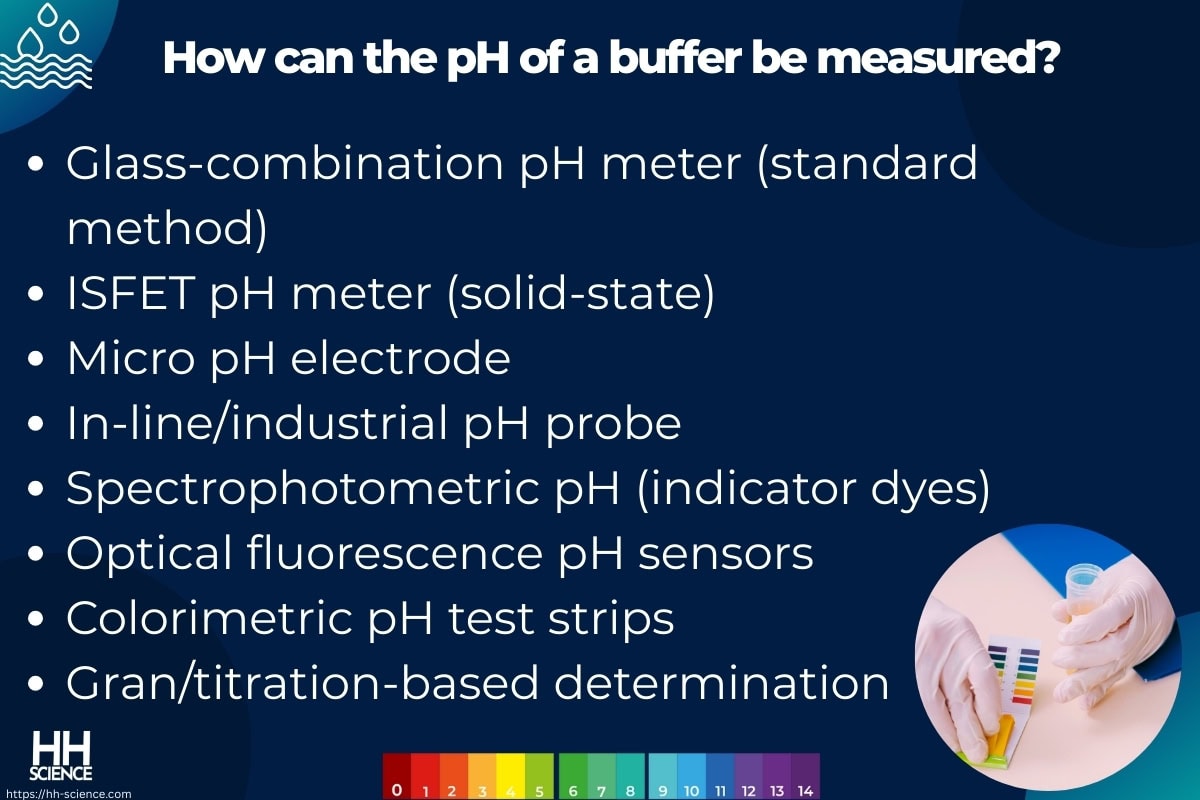
How can the pH of a buffer be measured?
You can measure the pH of a buffer electrometrically with a calibrated pH meter or by optical/indicator methods, with specialized options for small volumes and continuous process monitoring.
- Glass-combination pH meter (standard method): Calibrate with two–three NIST buffers (e.g., pH 4.00/7.00/10.00) with automatic temperature compensation, then immerse/rinse/measure for ±0.01–0.02 pH accuracy.
- ISFET pH meter (solid-state): Use a semiconductor ISFET probe for fast, robust readings in viscous, proteinaceous, or dirty samples where glass bulbs struggle.
- Micro pH electrode: Deploy a micro- or spear-tip glass electrode to measure tiny volumes (≤100–200 µL), narrow vessels, or surface spots with minimal sample loss.
- In-line/industrial pH probe: Install a process electrode with a transmitter (e.g., 4–20 mA/Modbus) for continuous buffer pH monitoring in reactors, CIP/SIP-capable systems.
- Spectrophotometric pH (indicator dyes): Add a suitable indicator (e.g., phenol red, bromothymol blue) and compute pH from absorbance ratios against a calibration curve (±0.01–0.05 pH).
- Optical fluorescence pH sensors: Use ratiometric fluorescent probes or fiber-optic patches for noninvasive, real-time pH tracking inside closed vessels or cell culture setups.
- Colorimetric pH test strips: Dip universal or narrow-range strips for a quick check (typical resolution 0.5–1.0 pH units), useful for screening but not precision work.
- Gran/titration-based determination: Record a strong acid/base titration curve and infer pH (and buffering points) from the electrode potential data or Gran plots when direct measurement is constrained.
(Tip: always bracket your expected pH with calibration buffers at the measurement temperature, rinse between samples, and avoid CO₂ absorption or junction contamination to keep readings stable.)
How do you adjust the pH of a buffer?
You can adjust a buffer’s pH by changing the [base]/[acid] ratio using the Henderson–Hasselbalch equation (pH = pKa + log₁₀([A⁻]/[HA]))—add HCl to convert A⁻ → HA (lowers pH) or NaOH to convert HA → A⁻ (raises pH), or add the conjugate component directly. You can compute the exact acid/base to add from the target ratio Rₜ = 10^(pHₜ − pKa) using the mole-balance formula x = (n_A− − Rₜ·n_HA) / (1 + Rₜ) (x > 0 = moles of H⁺ to add; x < 0 = |x| moles of OH⁻), then check capacity (↑ with total concentration) and temperature effects (e.g., Tris ≈ −0.028 pH/°C).
How can you change the pH of a buffer?
You can change a buffer’s pH by titrating with strong acid/base to reach the target [A⁻]/[HA] ratio, swapping/augmenting components (adding HA or A⁻ stock) to set R = 10^(pH − pKa), or choosing a different buffer system whose pKa is within ±1 pH unit of the desired value (e.g., move from acetate to phosphate or HEPES for ~7–7.5). You can also influence pH slightly via temperature (pKa shifts), CO₂ control for bicarbonate systems, and ionic strength adjustments, while noting that simple dilution changes capacity more than pH unless activities shift appreciably.
Can the pH of a buffer increase?
Yes, the pH of a buffer can increase if the [A⁻]/[HA] ratio rises (e.g., addition of base or loss of CO₂ from bicarbonate buffers), because Henderson–Hasselbalch (pH = pKa + log([A⁻]/[HA])) shifts upward; cooling can also raise pH for buffers with negative ΔpH/°C (e.g., Tris ≈ −0.028 pH per °C).
Does the pH of a buffer change when diluted?
Yes, the pH of a buffer can change on dilution if ionic strength and activity coefficients shift or if CO₂ exchange occurs; ideally the [A⁻]/[HA] ratio is unchanged so the shift is small (often ≤0.05–0.1 pH units), but buffer capacity drops markedly.
Can CO2 affect the pH of a buffer?
Yes, CO₂ can lower pH if it dissolves to form carbonic acid (CO₂ + H₂O ⇌ H₂CO₃ ⇌ H⁺ + HCO₃⁻), and in bicarbonate buffers the pH is explicitly governed by pCO₂ (e.g., ~7.35–7.45 in blood at ~5% CO₂).
Did dilution change the initial pH of the buffer?
Yes, dilution can change the initial pH if it alters ionic strength/activities or allows gas exchange; otherwise the theoretical pH set by the [A⁻]/[HA] ratio stays nearly constant while capacity (β) decreases.
Did the addition of NaCl buffer the pH changes?
No, the addition of NaCl did not buffer the pH changes because NaCl is not a conjugate acid–base pair; it only modifies ionic strength, which may slightly affect measured pH but does not provide buffering action.
Do strong acids affect the pH of a buffer?
Yes, strong acids can lower a buffer’s pH if the added H⁺ is comparable to or exceeds the buffer’s capacity (β); first neutralize A⁻ → HA, then use Henderson–Hasselbalch to calculate the new pH, noting large additions overwhelm the buffer.
Does adding water affect the pH of a buffer?
Yes, adding water can change pH slightly if dilution shifts activities or CO₂ equilibrates differently; in ideal cases the ratio is unchanged so pH shift is minimal, but capacity decreases substantially.
Does changing the concentration of the buffer affect the pH?
Yes, changing total concentration can nudge pH if ionic strength or apparent pKa changes; if the [A⁻]/[HA] ratio is held constant and ionic strength is controlled, the theoretical pH remains essentially the same while capacity scales with concentration.
Does the pH of a buffer change with temperature?
Yes, buffer pH changes with temperature because pKa is temperature-dependent; for example, Tris shifts about −0.028 pH/°C (warmer → lower pH), whereas phosphate and Good’s buffers have smaller but measurable ΔpH/°C.
Will digitonin change the pH of the lysis buffer?
No, digitonin will not meaningfully change the pH if the lysis solution is properly buffered, because digitonin is a nonionic detergent; any slight apparent change usually comes from dilution, ionic strength effects, or measurement artifacts, not from acid–base chemistry.
What affects the pH of a buffer?
The pH of a buffer is affected by the buffer pair’s pKa, the [base]/[acid] ratio, temperature (via shifts in pKa and pKw), ionic strength/activities, total concentration and dilution, gas exchange (especially CO₂), solvent composition (water/organic mix), interactions or precipitation with metal ions/other solutes, additions of strong acid/base, and measurement factors (meter calibration, junction potentials), because each of these changes the effective acid–base equilibria or how hydrogen-ion activity is sensed.
- pKa of the buffer pair: pH follows Henderson–Hasselbalch, so any change in the intrinsic pKa directly offsets the calculated pH.
- Conjugate ratio [A⁻]/[HA]: Increasing the base/acid ratio raises pH (and decreasing it lowers pH) per pH = pKa + log([A⁻]/[HA]).
- Temperature: pKa (and pKw) are temperature-dependent, so buffers like Tris show notable slopes (e.g., ~−0.028 pH/°C), shifting pH at different temperatures.
- Ionic strength/activity coefficients: Changing ionic strength alters activities (γ), effectively shifting pKa and the measured pH even at fixed concentrations.
- Total concentration & dilution: Dilution lowers buffer capacity and can slightly shift pH through activity changes, even if the [A⁻]/[HA] ratio is unchanged.
- Gas exchange (CO₂): CO₂ uptake forms carbonic acid and lowers pH; bicarbonate systems are explicitly governed by ambient pCO₂.
- Solvent composition: Adding organics (e.g., ethanol, acetonitrile) changes dielectric constant and activity, often shifting pKa and thus pH.
- Metal ions/precipitation/complexation: Phosphate can precipitate with Ca²⁺/Mg²⁺ or citrate can chelate metals, removing species from equilibrium and altering pH.
- Strong acid/base additions: H⁺ drives A⁻ → HA (lowering pH) and OH⁻ drives HA → A⁻ (raising pH); beyond capacity the buffer is overwhelmed.
- Measurement factors: Inaccurate calibration, temperature compensation errors, or junction potentials in electrodes can bias the apparent pH from its true equilibrium value.
What are the applications of pH in buffers?
Buffers keep systems operating in their optimal pH windows by controlling hydrogen-ion activity, which protects reaction rates, product quality, biological function, and material performance. Below are the main application areas and how pH control with buffers matters in each.
- Blood (bicarbonate buffer: pH 7.35–7.45): The CO₂/H₂CO₃/HCO₃⁻ system holds arterial plasma near pH 7.40 via respiratory CO₂ control and renal bicarbonate regulation, preserving enzyme activity and oxygen transport.
- Pharmaceuticals (drug stability): Formulation buffers set a target pH to maximize API stability and solubility, minimize hydrolysis/oxidation, and ensure bioavailability across shelf life and physiological conditions.
- Food & fermentation (yogurt, beer): Buffering moderates acid production (e.g., lactic fermentation) to control flavor, texture, and safety; brewing workflows keep mash/wort near optimal pH (≈5.2–5.6) for enzyme efficiency and clarity.
- Industrial (plating baths, pool chemistry): Electroplating baths use buffers to stabilize deposition rate, grain structure, and brightness, while pool buffers hold pH where free chlorine (HOCl) is most effective and scaling/corrosion are minimized.
- Biological research (Tris ≈ pH 7.4, phosphate ≈ pH 7.2, HEPES ≈ pH 7.5, MES ≈ pH 6.1): Laboratory buffers maintain near-physiological conditions for proteins, nucleic acids, and cells while offering low reactivity and predictable temperature behavior.
- Environmental (soil buffers, aquatic carbonate buffering): Soil carbonate/organic buffers modulate nutrient availability and resist acid rain, and the aquatic CO₂–HCO₃⁻–CO₃²⁻ system stabilizes lake/ocean pH against acidification.
- Cosmetics & personal care (skin buffer systems): Formulations are buffered to ≈pH 4.5–5.5 to match the skin acid mantle, supporting barrier function, microbiome balance, and active ingredient stability.
What are the limitations of buffer solution?
The limitations of buffer solutions are limited capacity (they can be overwhelmed by added strong acid/base) and dependence on total concentration and the conjugate [base]/[acid] ratio. These arise because buffer capacity β = dB/dpH is finite and scales with total buffer concentration, while pH follows Henderson–Hasselbalch (pH = pKa + log([A⁻]/[HA])) so deviations from the optimal ratio or excessive titrant quickly shift pH.
- Limited capacity (overwhelmed by strong acid/base): A buffer only neutralizes small added amounts; as the added H⁺ or OH⁻ approaches the available moles of the conjugate partner, pH drifts rapidly and fails beyond roughly pKa ± 1 or after the neutralization point.
- Dependence on concentration and ratio: Total concentration raises capacity (not the set pH), while the [A⁻]/[HA] ratio fixes pH (1:1 at pH = pKa, ~10:1 at pKa+1, ~1:10 at pKa−1), making buffers sensitive to dilution, evaporation, or mixing errors.


