
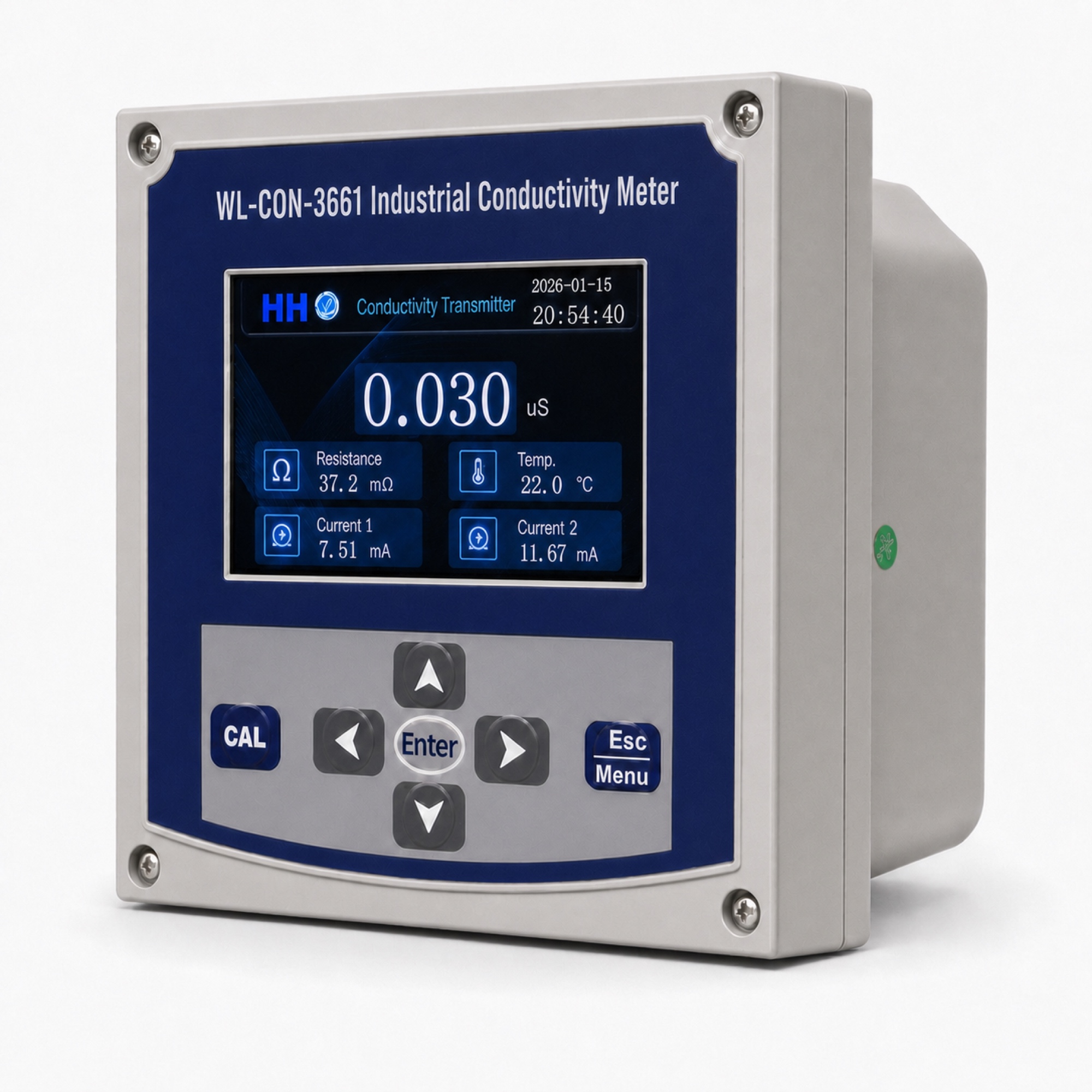
WL-CON-3661 Industrial Conductivity Meter
US$1,400.00
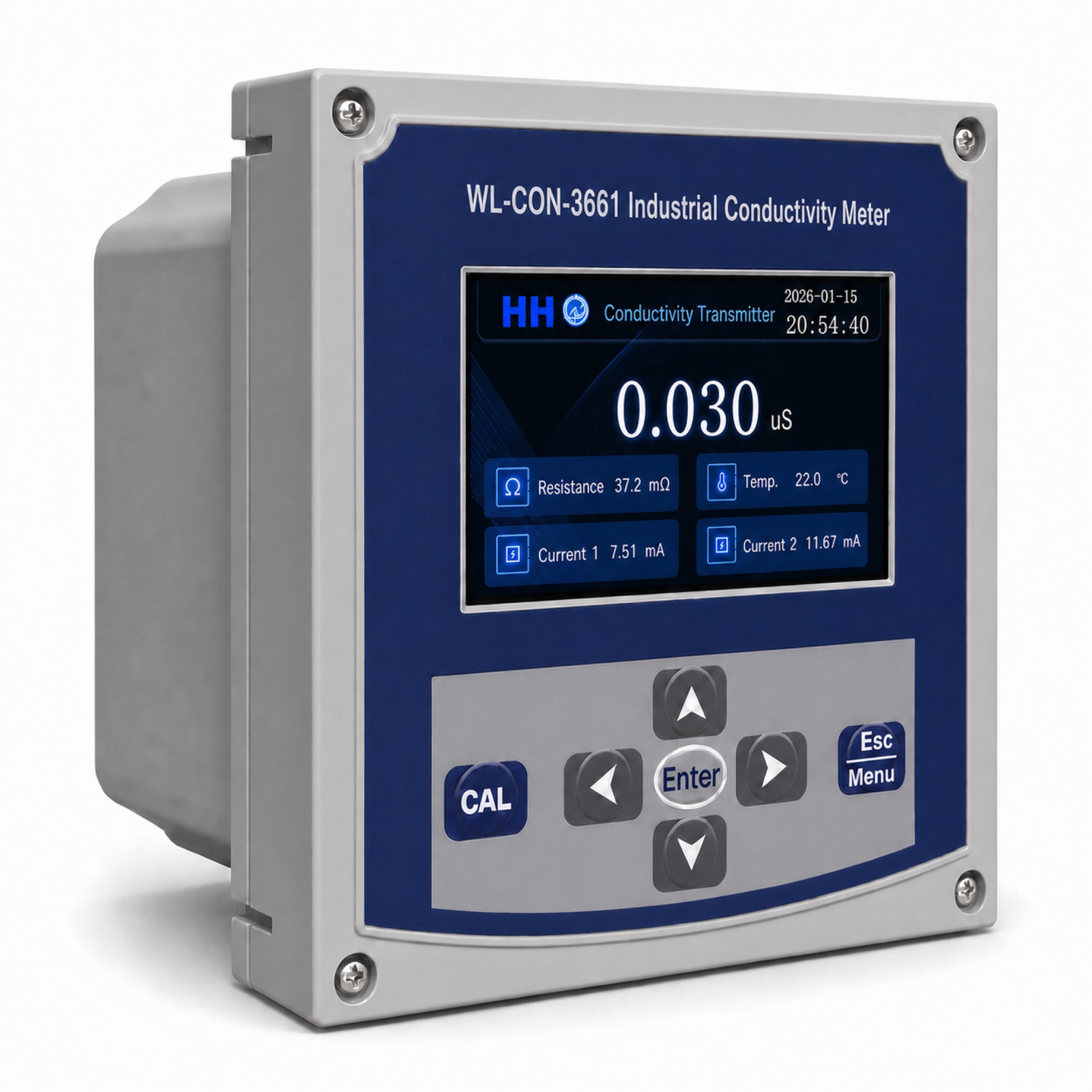
A panel-mounted industrial conductivity meter for continuous online monitoring of conductivity, resistivity, and temperature in pure water and general process water. Compatible with multiple conductivity-cell constants, it provides automatic range switching, configurable temperature compensation, isolated analog outputs, alarms, and Modbus RTU communication.
Key Features
- Four sensor configurations covering 0–20 μS/cm to 0–20.00 mS/cm
- Automatic range switching and configurable temperature compensation
- Dedicated compensation mode for pure-water conductivity measurement
- Two isolated 4–20 mA outputs and RS485 Modbus RTU communication
- Adjustable alarms, non-volatile parameter storage, and watchdog protection
The WL-CON-3661 is an industrial conductivity meter designed for continuous online water-quality monitoring and process control. It receives signals from a compatible two-electrode conductivity sensor, calculates conductivity or resistivity, measures temperature, and transfers the results to plant monitoring and control systems.
The meter can be paired with sensors having cell constants of 0.01, 0.10, 1.00, or 10.0 cm⁻¹. This allows the same instrument platform to support applications ranging from pure and demineralized water to tap water, process water, and compatible higher-conductivity industrial solutions.
Automatic range switching, selectable measurement frequencies, software-based zero correction, configurable temperature compensation, and digital signal processing help maintain stable measurements under changing process conditions.
Two isolated 4–20 mA outputs, high and low alarm relays, and RS485 communication using the Modbus RTU protocol allow the WL-CON-3661 to be integrated into compatible PLC, SCADA, dosing, and process-control systems.
Measurement and Control Functions
Multiple Conductivity Ranges
The selected conductivity sensor determines the available measurement range. Choosing the correct cell constant helps ensure that the normal process value remains within the sensor’s effective working range.
| Sensor cell constant | Configured measuring range | Typical measurement direction |
|---|---|---|
| K = 0.01 cm⁻¹ | 0–20 μS/cm | Pure water, demineralized water and RO permeate |
| K = 0.10 cm⁻¹ | 0–200 μS/cm | Purified water and low-conductivity process water |
| K = 1.00 cm⁻¹ | 0–2,000 μS/cm | Tap water, surface water and general process water |
| K = 10.0 cm⁻¹ | 0–20.00 mS/cm | Circulating water and compatible industrial solutions |
These application directions are general selection guidance. Final sensor selection should be based on the expected normal value, maximum conductivity, process composition, temperature, pressure, and transmitter compatibility.
Automatic Range Switching
Within the configured sensor range, the meter automatically selects an appropriate display range according to the measured conductivity. This allows low and high readings to be displayed clearly without repeated manual range adjustment.
Configurable Temperature Compensation
Conductivity changes significantly with temperature. The WL-CON-3661 uses the connected temperature sensor to compensate the measured conductivity to the selected reference condition.
For pure-water applications, the instrument provides a dedicated compensation mode combining two temperature-coefficient models. For other aqueous solutions, the temperature coefficient can be configured according to the process requirements.
Temperature compensation must match the actual sample chemistry. Pure water, neutral salts, acids, alkalis, and mixed industrial water do not share one universal temperature coefficient.
Selectable Measurement Frequency
Three measurement frequencies can be selected according to the conductivity of the process solution. Selecting an appropriate frequency helps control electrode polarization and electrical-capacitance effects across different conductivity ranges.
Analog and Digital Communication
The WL-CON-3661 provides two configurable isolated 4–20 mA outputs for connection to compatible recorders, PLCs, dosing systems, and control equipment.
RS485 communication with the standard Modbus RTU protocol enables remote access to measurement data and instrument parameters.
Alarm and System Protection
Users can configure upper and lower conductivity alarm limits. Alarm conditions are shown on the display and can activate the corresponding relay contacts.
An integrated watchdog monitors program operation and helps the instrument recover from abnormal software conditions. Configuration and calibration parameters are stored in non-volatile memory and remain available after a power interruption without requiring a backup battery.
Typical Applications
The WL-CON-3661 is suitable for continuous conductivity monitoring in the following applications:
- Pure and demineralized water systems
- Reverse-osmosis permeate monitoring
- Industrial water-treatment systems
- Municipal and tap-water monitoring
- Surface-water monitoring
- Recirculating and cooling-water systems
- Electronics and semiconductor water treatment
- Pharmaceutical water-treatment processes
- Chemical manufacturing
- Food and beverage production
- Pulp and paper manufacturing
- Power-generation water systems
- OEM water-treatment and automation equipment
Suitable Operating Environments
Control Panel Installation
The WL-CON-3661 is intended for installation in an indoor control panel or instrument cabinet where: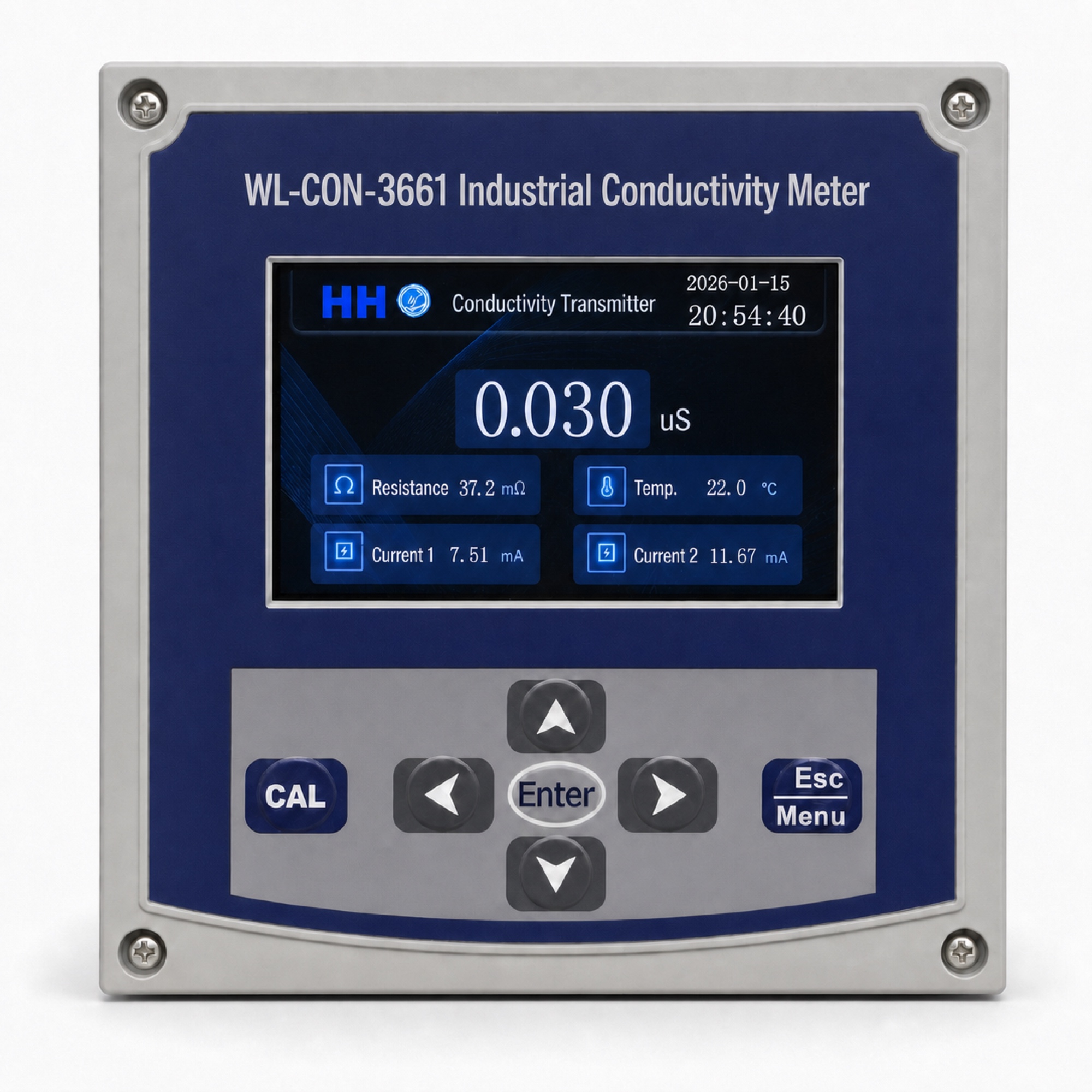
- Ambient temperature remains between 0 and 45 °C
- Relative humidity does not exceed 90%
- Condensation is prevented
- The meter is protected from direct water spray
- Excessive dust and vibration are controlled
- Corrosive gases do not enter the instrument enclosure
- A stable 220 VAC power supply is available
- Adequate space is provided for wiring, ventilation, and maintenance
No enclosure protection rating has been provided for the panel meter. Outdoor, washdown, or exposed installations require a suitably rated protective cabinet.
Process Measurement Conditions
The connected sensor and process assembly should be selected for:
- Process-liquid temperatures from 5 to 60 °C
- Process pressures not exceeding 0.3 MPa
- The expected conductivity range
- The chemical composition of the sample
- The required pipeline, flow-through, or immersion installation
- The applicable electrode, insulator, seal, and cable materials
- The required flow rate and minimum immersion depth
The process temperature and pressure limits apply to the selected conductivity sensor and installation assembly, not only to the panel-mounted meter.
Installation and Measurement Considerations
Select the Correct Cell Constant
Do not select a sensor only according to the maximum published range. Choose a cell constant that places the normal process conductivity comfortably within the effective measurement range.
A cell constant that is too low may be unsuitable for higher-conductivity liquids. A cell constant that is too high may reduce measurement sensitivity in pure or low-conductivity water.
The sensor cell constant entered in the meter must match the actual sensor.
Match Temperature Compensation to the Sample
A single linear temperature coefficient is not suitable for every liquid. Use a compensation mode appropriate for the process:
- Pure-water compensation for compatible low-conductivity water
- Neutral-salt compensation for suitable general water samples
- Process-specific coefficients for acids, alkalis, salts, or other defined solutions
Incorrect compensation can produce a stable but inaccurate conductivity value.
Control Low-Conductivity Water Conditions
Pure and low-conductivity water is particularly sensitive to contamination and sampling conditions. For reliable measurement:
- Use a clean, closed flow-through system where practical
- Maintain stable sample flow and temperature
- Prevent air ingress and trapped bubbles
- Minimize atmospheric carbon-dioxide absorption
- Avoid stagnant sample lines
- Use clean, compatible tubing and fittings
- Prevent contamination from upstream sensors and reference electrodes
For a combined conductivity and pH sampling line, position the conductivity sensor upstream of the pH electrode where practical. Electrolyte leaking from a pH reference junction can contaminate low-conductivity water.
Avoid Air Bubbles and Incomplete Immersion
The sensor electrodes must remain correctly immersed. Air bubbles, insufficient water level, or partially exposed electrodes can change the effective cell geometry and cause low, unstable, or non-representative readings.
Install the sensor where bubbles can escape and the sample remains representative.
Prevent Electrical Interference
Route sensor cables separately from power lines, motors, frequency converters, relay wiring, and other sources of electromagnetic interference.
Avoid unnecessary cable extension. Long cables increase electrical capacitance and may affect low-conductivity measurements, even when the installation remains within the stated 100 m maximum.
Inspect and Clean the Sensor
Deposits on the conductivity sensor change its effective cell constant:
- Non-conductive scale or coatings may reduce the measured value
- Conductive particles or metal deposits may increase the measured value
- Oil, biofilm, suspended solids, and corrosion products may cause drift or slow response
Cleaning methods must be compatible with the electrode material, insulator, seals, and process chemicals.
Verify Calibration Under Representative Conditions
Confirm the correct sensor cell constant and temperature reading before adjusting the meter. Calibration should use an appropriate conductivity standard or a verified reference method.
A successful laboratory calibration does not automatically confirm accuracy under actual online flow, temperature, pressure, contamination, and electrical conditions.
Required System Components
The WL-CON-3661 is a panel-mounted meter and does not contact the process liquid directly. A complete measurement system normally requires:
- A compatible conductivity sensor
- The correct sensor cell constant
- A compatible temperature element
- Sensor cable and wiring
- A process holder or flow-through chamber
- Suitable seals and process fittings
- A representative sample flow
- Connection to the plant power and control system
| Parameter | Specification |
| Product model | WL-CON-3661 |
| Product type |
Industrial online conductivity meter
|
| Measured parameters |
Conductivity, resistivity and temperature
|
| Display |
128 × 64 dot-matrix LCD or color LCD, depending on configuration
|
| Supported sensor cell constants |
0.01, 0.10, 1.00 and 10.0 cm⁻¹
|
| Lowest configured range | 0–20 μS/cm |
| Highest confirmed range | 0–20.00 mS/cm |
| Range switching | Automatic |
| Conductivity accuracy | ±1% FS ±1 digit |
| Temperature accuracy | ±0.5 °C |
| Stability |
±0.3% FS ±1 digit per 24 hours
|
| Automatic temperature-compensation range | 5–60 °C |
| Measurement frequencies |
Three selectable frequencies
|
| Reading stabilization time | ≤30 seconds |
| Analog outputs |
Two configurable isolated 4–20 mA outputs
|
| Maximum analog-output load | <500 Ω |
| Digital communication | RS485 |
| Communication protocol | Modbus RTU |
| Alarm functions |
Adjustable high and low limits
|
| Alarm relay |
Normally open contact, 24 VDC/5 A
|
| Alarm hysteresis | ±2% |
| Maximum sensor cable length | ≤100 m |
| Ambient operating temperature | 0–45 °C |
| Maximum relative humidity | 90% |
| Process-liquid temperature | 5–60 °C |
| Maximum process pressure | 0.3 MPa |
| Power supply |
220 VAC ±22 V, 50 Hz ±1 Hz
|
| Power consumption | 12 W |
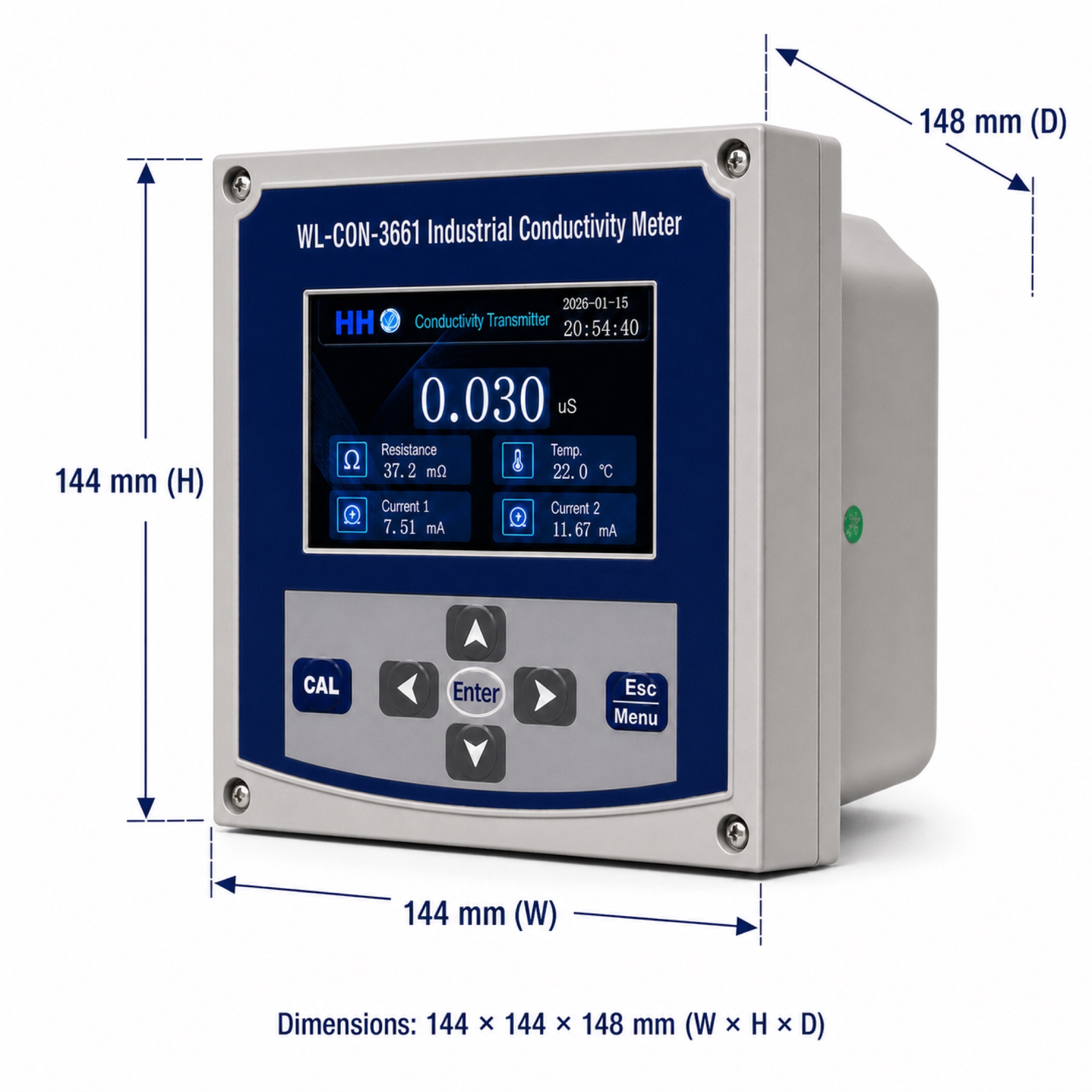
| Instrument dimensions |
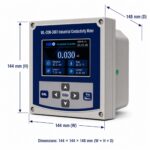
144 × 144 × 148 mm
|
| Panel cutout | 139 × 139 mm |
| Installation method | Panel mounting |
| Weight | 2 kg |
|---|---|
| Dimensions | 30 × 30 × 30 cm |
| Parameters | Conductivity |
| Application | Chemical Processing, Electronics Manufacturing Wastewater, Food & Beverage, Industrial Water & Wastewater Treatment, Municipal Water & Wastewater Treatment, OEM Water-Treatment Equipment, Pharmaceutical & Biotechnology, Power Generation & Steam-Water Cycle, Pure & Ultrapure Water |
Related Products
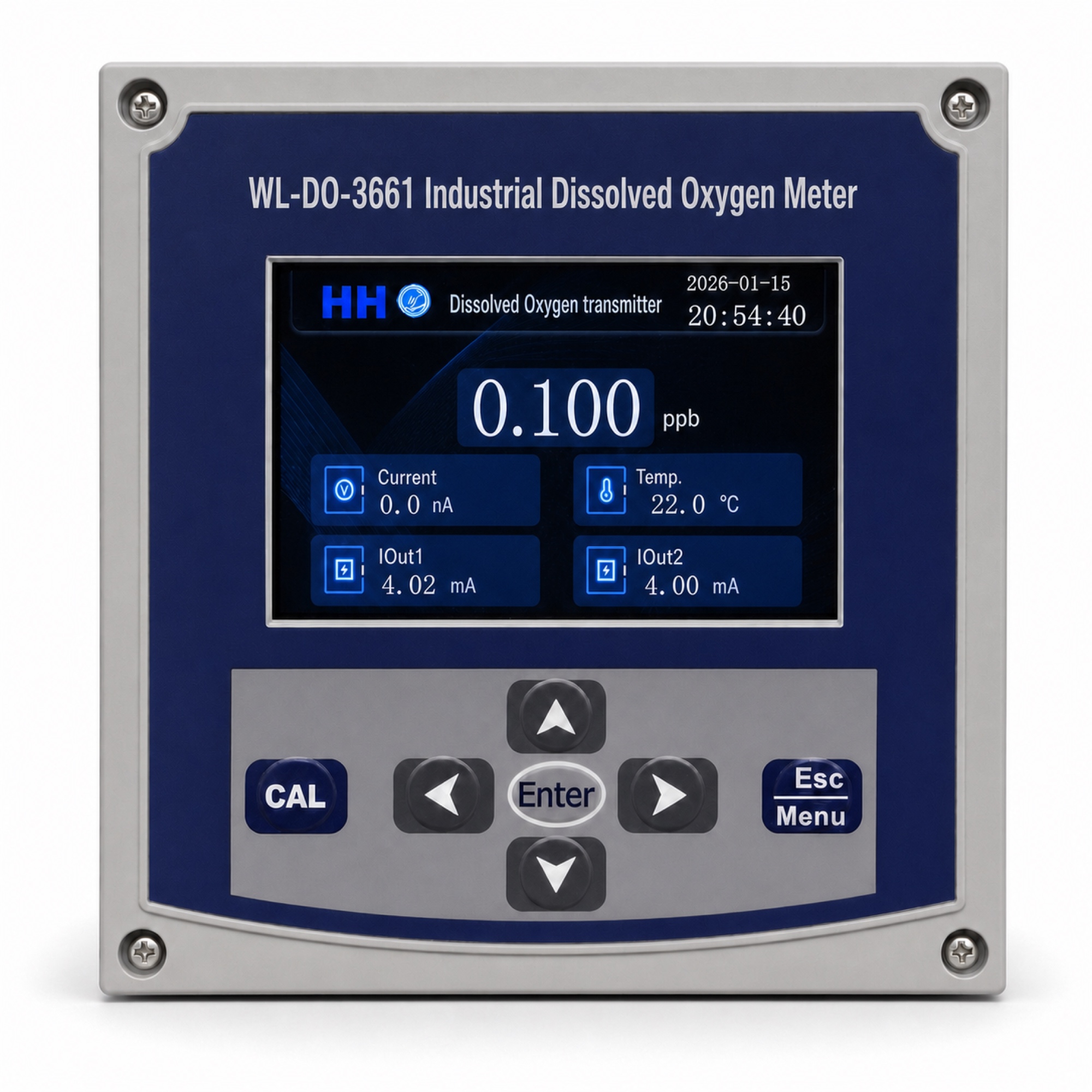
A panel-mounted industrial dissolved oxygen meter for continuous online monitoring across μg/L and mg/L concentration ranges. The WL-DO-3661 combines automatic range switching, temperature compensation, two-point calibration, isolated 4–20 mA output, alarms, self-diagnostics, and Modbus RTU communication.
Key Features
- Dual measuring ranges: 0–200.0 μg/L and 0.200–20.00 mg/L
- Automatic range switching and temperature compensation
- Zero-point and full-scale two-point calibration
- Isolated 4–20 mA output and RS485 Modbus RTU communication
- Adjustable alarms, self-diagnostics, and watchdog protection
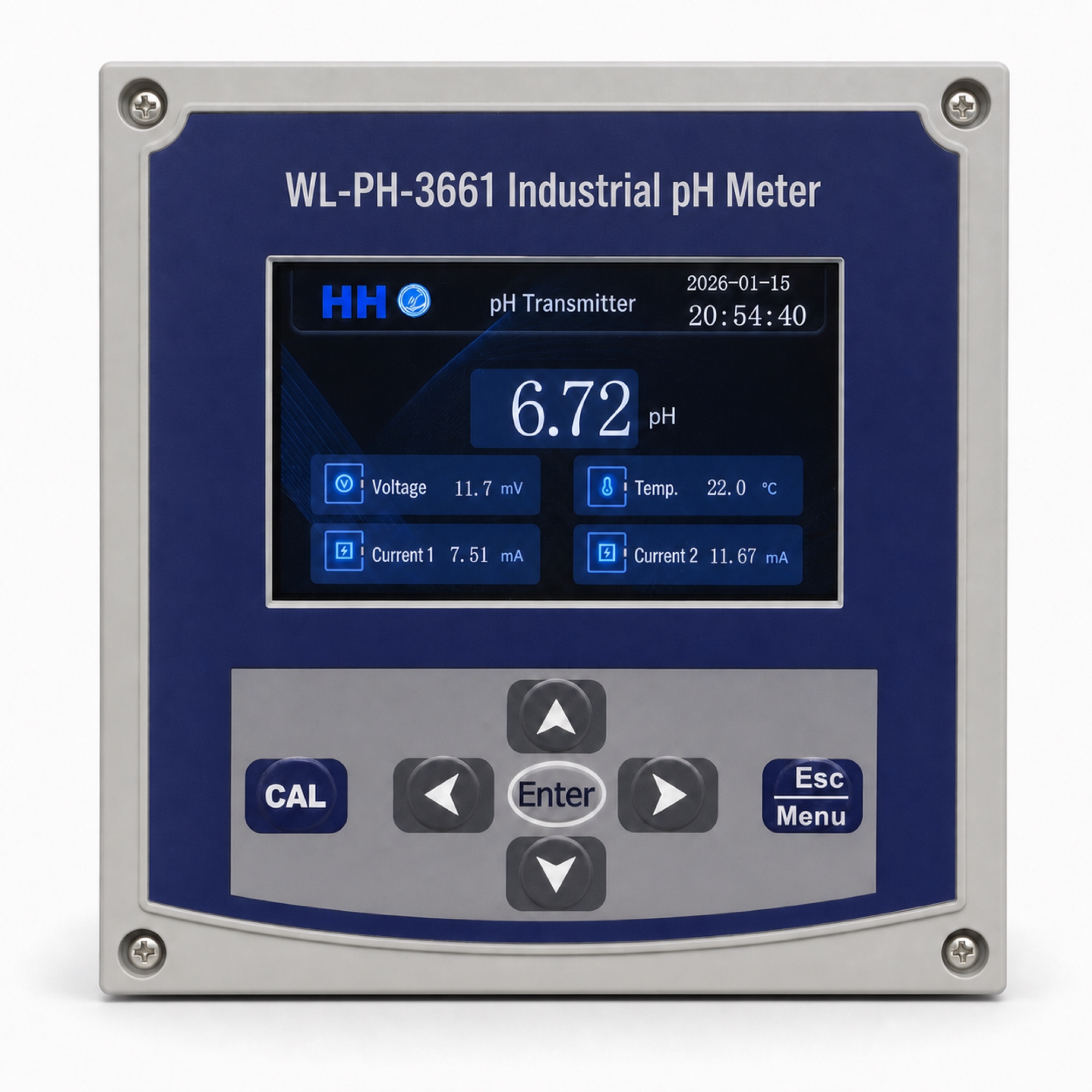
A panel-mounted industrial pH meter for continuous online measurement and process control in water treatment and industrial applications. It combines high-input-impedance signal processing, automatic temperature compensation, isolated analog outputs, alarm control, and Modbus RTU communication.
Key features
- 0–14.00 pH measurement with ±0.05 pH stated accuracy
- Automatic temperature compensation from 5 to 60 °C
- Two configurable isolated 4–20 mA outputs
- RS485 communication with Modbus RTU protocol
- Adjustable high and low alarms with relay outputs